


畜牧兽医学报 ›› 2025, Vol. 56 ›› Issue (12): 5952-5962.doi: 10.11843/j.issn.0366-6964.2025.12.002
曹金萍( ), 蔡泽曦, 李玲锋, 柳广斌*()
收稿日期:2025-05-13
出版日期:2025-12-23
发布日期:2025-12-24
通讯作者:
柳广斌
E-mail:2603579938@qq.com;gbliu@scau.edu.cn
作者简介:曹金萍(1999-),女,河南信阳人,博士生,主要从事动物遗传育种与繁殖研究,E-mail:2603579938@qq.com
基金资助:
CAO Jinping(), CAI Zexi, LI Lingfeng, LIU Guangbin*()
Received:2025-05-13
Online:2025-12-23
Published:2025-12-24
Contact:
LIU Guangbin
E-mail:2603579938@qq.com;gbliu@scau.edu.cn
摘要:
基因修饰是指通过人为干预对生物体的DNA序列进行精准编辑,以定向改造其基因组结构或功能。近年来,随着分子生物学和基因工程技术的发展,基因修饰技术(如转基因技术和基因编辑技术)结合辅助生殖技术,在牛羊抗病育种领域展现出巨大潜力。该技术不仅可以对抗病性状进行精准改良,提升牲畜的健康水平和生产性能,还弥补了传统选育方法效率低、周期长的不足。然而,与猪、鸡的抗病育种相比,牛羊在该领域仍有较大的进步空间。目前通过基因修饰技术优化牛羊基因组,正成为突破传统防控瓶颈的前沿方向。本文从动物转基因和基因编辑技术两方面阐述基因修饰技术的发展现状,并简要概括了该技术在牛羊抗病育种上的应用现状,为未来牛羊抗病育种研究提供一定参考。
中图分类号:
曹金萍, 蔡泽曦, 李玲锋, 柳广斌. 基因修饰技术及其在牛羊抗病育种中的应用[J]. 畜牧兽医学报, 2025, 56(12): 5952-5962.
CAO Jinping, CAI Zexi, LI Lingfeng, LIU Guangbin. Gene Modification Technology and Its Application in Breeding for Disease Resistance in Cattle and Small Ruminants[J]. Acta Veterinaria et Zootechnica Sinica, 2025, 56(12): 5952-5962.
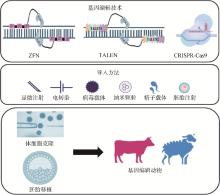
图 1
基因编辑技术在牛羊性状改良中的应用流程 通过ZFNs、TALENs和CRISPR-Cas9三种方法对基因进行精准编辑,利用显微注射、电转染、病毒载体、纳米颗粒、精子载体和胚胎注射等方式递送至细胞或受精卵,通过体细胞核移植(SCNT)将编辑后的细胞核注入去核卵母细胞形成重构胚胎,经胚胎移植培育出牛羊基因编辑后代"
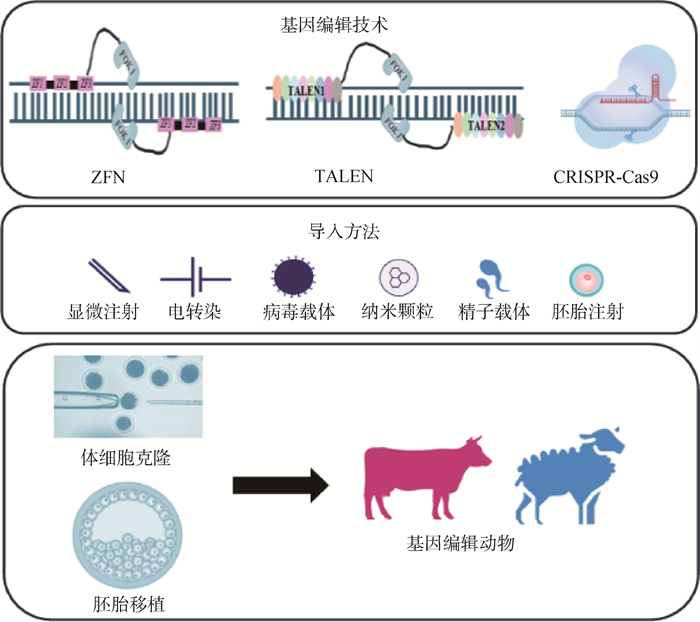
表 1
同源重组、成簇规律间隔短回文重复序列及碱基编辑技术的比较"
| 指标 Index | 同源重组 Homologous recombination | 成簇规律间隔短回文重复序列 CRISPR | 碱基编辑 Base editing |
| 编辑精度Editing precision | 单碱基至大片段精准编辑 | 随机插入/缺失 | 单碱基替换(无需DSB) |
| 效率Efficiency | 低(依赖细胞周期) | 高(适用于所有细胞周期) | 高(适用于非分裂细胞) |
| 复杂性Complexity | 需设计同源模板 | 仅需sgRNA | 需脱氨酶与Cas9融合蛋白 |
| 应用场景Application scenarios | 基因敲入、大片段替换 | 基因敲除、功能筛选 | 点突变修复、表观遗传调控 |
| 1 |
SHAKWEER W M E , KRIVORUCHKO A Y , DESSOUKI S M , et al. A review of transgenic animal techniques and their applications[J]. J Genet Eng Biotechnol, 2023, 21 (1): 55.
doi: 10.1186/s43141-023-00502-z |
| 2 | WHEELER M B , CAMPION D R . Animal production-a longstanding biotechnological success[J]. Am J Clin Nutr, 1993, 58 (2 Suppl): 276S- 281S. |
| 3 |
JAENISCH R , MINTZ B . Simian virus 40 DNA sequences in DNA of healthy adult mice derived from preimplantation blastocysts injected with viral DNA[J]. Proc Natl Acad Sci U S A, 1974, 71 (4): 1250- 1254.
doi: 10.1073/pnas.71.4.1250 |
| 4 | 朱元芳, 韩永胜, 张建胜, 等. 基因编辑技术在牛羊育种中的应用[J]. 现代畜牧科技, 2024 (8): 61- 64. |
| ZHU Y F , HAN Y S , ZHANG J S , et al. Application of gene editing technology in cattle and sheep breeding[J]. Modern Animal Science and Technology, 2024 (8): 61- 64. | |
| 5 | GOLDMAN I L , KADULIN S G , RAZIN S V . Transgenic animals in medicine: integration and expression of foreign genes, theoretical and applied aspects[J]. Med Sci Monit, 2004, 10 (11): RA274- RA285. |
| 6 |
VOSS A K , SANDMOLLER A , SUSKE G , et al. A comparison of mouse and rabbit embryos for the production of transgenic animals by pronuclear microinjection[J]. Theriogenology, 1990, 34 (5): 813- 824.
doi: 10.1016/0093-691X(90)90553-6 |
| 7 |
GAVIN W , BLASH S , BUZZELL N , et al. Generation of transgenic goats by pronuclear microinjection: a retrospective analysis of a commercial operation (1995-2012)[J]. Transgenic Res, 2018, 27 (1): 115- 122.
doi: 10.1007/s11248-017-0050-1 |
| 8 | PU X , YOUNG A P , KUBISCH H M . Production of Transgenic Mice by Pronuclear Microinjection[J]. Methods Mol Biol, 2019, 1874, 17- 41. |
| 9 |
王佳美, 黄永震, 高晨, 等. 多能性干细胞概述及其在家畜上的研究进展[J]. 畜牧兽医学报, 2025, 56 (4): 1473- 1483.
doi: 10.11843/j.issn.0366-6964.2025.04.001 |
|
WANG J M , HUANG Y Z , GAO C , et al. Overview of pluripotent stem cells and research progress in livestock[J]. Acta Veterinaria et Zootechnica Sinica, 2025, 56 (4): 1473- 1483.
doi: 10.11843/j.issn.0366-6964.2025.04.001 |
|
| 10 |
MITALIPOVA M , BEYHAN Z , FIRST N L . Pluripotency of bovine embryonic cell line derived from precompacting embryos[J]. Cloning, 2001, 3 (2): 59- 67.
doi: 10.1089/15204550152475563 |
| 11 |
BAO L , HE L , CHEN J , et al. Reprogramming of ovine adult fibroblasts to pluripotency via drug-inducible expression of defined factors[J]. Cell Res, 2011, 21 (4): 600- 608.
doi: 10.1038/cr.2011.6 |
| 12 |
CHOI E , YOON S , KOH Y E , et al. Maintenance of genome integrity and active homologous recombination in embryonic stem cells[J]. Exp Mol Med, 2020, 52 (8): 1220- 1229.
doi: 10.1038/s12276-020-0481-2 |
| 13 | CORTES D , ROBLEDO-ARRATIA Y , HERNANDEZ-MARTINEZ R , et al. Transgenic GDNF positively influences proliferation, differentiation, maturation and survival of motor neurons produced from mouse embryonic stem cells[J]. Front Cell Neurosci, 2016, 10, 217. |
| 14 |
SECHER J O , LIU Y , PETKOV S , et al. Evaluation of porcine stem cell competence for somatic cell nuclear transfer and production of cloned animals[J]. Anim Reprod Sci, 2017, 178, 40- 49.
doi: 10.1016/j.anireprosci.2017.01.007 |
| 15 |
TRAN M Y , KAMEN A A . Production of lentiviral vectors using a HEK-293 producer cell line and advanced perfusion processing[J]. Front Bioeng Biotechnol, 2022, 10, 887716.
doi: 10.3389/fbioe.2022.887716 |
| 16 |
HOFFMANN M D , SORENSEN R J , EXTROSS A , et al. Protein carrier adeno-associated virus[J]. ACS Nano, 2025, 19 (12): 12308- 12322.
doi: 10.1021/acsnano.5c01498 |
| 17 |
WANG M , SUN Z , YU T , et al. Large-scale production of recombinant human lactoferrin from high-expression, marker-free transgenic cloned cows[J]. Sci Rep, 2017, 7 (1): 10733.
doi: 10.1038/s41598-017-11462-z |
| 18 | 罗依妮, 王露. 转座子的研究现状[J]. 中国细胞生物学学报, 2024, 46 (7): 1323- 1334. |
| LUO Y N , WANG L . Current research on transposons[J]. Chinese Journal of Cell Biology, 2024, 46 (7): 1323- 1334. | |
| 19 | RINGERTZ N R . The discovery of "jumping genes" in corn gave the entire Nobel prize to a 81-year woman (Barbara McClintock)[J]. Lakartidningen, 1983, 80 (42): 3908- 3910. |
| 20 |
WATERSTON R H , LINDBLAD-TOH K , BIRNEY E , et al. Initial sequencing and comparative analysis of the mouse genome[J]. Nature, 2002, 420 (6915): 520- 562.
doi: 10.1038/nature01262 |
| 21 | SPADAFORA C . Sperm-mediated gene transfer: mechanisms and implications[J]. Soc Reprod Fertil Suppl, 2007, 65, 459- 467. |
| 22 |
SAMENI M , MORADBEIGI P , HOSSEINI S , et al. ZIF-8 nanoparticle: A valuable tool for improving gene delivery in sperm-mediated gene transfer[J]. Biol Proced Online, 2024, 26 (1): 4.
doi: 10.1186/s12575-024-00229-2 |
| 23 |
DEHGHAN Z , DARYA G , MEHDINEJADIANI S , et al. Comparison of two methods of sperm- and testis-mediated gene transfer in production of transgenic animals: A systematic review[J]. Anim Genet, 2024, 55 (3): 328- 343.
doi: 10.1111/age.13404 |
| 24 |
GARCIA-VAZQUEZ F A , RUIZ S , GRULLON L A , et al. Factors affecting porcine sperm mediated gene transfer[J]. Res Vet Sci, 2011, 91 (3): 446- 453.
doi: 10.1016/j.rvsc.2010.09.015 |
| 25 |
YUM S , LEE S , PARK S , et al. Long-term health and germline transmission in transgenic cattle following transposon-mediated gene transfer[J]. BMC Genomics, 2018, 19 (1): 387.
doi: 10.1186/s12864-018-4760-4 |
| 26 |
DHUP S , MAJUMDAR S S . Transgenesis via permanent integration of genes in repopulating spermatogonial cells in vivo[J]. Nat Methods, 2008, 5 (7): 601- 603.
doi: 10.1038/nmeth.1225 |
| 27 |
PRAMOD R K , MITRA A . Intratesticular injection followed by electroporation allows gene transfer in caprine spermatogenic cells[J]. Sci Rep, 2018, 8 (1): 3169.
doi: 10.1038/s41598-018-21558-9 |
| 28 |
DEHGHAN Z , DARYA G , MEHDINEJADIANI S , et al. Comparison of two methods of sperm- and testis-mediated gene transfer in production of transgenic animals: A systematic review[J]. Anim Genet, 2024, 55 (3): 328- 343.
doi: 10.1111/age.13404 |
| 29 | OGURA A , MATOBA S , INOUE K . 25th Anniversary Of Cloning By Somatic-Cell Nuclear tRANSFER: Epigenetic abnormalities associated with somatic cell nuclear transfer[J]. Reproduction, 2021, 162 (1): F45- F58. |
| 30 |
SWEGEN A , APPELTANT R , WILLIAMS S A . Cloning in action: can embryo splitting, induced pluripotency and somatic cell nuclear transfer contribute to endangered species conservation?[J]. Biol Rev Camb Philos Soc, 2023, 98 (4): 1225- 1249.
doi: 10.1111/brv.12951 |
| 31 |
MCCUTCHEON S R , ROHM D , IGLESIAS N , et al. Epigenome editing technologies for discovery and medicine[J]. Nat Biotechnol, 2024, 42 (8): 1199- 1217.
doi: 10.1038/s41587-024-02320-1 |
| 32 |
TRAN N T , HAN R . Rapidly evolving genome and epigenome editing technologies[J]. Mol Ther, 2024, 32 (9): 2803- 2806.
doi: 10.1016/j.ymthe.2024.08.011 |
| 33 |
CETIN B , ERENDOR F , EKSI Y E , et al. Gene and cell therapy of human genetic diseases: Recent advances and future directions[J]. J Cell Mol Med, 2024, 28 (17): e70056.
doi: 10.1111/jcmm.70056 |
| 34 |
ADANE M , ALAMNIE G . CRISPR/Cas9 mediated genome editing for crop improvement against abiotic stresses: current trends and prospects[J]. Funct Integr Genomics, 2024, 24 (6): 199.
doi: 10.1007/s10142-024-01480-2 |
| 35 |
PASCHON D E , LUSSIER S , WANGZOR T , et al. Diversifying the structure of zinc finger nucleases for high-precision genome editing[J]. Nat Commun, 2019, 10 (1): 1133.
doi: 10.1038/s41467-019-08867-x |
| 36 |
WANI A K , AKHTAR N , SINGH R , et al. Genome centric engineering using ZFNs, TALENs and CRISPR-Cas9 systems for trait improvement and disease control in Animals[J]. Vet Res Commun, 2023, 47 (1): 1- 16.
doi: 10.1007/s11259-022-09967-8 |
| 37 |
PASCHON D E , LUSSIER S , WANGZOR T , et al. Diversifying the structure of zinc finger nucleases for high-precision genome editing[J]. Nat Commun, 2019, 10 (1): 1133.
doi: 10.1038/s41467-019-08867-x |
| 38 |
LIU L , ZHANG Y , LIU M , et al. Structural insights into the specific recognition of 5-methylcytosine and 5-hydroxymethylcytosine by TAL effectors[J]. J Mol Biol, 2020, 432 (4): 1035- 1047.
doi: 10.1016/j.jmb.2019.11.023 |
| 39 |
ABDALLAH N A , PRAKASH C S , MCHUGHEN A G . Genome editing for crop improvement: Challenges and opportunities[J]. GM Crops Food, 2015, 6 (4): 183- 205.
doi: 10.1080/21645698.2015.1129937 |
| 40 |
ZHANG Y , LIU L , GUO S , et al. Deciphering TAL effectors for 5-methylcytosine and 5-hydroxymethylcytosine recognition[J]. Nat Commun, 2017, 8 (1): 901.
doi: 10.1038/s41467-017-00860-6 |
| 41 |
ZHU Y . Advances in CRISPR/Cas9[J]. Biomed Res Int, 2022, 2022, 9978571.
doi: 10.1155/2022/9978571 |
| 42 |
DING S , LIU J , HAN X , et al. CRISPR/Cas9-mediated genome editing in cancer therapy[J]. Int J Mol Sci, 2023, 24 (22): 16325.
doi: 10.3390/ijms242216325 |
| 43 |
LIU Z , SHI M , REN Y , et al. Recent advances and applications of CRISPR-Cas9 in cancer immunotherapy[J]. Mol Cancer, 2023, 22 (1): 35.
doi: 10.1186/s12943-023-01738-6 |
| 44 |
HUAI C , LI G , YAO R , et al. Structural insights into DNA cleavage activation of CRISPR-Cas9 system[J]. Nat Commun, 2017, 8 (1): 1375.
doi: 10.1038/s41467-017-01496-2 |
| 45 |
DOMAN J L , RAGURAM A , NEWBY G A , et al. Evaluation and minimization of Cas9-independent off-target DNA editing by cytosine base editors[J]. Nat Biotechnol, 2020, 38 (5): 620- 628.
doi: 10.1038/s41587-020-0414-6 |
| 46 |
LIU Z , CHEN S , XIE W , et al. Versatile and efficient in vivo genome editing with compact Streptococcus pasteurianus Cas9[J]. Mol Ther, 2022, 30 (1): 256- 267.
doi: 10.1016/j.ymthe.2021.06.013 |
| 47 |
HUSSAIN M S , BISHT A S , ALI H , et al. Glutathione-responsive nanoparticles for optimized Cas9/sgRNA gene editing delivery[J]. Curr Drug Targets, 2025,
doi: 10.2174/0113894501370119250409074208 |
| 48 |
ZHAO D , JIANG G , LI J , et al. Imperfect guide-RNA (igRNA) enables CRISPR single-base editing with ABE and CBE[J]. Nucleic Acids Res, 2022, 50 (7): 4161- 4170.
doi: 10.1093/nar/gkac201 |
| 49 |
BADIA-BRINGUE G , CANIVE M , VAZQUEZ P , et al. Genome-wide association study reveals quantitative trait loci and candidate genes associated with high interferon-gamma production in Holstein cattle naturally infected with mycobacterium bovis[J]. Int J Mol Sci, 2024, 25 (11): 6165.
doi: 10.3390/ijms25116165 |
| 50 | GONZALEZ-RUIZ S , STRILLACCI M G , DURAN-AGUILAR M , et al. Genome-wide association study in mexican holstein cattle reveals novel quantitative trait loci regions and confirms mapped loci for resistance to bovine tuberculosis[J]. Animals (Basel), 2019, 9 (9): 636. |
| 51 |
YU Y , JIN C , FU R , et al. Splenic comparative transcriptome analysis reveals the immunological mode of undomesticated Gayal (Bos frontalis) for adapting to harsh environments[J]. BMC Genomics, 2025, 26 (1): 514.
doi: 10.1186/s12864-025-11718-3 |
| 52 |
MALLIKARJUNAPPA S , SHANDILYA U K , SHARMA A , et al. Functional analysis of bovine interleukin-10 receptor alpha in response to Mycobacterium avium subsp. paratuberculosis lysate using CRISPR/Cas9[J]. BMC Genet, 2020, 21 (1): 121.
doi: 10.1186/s12863-020-00925-4 |
| 53 |
HUANG K , YUAN L , LIU J , et al. Application of multi-omics technology in pathogen identification and resistance gene screening of sheep pneumonia[J]. BMC Genomics, 2025, 26 (1): 507.
doi: 10.1186/s12864-025-11699-3 |
| 54 | 刘华阳, 李祥明. 我国疯牛病传染因子研究进展[J]. 饲料工业, 2020, 41 (15): 60- 64. |
| LIU H Y , LI X M . Research progress on the transmissible agent of bovine spongiform encephalopathy in China[J]. Feed Industry, 2020, 41 (15): 60- 64. | |
| 55 | 刘美丽, 赵德明. 疯牛病与转基因动物研究[J]. 中国动物检疫, 2004 (9): 46- 49. |
| LIU M L , ZHAO D M . BSE and transgenic animal research[J]. China Animal Quarantine, 2004 (9): 46- 49. | |
| 56 |
RICHT J A , KASINATHAN P , HAMIR A N , et al. Production of cattle lacking prion protein[J]. Nat Biotechnol, 2007, 25 (1): 132- 138.
doi: 10.1038/nbt1271 |
| 57 |
BEVACQUA R J , FERNANDEZ-MARTIN R , SAVY V , et al. Efficient edition of the bovine PRNP prion gene in somatic cells and IVF embryos using the CRISPR/Cas9 system[J]. Theriogenology, 2016, 86 (8): 1886- 1896.
doi: 10.1016/j.theriogenology.2016.06.010 |
| 58 |
BEVACQUA R J , FERNANDEZ-MARTIN R , SAVY V , et al. Efficient edition of the bovine PRNP prion gene in somatic cells and IVF embryos using the CRISPR/Cas9 system[J]. Theriogenology, 2016, 86 (8): 1886- 1896.
doi: 10.1016/j.theriogenology.2016.06.010 |
| 59 |
ZIGO F , VASIL' M , ONDRASOVICOVA S , et al. Maintaining optimal mammary gland health and prevention of mastitis[J]. Front Vet Sci, 2021, 8, 607311.
doi: 10.3389/fvets.2021.607311 |
| 60 |
KERR D E , PLAUT K , BRAMLEY A J , et al. Lysostaphin expression in mammary glands confers protection against staphylococcal infection in transgenic mice[J]. Nat Biotechnol, 2001, 19 (1): 66- 70.
doi: 10.1038/83540 |
| 61 |
FAN W , PLAUT K , BRAMLEY A J , et al. Adenoviral-mediated transfer of a lysostaphin gene into the goat mammary gland[J]. J Dairy Sci, 2002, 85 (7): 1709- 1716.
doi: 10.3168/jds.S0022-0302(02)74244-6 |
| 62 |
LIU X , WANG Y , GUO W , et al. Zinc-finger nickase-mediated insertion of the lysostaphin gene into the beta-casein locus in cloned cows[J]. Nat Commun, 2013, 4, 2565.
doi: 10.1038/ncomms3565 |
| 63 |
SHANDILYA U K , SHARMA A , MALLIKARJUNAPPA S , et al. CRISPR-Cas9-mediated knockout of TLR4 modulates Mycobacterium avium ssp. paratuberculosis cell lysate-induced inflammation in bovine mammary epithelial cells[J]. J Dairy Sci, 2021, 104 (10): 11135- 11146.
doi: 10.3168/jds.2021-20305 |
| 64 |
FENG R , ZHAO J , ZHANG Q , et al. Generation of anti-mastitis gene-edited dairy goats with enhancing lysozyme expression by inflammatory regulatory sequence using ISDra2-TnpB system[J]. Adv Sci (Weinh), 2024, 11 (38): e2404408.
doi: 10.1002/advs.202404408 |
| 65 |
REIS A C , RAMOS B , PEREIRA A C , et al. Global trends of epidemiological research in livestock tuberculosis for the last four decades[J]. Transbound Emerg Dis, 2021, 68 (2): 333- 346.
doi: 10.1111/tbed.13763 |
| 66 | WU H , WANG Y , ZHANG Y , et al. TALE nickase-mediated SP110 knockin endows cattle with increased resistance to tuberculosis[J]. Proc Natl Acad Sci U S A, 2015, 112 (13): E1530- E1539. |
| 67 |
SU F , CHEN X , LIU X , et al. Expression of recombinant HBD3 protein that reduces Mycobacterial infection capacity[J]. AMB Express, 2018, 8 (1): 42.
doi: 10.1186/s13568-018-0573-8 |
| 68 |
GAO Y , WU H , WANG Y , et al. Single Cas9 nickase induced generation of NRAMP1 knockin cattle with reduced off-target effects[J]. Genome Biol, 2017, 18 (1): 13.
doi: 10.1186/s13059-016-1144-4 |
| 69 |
DIAZ-SAN SEGUNDO F , MEDINA G N , STENFELDT C , et al. Foot-and-mouth disease vaccines[J]. Vet Microbiol, 2017, 206, 102- 112.
doi: 10.1016/j.vetmic.2016.12.018 |
| 70 |
TANG J , ABDULLAH S W , LI P , et al. Heat shock protein 60 is involved in viral replication complex formation and facilitates foot and mouth virus replication by stabilizing viral nonstructural proteins 3A and 2C[J]. mBio, 2022, 13 (5): e0143422.
doi: 10.1128/mbio.01434-22 |
| 71 |
LI W , WANG K , KANG S , et al. Tongue epithelium cells from shRNA mediated transgenic goat show high resistance to foot and mouth disease virus[J]. Sci Rep, 2015, 5, 17897.
doi: 10.1038/srep17897 |
| 72 |
DENG S , LI G , YU K , et al. RNAi combining Sleeping Beauty transposon system inhibits ex vivo expression of foot-and-mouth disease virus VP1 in transgenic sheep cells[J]. Sci Rep, 2017, 7 (1): 10065.
doi: 10.1038/s41598-017-09302-1 |
| 73 |
HOU S , WANG X , REN S , et al. Knockout of HDAC9 gene enhances foot-and-mouth disease virus replication[J]. Front Microbiol, 2022, 13, 805606.
doi: 10.3389/fmicb.2022.805606 |
| 74 |
WU X , YANG Y , RU Y , et al. Knockout of the WD40 domain of ATG16L1 enhances foot and mouth disease virus replication[J]. BMC Genomics, 2024, 25 (1): 796.
doi: 10.1186/s12864-024-10703-6 |
| [1] | 孙品之, 屈盈盈, 张沁, 杨丽雯, 李彦歌, 张怡清清, 张雨, 路浩. p5cr基因在金龟子绿僵菌合成苦马豆素中相关性分析[J]. 畜牧兽医学报, 2025, 56(9): 4718-4729. |
| [2] | 迟顺顺, 吴丹, 王楠, 王婉洁, 聂雨欣, 牟玉莲, 刘志国, 朱振东, 李奎. 基于RPA-CRISPR/Cas12a的MSTN基因编辑猪检测方法的建立及应用[J]. 畜牧兽医学报, 2025, 56(8): 3734-3748. |
| [3] | 张帆, 曾威, 周傲. 畜禽基因编辑抗病育种研究进展[J]. 畜牧兽医学报, 2025, 56(7): 3047-3056. |
| [4] | 李晓晗, 李桂萍, 霍彩云, 张启龙, 孙英健, 孙惠玲. Ⅱ类CRISPR/Cas系统及其在细菌合成生物学中的应用[J]. 畜牧兽医学报, 2025, 56(4): 1608-1620. |
| [5] | 解雅茹, 金昊延, 孔辰, 蔡蓓, 张令锴. CRISPR/Cas9系统在家畜生殖细胞中的研究进展[J]. 畜牧兽医学报, 2025, 56(2): 479-491. |
| [6] | 岳怡冰, 李俊良, 包斌武, 高晨, 陈燕, 朱波, 张路培, 王泽昭, 高会江, 高雪, 黄永震, 李俊雅. OMEGA基因编辑系统:结构、功能及其优化方案的研究进展[J]. 畜牧兽医学报, 2025, 56(11): 5335-5351. |
| [7] | 张留哲, 赵佳男, 张丽琼, 张裕荣, 唐露, 李俊良, 郭慧慧. 基于CRISPR-Cas12i技术构建XIST基因敲除的华西牛成纤维细胞系[J]. 畜牧兽医学报, 2025, 56(11): 5464-5474. |
| [8] | 包斌武, 邹惠影, 李俊良, 高晨, 高会江, 杜振伟, 张博玉, 李俊雅, 高雪. 基因编辑技术的研究进展[J]. 畜牧兽医学报, 2025, 56(1): 1-14. |
| [9] | 刘雯雯, 董发明, 毕延震. 多基因编辑技术的发展及其在畜牧种质创新中的应用[J]. 畜牧兽医学报, 2024, 55(8): 3267-3275. |
| [10] | 梁瑞英, 索静霞, 梁琳, 刘贤勇, 丁家波, 索勋, 汤新明. 艾美耳球虫的遗传操作:平台建立、应用与展望[J]. 畜牧兽医学报, 2024, 55(8): 3362-3373. |
| [11] | 李剑南, 袁利明, 华进联. CD46基因在家畜抗病育种中的应用研究进展[J]. 畜牧兽医学报, 2024, 55(5): 1866-1874. |
| [12] | 武上杰, 栾园园, 王明坤, 张贺春, 于波, 马月辉, 蒋琳, 何晓红. 绵羊布鲁氏菌病抗病育种研究进展[J]. 畜牧兽医学报, 2024, 55(3): 882-893. |
| [13] | 张多, 滕蔓, 张卓, 刘金玲, 郑鹿平, 各思雨, 韩放, 罗琴, 柴书军, 赵东, 余祖华, 罗俊. 一株马立克病病毒特超强变异株meq基因编辑缺失候选疫苗毒株的构建与鉴定[J]. 畜牧兽医学报, 2024, 55(12): 5672-5683. |
| [14] | 徐塽, 杜娟, 张凯艺, 苗佳坤, 杨宇, 王彦芳, 杨述林. 代谢性疾病易感猪皮下脂肪功能障碍分子病理机制解析[J]. 畜牧兽医学报, 2024, 55(11): 4938-4949. |
| [15] | 张学富, 陈运通, 范文瑞, 张子博, 于蒙蒙, 王素艳, 祁小乐, 李留安, 高玉龙. 鸡chNHE1精准基因编辑细胞系的构建及其抗ALV-J感染的研究[J]. 畜牧兽医学报, 2024, 55(11): 5238-5246. |
| 阅读次数 | ||||||
|
全文 |
|
|||||
|
摘要 |
|
|||||
