


Acta Veterinaria et Zootechnica Sinica ›› 2026, Vol. 57 ›› Issue (1): 96-107.doi: 10.11843/j.issn.0366-6964.2026.01.009
• REVIEW • Previous Articles Next Articles
ZHAO Xiumei1( ), ZHAO Haina4, HUA Shu4, CHENG Xu2, CHEN Xiang3, JIANG Yi2()
Received:2025-04-09
Online:2026-01-23
Published:2026-01-26
Contact:
JIANG Yi
E-mail:zhao_xiumei@126.com;yijiang620@126.com
CLC Number:
ZHAO Xiumei, ZHAO Haina, HUA Shu, CHENG Xu, CHEN Xiang, JIANG Yi. Research Progress on the Functions of Coronavirus Accessory Proteins[J]. Acta Veterinaria et Zootechnica Sinica, 2026, 57(1): 96-107.
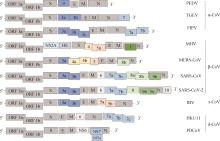
Fig.1
Genome structure of coronavirusORF. Open reading frame; HE. Hemagglutinin-esterase; NS. Non-structural proteins; S. Spike protein; N. Nucleocapsid protein; M. Membrane protein; E. Envelope protein"

Table 1
The quantity and main functions of coronavirus accessory proteins"
种属 Genera | 病毒 Virus | 数量 Quantity | 主要功能 Main functions |
|---|---|---|---|
| α-CoV | PEDV | 1 | 调节宿主免疫反应与病毒毒力 |
| TGEV | 3 | 调控宿主免疫反应、病毒毒力与组织嗜性 | |
| FIPV | 5 | 调控宿主免疫反应、炎症反应与病毒毒力 | |
| β-CoV | MHV | 4 | 免疫抑制与病毒毒力 |
| MERS-CoV | 5 | 免疫抑制、炎症反应、病毒毒力 | |
| SARS- CoV | 8 | 炎症反应、细胞凋亡、免疫抑制与病毒毒力 | |
| SARS- CoV-2 | 9 | 炎症反应、细胞凋亡、免疫抑制与病毒毒力 | |
| γ-CoV | IBV | 4 | 免疫抑制、发病机理与病毒毒力 |
| δ-CoV | PDCoV | 3 | 免疫抑制与病毒毒力 |
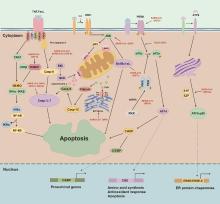
Fig.2
Cell apoptosis signaling pathway mediated by accessory proteins of coronavirus"
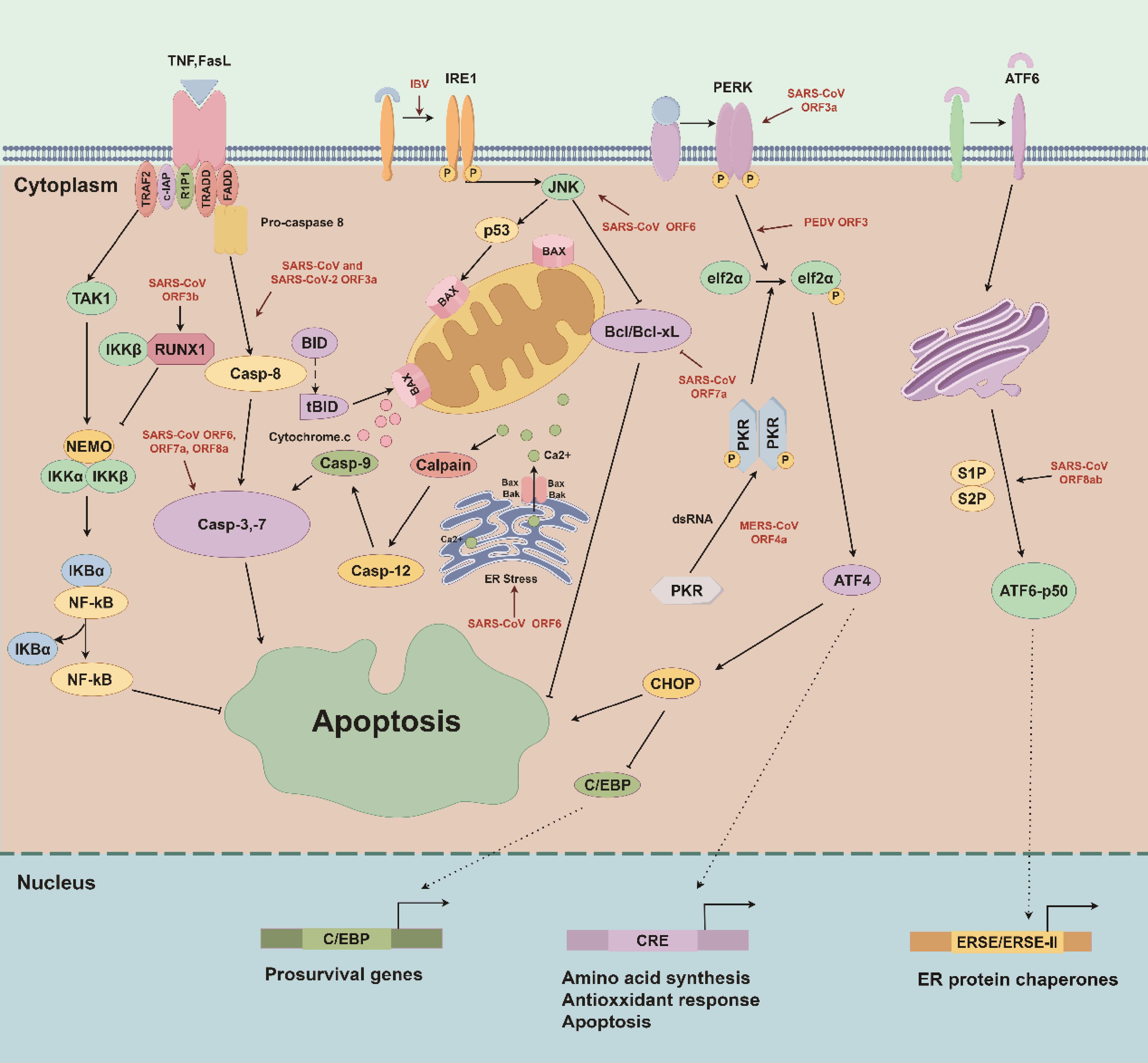
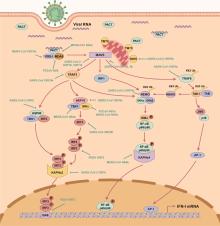
Fig.3
IFN-Ⅰ production signaling pathway infected by accessory proteins of coronavirus"
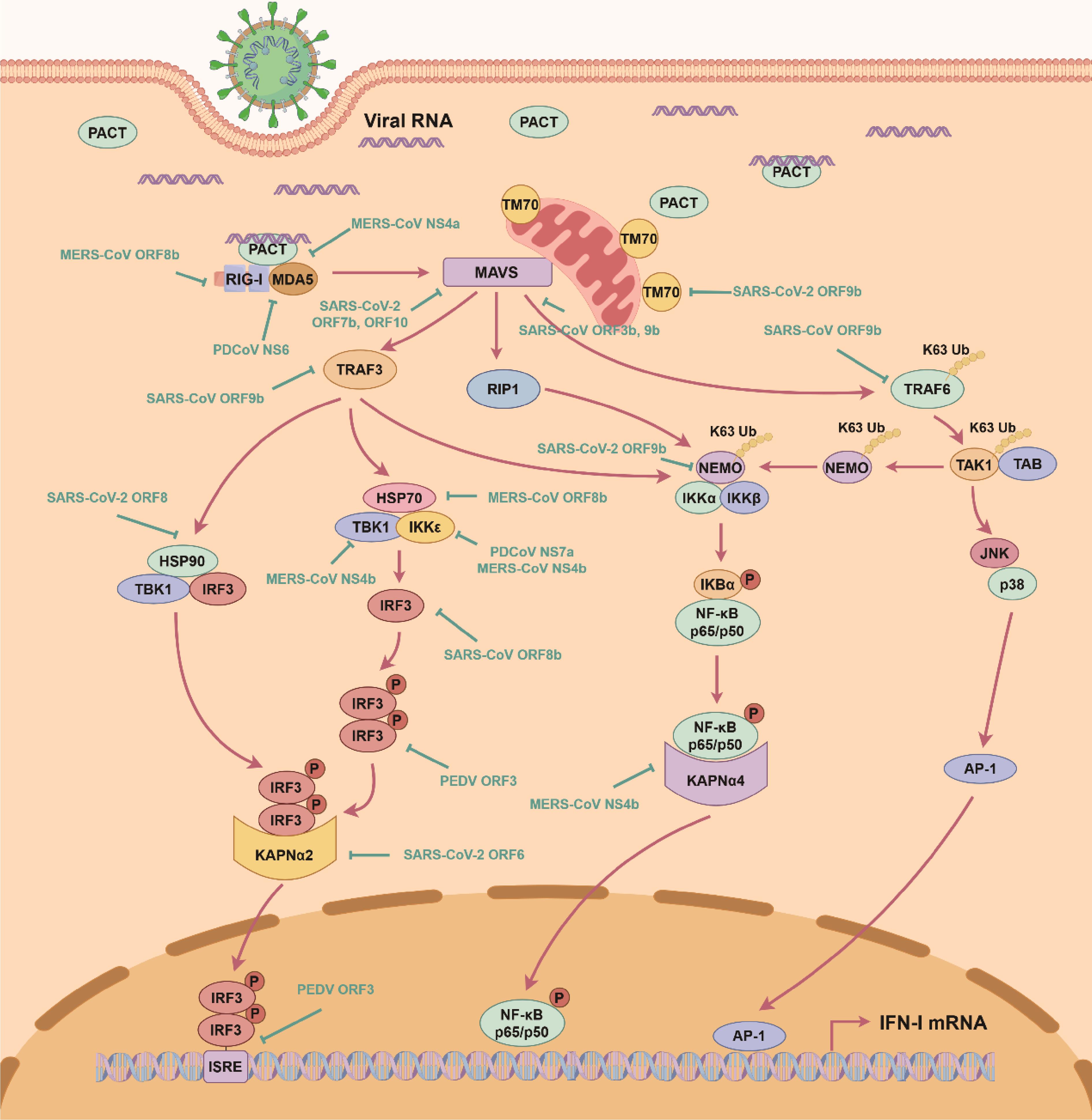
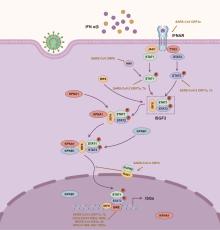
Fig.4
IFN-Ⅰ signaling transduction pathway infected by accessory proteins of coronavirus"

| [1] | ASHOUR H M,ELKHATIB W F,RAHMAN M M,et al.Insights into the recent 2019 novel coronavirus (SARS-CoV-2) in light of past human coronavirus outbreaks[J].Pathogens,2020,9(3):186. |
| [2] | KIRTIPAL N,BHARADWAJ S,KANG S G.From SARS to SARS-CoV-2,insights on structure,pathogenicity and immunity aspects of pandemic human coronaviruses[J].Infect Genet Evol,2020,85:104502. |
| [3] | HOERR F J.The pathology of infectious bronchitis[J].Avian Dis,2021,65(4):600-611. |
| [4] | WILLE M,HOLMES E C.Wild birds as reservoirs for diverse and abundant gamma- and deltacoronaviruses[J].FEMS Microbiol,2020,44:631-644. |
| [5] | LEDNICKY J A,TAGLIAMONTE M S,WHITE S K,et al.Emergence of porcine delta-coronavirus pathogenic infections among children in Haiti through independent zoonoses and convergent evolution[J].Nature,2021,600(7887):133-137. |
| [6] | FANG P,FANG L,ZHANG H,et al.Functions of coronavirus accessory proteins:overview of the state of the art[J].Viruses,2021,13(6):1139. |
| [7] | YOSHIMOTO F K.The proteins of severe acute respiratory syndrome coronavirus-2 (SARS CoV-2 or N-COV19),the cause of COVID-19[J].Protein J,2020,39(3):198-216. |
| [8] | MICHEL C J,MAYER C,POCH O,et al.Characterization of accessory genes in coronavirus genomes[J].Virol J,2020,17(1):131. |
| [9] | LIU D X,FUNG T S,CHONG K K,et al.Accessory proteins of SARS-CoV and other coronaviruses[J].Antiviral Res,2014,109:97-109. |
| [10] | WU A,PENG Y,HUANG B,et al.Genome composition and divergence of the novel coronavirus (2019-nCoV) originating in China[J].Cell Host Microbe,2020,27(3):325-328. |
| [11] | TAYLOR R C,CULLEN S P,MARTIN S J.Apoptosis:controlled demolition at the cellular level[J].Nat Rev Mol Cell Biol,2008,9(3):231-41. |
| [12] | PADHAN K,MINAKSHI R,BIN TOWHEED M A,et al.Severe acute respiratory syndrome coronavirus 3a protein activates the mitochondrial death pathway through p38 MAP kinase activation[J].J Gen Virol,2008,89:1960-1969. |
| [13] | TAN Y X,TAN T H,LEE M J,et al.Induction of apoptosis by the severe acute respiratory syndrome coronavirus 7a protein is dependent on its interaction with the Bcl-XL protein[J].J Virol,2007,81:6346-6355. |
| [14] | TAN Y J,FIELDING B C,GOH P Y.Overexpression of 7a,a protein specifically encoded by the severe acute respiratory syndrome coronavirus,induces apoptosis via a caspase-dependent pathway[J].J Virol,2004,78:14043-14047. |
| [15] | YE Z D,WONG C K,LI P,et al.The role of SARS-CoV protein,ORF-6,in the induction of host cell death[J].Hong Kong Med J,2010,16(5 Suppl 4):22-6. |
| [16] | CHEN C Y,PING Y H,LEE H C,et al.Open reading frame 8a of the human severe acute respiratory syndrome coronavirus not only promotes viral replication but also induces apoptosis[J].J Infect Dis,2007,196:405-415. |
| [17] | REN Y,SHU T,WU D,et al.The ORF3a protein of SARS-CoV-2 induces apoptosis in cells[J].Cell Mol Immunol,2020,17:881-883. |
| [18] | VARSHNEY B,AGNIHOTHRAM S,TAN Y J,et al.SARS coronavirus 3b accessory protein modulates transcriptional activity of RUNX1b[J].PLoS One,2012,7(1):e29542. |
| [19] | MINAKSHI R,PADHAN K,RANI M.The SARS coronavirus 3a protein causes endoplasmic reticulum stress and induces ligand-independent downregulation of the type 1 interferon receptor[J].PLoS One,2009,4(12):e8342. |
| [20] | YE Z,WONG C K,LI P,et al.SARS-CoV protein,ORF-6,induces caspase-3 mediated,ER stress and JNK-dependent apoptosis[J].Biochim Biophys Acta,2008,1780(12):1383-1387. |
| [21] | FUNG T S,LIU D X.The ER stress sensor IRE1 and MAP kinase ERK modulate autophagy induction in cells infected with coronavirus infectious bronchitis virus[J].Virology,2019,533:34-44. |
| [22] | FUNG T S,LIAO Y,LIU D X.The endoplasmic reticulum stress sensor IRE1 protects cells from apoptosis induced by the coronavirus infectious bronchitis virus[J].J Virol,2014,88:12752-12764. |
| [23] | ZOU D,XU J,DUAN X,et al.Porcine epidemic diarrhea virus ORF3 protein causes endoplasmic reticulum stress to facilitate autophagy[J].Vet Microbiol,2019,235:209-219. |
| [24] | V’KOVSKI P,KRATZEL A,STEINER S,et al.Coronavirus biology and replication:implications for SARS-CoV-2[J].Nat Rev Microbiol,2021,19(3):155-170. |
| [25] | YOO J S,KATO H,FUJITA T.Sensing viral invasion by RIG-I like receptors[J].Curr Opin Microbiol,2014,20:131-138. |
| [26] | SIU K L,YEUNG M L,KOK K H.Middle east respiratory syndrome coronavirus 4a protein is a double-stranded RNA-binding protein that suppresses PACT-induced activation of RIG-I and MDA5 in the innate antiviral response[J].J Virol,2014,88:4866-4876. |
| [27] | FANG P,FANG L,REN J,et al.Porcine deltacoronavirus accessory protein NS6 antagonizes interferon beta production by interfering with the binding of RIG-I/MDA5 to double-Stranded RNA[J].J Virol,2018,92(15):e00712-18. |
| [28] | XIAO X,FU Y,YOU W.Inhibition of the RLR signaling pathway by SARS-CoV-2 ORF7b is mediated by MAVS and abrogated by ORF7b-homologous interfering peptide[J].J Virol,2024,98(5):e0157323. |
| [29] | LI X,HOU P,MA W.SARS-CoV-2 ORF10 suppresses the antiviral innate immune response by degrading MAVS through mitophagy[J].Cell Mol Immunol,2022,19(1):67-78. |
| [30] | SHI C S,QI H Y.SARS-Coronavirus open reading frame-9b suppresses innate immunity by targeting mitochondria and the MAVS/TRAF3/TRAF6 signalosome[J].J Immunol,2014,193:3080-3089. |
| [31] | GAO X,ZHU K,QIN B.Crystal structure of SARS-CoV-2 ORF9b in complex with human TOM70 suggests unusual virus-host interactions[J].Nat Commun,2021,12(1):2843. |
| [32] | WU J,SHI Y,PAN X.SARS-CoV-2 ORF9b inhibits RIG-I-MAVS antiviral signaling by interrupting K63-linked ubiquitination of NEMO[J].Cell Rep,2021,34(7):108761. |
| [33] | NIE Y,MOU L,LONG Q.SARS-CoV-2 ORF3a positively regulates NF-κB activity by enhancing IKKβ- NEMO interaction[J].Virus Res,2023,328:199086. |
| [34] | RUI Y,SHEN S,WANG Y,et al.HIV-1 vpu and SARS-CoV-2 ORF3a proteins disrupt STING-mediated activation of antiviral NF-κB signaling[J].Sci Signal,2025,18(870):eadd6593. |
| [35] | FANG P,FANG L,XIA S.Porcine deltacoronavirus accessory protein NS7a antagonizes IFN-β production by competing with TRAF3 and IRF3 for binding to IKKε[J].Front Cell Infect Microbiol,2020,10:257. |
| [36] | YANG Y,YE F,ZHU N,et al.Middle east respiratory syndrome coronavirus ORF4b protein inhibits type I interferon production through both cytoplasmic and nuclear targets[J].Sci Rep,2015,5:17554. |
| [37] | WONG L R,YE Z W,LUI P Y,et al.Middle east respiratory syndrome coronavirus ORF8b accessory protein suppresses type I IFN expression by impeding HSP70-dependent activation of IRF3 kinase IKKepsilon[J].J Immunol,2020,205:1564-1579. |
| [38] | WONG H H,FUNG T S,FANG S,et al.Accessory proteins 8b and 8ab of severe acute respiratory syndrome coronavirus suppress the interferon signaling pathway by mediating ubiquitin-dependent rapid degradation of interferon regulatory factor 3[J].Virology,2018,515:165-175. |
| [39] | CANTON J,FEHR A R,FERNANDEZ-DELGADO R,et al.MERS-CoV 4b protein interferes with the NF-kappaB-dependent innate immune response during infection[J].PLoS Pathog,2018,14(1):e1006838. |
| [40] | ZHANG Q,SHI K,YOO D.Suppression of type I interferon production by porcine epidemic diarrhea virus and degradation of CREB-binding protein by nsp1[J].Virology,2016,489:252-68. |
| [41] | ZHENG L,LIU H,TIAN Z.Porcine epidemic diarrhea virus (PEDV) ORF3 protein inhibits cellular type I interferon signaling through down-regulating proteins expression in RLRs-mediated pathway[J].Res Vet Sci,2023,159:146-159. |
| [42] | LEI X,DONG X,MA R.Activation and evasion of type I interferon responses by SARS-CoV-2[J].Nat Commun,2020,11(1):3810. |
| [43] | CHEN J,LU Z,YANG X.Severe acute respiratory syndrome coronavirus 2 ORF8 protein inhibits type I interferon production by targeting HSP90B1 signaling[J].Front Cell Infect Microbiol,2022,12:899546. |
| [44] | CHENG W,CHEN S,LI R.Severe acute respiratory syndrome coronavirus protein 6 mediates ubiquitin-dependent proteosomal degradation of N-Myc (and STAT) interactor[J].Virol Sin,2015,30(2):153-161. |
| [45] | WANG J,YANG B,HU Y,et al.Negative regulation of Nmi on virus-triggered type I IFN production by targeting IRF7[J].J Immunol,2013,191(6):3393-3399. |
| [46] | MIORIN L,KEHRER T,SANCHEZ-APARICIO M T,et al.SARS-CoV-2 Orf6 hijacks Nup98 to block STAT nuclear import and antagonize interferon signaling[J].Proc Nat Acad Sci USA,2020,117(45):28344-28354. |
| [47] | XIA H,CAO Z,XIE X,et al.Evasion of type I interferon by SARS-CoV-2[J].Cell Rep,2020,33(1):108234. |
| [48] | BEIDAS M,CHEHADEH W.Effect of human coronavirus OC43 structural and accessory proteins on the transcriptional activation of antiviral response elements[J].Intervirology,2018,61(1):30-35. |
| [49] | YANG Y,ZHANG L,GENG H,et al.The structural and accessory proteins M,ORF 4a,ORF 4b,and ORF 5 of middle east respiratory syndrome coronavirus (MERS-CoV) are potent interferon antagonists[J].Protein Cell,2013,4(12):951-961. |
| [50] | LU Y,SU X,DU C.Genetic diversity of porcine epidemic diarrhea virus with a naturally occurring truncated ORF3 gene found in Guangxi,China[J].Front Vet Sci,2020,7:435. |
| [51] | ZHANG Y H,LI H X,CHEN X M.Genetic characteristics and pathogenicity of a novel porcine epidemic diarrhea virus with a naturally occurring truncated ORF3 gene[J].Viruses,2022,14(3):487. |
| [52] | HAIJEMA B J,VOLDERS H,ROTTIER P J M.Live,attenuated coronavirus vaccines through the directed deletion of group-specific genes provide protection against feline infectious peritonitis[J].J Virol,2004,78:3863-3871. |
| [53] | DEDEURWAERDER A,DESMARETS L M,OLYSLAEGERS D A.The role of accessory proteins in the replication of feline infectious peritonitis virus in peripheral blood monocytes[J].Vet Microbiol,2013,162:447-455. |
| [54] | CRUZ J L,SOLA I,BECARES M.Coronavirus gene 7 counteracts host defenses and modulates virus virulence[J].PLoS Pathog,2011,7(6):e1002090. |
| [55] | ISSA E,MERHI G,PANOSSIAN B,et al.SARS-CoV-2 and ORF3a:nonsynonymous mutations,functional domains,and viral pathogenesis[J].mSystems,2020,5(3):e00266-20. |
| [56] | HASSAN S S,CHOUDHURY P P,BASU P,et al.Molecular conservation and differential mutation on ORF3a gene in Indian SARS-CoV2 genomes[J].Genomics,2020,112(5):3226-3237. |
| [57] | HASSAN S S,ATTRISH D,GHOSH S,et al.Pathogenic perspective of missense mutations of ORF3a protein of SARS-CoV-2[J]. Virus Res,2021,300:198441. |
| [58] | SILVAS J A,VASQUEZ D M,PARK J G,et al.Contribution of SARS-CoV-2 accessory proteins to viral pathogenicity in K18 human ACE2 transgenic mice[J].J Virol,2021,95(17):e0040221. |
| [59] | YOUNG B E,FONG S W,CHAN Y H,et al.Effects of a major deletion in the SARS-CoV-2 genome on the severity of infection and the inflammatory response:an observational cohort study[J].Lancet,2020,396(10251):603-611. |
| [60] | LIU Y,ZHANG X,LIU J.A live-attenuated SARS-CoV-2 vaccine candidate with accessory protein deletions[J]. Nat Commun,2022,13(1):4337. |
| [61] | BELLO-PEREZ M,HURTADO-TAMAYO J,MYKYTYN A Z.SARS-CoV-2 ORF8 accessory protein is a virulence factor[J].mBio,2023,14(5):e0045123. |
| [62] | PEWE L,ZHOU H,NETLAND J,et al.A severe acute respiratory syndrome-associated coronavirus-specific protein enhances virulence of an attenuated murine coronavirus[J].J Virol,2005,79(17):11335-11342. |
| [63] | DE HAAN C A,MASTERS P S,SHEN X,et al.The group-specific murine coronavirus genes are not essential,but their deletion,by reverse genetics,is attenuating in the natural host[J].Virology,2002,296(1):177-189. |
| [64] | MENACHERY V D,MITCHELL H D,COCKRELL A S.MERS-CoV accessory ORFs play key role for infection and pathogenesis[J].mBio,2017,8(4):e00665-17. |
| [65] | LI Y,JIN Y,KUANG L.The N-terminal region of middle east respiratory syndrome coronavirus accessory protein 8b is essential for enhanced virulence of an attenuated murine coronavirus[J].J Virol,2022,96(3):e0184221. |
| [66] | VAN BEURDEN S J,BERENDS A J,KRÄMER-KÜHL A,et al.Recombinant live attenuated avian coronavirus vaccines with deletions in the accessory genes 3ab and/or 5ab protect against infectious bronchitis in chickens[J].Vaccine,2018,36 (8):1085-1092. |
| [67] | LACONI A,VAN BEURDEN S J,BERENDS A J,et al.Deletion of accessory genes 3a,3b,5a or 5b from avian coronavirus infectious bronchitis virus induces an attenuated phenotype both in vitro and in vivo[J].J Gen Virol,2018,99 (10):1381-1390. |
| [68] | ZHAO X,JIANG Y,CHENG X,et al.Pathogenicity of a QX-like strain of infectious bronchitis virus and effects of accessory proteins 3a and 3b in chickens[J].Vet Microbiol,2019,239 (4):108-114. |
| [69] | ZHAO Y,CHENG J,YAN S,et al.S gene and 5a accessory gene are responsible for the attenuation of virulent infectious bronchitis coronavirus[J].Virology,2019,533 (2):12-20. |
| [70] | ZHANG M,LI W,ZHOU P,et al.Genetic manipulation of porcine deltacoronavirus reveals insights into NS6 and NS7 functions:a novel strategy for vaccine design[J].Emerg Microbes Infect,2019,9(1):20-31. |
| [71] | YE C,PARK J G,CHIEM K.Immunization with recombinant accessory protein-deficient SARS-CoV-2 protects against lethal challenge and viral transmission[J]. Microbiol Spectr,2023,11(3):e0065323. |
| [72] | ZHANG C,GERZANICH V,CRUZ-COSME R,et al.SARS-CoV-2 ORF3a induces COVID-19-associated kidney injury through HMGB1-mediated cytokine production[J].mBio,2024,15(11):e0230824. |
| [73] | ZHANG J,HOM K,ZHANG C.SARS-CoV-2 ORF3a protein as a therapeutic target against COVID-19 and long-term post-infection effects[J].Pathogens,2024,13(1):75. |
| [74] | ZHANG Y,CHEN Y,LI Y.The ORF8 protein of SARS-CoV-2 mediates immune evasion through down-regulating MHC-Ι[J].Proc Natl Acad Sci U S A,2021,118(23):e2024202118. |
| [75] | ZINZULA L.Lost in deletion:the enigmatic ORF8 protein of SARS-CoV-2[J].Biochem Biophys Res Commun,2021,538:116-124. |
| [76] | JIANG H W,ZHANG H N,MENG Q F.SARS-CoV-2 Orf9b suppresses type I interferon responses by targeting TOM70[J].Cell Mol Immunol,2020,17(9):998-1000. |
| [1] | LI Mengfan, LI Qingyang, SONG Yanwen, SONG Zhenhui, ZHANG Xingcui. Structure and Function of Coronavirus S Proteins [J]. Acta Veterinaria et Zootechnica Sinica, 2025, 56(9): 4241-4252. |
| [2] | MAI Yanqi, SUN Xiaozheng, LIU Xiaoxuan, LIANG Xinglan, HUANG Ying, WU Xiaojuan, LIU Xiande, PEI Yechun. Analysis of the Preventive Effect of Recombinant E. coli Expressing rFel d 1 against Fel d 1-Induced Allergic Asthma [J]. Acta Veterinaria et Zootechnica Sinica, 2025, 56(9): 4529-4545. |
| [3] | LIU Junjun, GUO Donghui, LIU Huanhuan, SONG Runze, ZHAO Saiya, YANG Junyao, WEI Zhanyong, XIANG Yuqiang, CHEN Liying. Rapid Visual Detection for PDCoV/TGEV IgG Antibodies Using Smartphone-Assisted Colorimetric Sensing Platform based on Immunomagnetic Beads [J]. Acta Veterinaria et Zootechnica Sinica, 2025, 56(9): 4559-4571. |
| [4] | GUO Guihai, MA Rumeng, YIN Fangjie, LIU Xinzi, WANG Zi, MENG Weijing, LI Jiaxuan, CUI Wen, JIANG Yanping, TANG Lijie, ZHAO Haiyuan, WANG Xiaona. Study on the Expression of Recombinant Limosilactobacillus reuteri Expressing the S1 Gene of Porcine Epidemic Diarrhea Virus to Induce Specific Immune Responses in Piglets [J]. Acta Veterinaria et Zootechnica Sinica, 2025, 56(9): 4581-4592. |
| [5] | YU Qiurong, CAI Xuhang, HE Yi, LI Jizong, MAO Li, XU Xingang, LI Bin. Identification and Isolation of a Caprine Coronavirus and Analysis of the Complete Genome Sequence [J]. Acta Veterinaria et Zootechnica Sinica, 2025, 56(9): 4604-4614. |
| [6] | TAO Lihan, LIN Cui, WU Chengcheng, KANG Zhaofeng, HUANG Jianzhen. Research Progress on the Structure and Function of Proteins Encoded by Porcine Deltacoronavirus [J]. Acta Veterinaria et Zootechnica Sinica, 2025, 56(8): 3678-3689. |
| [7] | XUE Xiaoxiao, MENG Lingzhai, WANG Suyan, YU Mengmeng, CHEN Yuntong, QI Xiaole, LI Liuan, YU Xiaoxue, GAO Yulong. Study on Immune Effect of Subtype B Attenuated Avian Metapneumovirus Disease Vaccine on Commercial Layer Chickens [J]. Acta Veterinaria et Zootechnica Sinica, 2025, 56(8): 3958-3966. |
| [8] | TIAN Ru, FU Xingwei, HU Leyu, ZHU Mingjun, TONG Dewen. Isolation and Pathogenicity Analysis of a GⅡa Porcine Epidemic Diarrhea Virus [J]. Acta Veterinaria et Zootechnica Sinica, 2025, 56(8): 4101-4111. |
| [9] | XIANG Lingxian, JI Qianyu, SHAN Xinxin, LI Lin. Advances in the Study of Drug Resistance and Pathogenicity of Bacterial Two-component Systems [J]. Acta Veterinaria et Zootechnica Sinica, 2025, 56(7): 3116-3128. |
| [10] | CHEN Yunlong, FAN Gang, FAN Xinyi, GUO Yongchao, ZHANG Xinmiao, WANG Yan, ZHANG Shiqiang. Isolation and Identification of a Novel Porcine Circovirus Type 2d Strain with Multiple Nucleotide Substitutions [J]. Acta Veterinaria et Zootechnica Sinica, 2025, 56(6): 3032-3040. |
| [11] | WU Qianhui, ZHANG Yu, ZHANG Taoni, MO Meilan. Research Progress on Mechanism of Lipid Raft Involved in Coronavirus Infection and Its Application [J]. Acta Veterinaria et Zootechnica Sinica, 2025, 56(5): 2112-2122. |
| [12] | WANG Yanan, GUO Yaru, JIANG Yanping, CUI Wen, LI Jiaxuan, LI Yijing, WANG Li. Isolation, Identification and Pathogenicity Analysis of Porcine Rotavirus [J]. Acta Veterinaria et Zootechnica Sinica, 2025, 56(5): 2259-2269. |
| [13] | HU Mi, SHEN Yaoxin, FAN Baochao, SUN Min, ZHOU Jinzhu, GUO Rongli, LI Bin. Evaluation of the Characteristics of Eudragit L100-Modified Aluminum-Manganese Metal-Organic Framework as an Oral Delivery Vehicle for Inactivated Porcine Epidemic Diarrhea Vaccine [J]. Acta Veterinaria et Zootechnica Sinica, 2025, 56(5): 2292-2230. |
| [14] | ZHANG Xiaoling, HE Xinglin, ZHANG Mengdi, LI Pengfei, SUN Yumei, MA Hailong, ZHU Hongmei, ZHANG Mengjia, LI Wentao. Preparation of E2 Protein Nanoparticles from Classical Swine Fever Virus and the Immunogenicity Study in Rabbit [J]. Acta Veterinaria et Zootechnica Sinica, 2025, 56(5): 2301-2311. |
| [15] | JIA Chaoying, ZHANG Huawei, LUO Xiuxin, LIU Qingyun, WANG Xiangru. Establishment of Mice Model Infected by Bovine Mannheimia haemolytica and the Immunogenicity of Inactivated Vaccine [J]. Acta Veterinaria et Zootechnica Sinica, 2025, 56(5): 2312-2324. |
| Viewed | ||||||
|
Full text |
|
|||||
|
Abstract |
|
|||||
