


Acta Veterinaria et Zootechnica Sinica ›› 2026, Vol. 57 ›› Issue (1): 136-145.doi: 10.11843/j.issn.0366-6964.2026.01.012
• ANIMAL GENETICS AND BREEDING • Previous Articles Next Articles
XU Liming1( ), ZHANG Cong1, WEN Dun1, RAO Zhaoxi2, HAO Yun1, LIU Junyi1, DU Taoran1, WANG Wenqiang3, LI Qiang4, LI Pinghua1,3(), HUANG Ruihua1,3()
Received:2025-06-09
Online:2026-01-23
Published:2026-01-26
Contact:
LI Pinghua, HUANG Ruihua
E-mail:2022205006@stu.njau.edu.cn;lipinghua718@njau.edu.cn;rhhuang@njau.edu.cn
CLC Number:
XU Liming, ZHANG Cong, WEN Dun, RAO Zhaoxi, HAO Yun, LIU Junyi, DU Taoran, WANG Wenqiang, LI Qiang, LI Pinghua, HUANG Ruihua. Mining of Host Gene Loci Affecting the Apparent Digestibility of Crude Fiber in Suhuai Pigs[J]. Acta Veterinaria et Zootechnica Sinica, 2026, 57(1): 136-145.
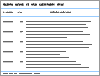
Table 1
Description and statistics of apparent digestibility traits of crude fiber in Suhuai pigs"
性状 Trait | 个体数 Number of individuals | 最小值/% Minimumvalue | 最大值/% Maximumvalue | 均值±标准误/% Mean±Standarderror | 变异系数/% Coefficient of variation |
|---|---|---|---|---|---|
粗纤维表观消化率 Apparent digestibility of crude fiber | 320 | 11.13 | 84.64 | 54.30±1.03 | 33.87 |
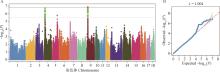
Fig.1
Manhattan diagram (A) and QQ diagram (B) of phenotype of apparent digestibility of crude fiber"
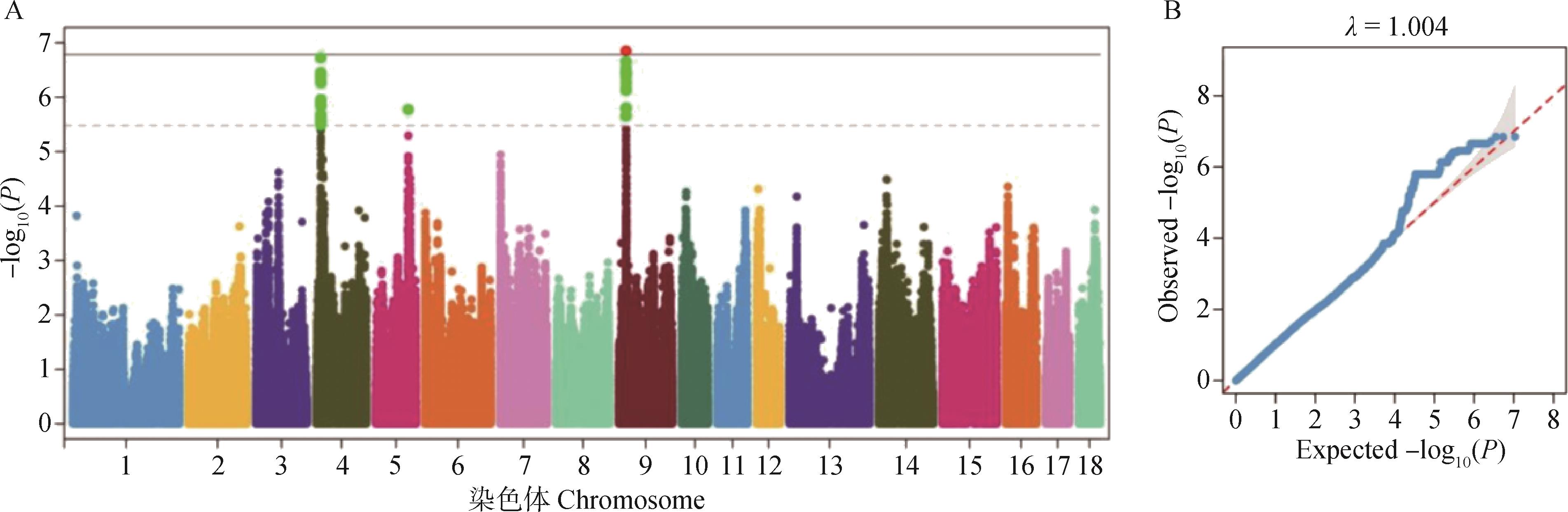
Fig.2
The position of QTLs on chromosome 4 (A), chromosome 5 (B), chromosome 9 (C) affecting the apparent digestibility traits of crude fiber"
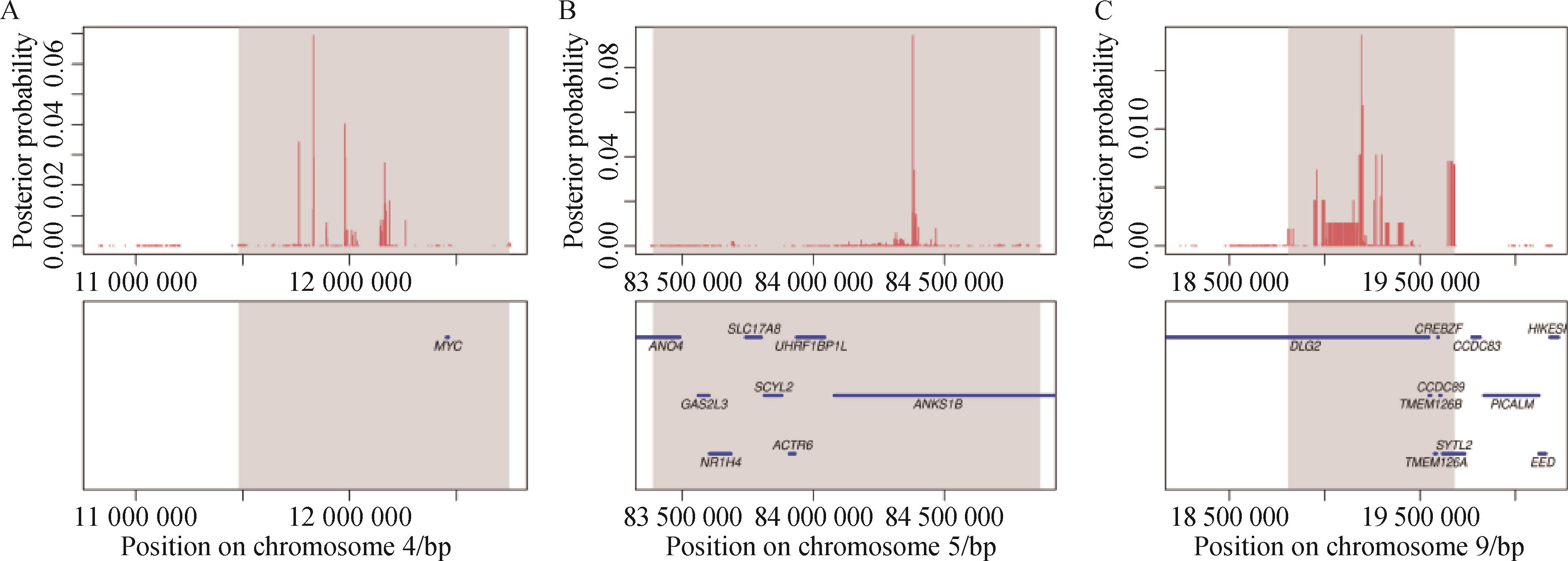
Table 2
QTLs and functional candidate genes affecting the apparent digestibility of crude fiber of pig"
| 染色体Chromosome | QTL置信区间/Mb QTL confidence interval | 候选基因 Candidate gene | 功能候选基因的主要功能 Function of candidate genes |
|---|---|---|---|
| 4 | 11.48~12.75 | MYC | MYC:通过调节细胞的能量代谢和生物合成过程,间接影响膳食纤维的消化代谢 |
| 5 | 83.39~84.86 | ANO4、NR1H4、ACTR6、 SCYL2、GAS2L3、SLC17A8、UHRF1BP1L、ANKS1B、 | ANO4:在细胞信号传导和离子平衡调节方面的功能可能对维持消化道细胞的正常生理功能有一定影响,从而间接影响膳食纤维的消化代谢过程; NR1H4:可能通过调节胆汁酸的代谢间接影响膳食纤维的消化代谢过程; ACTR6:参与细胞内的多种生物学过程,可能对消化道中与膳食纤维代谢相关的基因表达有一定的影响; SCYL2:在Wnt信号通路中的作用可能影响肠道细胞的分化和功能,从而间接影响膳食纤维的消化代谢 |
| 9 | 18.81~19.68 | DLG2、CREBZF、CCDC83、HIKESA、CCDC89、TMEM126B、PICALM、TMEM126A、EED | DLG2:可能通过维持细胞的正常结构和功能进而促进纤维消化 |
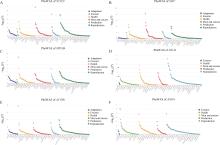
Fig.3
PheWAS scatter plots of functional candidate genes SCYL2(A), MYC (B), NR1H4(C), DLG2(D), ACTR6 (E), ANO4 (F)"

| [1] | ZHANG F,JIN C,JIANG S,et al.Dietary supplementation with pioglitazone hydrochloride and resveratrol improves meat quality and antioxidant capacity of broiler chickens[J].Appl Sci,2020,10(7):2452. |
| [2] | NITIN M,S A S,P S D,et al.Novel trends in development of dietary fiber rich meat products-a critical review[J].J Food Sci Technol,2015,52(2):633-647. |
| [3] | GUANG P,PINGHUA L,TAORAN D,et al.Adding appropriate fiber in diet increases diversity and metabolic capacity of distal gut microbiota without altering fiber digestibility and growth rate of finishing pig[J].Front Microbiol,2020,11:533. |
| [4] | 何金庆,王 欢,杜陶然,等.日粮纤维水平对育肥期苏淮猪空肠黏膜微生物的影响[J].畜牧与兽医,2025,57(2):22-31. |
| HE J Q,WANG H,DU T R,et al.The effect of dietary fiber levels on the jejunal mucosal microbiota of Su Huai pigs during the fattening period.[J].Animal Husbandry & Veterinary Medicine,2025,57(2):22-31.(in Chinese) | |
| [5] | KRAMER J,MALEK M,LAMONT S J.Association of twelve candidate gene polymorphisms and response to challenge with Salmonella enteritidis in poultry[J].Anim Genet,2003,34(5):339-348. |
| [6] | 牛 清.基于16S rRNA基因测序技术鉴别与猪纤维消化相关的肠道微生物[D].南京:南京农业大学,2019. |
| NIU Q.Identification of intestinal microorganisms related to fiber digestion in pigs based on 16S rRNA gene sequencing technology [D].Nanjing:Nanjing Agricultural University,2019(in Chinese) | |
| [7] | 孙晓燕,刘向明,冷尚集.饲料中不同粗纤维水平对猪的影响[J].中国畜禽种业,2022,18(1):93-94. |
| SUN X Y,LIU X M,LENG S J.The effects of different levels of crude fiber in the feed on pigs[J].The Chinese Livestock and Poultry Breeding,2022,18(1):93-94.(in Chinese) | |
| [8] | 张崇玉,巩立书,张明凤,等.饲料粗纤维快速测定方法在生产中的应用[J].山东畜牧兽医,2020,41(12):16-17. |
| ZHANG C Y,GONG L S,ZHANG M F,et al.The application of rapid method for measuring feed crude fiber in production[J].Shandong Journal of Animal Science and Veterinary Medicine,2020,41(12):16-17.(in Chinese) | |
| [9] | 刘 磊,李福昌,杨鹏程,等.饲料粗纤维、中性洗涤纤维和酸性洗涤纤维残渣中各成分的研究[J].动物营养学报,2018,30(3):1044-1051. |
| LIU L,LI F C,YANG P C,et al.Research on the components of the residual substances of crude fiber,neutral detergent fiber and acid detergent fiber in feed[J].Chinese Journal of Animal Nutrition,2018,30(3):1044-1051.(in Chinese) | |
| [10] | LI K,HOU L,DU T,et al.Genome-wide association study identified five quantitative trait loci and two candidate genes for digestive traits in Suhuai pigs[J].Anim Genet,2024,55(3):471-474. |
| [11] | 李开军,侯黎明,蒲 广,等.基于全基因组Fst和nSL分析鉴别苏淮猪中性洗涤纤维表观消化率相关候选基因位点[J].畜牧兽医学报,2021,52(7):1809-1819. |
| LI K J,HOU L M,PU G,et al.Based on genome-wide Fst and nSL analysis,candidate gene loci related to the apparent digestibility of neutral detergent fiber in Su-Huai pigs were identified[J].Acta Veterinaria et Zootechnica Sinica,2021,52(7):1809-1819.(in Chinese) | |
| [12] | PURCELL S,NEALE B,TODD-BROWN K,et al.PLINK:A tool set for whole-genome association and population-based linkage analyses[J].Am J Hum Genet,2007,81(3):559-575. |
| [13] | BROWNING B L,BROWNING S R.Genotype imputation with millions of reference samples[J].Am J Hum Genet,2016,98(1):116-126. |
| [14] | 谭碧娥,伍树松,贺建华,等.地方猪耐粗饲和肉质性状形成的微生物代谢机制[J].动物营养学报,2020,32(7):2941-2946. |
| TAN B E,WU S S,HE J H,et al.The microbial metabolic mechanism underlying the formation of the forage tolerance and meat quality traits in local pigs[J].Chinese Journal of Animal Nutrition,2020,32(7):2941-2946.(in Chinese) | |
| [15] | 周根来,倪黎纲,张 伟,等.生长肥育阶段姜曲海猪饲粮中适宜粗纤维水平的研究[J].家畜生态学报,2020,41(5):23-29. |
| ZHOU G L,NI L G,ZHANG W,et al.Study on the appropriate level of crude fiber in the diet of Jiangquhai piglets during the growth and fattening stage[J].Acta Ecologae Animalis Domastici,2020,41(5):23-29.(in Chinese) | |
| [16] | 韩萍萍,高 琛,李平华,等.不同脱脂米糠水平日粮对苏淮猪胴体性状及肉品质的影响[J].畜牧兽医学报,2020,51(4):783-793. |
| HAN P P,GAO C,LI P H,et al.The effects of different levels of defatted rice bran in the diet on the carcass traits and meat quality of Su-Huai pigs[J].Acta Veterinaria et Zootechnica Sinica,2020,51(4):783-793.(in Chinese) | |
| [17] | 高 琛.苏淮猪肉滴水损失相关候选基因鉴别及适宜日粮脱脂米糠水平的遴选 [D].南京:南京农业大学,2019. |
| GAO C.Identification of candidate genes related to water loss in pork from Su Hua pigs and selection of appropriate dietary levels of defatted rice bran [D].Nanjing:Nanjing Agricultural University,2019.(in Chinese) | |
| [18] | 张叶秋.高米糠日粮对苏淮猪肠道发育和肠道微生物的影响[D].南京:南京农业大学,2016. |
| ZHANG Y Q.The effects of high-milled rice bran diet on the intestinal development and intestinal microflora of Su-Huai pigs[D].Nanjing:Nanjing Agricultural University,2016.(in Chinese) | |
| [19] | 谭占坤,刘 瑶,刘锁珠,等.藏猪肠道因子与饲粮粗纤维表观消化率的相关性研究[J].高原农业,2021,5(5):465-471. |
| TAN Z K,LIU Y,LIU S Z,et al.Study on the correlation between intestinal factors of Tibetan pigs and the apparent digestibility of dietary crude fiber[J].Journal of Plateau Agriculture,2021,5(5):465-471.(in Chinese) | |
| [20] | 王 诚,王文亭,李福昌.日粮粗纤维水平对莱芜猪及其杂交猪氮代谢及营养物质消化率的影响[J].山东农业大学学报(自然科学版),2011,42(3):422-427. |
| WANG C,WANG W T,LI F C.The effect of dietary crude fiber level on nitrogen metabolism and nutrient digestibility in Laiwu pigs and their hybrid pigs[J].Journal of Shandong Agricultural University(Natural Science Edition),2011,42(3):422-427.(in Chinese) | |
| [21] | 王清义.淮南猪种质特性的研究与应用 [D].北京:中国农业大学,2005. |
| WANG Q Y.Research and application of the genetic characteristics of Huainan pig breed [D].Beijing:China Agricultural University,2005.(in Chinese) | |
| [22] | DÉRU V,BOUQUET A,LABUSSIÉRE E,et al.Genetics of digestive efficiency in growing pigs fed a conventional or a high-fibre diet[J].J Anim Breed Genet,2020,138(2):246-258. |
| [23] | YIN Y Z,HOU L M,LIU C X,et al.Genome-wide association study identified a quantitative trait locus and two candidate genes on sus scrofa chromosome 2 affecting vulvar traits of Suhuai pigs[J].Genes (Basel),2022,13(8):1294. |
| [24] | TINA S,PATRICK S,ANDREAS T,et al.c-Myc affects mRNA translation,cell proliferation and progenitor cell function in the mammary gland[J].BMC Biol,2009,7(1):63. |
| [25] | REICHHART N,SCHÖBERL S,KECKEIS S,et al.Anoctamin-4 is a bona fide Ca2+-dependent non-selective cation channel[J].Sci Rep,2019,9(1):2257. |
| [26] | WANG Y,YU Y B,LI L X,et al.Bile acid-dependent transcription factors and chromatin accessibility determine regional heterogeneity of intestinal antimicrobial peptides[J].Nat Commun,2023,14(1):5093. |
| [27] | WANG J,SONG M,TANG J,et al.Expression,prognosis and preliminary investigation of the mechanism of action of ACTR6,a member of the ARPs gene family,in hepatocellular carcinoma[J].Front Med (Lausanne),2025,12:1513233. |
| [28] | LIU H,FREDIMOSES M,NIU P J,et al.EPRS/GluRS promotes gastric cancer development via WNT/GSK-3β/β-catenin signaling pathway[J].Gastric Cancer,2021,24(5):1021-1036. |
| [29] | VARUN M,STEFAN E,CARL-HENRIK H,et al.Genome-wide binding of transcription factor ZEB1 in triple-negative breast cancer cells[J].J Cell Physiol,2018,233(10):7113-7127. |
| [30] | TRAN T C,SCHLUETER D J,ZENG C,et al.PheWAS analysis on large-scale biobank data with PheTK[J].Bioinformatics,2024,41(1):btae719. |
| [31] | 张 虎,黄大鹏,李姝超.日粮粗纤维水平对妊娠母猪繁殖性能的影响[J].中国畜牧兽医文摘,2012,28(11):161. |
| ZHANG H,HUANG D P,LI S C.The influence of dietary crude fiber level on the reproductive performance of pregnant sows[J].ZHONGGUO XUMU SHOUYI WENZHAI,2012,28(11):161.(in Chinese) | |
| [32] | SHUNLI P,NORIYOSHI M,YOSHIKI Y.3D Structures of IgA,IgM,and components[J].Int J Mol Sci,2021,22(23):12776. |
| [33] | SHANG Q H,LIU H S,WU D,et al.Source of fiber influences growth,immune responses,gut barrier function and microbiota in weaned piglets fed antibiotic-free diets[J].Anim Nutr,2021,7(2):315-325. |
| [34] | HE W,GAO Y N,GUO Z Q,et al.Effects of fermented wheat bran and yeast culture on growth performance,immunity and intestinal microflora in growing-finishing pigs[J].J Anim Sci,2021,99(11):skab308. |
| [35] | 来金良,吕尊周,姚玥州,等.饲粮粗纤维水平对中新鸭生长性能、屠宰性能、肠道发育及盲肠菌群结构的影响[J].动物营养学报,2023,35(12):7805-7816. |
| LAI J L,LV Z Z,YAO Y Z,et al.The effects of dietary crude fiber levels on the growth performance,slaughter performance,intestinal development and cecum microbiota structure of New China ducks[J].Chinese Journal of Animal Nutrition,2023,35(12):7805-7816.(in Chinese) | |
| [36] | 蒲 广,侯黎明,刘根盛,等.日粮纤维水平对梅山猪生长性能、纤维表观消化率及肠道微生物区系的影响[J].中国畜牧杂志,2021,57(S1):262-267. |
| PU G,HOU L M,LIU G S,et al.The effects of dietary fiber levels on the growth performance,apparent digestibility of fiber,and intestinal microbial flora of Meishan pigs[J].Chinese Journal of Animal Science,2021,57(S1):262-267.(in Chinese) | |
| [37] | XIAO L G,LIU J Z,QIN L S,et al.Multi-omics reveal the effects and regulatory mechanism of dietary echinocystic acid supplementation on abdominal fat and liver steatosis in broiler chickens[J].Poult Sci,2025,104(4):104981. |
| [1] | SUN Zeyuan, XIANG Lingxian, LI Lin, ZUO Runan. Mechanisms and Influencing Factors of Horizontal Transfer of Drug-resistant Genes in Salmonella [J]. Acta Veterinaria et Zootechnica Sinica, 2026, 57(1): 108-119. |
| [2] | LIU Chenlong, DENG Xiao, LIN Ketuan, WAN Mingchun, YANG Wenqing, PENG Fugui, ZHOU Quanyong, ZHENG Xiaoming, TAN Meifang, JI Huayuan. Comparative Study on Production Performance, Meat Quality Traits and Serum Biochemical Indicators between Yushan Black Pig and Its Different Cross Combinations [J]. Acta Veterinaria et Zootechnica Sinica, 2026, 57(1): 120-135. |
| [3] | WANG Yan, GU Yiren, ZHANG Jinwei, YANG Xuemei, LIANG Yan, LIU Rui, TAO Xuan, YANG Yuekui, AN Rui, YANG Kun, ZHANG Xing, CHEN Xiaohui, GONG Jianjun. Analysis of Intestinal Microbial Diversity Differences among Chuanxiang Black Pigs, Berkshire Pigs and Duroc Pigs [J]. Acta Veterinaria et Zootechnica Sinica, 2026, 57(1): 146-154. |
| [4] | YANG Kai, LI Dongfeng, SHAO Yonggang, ZHAI Manjun, BAI Xianguang, ZHANG Lifan. Study on Genetic Relationships and Genomic Differences of Local Chicken Breeds in Xinjiang [J]. Acta Veterinaria et Zootechnica Sinica, 2026, 57(1): 155-166. |
| [5] | XIE Zeting, HOU Xiaoyun, ZHAN Yinkai, LIN Suiyuan, ZHU Purui, GUO Shiqi, QIN Shuang, LUO Yangbing, LI Xiujin, HUANG Yunmao, WU Zhongping, ZHANG Xumeng. Comparative Analysis of Histomorphology and Transcriptome in Pectoral Muscle Tissues between Shitou and Wuzong Geese [J]. Acta Veterinaria et Zootechnica Sinica, 2026, 57(1): 206-220. |
| [6] | WANG Fuxi, MA Cui, HUANG Kang, LI Ruitong, ZHAO Qingyu, ZHANG Junmin, YAN Yibo, SI Wei. 18β-glycyrrhetinic Acid can Alleviate Oxidative Stress Induced Lung Injury in Weaned Piglets Induced by D-galactose [J]. Acta Veterinaria et Zootechnica Sinica, 2026, 57(1): 305-316. |
| [7] | LI Chenyang, ZHANG Chuanmei, HUI Yutao, LÜ Ying, YANG Min. Detection of Virulence Genes and Drug Resistance Analysis of 15 Serotypes of Riemerella anatipestifer [J]. Acta Veterinaria et Zootechnica Sinica, 2026, 57(1): 360-368. |
| [8] | LUO Runbo, WU Dan, LI Kexin, ZHONG Ya’nan, SUOLANG Sizhu, SHANG Peng. Isolation and Drug Resistance Analysis of Clostridium perfringens from Tibetan Pigs [J]. Acta Veterinaria et Zootechnica Sinica, 2026, 57(1): 392-400. |
| [9] | GAO Linlin, GUAN Yuxin, LI Jiping, WANG Zhen, REN Jing, GUO Qianqian, LI Chunyi. Therapeutic Efficacy of Deer Blood Polypeptides Collected during Antler Regeneration Period in Androgenetic Alopecia in Mice [J]. Acta Veterinaria et Zootechnica Sinica, 2026, 57(1): 432-442. |
| [10] | ZHAO Lin, WU Kunfu, CHE Siyan, LU Yu, WANG Zi, WU Miaomiao. Effects of Panax notoginseng Stem and Leaf Extract on Growth Performance, Diarrhea Index and Intestinal Health of LPS-Challenged Piglets [J]. Acta Veterinaria et Zootechnica Sinica, 2026, 57(1): 540-552. |
| [11] | LIN Xiao, LI Ruijie, LIU Long, GENG Tuoyu, GONG Daoqing. Research Progress on Sex Determining Genes and Their Methylation Regulation in Animals [J]. Acta Veterinaria et Zootechnica Sinica, 2025, 56(9): 4129-4142. |
| [12] | YANG Xin, WANG Shaoyu, TONG Chang, PENG Zhitao, CAI Shenghuang, HUANG Junxiong, XU Jiaojiao, WEN Xin, WU Yinbao. Research Progress on the Horizontal Gene Transfer of Antibiotic Resistance Genes from Livestock and Poultry Manure [J]. Acta Veterinaria et Zootechnica Sinica, 2025, 56(9): 4279-4293. |
| [13] | TIAN Jiao, LONG Juyan, CHEN Xia, CEN Xiaoli, NIU Xi, HUANG Shihui, WANG Jiafu, RAN Xueqin. Down-regulation of Gene Expression by SINE Insertion in the 3'UTR of the ENTPD1 Gene in the Xiang Pig [J]. Acta Veterinaria et Zootechnica Sinica, 2025, 56(9): 4303-4314. |
| [14] | CAO Xiaoyao, WANG Congyong, WANG Ting, XIONG Lanling, YU Heyang, WANG Zezhao, GAO Huijiang, LI Junya, ZHU Bo. Estimation of Genetic Parameters and Genetic Progress for Growth and Development Traits in Huaxi Cattle [J]. Acta Veterinaria et Zootechnica Sinica, 2025, 56(9): 4355-4368. |
| [15] | ZHENG Yunchang, HOU Ruilin, LIANG Xiaohe, YANG Lidan, ZHANG Yinjiao, HUO Haonan, CHEN Weina, ZHANG Cui, LI Shijie. Analysis of Monoallelic Expression and DNA Methylation Status of Bovine FOXP2 Gene [J]. Acta Veterinaria et Zootechnica Sinica, 2025, 56(9): 4369-4378. |
| Viewed | ||||||
|
Full text |
|
|||||
|
Abstract |
|
|||||
