


Acta Veterinaria et Zootechnica Sinica ›› 2026, Vol. 57 ›› Issue (1): 120-135.doi: 10.11843/j.issn.0366-6964.2026.01.011
• ANIMAL GENETICS AND BREEDING • Previous Articles Next Articles
LIU Chenlong1( ), DENG Xiao2, LIN Ketuan2, WAN Mingchun1, YANG Wenqing2, PENG Fugui2, ZHOU Quanyong1, ZHENG Xiaoming2, TAN Meifang1, JI Huayuan1()
Received:2025-06-06
Online:2026-01-23
Published:2026-01-26
Contact:
JI Huayuan
E-mail:liuchenlong1204@163.com;jhy478731@163.com
CLC Number:
LIU Chenlong, DENG Xiao, LIN Ketuan, WAN Mingchun, YANG Wenqing, PENG Fugui, ZHOU Quanyong, ZHENG Xiaoming, TAN Meifang, JI Huayuan. Comparative Study on Production Performance, Meat Quality Traits and Serum Biochemical Indicators between Yushan Black Pig and Its Different Cross Combinations[J]. Acta Veterinaria et Zootechnica Sinica, 2026, 57(1): 120-135.
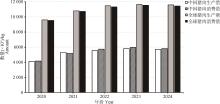
Fig.1
The production and consumption of pork in China and worldwide in the past 5 years (Data from National Bureau of Statistics and United States Department of Agriculture)"
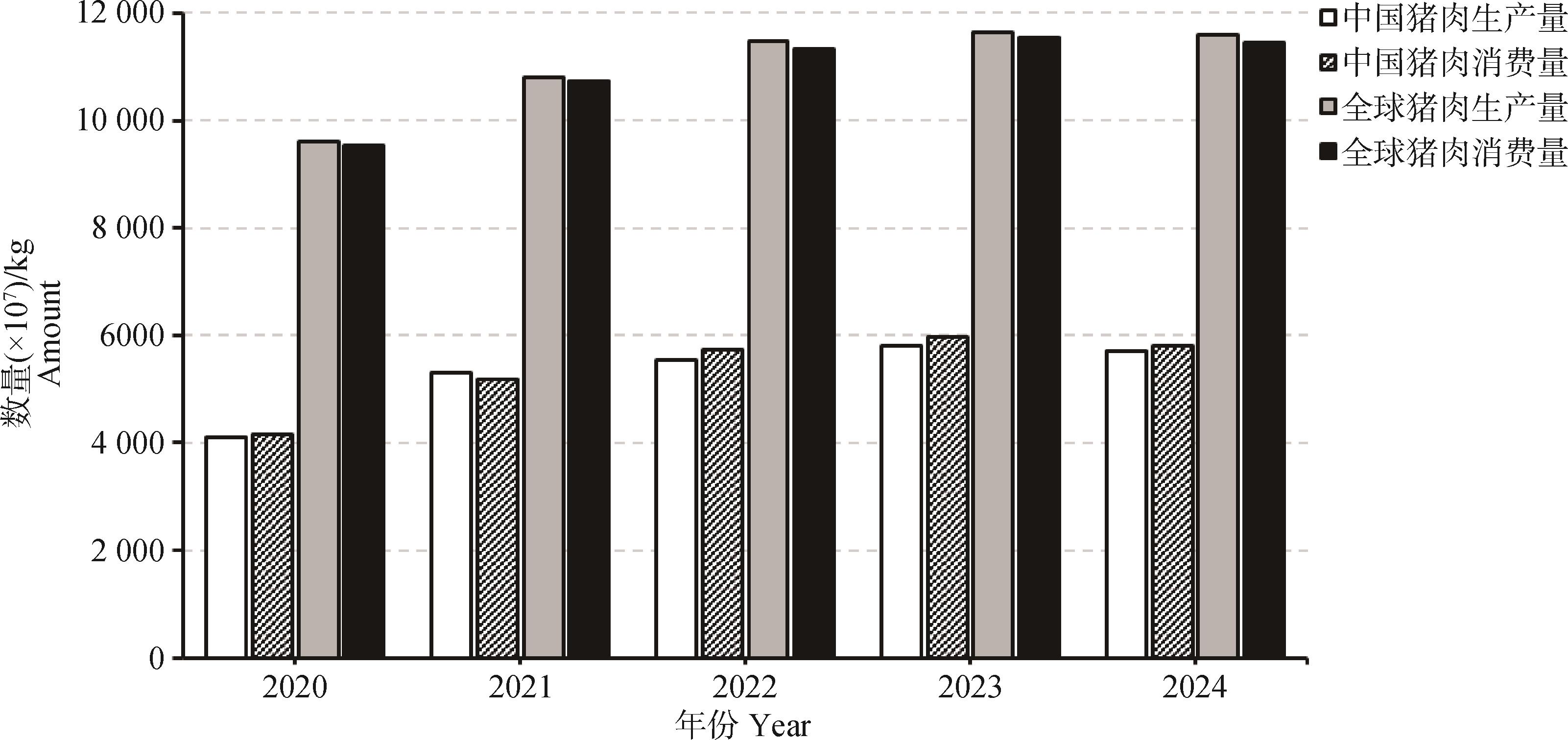
Table 1
Comparison analysis results of the fattening performance between Yushan black pig and its hybrid pigs"
指标 Index | 玉山黑猪(n=3) YY (n=3) | 杜玉(n=3) DY (n=3) | 巴玉(n=3) BY (n=3) | 山玉(n=3) SY (n=3) | P-值 P-value |
|---|---|---|---|---|---|
| 育肥前期增重/kgWeight gain of EFP | 141.07±7.37Bb | 190.00±2.14Aa | 183.80±2.50Aa | 176.60±2.53Aa | 1.59e-04 |
| 育肥前期ADG/kgThe ADG of EFP | 1.91±0.10Bb | 2.57±0.03Aa | 2.48±0.03Aa | 2.39±0.03Aa | 1.59e-04 |
| 育肥前期耗料量/kgThe feed consumption of EFP | 408.10±0.61Bc | 471.67±0.18Aa | 471.40±0.42Aab | 470.20±0.42Ab | 1.56e-13 |
| 育肥前期FCRThe FCR of EFP | 2.91±0.14Aa | 2.48±0.03Bb | 2.57±0.04ABb | 2.66±0.04ABab | 0.019 7 |
| 育肥后期增重/kgWeight gain of LFP | 222.93±3.99Bc | 259.67±5.72Bb | 316.13±4.97Aa | 253.73±16.98Bbc | 8.37e-04 |
| 育肥后期ADG/kgThe ADG of LFP | 2.01±0.04Bc | 2.34±0.05Bb | 2.85±0.04Aa | 2.29±0.15Bbc | 8.37e-04 |
| 育肥后期耗料量/kgThe feed consumption of LFP | 1 046.90±0.61Cd | 1 149.33±11.72ABb | 1 189.93±10.77Aa | 1 104.80±12.20Bc | 4.69e-05 |
| 育肥后期FCRThe FCR of LFP | 4.70±0.08Aa | 4.43±0.13ABa | 3.77±0.08Bb | 4.39±0.29ABa | 0.023 7 |
| 育肥期增重/kgWeight gain of FP | 364.00±4.13Cc | 449.67±7.03Bb | 499.93±2.79Aa | 430.33±15.42Bb | 3.48e-05 |
| 育肥期ADG/kgThe ADG of FP | 1.97±0.02Cc | 2.43±0.04Bb | 2.7±0.02Aa | 2.33±0.08Bb | 3.48e-05 |
| 育肥期耗料量/kgThe feed consumption of FP | 1 455.00±0.00Cd | 1 621.00±11.59ABb | 1 661.33±10.67Aa | 1 575.00±12.58Bc | 2.83e-06 |
| 育肥期FCR The FCR of FP | 4.00±0.04Aa | 3.61±0.08Bb | 3.32±0.03Bc | 3.67±0.12ABb | 0.001 7 |
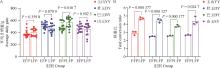
Fig.2
The difference of the ADG (A) and FCR (B) between EFP and LFP in the same group"
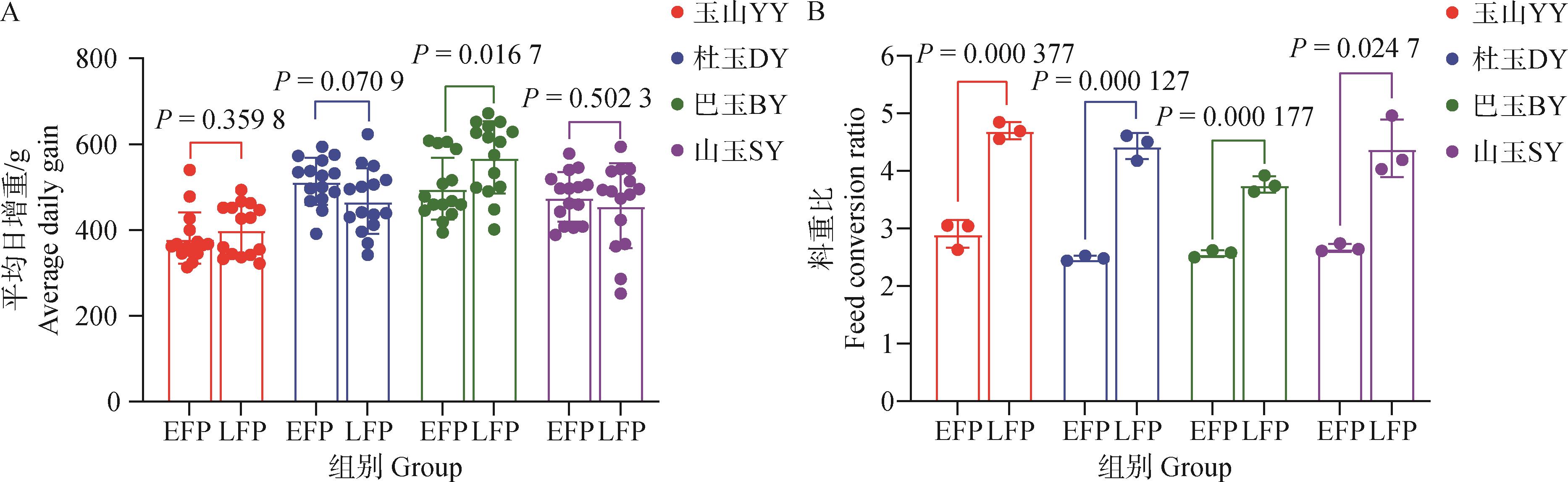
Table 2
Comparison analysis results of the carcass traits between Yushan black pig and its hybrid pigs"
指标 Index | 玉山黑猪(n=8) YY (n=8) | 杜玉(n=8) DY (n=8) | 巴玉(n=8) BY (n=8) | 山玉(n=8) SY (n=8) | P-值 P-value |
|---|---|---|---|---|---|
| 宰前活重/kg Live weight | 97.75±1.85Bb | 111.35±3.45Aa | 120.00±3.72Aa | 112.05±2.81Aa | 2.13e-04 |
| 胴体重/kg Carcass weight | 72.60±1.71Bb | 85.05±2.53Aa | 91.31±3.04Aa | 85.21±2.45Aa | 1.17e-04 |
| 屠宰率/% Dressing percentage | 74.23±0.49Bb | 76.40±0.33Aa | 76.07±0.50ABa | 76.01±0.66ABa | 0.022 2 |
| 皮重/kg Skin weight | 4.53±0.23Aa | 3.35±0.21Bb | 4.08±0.31ABa | 4.28±0.19ABa | 0.011 7 |
| 皮率/% Skin rate | 13.86±0.69Aa | 8.59±0.59Bc | 9.60±0.52Bbc | 10.63±0.60Bb | 7.37e-06 |
| 骨重/kg Bone weight | 2.57±0.09Bb | 3.31±0.13Aa | 3.00±0.19ABab | 3.24±0.17Aa | 0.007 9 |
| 骨率/% Bone rate | 7.87±0.24ABab | 8.46±0.34Aa | 7.06±0.27Bb | 8.01±0.38ABa | 0.029 9 |
| 肥肉重/kg Fat weight | 14.14±0.40Bc | 14.22±0.87Bbc | 18.07±0.60Aa | 16.26±0.90ABab | 0.001 5 |
| 肥肉率/% Fat rate | 43.22±1.05Aa | 36.12±1.54Bb | 42.95±1.58Aa | 39.98±1.40ABab | 0.004 1 |
| 瘦肉重/kg Lean meat weight | 11.49±0.42Bb | 18.34±0.53Aa | 17.09±0.83Aa | 16.75±0.54Aa | 3.57e-08 |
| 瘦肉率/% Lean meat rate | 35.05±0.73Cc | 46.83±0.75Aa | 40.39±1.23Bb | 41.38±0.74Bb | 8.01e-09 |
| 后腿重/kg Hind leg weight | 8.55±0.25Bb | 11.33±0.34Aa | 12.03±0.34Aa | 11.46±0.31Aa | 5.35e-08 |
后腿占胴体比例/% Proportion of hind leg to carcass | 23.63±0.65Bb | 26.48±0.31Aa | 26.45±0.55Aa | 27.05±0.53Aa | 3.31e-04 |
肩部最厚处背膘厚/mm Backfat thickness at the thickestpart of the shoulder | 62.12±2.51Aa | 59.16±2.02Aa | 64.34±2.88Aa | 59.60±2.43Aa | 0.433 0 |
最后肋骨处背膘厚/mm Backfat thickness at the last rib | 41.71±2.14Bb | 42.34±2.82ABb | 53.97±3.98Aa | 37.49±3.00Bb | 0.004 8 |
腰荐结合处背膘厚/mm Backfat thickness at the waist joint | 32.28±1.70Bb | 34.70±1.84ABb | 42.40±3.25Aa | 30.33±2.71Bb | 0.009 4 |
平均背膘厚/mm Average backfat thickness | 45.37±1.64ABb | 45.40±2.05ABb | 53.57±3.13Aa | 42.47±1.95Bb | 0.011 0 |
| 皮厚/mm Skin thickness | 5.70±0.56Aa | 3.53±0.33Bb | 4.26±0.33ABb | 4.14±0.41ABb | 0.008 3 |
| 胴体长/cm Carcass length | 74.36±1.33Aa | 76.75±1.15Aa | 76.94±1.82Aa | 77.38±0.89Aa | 0.399 0 |
| 肋骨数 Rib number | 14.00±0.00Cc | 15.00±0.00Aa | 15.00±0.00Aa | 14.38±0.18Bb | 9.49e-09 |
| 眼肌面积/cm2 Loin eye area | 19.96±0.89Cc | 38.07±1.28Aa | 28.12±2.21Bb | 30.28±1.43Bb | 7.62e-08 |
| 头重/kg Head weight | 6.53±0.22Bb | 6.85±0.23ABab | 7.43±0.24Aa | 7.15±0.18ABab | 0.041 6 |
| 总板油重/kg Total leaf fat weight | 4.14±0.25Aab | 3.76±0.27Abc | 4.77±0.25Aa | 3.54±0.37Ac | 0.041 0 |
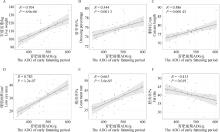
Fig.3
The correlation results between early fattening period ADG and production traits"

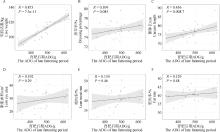
Fig.4
The correlation results between late fattening period ADG and production traits"

Table 3
Comparison analysis results of the organs between Yushan black pig and its hybrid pigs"
指标 Index | 玉山黑猪(n=8) YY (n=8) | 杜玉(n=8) DY (n=8) | 巴玉(n=8) BY (n=8) | 山玉(n=8) SY (n=8) | P-值 P-value |
|---|---|---|---|---|---|
| 心脏重/kg Heart weight | 0.24±0.01Cc | 0.35±0.02Aa | 0.29±0.01BCb | 0.31±0.02ABab | 3.25e-05 |
| 胃重/kg Stomach weight | 0.53±0.03Bb | 0.63±0.03Aa | 0.60±0.02ABa | 0.64±0.02Aa | 0.009 3 |
| 肝脏重/kg Liver weight | 1.01±0.03Bb | 1.24±0.09Aa | 1.23±0.05Aa | 1.28±0.04Aa | 0.009 7 |
| 脾脏重/kg Spleen weight | 0.14±0.00Bb | 0.19±0.01Aa | 0.15±0.01Bb | 0.14±0.01Bb | 4.02e-04 |
| 肾脏重/kg Kidney weight | 0.25±0.01Aa | 0.27±0.01Aa | 0.27±0.01Aa | 0.27±0.01Aa | 0.963 0 |
| 肺重/kg Lung weight | 1.38±0.11Bc | 1.74±0.08ABab | 1.55±0.11ABbc | 1.87±0.10Aa | 0.009 4 |
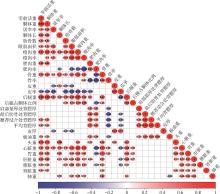
Fig.5
The correlation analysis results of the carcass and organ traits between Yushan black pig and its hybrid pigsIn this figure, the red represents a significant positive correlation, and the blue represents a significant negative correlation (P<0.05); the darker the color, the bigger the correlation coefficient value. The blank cells represents insignificant correlation (P>0.05)"

Table 4
The statistic table of the Pearson correlation coefficient absolute value |R|>0.8 and P<0.05 between carcass and organ traits"
指标1 Index 1 | 指标2 Index 2 | 相关性系数 Correlation coefficient | P值 P-value |
|---|---|---|---|
| 胴体重 Carcass weight | 宰前活重 Live weight | 0.986 | 0 |
| 胴体重 Carcass weight | 后腿重 Hind leg weight | 0.880 | 3.35e-11 |
| 胴体重 Carcass weight | 瘦肉重 Lean meat weight | 0.805 | 2.80e-08 |
| 后腿重 Hind leg weight | 瘦肉重 Lean meat weight | 0.914 | 2.60e-13 |
| 后腿重 Hind leg weight | 宰前活重 Live weight | 0.850 | 7.73e-10 |
| 皮率 Skin rate | 皮重 Skin weight | 0.815 | 1.34e-08 |
| 平均背膘厚 Average backfat thickness | 最后肋骨处背膘厚 Backfat thickness at the last rib | 0.949 | 0 |
| 平均背膘厚 Average backfat thickness | 腰荐结合处背膘厚 Backfat thickness at the waist joint | 0.896 | 4.09e-12 |
| 瘦肉率 Lean meat rate | 眼肌面积 Loin eye area | 0.847 | 1.03e-09 |
| 瘦肉率 Lean meat rate | 瘦肉重 Lean meat weight | 0.831 | 4.06e-09 |
| 瘦肉重 Lean meat weight | 眼肌面积 Loin eye area | 0.845 | 1.21e-09 |
| 瘦肉重 Lean meat weight | 心脏重 Heart weight | 0.802 | 3.43e-08 |
腰荐结合处背膘厚 Backfat thickness at the waist joint | 最后肋骨处背膘厚 Backfat thickness at the last rib | 0.843 | 1.38e-09 |
| 肥肉率 Fat rate | 瘦肉率 Lean meat rate | -0.810 | 2.02e-08 |
Table 5
Comparison analysis results of the meat quality traits between Yushan black pig and its hybrid pigs"
指标 Index | 玉山黑猪(n=8) YY (n = 8) | 杜玉(n=8) DY (n = 8) | 巴玉(n=8) BY (n = 8) | 山玉(n=8) SY (n = 8) | P-值 P-value |
|---|---|---|---|---|---|
| 肉色评分 Meat color score | 3.19±0.03Aab | 3.13±0.03Ab | 3.38±0.06Aab | 3.56±0.07Aa | 0.175 3 |
| L | 43.79±0.25Aa | 43.95±0.21Aa | 42.4±0.25Aa | 42.23±0.38Aa | 0.290 8 |
| a | 2.42±0.21Aa | 1.49±0.15Aab | 0.87±0.04Ab | 1.83±0.19Aab | 0.140 5 |
| b | 9.74±0.07Aa | 9.79±0.13Aa | 8.54±0.09Bb | 8.94±0.13ABab | 0.015 7 |
| pH1 | 6.64±0.02Aa | 6.54±0.02Aa | 6.37±0.04Aa | 6.55±0.04Aa | 0.292 3 |
| pH24 | 5.91±0.04Aa | 5.78±0.02Aa | 5.97±0.05Aa | 6.04±0.04Aa | 0.402 3 |
| 大理石纹评分 Marbling score | 2.25±0.13Aab | 2.75±0.10Aa | 1.94±0.05Ab | 2.06±0.06Aab | 0.139 9 |
| 肌内脂肪含量/%Intramuscular fat content | 4.40±0.64Aa | 3.83±0.68ABab | 2.33±0.33Bb | 2.34±0.37Bb | 0.017 1 |
| 滴水损失/% Drip loss | 1.11±0.06Bbc | 0.86±0.04Bc | 1.60±0.06ABab | 1.89±0.10Aa | 0.003 9 |
| 剪切力/N Shear force | 48.21±2.87Bc | 72.55±4.83ABb | 98.29±12.72Aa | 81.38±6.41Aab | 8.25e-04 |
| 熟肉率/% Cooked meat percentage | 68.68±0.44ABb | 69.09±0.28ABb | 73.09±0.63Aa | 67.84±0.41Bb | 0.036 2 |
Table 6
Comparison analysis results of the serum immune and antioxidant indicators between Yushan black pig and its hybrid pigs"
指标 Index | 玉山黑猪(n=8) YY (n=8) | 杜玉(n=8) DY (n=8) | 巴玉(n=8) BY (n=8) | 山玉(n=8) SY (n=8) | P-值 P-value |
|---|---|---|---|---|---|
| IgA/(μg·mL‒1) | 33.30±1.16ABab | 29.50±0.62Bb | 36.66±2.49Aa | 36.26±1.72Aa | 0.016 7 |
| IgG/(μg·mL‒1) | 309.18±7.45Aab | 276.18±9.47Ab | 332.61±12.74Aa | 336.28±27.56Aa | 0.054 1 |
| IgM/(μg·mL‒1) | 38.03±1.01Aa | 35.31±2.03Aa | 38.97±1.79Aa | 39.36±2.84Aa | 0.496 9 |
| CAT/(U·mL‒1) | 12.07±2.05Aa | 11.07±2.22Aa | 8.90±1.54Aa | 11.48±1.93Aa | 0.683 4 |
| GSH-Px/(U·mL‒1) | 3 360.33±132.19BCbc | 2 996.69±269.91Cc | 3 870.25±158.68ABab | 4 166.53±188.30Aa | 9.93e-04 |
| MDA/(nmol·mL‒1) | 5.47±0.80Aa | 2.56±0.46Bb | 4.79±0.67ABa | 4.70±0.86ABa | 0.042 5 |
| SOD/(U·mL‒1) | 50.08±3.32Aa | 40.17±2.86Aab | 43.99±1.92Aab | 37.90±4.94Ab | 0.088 7 |
| T-AOC/(mmol·L‒1) | 0.35±0.02Aa | 0.31±0.03Aa | 0.33±0.02Aa | 0.29±0.04Aa | 0.341 4 |
Table 7
Comparison analysis results of the serum glucose and serum lipids indicators between Yushan black pig and its hybrid pigs"
指标 Index | 玉山黑猪(n=8) YY (n=8) | 杜玉(n=8) DY (n=8) | 巴玉(n=8) BY (n=8) | 山玉(n=8) SY (n=8) | P-值 P-value |
|---|---|---|---|---|---|
| GLU/(mmol·L‒1) | 5.17±0.51Bc | 6.24±0.36Bbc | 6.96±0.58ABab | 8.23±0.51Aa | 0.001 4 |
| TG/(mmol·L‒1) | 0.94±0.07ABab | 1.08±0.05Aa | 1.08±0.07Aa | 0.79±0.06Bb | 0.006 0 |
| TC/(mmol·L‒1) | 2.60±0.14Aa | 2.52±0.14Aa | 2.65±0.15Aa | 2.51±0.16Aa | 0.893 2 |
| LDL-C/(mmol‒L-1) | 2.78±0.18Aa | 2.62±0.16Aa | 2.91±0.19Aa | 2.74±0.21Aa | 0.749 4 |
| HDL-C/(mmol·L‒1) | 2.06±0.10Aa | 2.22±0.12Aa | 2.13±0.11Aa | 2.11±0.10Aa | 0.755 4 |
| [1] | 刘书杰,张海峰,王祖力,等.2024年全球生猪产业发展情况及2025年的趋势[J].猪业科学,2025,42(2):32-35. |
| LIU S J,ZHANG H F,WANG Z L,et al.Development of global pig industry in 2024 and trends in 2025[J].Swine Industry Science,2025,42(2):32-35.(in Chinese) | |
| [2] | 李 萌,孙 蕾,卓兰英,等.巴克夏猪与鲁莱黑猪杂交后代猪生长肥育、胴体性能及肉品质测定研究[J].猪业科学,2025,42(3):107-108. |
| LI M,SUN L,ZHUO L Y,et al.Study on the growth,fattening,carcass performance,and meat quality of offsprings from the hybrid of Berkshire pig and Lulai black pig[J].Swine Industry Science,2025,42(3):107-108.(in Chinese) | |
| [3] | 张冰雪,刘 奇,金 宇,等.大围子猪与不同品种瘦肉型猪杂交效果比较[J].猪业科学,2024,41(8):126-128. |
| ZHANG B X,LIU Q,JIN Y,et al.Comparison of crossbreeding effects between Daweizi pig and different lean meat pig breeds[J].Swine Industry Science,2024,41(8):126-128.(in Chinese) | |
| [4] | 郑小明,林克团.国外猪种大量引进导致本土猪种濒临灭绝的原因分析及应对建议(以玉山黑猪为例)[J].猪业科学,2021,38(3):122-123. |
| ZHENG X M,LIN K T.Analysis of the reasons for domestic pig breeds endangered by the large-scale introduction of foreign pig breeds and the countermeasures[J].Swine Industry Science,2021,38(3):122-123.(in Chinese) | |
| [5] | 王成斌,王小鹏,郑小明,等.玉山黑猪两种头型遗传机制的初步解析[J].畜牧兽医学报,2018,49(8):1585-1593. |
| WANG C B,WANG X P,ZHENG X M,et al.A study of the genetic mechanisms for two head types in Yushan black pig[J].Acta Veterinaria et Zootechnica Sinica,2018,49(8):1585-1593.(in Chinese) | |
| [6] | 易松强,姜树林,余华阳,等.玉山黑猪冷冻精液制作初探[J].江西畜牧兽医杂志,2020(2):19-21. |
| YI S Q,JIANG S L,YU H Y,et al.A preliminary study on the production of frozen semen from Yushan black pig[J].Jiangxi Journal of Animal Husbandry & Veterinary Medicine,2020(2):19-21.(in Chinese) | |
| [7] | 王鹏伟.音乐声波对玉山黑猪断奶仔猪生长影响的研究[D].南昌:江西农业大学,2015. |
| WANG P W.The effects of music sound waves on Yushan black pig weaned piglets' growth[D].Nanchang:Jiangxi Agricultural University,2015.(in Chinese) | |
| [8] | 李瑞丽,胡丽芳,唐书升,等.玉山黑猪肉营养特性分析[J].肉类研究,2013,27(5):10-13. |
| LI R L,HU L F,TANG S S,et al.Nutritional characteristics of meat from Yushan black pig[J].Meat Research,2013,27(5):10-13.(in Chinese) | |
| [9] | 万明春,杨 群,梅卫军,等.玉山黑猪与巴克夏、长白二元杂交猪屠宰及肉质性能比较研究[J].家畜生态学报,2011,32(4):41-45. |
| WAN M C,YANG Q,MEI W J,et al.Comparison study on slaughter performance and meat trait between Yushan black pig and its Berkshire and Landrace two-way cross breeds[J].Journal of Domestic Animal Ecology,2011,32(4):41-45.(in Chinese) | |
| [10] | 刘晨龙,林建国,万明春,等.赣西两头乌猪屠宰测定与肉质检测初报[J].江西农业大学学报,2021,43(2):371-377. |
| LIU C L,LIN J G,WAN M C,et al.A preliminary report on the slaughter performance and meat quality of Ganxi two-end-black pig[J].Acta Agriculturae Universitatis Jiangxiensis,2021,43(2):371-377.(in Chinese) | |
| [11] | QUAN J,YANG M,WANG X,et al.Multi-omic characterization of allele-specific regulatory variation in hybrid pigs[J].Nat Commun,2024,15(1):5587. |
| [12] | LUO J,SHEN L,TAN Z,et al.Comparison reproductive,growth performance,carcass and meat quality of Liangshan pig crossbred with Duroc and Berkshire genotypes and heterosis prediction[J].Livest Sci,2018,212(2018):61-68. |
| [13] | 李龙云,晏 敏,涂金敏,等.山下黑猪与杜山下杂交猪生产性能的比较分析[J].江西农业大学学报,2022,44(2):403-410. |
| LI L Y,YAN M,TU J M,et al.Comparing production performance of Shanxia black pig with intercross between Duroc boars and Shanxia black pig Sows [J].Acta Agriculturae Universitatis Jiangxiensis,2022,44(2):403-410.(in Chinese) | |
| [14] | 高 祥,王拓原,孙雅妮,等.地方猪育种研究进展[J].中国猪业,2025,20(2):63-74. |
| GAO X,WANG T Y,SUN Y N,et al.Progress in local pig breeding research [J].China Swine Industry,2025,20(2):63-74.(in Chinese) | |
| [15] | 李 闯,韦明飞,莫德林,等.巴克夏与广东小耳花猪杂交效果分析[J].中国畜牧杂志,2019,55(4):62-65. |
| LI C,WEI M F,MO D L,et al.Analysis of the hybrid effects of Berkshire and Guangdong small ear pig [J].Chinese Journal of Animal Science,2019,55(4):62-65.(in Chinese) | |
| [16] | LIU Q,YUE J,NIU N,et al.Genome-wide association analysis identified BMPR1A as a novel candidate gene affecting the number of thoracic vertebrae in a Large White x Minzhu intercross pig population[J].Animals (Basel),2020,10(11):2186. |
| [17] | ZHANG Y,WANG M,YUAN J,et al.Association of polymorphisms in NR6A1,PLAG1 and VRTN with the number of vertebrae in Chinese Tongcheng x Large White crossbred pigs[J].Anim Genet,2018,49(4):353-354. |
| [18] | MOLINERO E,PENA R N,ESTANY J,et al.Unravelling novel and closely linked association signals for fat-related traits in pigs using prioritised variants from whole-genome sequence data[J].Animal,2025,19(5):101496. |
| [19] | 倪黎纲,赵旭庭,朱淑斌,等.苏姜猪杂交配合力测定与分析[J].西南农业学报,2015,28(5):2255-2258. |
| NI L G,ZHAO X T,ZHU S B,et al.Determination and analysis of cross combining ability of Sujiang pig[J].Southwest China Journal of Agricultural Sciences,2015,28(5):2255-2258.(in Chinese) | |
| [20] | 吴买生,张善文,向拥军,等.湘沙猪配套系杂交组合肥育、胴体及肉质性状配合力测定[J].猪业科学,2018,35(5):124-126. |
| WU M S,ZHANG S W,XIANG Y J,et al.Determination of combining ability of fattening,carcass and meat quality characteristics of Xiangsha pig hybrid combination[J].Swine Industry Science,2018,35(5):124-126.(in Chinese) | |
| [21] | 李世豪,杨又兵,娄 然,等.长白猪系间杂交初生重性状配合力分析[J].养殖与饲料,2021,20(11):20-25. |
| LI S H,YANG Y B,LOU R,et al.A study on combining ability of primary weight trait of hybrids between different Landrace lines[J].Animal Breeding and Feed,2021,20(11):20-25.(in Chinese) | |
| [22] | 徐 忠,张 哲,孙 浩,等.金华猪与杜洛克、长白猪、大白猪杂交的杂种优势预测[J].中国畜牧杂志,2019,55(1):64-67. |
| XU Z,ZHANG Z,SUN H,et al.Prediction of heterosis on hybrids of Jinhua pig with Duroc,Landrace,and Large White pigs[J].Chinese Journal of Animal Science,2019,55(1):64-67.(in Chinese) | |
| [23] | 杜俊成,张 雷,杨 莎,等.四种不同黑猪杂交组合试验[J].黑龙江畜牧兽医,2018,8:62-64. |
| DU J C,ZHANG L,YANG S,et al.The hybrid combination experiment of four black pigs [J].Heilongjiang Animal Science and Veterinary Medicine,2018,8:62-64.(in Chinese) | |
| [24] | SU J,LI J,AZAD M,et al.Dynamic distribution of gut microbiota-metabolites during post-weaning longissimus dorsi muscle development in Ningxiang pigs[J].Microbiol Spectr,2024,12(10):e0081324. |
| [25] | 笪 浩,陈 雯,陈 超,等.杜×梅杂交一代猪的生长育肥和产肉性能研究[J].畜牧与兽医,2021,53(9):5-8. |
| DA H,CHEN W,CHEN C,et al.Research on the fattening and meat production performance of Du-Mei hybrid F1 pigs [J].Animal Husbandry & Veterinary Medicine,2021,53(9):5-8.(in Chinese) | |
| [26] | BERGAMASCHI M,TIEZZI F,HOWARD J,et al.Gut microbiome composition differences among breeds impact feed efficiency in swine[J].Microbiome,2020,8(1):110. |
| [27] | 刘 越,苏小妹,孙武胜,等.松辽黑猪不同屠宰体重的性状测定与分析[J].养猪,2023(5):23-26. |
| LIU Y,SU X M,SUN W S,et al.Determination and analysis of different slaughtering weights of Songliao black pigs[J].Swine Production,2023(5):23-26.(in Chinese) | |
| [28] | OKUMURA T,IIZUKA S,NAKAJIMA I,et al.Predicting primal weight and primal yield in pork carcasses from a large-scale survey at major meat processing centers in Japan[J].Anim Sci J,2024,95(1):e14001. |
| [29] | LIU K,YIN Y,WANG B,et al.Integrating significant SNPs identified by GWAS for genomic prediction of the number of ribs and carcass length in Suhuai pigs[J].Animals (Basel),2025,15(3):412. |
| [30] | LIU C,HOU L,ZHAO Q,et al.The selected genes NR6A1,RSAD2-CMPK2,and COL3A1 contribute to body size variation in Meishan pigs through different patterns[J].J Anim Sci,2023,101:skad304. |
| [31] | LI L Y,XIAO S J,TU J M,et al.A further survey of the quantitative trait loci affecting swine body size and carcass traits in five related pig populations[J].Anim Genet,2021,52(5):621-632. |
| [32] | 崔清明,张四阳,邓 缘,等.宁乡猪及其杂交猪不同屠宰体重下内脏组织变化的研究[J].猪业科学,2022,39(11):116-118. |
| CUI Q M,ZHANG S Y,DENG Y,et al.Study on visceral tissue changes of Ningxiang pig and its hybrid pigs at different slaughter weights[J].Swine Industry Science,2022,39(11):116-118.(in Chinese) | |
| [33] | LI M,TIAN S,YEUNG C K,et al.Whole-genome sequencing of Berkshire (European native pig) provides insights into its origin and domestication[J].Sci Rep,2014,4:4678. |
| [34] | GUO Q,WANG J,WANG X,et al.Supplemented with Astragalus dregs improves growth performance,immunity,and antioxidant capacity in fattening pigs[J].J Nutr Sci,2025,14:e5. |
| [35] | DI STEFANO M,MIRABELLA L,COTOIA A K.A possible protective effect of IgA against severe acute respiratory syndrome corona virus 2 (SARS-CoV-2) in bronchoalveolar lavage in COVID-19 patients admitted to intensive care unit[J].Viruses,2024,16(12):1851. |
| [36] | SCHIEBER M,CHANDEL N S.ROS function in redox signaling and oxidative stress[J].Curr Biol,2014,24(10):R453-R462. |
| [37] | WANG Y,ZHANG Z,DU M,et al.Berberine alleviates ETEC-induced intestinal inflammation and oxidative stress damage by optimizing intestinal microbial composition in a weaned piglet model[J].Front Immunol,2024,15:1460127. |
| [38] | DENG Q,XU J,YU B,et al.Effect of dietary tea polyphenols on growth performance and cell-mediated immune response of post-weaning piglets under oxidative stress[J].Arch Anim Nutr,2010,64(1):12-21. |
| [39] | PRATES J.Nutritional value and health implications of meat from monogastric animals exposed to heat stress[J].Nutrients,2025,17(8):1390. |
| [40] | COULOMBIER N,JAUFFRAIS T,LEBOUVIER N.Antioxidant compounds from microalgae:a review[J].Mar Drugs,2021,19(10):549. |
| [41] | SOBEKOVA A,PIESOVA E,MAKOVA Z,et al.Duration of the flaxseed supplementation affects antioxidant defence mechanisms and the oxidative stress of fattening pigs[J].Vet Sci,2023,10(9):586. |
| [42] | 曾治君,刘晨龙,杨 慧,等.利用高密度SNP对猪血糖和糖基化血清蛋白性状的全基因组关联分析[J].中国农业科学,2014,47(18):3700-3707. |
| ZENG Z J,LIU C L,YANG H,et al.Genome-wide association study on porcine serum glucose (GLU) and glycosylated serum proteins (GSP) with high density SNP markers[J].Scientia Agricultura Sinica,2014,47(18):3700-3707.(in Chinese) | |
| [43] | CAI G,COLE S A,BUTTE N F,et al.A quantitative trait locus on chromosome 13q affects fasting glucose levels in Hispanic children[J].J Clin Endocrinol Metab,2007,92(12):4893-4896. |
| [44] | CURE E,CUMHUR C M.Emerging risks of lipid-lowering therapy and low LDL levels:implications for eye,brain,and new-onset diabetes[J].Lipids Health Dis,2025,24(1):185. |
| [45] | LI J,MA C,WANG X,et al.Development and validation of a novel glucolipid metabolism-related nomogram to enhance the predictive performance for osteoporosis complications in prediabetic and diabetic patients[J].Lipids Health Dis,2025,24(1):183. |
| [46] | RAZA S,PANT S D,ZHAO G,et al.Impact of wheat processing on growth,serum biochemistry,and ruminal microbiota in sheep (Ovis aries)[J].Microb Pathog,2024,195:106887. |
| [47] | SUN Z,LIU D,AN S,et al.Effects of acorns on fatty acid composition and lipid metabolism in adipose tissue of Yuxi Black pigs[J].Animals (Basel),2024,14(22):3271. |
| [1] | WANG Zhijing, LIU Yingming, GAO Zhenhua, YIN Fuquan. Study on the Reciprocal Cross Effects of Hybrid Combinations between Kirin Chicken and Huaixiang Chicken [J]. Acta Veterinaria et Zootechnica Sinica, 2026, 57(1): 167-180. |
| [2] | LI Weihao, SHANG Xiuguo, ZHU Xiaoping, ZHENG Chuntian. Physiological Functions of Fucoidan and Its Effects on Gut Health and Livestock Production Performance [J]. Acta Veterinaria et Zootechnica Sinica, 2026, 57(1): 58-67. |
| [3] | ZHENG Yongjie, SUN Tongyu, HU Fengming, WEI Manlin, MA Tao. Research Progress on the Manipulation of Performance, Product Quality and Health Status of Ruminants by Resveratrol [J]. Acta Veterinaria et Zootechnica Sinica, 2025, 56(8): 3631-3639. |
| [4] | WANG Linwei, WANG Jing, HAN Saibo, LI Hanchuan, WANG Panpan, GUO Gang, JIANG Linshu. Meta-Analysis of the Effects of Essential Oils on Serum Immune and Biochemical Indicators in Suckling Calves [J]. Acta Veterinaria et Zootechnica Sinica, 2025, 56(8): 3872-3892. |
| [5] | TU Minhang, CAI Gentan, SONG Yanze, AN Guihua, WU Jiangheng, MA Longfei, SHI Zhendan, HAN Guofeng, CHEN Zhe, WANG Tian, WANG Chao. Dietary Lycium barbarum Flavonoids Improve Muscle Quality of Meat Ducks by Regulating Nrf/HO-1 Signaling Pathway [J]. Acta Veterinaria et Zootechnica Sinica, 2025, 56(8): 3922-3932. |
| [6] | LAN Mingxi, QIN Qing, ZHANG Chongyan, LIU Zhichen, ZHANG Jingwen, ZHAO Dan, WU Danni, QIN Tian, WANG Zhixin, LIU Zhihong. Determination and Analysis of Slaughtering Performance and Meat Quality of Different Parts of Ujumqin Sheep [J]. Acta Veterinaria et Zootechnica Sinica, 2025, 56(7): 3177-3187. |
| [7] | HUO Zhen, ZHUANG Lei, ZHOU Wei, WANG Shuaiqin, XIE Ming, HOU Shuisheng, HOU Shuisheng. Effects of Dietary Folic Acid Levels on Production Performance, Plasma Biochemical Indicators and Antioxidant Capacity of Pekin Ducks from 1 to 21 Days of Age [J]. Acta Veterinaria et Zootechnica Sinica, 2025, 56(7): 3327-3334. |
| [8] | CHEN Yanru, MA Xiaochun, WANG Minghui, TANG Yaoyao, BAI Lu, ZHAO Guiping, WEN Jie, LIU Ranran. Incidence of Spaghetti Meat and Wooden Breast in Breast Muscles of Broilers and Their Effects on Meat Quality [J]. Acta Veterinaria et Zootechnica Sinica, 2025, 56(6): 2672-2684. |
| [9] | LUO Jia, PU Qiang, CHAI Jie, CHEN Li, WANG Jinyong. Biological Effects and Genetic Mechanisms of Intrauterine Heat Stress in Swine [J]. Acta Veterinaria et Zootechnica Sinica, 2025, 56(5): 2004-2014. |
| [10] | WU Xiuju, XIA Pei, LUO Yihao, LUO Jinwei, XUE Mengdi, KE Yanhang, LI Juan, LÜ Jingzhi. Effect of Dietary Lactulose Supplementation on Growth Performance, Serum Parameters and Meat Quality in Meat Rabbits [J]. Acta Veterinaria et Zootechnica Sinica, 2025, 56(4): 1813-1824. |
| [11] | JIA Wanli, WANG Jiying, LI Jingxuan, WANG Yanping, GENG Liying, ZHANG Chuansheng, ZHAO Xueyan. Identification of Key Genes Affecting Drip Loss in Laiwu Pigs Based on Transcriptome Sequencing Technology [J]. Acta Veterinaria et Zootechnica Sinica, 2025, 56(3): 1134-1146. |
| [12] | CHEN Qiong, MAO Shuaixiang, WU Longfei, YANG Chuang, SUN Baoli. lncRNA Expression Characteristics in Semitendinosus Muscle of Leiqiong Cattle and Lufeng Cattle and Its ceRNA Network Analysis in Skeletal Muscle Development and Fat Deposition [J]. Acta Veterinaria et Zootechnica Sinica, 2025, 56(3): 1203-1215. |
| [13] | ZHANG Xiwen, YIN Yue, LI Xiang, WANG Min, WANG Yongfang, JIN Shuning, FENG Xinhui, ZHAO Yurong. Effects of Ursolic Acid on Breast Meat Quality and Wooden Breast of Broilers [J]. Acta Veterinaria et Zootechnica Sinica, 2025, 56(2): 711-721. |
| [14] | DONG Ruiling, LI Jianhui, ZHANG Minhong, FENG Jinghai. Effect of Broussonetia Papyrifera Leaf Feeding on the Production Performance and Meat Quality of Yellow-Feathered Chickens [J]. Acta Veterinaria et Zootechnica Sinica, 2025, 56(12): 6232-6241. |
| [15] | CHENG Haotong, ZHANG Lin, ZHAO Liang, GAO Feng, XING Tong. Progress of Candidate Genes for Carcass Appearance and Meat Quality Traits in Broiler Chickens [J]. Acta Veterinaria et Zootechnica Sinica, 2025, 56(11): 5352-5366. |
| Viewed | ||||||
|
Full text |
|
|||||
|
Abstract |
|
|||||
