


畜牧兽医学报 ›› 2025, Vol. 56 ›› Issue (11): 5623-5634.doi: 10.11843/j.issn.0366-6964.2025.11.022
龚常亮1( ), 靳奥龙1, 赵永聚1, 肖遥2, 陈小川1,*()
收稿日期:2024-11-29
出版日期:2025-11-23
发布日期:2025-11-27
通讯作者:
陈小川
E-mail:2895294277@qq.com;ans@swu.edu.cn
作者简介:龚常亮(1999-),男,河南固始人,硕士,主要从事动物科学研究,E-mail:2895294277@qq.com
基金资助:
GONG Changliang1(), JIN Aolong1, ZHAO Yongju1, XIAO Yao2, CHEN Xiaochuan1,*()
Received:2024-11-29
Online:2025-11-23
Published:2025-11-27
Contact:
CHEN Xiaochuan
E-mail:2895294277@qq.com;ans@swu.edu.cn
摘要:
哺乳早期仔猪的肠道发育和健康对其未来生长至关重要,因为这一阶段肠道生理功能的完善,不仅能适应当前的营养需求,更能为后续的快速生长奠定坚实基础。本试验旨在探究哺乳期补充等渗蛋白溶液对哺乳仔猪的生长性能、肠道形态及空肠转录组的影响。试验选取12窝刚出生体重相近(1.48±0.22 kg)、母猪胎次相同的“杜×(长×大)”三元杂交哺乳仔猪120头。根据体重相近的原则,随机将其分为对照组(Con组)和试验组(Px组),每组6窝。在仔猪出生后2~8天,Con组仔猪每窝每天补充500 mL纯净水,Px组仔猪每窝每天补充500 mL 3%的等渗蛋白溶液。在断奶前3天,两组仔猪每天均接受250 g教槽料糊状混合物的补充,其中Con组混合物使用纯净水配制,Px组混合物则使用3% Px溶液配制。整个试验期24 d。结果表明,哺乳期补充等渗蛋白溶液分别提高了仔猪的断奶体重、1~24 d及16~24 d日增重,并改善了空肠绒毛高度(P<0.05)。对空肠组织进行转录组测序和生物信息学分析后,共筛选出163个差异显著基因,其中105个基因表达上调,58个基因表达下调。GO功能注释和KEGG富集分析显示,这些差异基因主要参与多个关键的生物学过程和信号通路,包括离子运输(如SLC46A1、SLC40A1、SLC26A6)、矿物质吸收(如S100G)、铁死亡调控、氨基酸代谢以及维生素消化等,具体基因还包括ICA和TRPM6。本研究表明,在哺乳期补充等渗蛋白溶液,可以提高哺乳仔猪的生长性能,促进肠道发育。潜在的调控机制可能涉及空肠中矿物质和维生素物质吸收和转运相关基因的改变,影响了肠道的发育和营养物质的吸收能力。
中图分类号:
龚常亮, 靳奥龙, 赵永聚, 肖遥, 陈小川. 早期补充等渗蛋白溶液对哺乳仔猪生长性能、空肠发育及转录组变化的影响[J]. 畜牧兽医学报, 2025, 56(11): 5623-5634.
GONG Changliang, JIN Aolong, ZHAO Yongju, XIAO Yao, CHEN Xiaochuan. Effects of Early Isotonic Protein Solution Supplementation on Growth Performance, Jejunal Development, and Transcriptomic Alterations in Suckling Piglets[J]. Acta Veterinaria et Zootechnica Sinica, 2025, 56(11): 5623-5634.
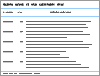
表 1
等渗蛋白溶液组成和营养水平表"
| 原料Ingredients | 含量/% Content | 营养水平1 Nutrient levels | 含量/% Content | |
| 葡萄糖Glucose | 61 | 粗蛋白Crude protein | 16.98 | |
| 乳清蛋白Whey protein | 21 | 粗脂肪Crude fat | 33.2 | |
| 柠檬酸Citric acid | 5.2 | 粗纤维Crude fiber | 2.43 | |
| 钠+ Na+ | 5.2 | 粗灰分Crude ash | 15.0 | |
| 钾+ K+ | 5.3 | 赖氨酸Lysine | 0.45 | |
| 谷氨酸钠Sodium glutamate | 1.8 | 精氨酸Arginine | 0.05 | |
| 苯甲酸钠Sodium benzoate | 0.5 | 异亮氨酸Isoleucine | 0.07 | |
| 总计Total | 100 |
表 2
母猪基础日粮组成和营养水平(干物质基础)"
| 原料Ingredient | 含量/% Content | 营养水平2 Nutrient levels | 含量/% Content | |
| 玉米Corn | 58 | 消化能/(MJ·kg-1)Digestion | 16.98 | |
| 油脂Grease | 2 | 粗蛋白Crude protein | 15.73 | |
| 豆粕Soybean meal | 21 | 粗脂肪Crude fat | 7.38 | |
| 鱼粉Fish meal | 2 | 钙Calcium | 0.88 | |
| 乳清粉Whey | 6 | 总磷Total phosphorus | 0.59 | |
| 膨化大豆Extruded soybean | 6 | 赖氨酸Lysine | 0.67 | |
| 预混料1 Premix1 | 5 | 精氨酸Arginine | 0.71 | |
| 总计Total | 100 | 异亮氨酸Isoleucine | 0.56 |
表 3
引物信息"
| 基因 Gene | 引物序列(5′→3′) Primer sequences(5′→3′) | 登录号 GenBank accession No. |
| SLC46A1 | F:CTGGGACTCTAGGCTGATCG R:AGTGATGACCAGCGACAGAA | NM_001243383 |
| SLC40A1 | F:TGTCCCTGAGATGAGCCCTAAACC R:AAGACCGATTCTAGCAGCAATGACG | XM_003483701 |
| SLC26A6 | F:GGTTGGTGCTCGTGCTGGTG R:TGCCGTAGGAGATGCCTGTGG | NM_001012298 |
| ICA | F:CCGAAGACTGTATCGCCAAG R:ACCCTTTCTCTGGTGTGTTTAC | NM_001244653 |
| β-actin | F:TCTGGCACCACACCTTCT R:TGATCTGGGTCATCTTCTCAC | XM_021086047.1 |
表 4
等渗蛋白溶液对哺乳仔猪生长性能的影响"
| 项目 Item | 组别Group | P 值 P-value | |
| 对照组Con group | 试验组Px group | ||
| 体重/kg Body weight | |||
| 1 d | 1.48±0.18 | 1.48±0.26 | 0.99 |
| 8 d | 2.90±0.40 | 2.93±0.46 | 0.92 |
| 16 d | 5.11±0.43 | 4.92±0.64 | 0.52 |
| 24 d | 6.81±0.38 | 7.22±0.16 | 0.03 |
| 平均日增重/g Average daily weight gain | |||
| 1~8 d | 178.77±46.91 | 177.14±36.61 | 0.94 |
| 8~16 d | 275.36±45.11 | 249.06±38.80 | 0.21 |
| 16~24 d | 214.80±32.84 | 270.81±50.76 | 0.02 |
| 1~24 d | 217.98±18.07 | 239.29±7.02 | 0.02 |
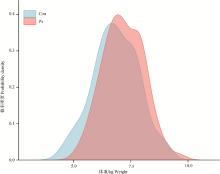
图 1
断奶仔猪体重的核密度分布 阴影区域表示密度曲线,横坐标为体重(kg),纵坐标为概率密度"
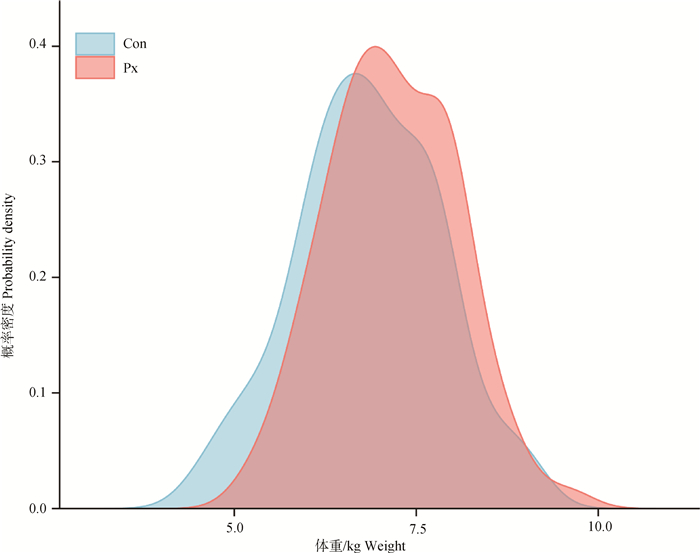
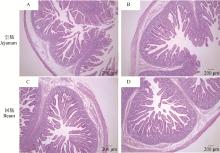
图 2
等渗蛋白溶液对哺乳仔猪肠道组织形态的影响(n=6) A、C.对照组;B、D.试验组"

表 5
等渗蛋白溶液对哺乳仔猪肠道组织形态的影响"
| 项目 Item | 组别Group | P值 P-value | |
| 对照组Con group | 试验组Px group | ||
| 空肠Jejunum | |||
| 绒毛高度/μm VH | 599.40±15.70 | 643.99±30.26 | 0.01 |
| 隐窝深度/μm CD | 125.13±29.18 | 138.34±25.35 | 0.41 |
| 绒毛/隐窝V/C | 4.98±0.97 | 4.81±1.03 | 0.77 |
| 回肠Ileum | |||
| 绒毛高度/μm VH | 464.13±49.51 | 474.89±47.17 | 0.72 |
| 隐窝深度/μm CD | 117.89±8.52 | 121.39±15.94 | 0.67 |
| 绒毛/隐窝V/C | 3.95±0.42 | 3.94±0.37 | 0.97 |
表 6
空肠转录组测序数据质量评估"
| 样品 Samples | 原始数据/条 Raw reads | 有效数据/条 Clean reads | 错误率/% Error rate | Q30/% | GC含量/% GC content |
| Con1 | 40 101 612 | 39 763 936 | 0.79 | 94.11 | 51.24 |
| Con2 | 46 167 906 | 45 747 032 | 0.84 | 92.83 | 51.38 |
| Con3 | 40 995 142 | 40 636 264 | 0.82 | 92.86 | 51.27 |
| Px1 | 38 780 452 | 38 461 904 | 0.77 | 93.81 | 51.26 |
| Px2 | 41 394 800 | 41 023 504 | 0.84 | 93.18 | 51.24 |
| Px3 | 40 100 422 | 39 735 260 | 0.84 | 93.16 | 51.26 |
图 3
差异表达基因火山图"
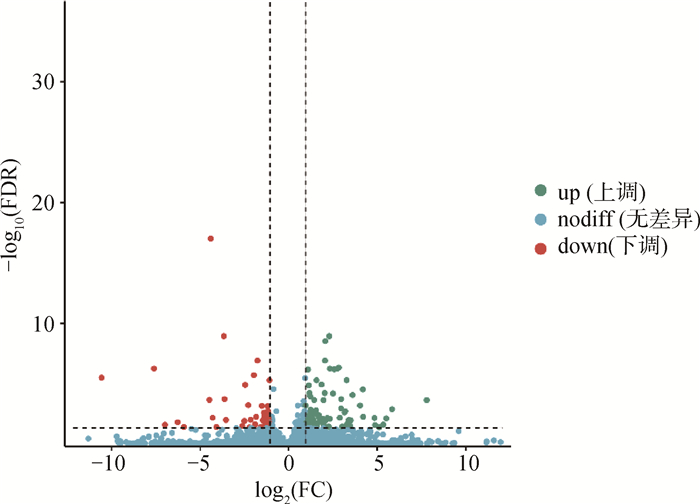
图 4
差异基因富集通路气泡图 A. GO cellular component前十的通路富集气泡图;B. KEGG pathway前十的通路富集气泡图"
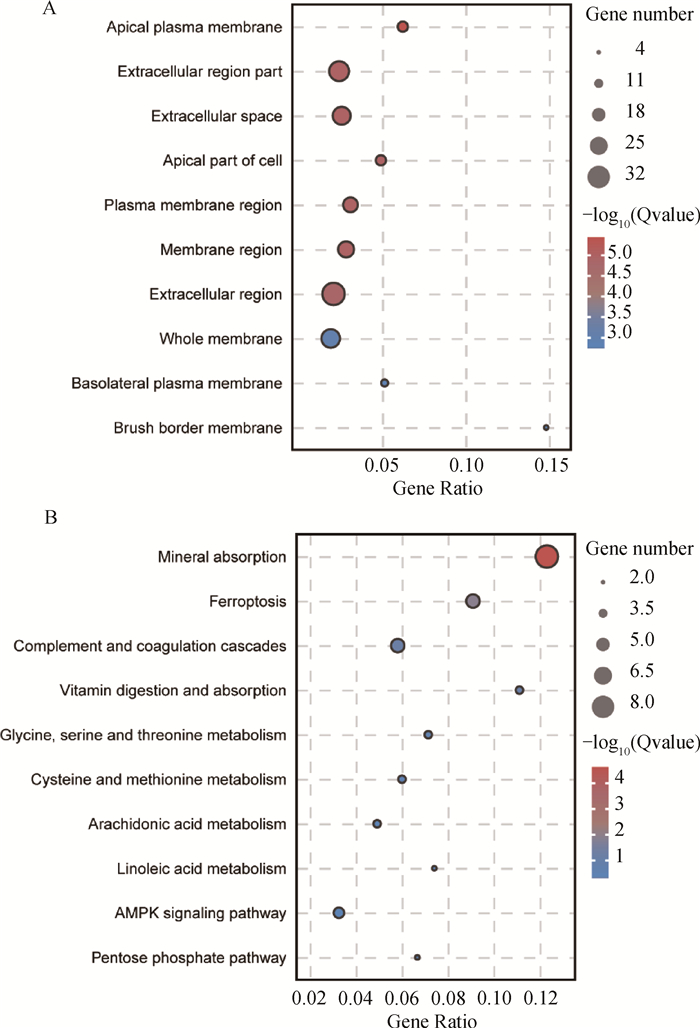
表 7
KEGG功能富集离子转运相关显著差异表达基因"
| 通路ID Pathway ID | 通路注释 Access note | 基因名称 Gene name | 基因数/个 Number of gene |
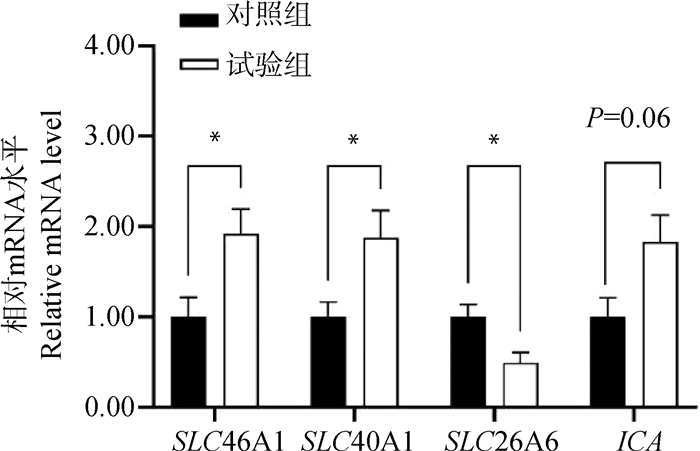
| 矿物质吸收 Mineral absorption | ko04978 | TRPM6/SLC46A1/SLC40A1/SLC26A6/S100G/ICA | 6 |
| 铁死亡 Ferroptosis | ko04216 | NCOA4/SLC40A1/ICA | 3 |
| 维生素消化与吸收 Vitamin digestion and absorption | ko04977 | SLC46A1/CBLIF/PLB1 | 3 |
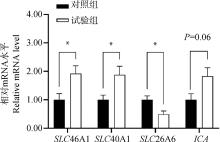
图 5
4个差异表达基因实时荧光定量PCR验证(n=6)"
| 1 | MODINA S C , AIDOS L , ROSSI R , et al. Stages of gut development as a useful tool to prevent gut alterations in piglets[J]. Animals (Basel), 2021, 11 (5): 1412. |
| 2 |
GRESSE R , CHAUNCHEYRAS-DURAND F , FLEURY M A , et al. Gut microbiota dysbiosis in postweaning piglets: understanding the keys to health[J]. Trends Microbiol, 2017, 25 (10): 851- 873.
doi: 10.1016/j.tim.2017.05.004 |
| 3 |
FERRARI C V , SBARDELLA P E , BERNARDI M L , et al. Effect of birth weight and colostrum intake on mortality and performance of piglets after cross-fostering in sows of different parities[J]. Prev Vet Med, 2014, 114 (3-4): 259- 266.
doi: 10.1016/j.prevetmed.2014.02.013 |
| 4 |
EVERAERT N , VAN CRUCHTEN S , WESTRÖM B , et al. A review on early gut maturation and colonization in pigs, including biological and dietary factors affecting gut homeostasis[J]. Anim Feed Sci Tech, 2017, 233, 89- 103.
doi: 10.1016/j.anifeedsci.2017.06.011 |
| 5 |
HAKIM R S , BALDWIN K , SMAGGHE G . Regulation of midgut growth, development, and metamorphosis[J]. Annu Rev Entomol, 2010, 55, 593- 608.
doi: 10.1146/annurev-ento-112408-085450 |
| 6 |
SARKAR V K , DE U K , KALA A , et al. Early-Life intervention of lactoferrin and probiotic in suckling piglets: effects on immunoglobulins, intestinal integrity, and neonatal mortality[J]. Probiotics Antimicrob Proteins, 2023, 15 (1): 149- 159.
doi: 10.1007/s12602-022-09964-y |
| 7 |
CHEN J , XU Y R , KANG J X , et al. Effects of alkaline mineral complex water supplementation on growth performance, inflammatory response, and intestinal barrier function in weaned piglets[J]. J Anim Sci, 2022, 100 (10): skac251.
doi: 10.1093/jas/skac251 |
| 8 |
NASSINI R , ANDRō E , GAZZIERI D , et al. A bicarbonate-alkaline mineral water protects from ethanol-induced hemorrhagic gastric lesions in mice[J]. Biol Pharm Bull, 2010, 33 (8): 1319- 1323.
doi: 10.1248/bpb.33.1319 |
| 9 | ARNAUD E A , GARDINER G E , LAWLOR P G . Selected nutrition and management strategies in suckling pigs to improve Post-Weaning outcomes[J]. Animals (Basel), 2023, 13 (12): 1998. |
| 10 |
TANG X , XIONG K , FANG R , et al. Weaning stress and intestinal health of piglets: A review[J]. Front Immunol, 2022, 13, 1042778.
doi: 10.3389/fimmu.2022.1042778 |
| 11 |
FACCIN J E G , TOKACH M D , ALLERSON M W , et al. Relationship between weaning age and antibiotic usage on pig growth performance and mortality[J]. J Anim Sci, 2020, 98 (12): skaa363.
doi: 10.1093/jas/skaa363 |
| 12 |
SAMPATH V , PARK J H , SHANMUGAM S , et al. Lactating sows fed whey protein supplement has eventually increased the blood profile of piglets[J]. J Anim Physiol Anim Nutr (Berl), 2023, 107 (1): 121- 128.
doi: 10.1111/jpn.13674 |
| 13 |
PFANNKUCHE H , GÄBEL G . Glucose, epithelium, and enteric nervous system: dialogue in the dark[J]. J Anim Physiol Anim Nutr (Berl), 2009, 93 (3): 277- 286.
doi: 10.1111/j.1439-0396.2008.00847.x |
| 14 |
SHAWK D J , TOKACH M D , GOODBAND R D , et al. Effects of sodium and chloride source and concentration on nursery pig growth performance[J]. J Anim Sci, 2019, 97 (2): 745- 755.
doi: 10.1093/jas/sky429 |
| 15 |
WANG M , YANG C , WANG Q , et al. The relationship between villous height and growth performance, small intestinal mucosal enzymes activities and nutrient transporters expression in weaned piglets[J]. J Anim Physiol Anim Nutr (Berl), 2020, 104 (2): 606- 615.
doi: 10.1111/jpn.13299 |
| 16 |
TANG X , XIONG K . Intrauterine growth retardation affects intestinal health of suckling piglets via altering intestinal antioxidant capacity, glucose uptake, tight junction, and immune responses[J]. Oxid Med Cell Longev, 2022, 2022, 2644205.
doi: 10.1155/2022/2644205 |
| 17 |
MA X , HAO Y , MAO R , et al. Effects of dietary supplementation of bovine lactoferrin on growth performance, immune function and intestinal health in weaning piglets[J]. Biometals, 2023, 36 (3): 587- 601.
doi: 10.1007/s10534-022-00461-x |
| 18 |
WANG Z , LI J , WANG Y , et al. Dietary vitamin a affects growth performance, intestinal development, and functions in weaned piglets by affecting intestinal stem cells[J]. J Anim Sci, 2020, 98 (2): skaa020.
doi: 10.1093/jas/skaa020 |
| 19 |
ZHOU J , QIN Y , XIONG X , et al. Effects of iron, vitamin A, and the interaction between the two nutrients on intestinal development and cell differentiation in piglets[J]. J Anim Sci, 2021, 99 (10): skab258.
doi: 10.1093/jas/skab258 |
| 20 |
SAMPATH V , SURESHKUMAR S , SEOK W J , et al. Role and functions of micro and macro-minerals in swine nutrition: a short review[J]. J Anim Sci Technol, 2023, 65 (3): 479- 489.
doi: 10.5187/jast.2023.e9 |
| 21 |
RINCKER M J , HILL G M , LINK J E , et al. Effects of dietary iron supplementation on growth performance, hematological status, and whole-body mineral concentrations of nursery pigs[J]. J Anim Sci, 2004, 82 (11): 3189- 3197.
doi: 10.2527/2004.82113189x |
| 22 |
WILLIAMS H E , DEROUCHEY J M , WOODWORTH J C , et al. Effects of increasing Fe dosage in newborn pigs on suckling and subsequent nursery performance and hematological and immunological criteria[J]. J Anim Sci, 2020, 98 (8): skaa221.
doi: 10.1093/jas/skaa221 |
| 23 |
DING H , YU X , FENG J . Iron homeostasis disorder in piglet intestine[J]. Metallomics, 2020, 12 (10): 1494- 1507.
doi: 10.1039/d0mt00149j |
| 24 |
ZENG Y , ZHOU B , HUANG L , et al. Iron-rich Candida utilis improves intestinal health in weanling piglets[J]. J Appl Microbiol, 2023, 134 (7): lxad135.
doi: 10.1093/jambio/lxad135 |
| 25 | 安清聪, 徐娜娜, 张春勇, 等. 不同水平乳铁蛋白对滇撒配套系仔猪生产性能、小肠形态学和机体抗病能力的影响[J]. 畜牧兽医学报, 2015, 46 (12): 2206- 2217. |
| AN Q C , XU N N , ZHANG C Y , et al. The effect of different levels of lactoferrin on the growth performance, small intestinal morphology and body resistance to disease of diansa weaning piglets[J]. Acta Veterinaria et Zootechnica Sinca, 2015, 46 (12): 2206- 2217. | |
| 26 |
ZHAO R , ALURI S , GOLDMAN I D . The proton-coupled folate transporter (PCFT-SLC46A1) and the syndrome of systemic and cerebral folate deficiency of infancy: Hereditary folate malabsorption[J]. Mol Aspects Med, 2017, 53, 57- 72.
doi: 10.1016/j.mam.2016.09.002 |
| 27 |
LI H , WANG D , WU H , et al. SLC46A1 contributes to hepatic iron metabolism by importing heme in hepatocytes[J]. Metabolism, 2020, 110, 154306.
doi: 10.1016/j.metabol.2020.154306 |
| 28 |
SHULPEKOVA Y , NECHAEV V , KARDASHEVA S , et al. The concept of folic acid in health and disease[J]. Molecules, 2021, 26 (12): 3731.
doi: 10.3390/molecules26123731 |
| 29 |
WANG S P , YIN Y L , QIAN Y , et al. Effects of folic acid on the performance of suckling piglets and sows during lactation[J]. J Sci Food Agric, 2011, 91 (13): 2371- 2377.
doi: 10.1002/jsfa.4469 |
| 30 |
ECKENROTH B E , MASON A B , MCDEVITT M E , et al. The structure and evolution of the murine inhibitor of carbonic anhydrase: A member of the transferrin superfamily[J]. Protein Science, 2010, 19 (9): 1616- 1626.
doi: 10.1002/pro.439 |
| 31 |
GOMME P T , MCCANN K B , BERTOLINI J . Transferrin: structure, function and potential therapeutic actions[J]. Drug Discovery Today, 2005, 10 (4): 267- 273.
doi: 10.1016/S1359-6446(04)03333-1 |
| 32 |
NEMETH E , GANZ T . Hepcidin-ferroportin interaction controls systemic iron homeostasis[J]. Int J Mol Sci, 2021, 22 (12): 6493.
doi: 10.3390/ijms22126493 |
| 33 | WANG J , WANG W , WANG H , et al. Physiological and pathological functions of SLC26A6[J]. Front Med (Lausanne), 2020, 7, 618256. |
| 34 |
GUO Y , ZHAO W , LI N , et al. Integration analysis of metabolome and transcriptome reveals the effect of exogenous supplementation with mixtures of vitamins ADE, zinc, and selenium on follicular growth and granulosa cells molecular metabolism in donkeys (Equus asinus)[J]. Front Vet Sci, 2022, 9, 993426.
doi: 10.3389/fvets.2022.993426 |
| 35 |
MCCOLE D F , BARRETT K E . Varied role of the gut epithelium in mucosal homeostasis[J]. Curr Opin Gastroenterol, 2007, 23 (6): 647- 654.
doi: 10.1097/MOG.0b013e3282f0153b |
| 36 |
LIPINSKI P , STARZYŃSKI R R , CANONNE-HERGAUX F , et al. Benefits and risks of iron supplementation in anemic neonatal pigs[J]. Am J Pathol, 2010, 177 (3): 1233- 1243.
doi: 10.2353/ajpath.2010.091020 |
| 37 |
PU Y , LI S , XIONG H , et al. Iron promotes intestinal development in neonatal piglets[J]. Nutrients, 2018, 10 (6): 726.
doi: 10.3390/nu10060726 |
| 38 |
FANG Q , YU L , TIAN F , et al. Effects of dietary irritants on intestinal homeostasis and the intervention strategies[J]. Food Chem, 2023, 409, 135280.
doi: 10.1016/j.foodchem.2022.135280 |
| 39 |
张文嫦, 王志华, 练家乐, 等. 仔鼠哺乳期补充参苓白术散改善抗生素诱导的肠道稳态失衡[J]. 畜牧兽医学报, 2023, 54 (2): 825- 836.
doi: 10.11843/j.issn.0366-6964.2023.02.038 |
|
ZHANG W C , WANG Z H , LIAN J L , et al. Supplement of shenling Baizhu powder to offspring rats during sucking improved intestinal dyshomeostasis induced by antibiotics[J]. Acta Veterinaria et Zootechnica Sinca, 2023, 54 (2): 825- 836.
doi: 10.11843/j.issn.0366-6964.2023.02.038 |
| [1] | 张皓阳, 刘薇, 孙文清, 徐玉凤, 刘芷芹, 杨子辉, 董朕, 曾建国. 博落回提取物对草鱼生长性能的影响及其效用成分的药代动力学和残留消除研究[J]. 畜牧兽医学报, 2025, 56(8): 4018-4030. |
| [2] | 孙淑佳, 郑嘉祺, 卢姝婉, 刘金松, 姚春雷, 杨彩梅, 许英蕾, 张瑞强. 乳酸菌对黄羽肉鸡生长性能、消化功能和养分利用率的影响[J]. 畜牧兽医学报, 2025, 56(7): 3335-3343. |
| [3] | 朱云, 王钰明, 孙晓晓, 陈辉, 赵峰, 解竞静, 陈一凡, 萨仁娜. 低蛋白多元化饲粮添加玉米蛋白粉对白羽肉鸡生长性能和消化特性的影响[J]. 畜牧兽医学报, 2025, 56(4): 1802-1812. |
| [4] | 吴秀菊, 夏培, 罗懿豪, 罗劲炜, 薛梦迪, 柯炎杭, 李娟, 吕景智. 饲粮中添加乳果糖对肉兔生长性能、血清指标和肉品质的影响[J]. 畜牧兽医学报, 2025, 56(4): 1813-1824. |
| [5] | 王馨怡, 姚军虎, 张霞, 张俊. 胆汁酸调控动物肠道健康的作用及机制研究进展[J]. 畜牧兽医学报, 2025, 56(3): 1006-1018. |
| [6] | 张雨, 王琪茹, 师鑫潮, 郭子明, 何欣, 张铁, 赵兴华. 厚朴酚固体分散体对犊牛生长性能、血清抗氧化能力和肠道微生物的影响[J]. 畜牧兽医学报, 2025, 56(2): 943-952. |
| [7] | 白国松, 滕春然, 王俊洪, 钟儒清, 马腾, 陈亮, 张宏福. 酶解玉米蛋白粉替代鱼粉和豆粕对断奶仔猪生长性能和肠道健康的影响[J]. 畜牧兽医学报, 2025, 56(2): 953-968. |
| [8] | 赵笑怡, 朱龙龙, 刘辉, 张董燕, 蔡龙, 王雅蕾, 王晶, 赵俊星, 陈美霞. L-苹果酸对猪卵巢颗粒细胞增殖及转录谱的影响[J]. 畜牧兽医学报, 2025, 56(11): 5563-5574. |
| [9] | 张纪桥, 蔡瑛婕, 李雨笑, 曹敞, 李涛, 鲍秀瑜, 张建勤. 不同饲养模式下略阳乌鸡生长性能、免疫、肠道结构及盲肠菌群的对比分析[J]. 畜牧兽医学报, 2024, 55(9): 4001-4011. |
| [10] | 陈雨, 修子清, MGENIMusa, 施屹, 张俊秋, 蒋小雨, 吕景智, 孙雅望. 蒲公英与木通提取物对断奶仔兔生长性能、肠道健康和药物转运体基因相对表达量的影响[J]. 畜牧兽医学报, 2024, 55(8): 3725-3739. |
| [11] | 刘维哲, 罗成刚, 袁蓉, 廖艺杰, 文艺悯, 孙莹, 俞恩波, 曹三杰, 黄小波. 一株猪流行性腹泻病毒强毒株的分离与鉴定[J]. 畜牧兽医学报, 2024, 55(7): 3049-3063. |
| [12] | 刘彬, 刘彦, 郑琛, 冯涛. 氨基葡萄糖对断奶仔猪生长性能、抗氧化能力及免疫功能的影响[J]. 畜牧兽医学报, 2024, 55(7): 3246-3254. |
| [13] | 罗志斌, 欧慧敏, 李建中, 谭支良, 焦金真. 添加过瘤胃氨基酸低蛋白质饲粮对呼伦贝尔羊生长性能、养分表观消化率及肉品质的影响[J]. 畜牧兽医学报, 2024, 55(6): 2498-2509. |
| [14] | 李亚霖, 甄士博, 曹林, 孙逢雪, 王利华. 植物乳杆菌及其后生元对育成期母貂生长性能、免疫功能及肠道健康的影响[J]. 畜牧兽医学报, 2024, 55(6): 2530-2539. |
| [15] | 王吉, 周馨妍, 郭芳瑞, 徐秋容, 武东怡, 毛妍, 袁志航, 易金娥, 文利新, 邬静. 紫花地丁对热应激下肉鸡生长性能、肉品质和肠道菌群的改善作用[J]. 畜牧兽医学报, 2024, 55(6): 2761-2774. |
| 阅读次数 | ||||||
|
全文 |
|
|||||
|
摘要 |
|
|||||
