


畜牧兽医学报 ›› 2025, Vol. 56 ›› Issue (11): 5600-5611.doi: 10.11843/j.issn.0366-6964.2025.11.020
胡文悦1( ), 梁慧情1, 赵鹏宇2,3, 冯思嘉1, 姚子豪1, 韩帅娟1,*(), 陈宝江1,*()
收稿日期:2025-03-03
出版日期:2025-11-23
发布日期:2025-11-27
通讯作者:
韩帅娟,陈宝江
E-mail:huwenyueya@163.com;hansjuan@163.com;chenbaojiang@vip.sina.com
作者简介:胡文悦(1999-),女,河北保定人,硕士生,主要从事动物营养与饲料科学研究,E-mail: huwenyueya@163.com
基金资助:
HU Wenyue1(), LIANG Huiqing1, ZHAO Pengyu2,3, FENG Sijia1, YAO Zihao1, HAN Shuaijuan1,*(), CHEN Baojiang1,*()
Received:2025-03-03
Online:2025-11-23
Published:2025-11-27
Contact:
HAN Shuaijuan, CHEN Baojiang
E-mail:huwenyueya@163.com;hansjuan@163.com;chenbaojiang@vip.sina.com
摘要:
旨在探究饲粮中添加槲皮万寿菊素(quercetagetin, QG)对过氧化氢(hydrogen peroxide, H2O2)攻毒肉鸡的屠宰性能、肉品质、血清抗氧化与免疫功能及肠道菌群的影响。试验采用单因素完全随机设计,选取240只1日龄科宝(Cobb)肉鸡,随机分为3组:对照组(饲喂基础饲粮+37日龄腹腔注射1.0 mL·kg-1 BW生理盐水),H2O2组(饲喂基础饲粮+37日龄腹腔注射1.0 mL·kg-1 BW的10% H2O2溶液),QG组(饲喂添加100 mg·kg-1 QG的基础饲粮+37日龄腹腔注射1.0 mL·kg-1 BW的10% H2O2溶液),每组8个重复,每个重复10只鸡。试验期总计42 d。结果表明:1)与对照组相比,H2O2组肉鸡的屠宰率、腿肌率显著降低(P < 0.05);饲粮添加QG使肉鸡的屠宰率、腿肌率与对照组相比均无显著差异(P>0.05)。2)与对照组相比,H2O2组腿肌的红度a*显著降低(P < 0.05),蒸煮损失显著提高(P < 0.05);饲粮添加QG使腿肌的a*和蒸煮损失与对照组相比均无显著差异(P>0.05)。3)与对照组相比,H2O2组肉鸡血清中SOD、GSH-Px、T-AOC、CAT活性和IgA、IgG、C3含量显著降低(P < 0.05),MDA水平和IgM和TNF-α含量显著提高(P < 0.05);但与H2O2组相比,饲粮中添加QG后可显著提高肉鸡血清中SOD、GSH-Px、T-AOC、CAT活性和IgA、C3含量(P < 0.05),并显著降低MDA水平(P < 0.05)。4)厚壁菌门(Firmicutes)、拟杆菌门(Bacteroidota)是肉鸡盲肠门水平的优势门。与对照组相比,H2O2组的厚壁菌门(Firmicutes)相对丰度显著降低(P < 0.05),QG组的拟杆菌属(Bacteroides)相对丰度显著升高(P < 0.05)。综上所述:饲粮添加100 mg·kg-1 QG可以通过提高抗氧化和免疫功能,优化盲肠菌群结构,缓解H2O2诱导的氧化应激对肉鸡屠宰性能和肉品质的不利影响,为QG在肉鸡健康养殖中的科学应用提供理论依据。
中图分类号:
胡文悦, 梁慧情, 赵鹏宇, 冯思嘉, 姚子豪, 韩帅娟, 陈宝江. 槲皮万寿菊素对过氧化氢攻毒肉鸡屠宰性能、肉品质、抗氧化、免疫功能及肠道菌群的影响[J]. 畜牧兽医学报, 2025, 56(11): 5600-5611.
HU Wenyue, LIANG Huiqing, ZHAO Pengyu, FENG Sijia, YAO Zihao, HAN Shuaijuan, CHEN Baojiang. Effects of Dietary Supplementation of Quercetagetin on the Slaughter Performance, Meat Quality, Antioxidant and Immunity Function, and Intestinal Microbiota of Broiler Chickens Challenged with Hydrogen Peroxide[J]. Acta Veterinaria et Zootechnica Sinica, 2025, 56(11): 5600-5611.
表 1
基础饲粮组成及营养水平(饲喂基础)"
| 项目 Item | 阶段Stage | |
| 0~3周0 to 3 weeks | 4~6周4 to 6 weeks | |
| 原料Ingredients | ||
| 玉米Corn | 53.87 | 62.03 |
| 豆粕Soybean meal | 39.90 | 31.70 |
| 大豆油Soybean oil | 2.20 | 2.80 |
| 磷酸氢钙Dicalcium phosphate | 1.74 | 1.39 |
| 石粉Limestone | 0.98 | 0.89 |
| 氯化钠Sodium chloride | 0.30 | 0.30 |
| L-赖氨酸盐酸盐L-Lysine HCl | 0.25 | 0.21 |
| DL-蛋氨酸DL-Methionine | 0.16 | 0.15 |
| L-苏氨酸L-Threonine | 0.10 | 0.03 |
| 预混料Premix1 | 0.50 | 0.50 |
| 总计Total | 100.00 | 100.00 |
| 营养水平Nutrient levels2 | ||
| 干物质Dry matter | 90.26 | 90.06 |
| 代谢能/(MJ·kg-1) Metabolizable energy | 12.45 | 12.97 |
| 粗蛋白质Crude protein | 21.75 | 19.23 |
| 钙Calcium | 0.89 | 0.76 |
| 总磷Total phosphorus | 0.75 | 0.66 |
| 非植酸磷 | 0.59 | 0.53 |
| 可消化氨基酸Digestible amino acid | ||
| 赖氨酸Lysine | 1.22 | 1.02 |
| 蛋氨酸Methionine | 0.46 | 0.42 |
| 苏氨酸Threonine | 0.83 | 0.66 |
| 色氨酸Tryptophan | 0.24 | 0.20 |
| 缬氨酸Valine | 0.95 | 0.82 |
表 2
饲粮添加槲皮万寿菊素对过氧化氢攻毒肉鸡屠宰性能及肌肉相对重量的影响"
| 项目 Item | 组别Group | 标准误 SEM | P值 P-value | ||
| 对照组 Control group | H2O2组 H2O2 group | QG组 QG group | |||
| 屠宰率Carcass yield | 91.76a | 90.28b | 91.43ab | 0.47 | 0.044 |
| 半净膛率Half-eviscerated yield | 84.20 | 82.73 | 84.30 | 0.65 | 0.092 |
| 全净膛率Eviscerated yield | 71.52 | 70.74 | 73.32 | 1.82 | 0.404 |
| 胸肌率Breast muscle yield | 29.78 | 25.44 | 29.28 | 2.11 | 0.160 |
| 腿肌率Thigh muscle yield | 17.61a | 16.60b | 17.40a | 0.21 | 0.006 |
表 3
饲粮添加槲皮万寿菊素对过氧化氢攻毒肉鸡器官指数的影响"
| 项目 Item | 组别Group | 标准误 SEM | P值 P-value | ||
| 对照组 Control group | H2O2组 H2O2 group | QG组 QG group | |||
| 脾脏指数Splenic index | 2.24 | 2.06 | 2.19 | 0.27 | 0.790 |
| 胸腺指数Thymus index | 1.89 | 2.07 | 1.93 | 0.19 | 0.633 |
| 法氏囊指数Bursa of fabricus index | 0.95 | 0.93 | 0.97 | 0.13 | 0.955 |
| 心脏指数Heart index | 4.09 | 4.62 | 4.67 | 0.29 | 0.111 |
| 肝脏指数Liver index | 19.17 | 18.74 | 20.38 | 1.31 | 0.446 |
表 4
饲粮添加槲皮万寿菊素对过氧化氢攻毒肉鸡腿肌肉品质的影响"
| 项目 Item | 组别Group | 标准误 SEM | P值 P-value | ||
| 对照组 Control group | H2O2组 H2O2 group | QG组 QG group | |||
| pH45min | 6.84 | 6.86 | 6.94 | 0.10 | 0.520 |
| pH24h | 6.68 | 6.59 | 6.69 | 0.09 | 0.464 |
| 亮度L* | 42.83 | 46.49 | 43.33 | 0.21 | 0.235 |
| 红度a* | 11.58a | 8.89b | 9.91ab | 0.69 | 0.004 |
| 黄度b* | 7.96 | 10.90 | 9.65 | 1.57 | 0.200 |
| 滴水损失/% Drip loss | 2.07 | 1.89 | 1.95 | 0.47 | 0.933 |
| 蒸煮损失/% Cooking loss | 24.69b | 29.97a | 26.96ab | 1.84 | 0.033 |
| 剪切力/N Shear force value | 12.49 | 15.33 | 12.85 | 1.53 | 0.165 |
表 5
饲粮添加槲皮万寿菊素对过氧化氢攻毒肉鸡血清抗氧化指标的影响"
| 项目 Item | 组别Group | 标准误 SEM | P值 P-value | ||
| 对照组 Control group | H2O2组 H2O2 group | QG组 QG group | |||
| 丙二醛/(nmol·mL-1)MDA | 2.74c | 4.82a | 3.45b | 0.18 | <0.001 |
| 超氧化物歧化酶/(U·mL-1)SOD | 521.71a | 206.86c | 464.56b | 21.40 | <0.001 |
| 谷胱甘肽过氧化物酶/(U·mL-1)GSH-Px | 510.61a | 303.23c | 369.14b | 16.07 | <0.001 |
| 过氧化氢酶/(U·mL-1)CAT | 78.30a | 36.19c | 66.11b | 2.83 | <0.001 |
| 总抗氧化能力/(U·mL-1)T-AOC | 22.69a | 11.65c | 20.63b | 0.81 | <0.001 |
表 6
饲粮添加槲皮万寿菊素对过氧化氢攻毒肉鸡血清免疫指标的影响"
| 项目 Item | 组别Group | 标准误 SEM | P值 P-value | ||
| 对照组 Control group | H2O2组 H2O2 group | QG组 QG group | |||
| 免疫球蛋白A/(μg·mL-1) IgA | 350.54a | 313.16b | 373.80a | 12.37 | <0.001 |
| 免疫球蛋白G/(μg·mL-1) IgG | 329.73a | 304.77b | 316.12ab | 8.52 | 0.030 |
| 免疫球蛋白M/(μg·mL-1) IgM | 110.87b | 135.27a | 123.65ab | 5.30 | 0.001 |
| 补体C3/(μg·mL-1) C3 | 129.68a | 116.89b | 136.16a | 4.85 | 0.003 |
| 补体C4/(μg·mL-1) C4 | 36.37 | 32.12 | 33.14 | 3.25 | 0.411 |
| 白细胞介素-1β/(pg·mL-1) IL-1β | 19.96 | 22.66 | 21.58 | 1.15 | 0.086 |
| 白细胞介素-6/(pg·mL-1) IL-6 | 3.69 | 3.79 | 3.73 | 1.16 | 0.806 |
| 肿瘤坏死因子-α/(pg·mL-1) TNF-α | 14.51b | 17.49a | 16.39ab | 0.79 | 0.005 |

图 1
肉鸡盲肠微生物菌群结构 A. 门水平分布;B. 属水平分布;C. 门水平菌群结构差异;D. 属水平菌群结构差异。Con为对照组,T1为H2O2组,T2为QG组,下同"
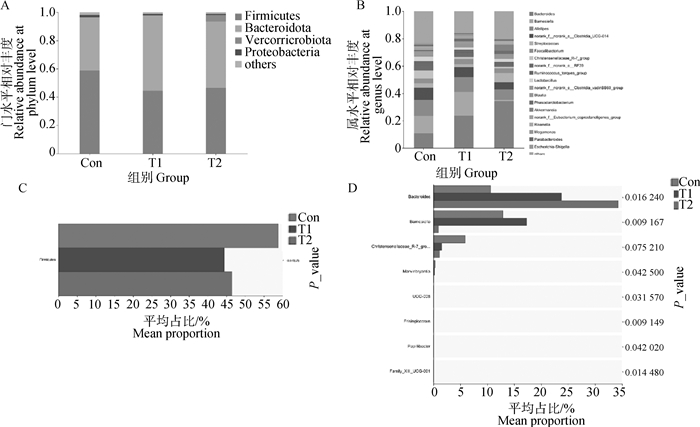

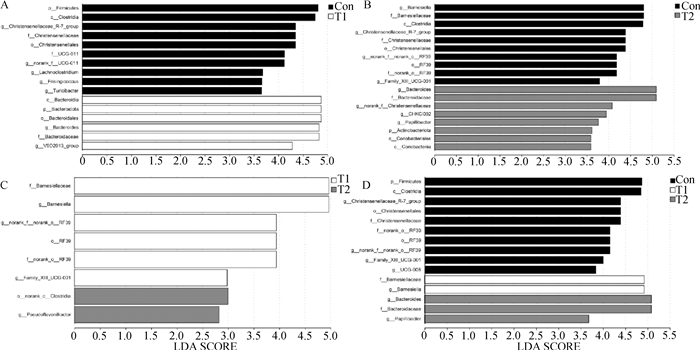
图 2
LEfSe分析肉鸡盲肠显著富集到的微生物菌群 A. 对照组和T1组;B. 对照组和T2组;C. T1和T2组;D. 对照组、T1和T2组"
| 1 |
OKE O E , AKOSILE O A , ONI A I , et al. Oxidative stress in poultry production[J]. Poult Sci, 2024, 103 (9): 104003.
doi: 10.1016/j.psj.2024.104003 |
| 2 | 王嘉怡. 饲粮添加不同硒源对热应激肉鸡生长性能、肉品质和肝脂代谢的影响[D]. 成都: 四川农业大学, 2024. |
| WANG J Y. Effects of different dietary sources ofselenium supplementation on growthperformance, meat quality and lipidmetabolism of heat stressed-broilers[D]. Chengdu: Sichuan Agricultural University, 2024. (in Chinese) | |
| 3 |
王吉, 周馨妍, 郭芳瑞, 等. 紫花地丁对热应激下肉鸡生长性能、肉品质和肠道菌群的改善作用[J]. 畜牧兽医学报, 2024, 55 (6): 2761- 2774.
doi: 10.11843/j.issn.0366-6964.2024.06.046 |
|
WANG J , ZHOU X Y , GUO F R , et al. Viola yedoensis makino improves the growth performance, meat quality, and gut microbiota of broilers exposed to heat stress[J]. Acta Veterinaria et Zootechnica Sinica, 2024, 55 (6): 2761- 2774.
doi: 10.11843/j.issn.0366-6964.2024.06.046 |
|
| 4 |
AKINYEMI F , ADEWOLE D . Effects of brown seaweed products on growth performance, plasma biochemistry, immune response, and antioxidant capacity of broiler chickens challenged with heat stress[J]. Poult Sci, 2022, 101 (12): 102215.
doi: 10.1016/j.psj.2022.102215 |
| 5 | HUANG X , GAO W , YUN X , et al. Effect of natural antioxidants from marigolds (Tagetes erecta L.) on the oxidative stability of soybean oil[J]. Molecules, 2022, 27 (8): 2865. |
| 6 | 张毅峰. 槲皮万寿菊素对肉鸡生长性能、抗氧化能力、免疫性能及血清生化指标影响[D]. 邯郸: 河北工程大学, 2020. |
| ZHANG Y F. Effects of quercetagetin on growth performance, antioxidant capacity, immune performance and serum biochemical indexes of broilers[D]. Handan: Hebei University of Engineering, 2020. (in Chinese) | |
| 7 | 温红瑞, 贾英健, 李晓双, 等. 槲皮万寿菊素抗氧化性的研究[J]. 饲料工业, 2022, 43 (5): 51- 54. |
| WEN H R , JIA Y J , LI X S , et al. Study on antioxidant activity of quercetagetin[J]. Feed Industry, 2022, 43 (5): 51- 54. | |
| 8 |
WANG W , XU H , CHEN H , et al. In vitro antioxidant, anti-diabetic and antilipemic potentials of quercetagetin extracted from marigold (Tagetes erecta L.) inflorescence residues[J]. J Food Sci Technol, 2016, 53, 2614- 2624.
doi: 10.1007/s13197-016-2228-6 |
| 9 | 郑旭, 饶志勇, 孟春颜, 等. 饲粮中添加槲皮万寿菊素对肉鸡生长性能、养分表观消化率和抗氧化能力的影响[J]. 动物营养学报, 2022, 34 (7): 4271- 4282. |
| ZHENG X , RAO Z Y , MENG C Y , et al. Effects of dietary quercetagetin on growth performance, nutrient apparent digestibility and antioxidant capacity of broilers[J]. Chinese Journal of Animal Nutrition, 2022, 34 (7): 4271- 4282. | |
| 10 |
LIANG H Q , FAN D F , HU W Y , et al. Effects of quercetagetin on the growth performance, nutrient digestibility, slaughter performance, meat quality, and antioxidant capacity of broiler chickens[J]. Anim Sci J, 2024, 95 (1): e70008.
doi: 10.1111/asj.70008 |
| 11 | 王浩男. 槲皮万寿菊素对肉鸡生长性能、免疫及抗氧化影响研究[D]. 保定: 河北农业大学, 2021. |
| WANG H N. Effect of quercetagetin on growth performance, immune and antioxidant related indexes in broilers[D]. Baoding: Hebei Agricultural University, 2021. (in Chinese) | |
| 12 | 张庆月, 黄李, 王玉梅, 等. 二烯丙基二硫醚对过氧化氢诱导的湖羊瘤胃上皮细胞氧化应激的缓解作用[J]. 动物营养学报, 2023, 35 (12): 8036- 8045. |
| ZHANG Q Y , HUANG L , WANG Y M , et al. Alleviation effect of diallyl disulfide on oxidative stress damage in Hu Sheep rumen epithelial cells induced by hydrogen peroxide[J]. Chinese Journal of Animal Nutrition, 2023, 35 (12): 8036- 8045. | |
| 13 | 陈作栋. 过氧化氢诱导的氧化应激对肉鸡肌肉损伤的作用机制研究[D]. 南京: 南京农业大学, 2022. |
| CHEN Z D. Mechanism of oxidative stress Induced by hydrogen peroxide on the injury of breast muscle in broilers[D]. Nanjing: Nanjing Agricultural University, 2022. (in Chinese) | |
| 14 |
YAN Y , CHEN X , HUANG J , et al. H2O2-induced oxidative stress impairs meat quality by inducing apoptosis and autophagy via ROS/NF-κB signaling pathway in broiler thigh muscle[J]. Poult Sci, 2022, 101 (4): 101759.
doi: 10.1016/j.psj.2022.101759 |
| 15 | 梁慧情, 谭凯, 李泽强, 等. 槲皮万寿菊素对氧化应激下肉鸡抗氧化能力和免疫功能的影响[J]. 饲料研究, 2024, 47 (10): 43- 47. |
| LIANG H Q , TAN K , LI Z Q , et al. Effects of quercetagetin on antioxidant capacity and immune function of broilers under oxidative stress[J]. Feed Research, 2024, 47 (10): 43- 47. | |
| 16 | Cobb-Vantress . Broiler Performance & Nutritition Supplement Cobb 500[M]. Springdale, AR, USA: Cobb-Vantress Inc., 2018. |
| 17 | 中华人民共和国农业农村部. NY/T 823—2020家禽生产性能名词术语和度量计算方法[S]. 北京: 中国农业出版社, 2020. |
| Ministry of Agriculture and Rural Affairs of the People's Republic of China. NY/T 823-2020 Poultry production performance terminology and measurement calculation method[S]. Beijing: China Agriculture Press, 2020. (in Chinese) | |
| 18 |
FUENTES J , DE CAMARGO A C , ATALA E , et al. Quercetin oxidation metabolite present in onion peel protects caco-2 cells against the oxidative stress, NF-kB activation, and loss of epithelial barrier function induced by NSAIDs[J]. J Agric Food Chem, 2021, 69 (7): 2157- 2167.
doi: 10.1021/acs.jafc.0c07085 |
| 19 | 王凯. 槲皮素对脂多糖应激下鹅生长性能、血液生化指标及肠道消化酶的影响[D]. 长春: 吉林农业大学, 2023. |
| WANG K. Effects of quercetin on production performance, blood biochemical indexes, and intestinal digestive enzymes in goose under lipopolysaccharide stress[D]. Changchun: Jilin Agricultural University, 2023. (in Chinese) | |
| 20 |
OUYANG K , XU M , JIANG Y , et al. Effects of alfalfa flavonoids on broiler performance, meat quality, and gene expression[J]. Canadian Journal of Animal Science, 2016, 96 (3): 332- 341.
doi: 10.1139/cjas-2015-0132 |
| 21 | 苏晓月, 吕转平, 王艳萍, 等. 桑叶黄酮对肉羊生长性能、肉品质、屠宰性能和血清抗氧化指标的影响[J]. 饲料研究, 2025, 48 (2): 22- 26. |
| SU X Y , LÜ Z P , WANG Y P , et al. Effect of mulberry leaf flavonoids on growth performance, meat quality, slaughter traits, and serum antioxidant indexes of mutton sheep[J]. Feed Research, 2025, 48 (2): 22- 26. | |
| 22 |
ZHU X , TAO L , LIU H , et al. Effects of fermented feed on growth performance, immune organ indices, serum biochemical parameters, cecal odorous compound production, and the microbiota community in broilers[J]. Poult Sci, 2023, 102 (6): 102629.
doi: 10.1016/j.psj.2023.102629 |
| 23 |
YANG J , MARIA T , ZHOU B , et al. Quercetin improves immune function in Arbor Acre broilers through activation of NF-κB signaling pathway[J]. Poult Sci, 2020, 99 (2): 906- 913.
doi: 10.1016/j.psj.2019.12.021 |
| 24 | 郑旭. 槲皮万寿菊素对肉鸡生长性能、肉品质及抗氧化能力的影响[D]. 郑州: 河南农业大学, 2022. |
| ZHENG X. Effects of quercetagetin on growth performance, meat quality and antioxidant capacity of broilers[D]. Zhengzhou: Henan Agricultural University, 2022. (in Chinese) | |
| 25 | 师嘉浩, 王鑫晶, 成日青, 等. 黄酮类化合物治疗心脑血管疾病机制及其新型递送系统研究进展[J]. 内蒙古医科大学学报, 2024, 46 (1): 84- 90. |
| SHI J H , WANG X J , CHENG R Q , et al. Research progress on the mechanism of flavonoids in the treatment of cardiovascular and cerebrovascular diseases and its new deliver system[J]. Journal of Inner Mongolia Medical University, 2024, 46 (1): 84- 90. | |
| 26 |
BAÉZA E , GUILLIER L , PETRACCI M . Production factors affecting poultry carcass and meat quality attributes[J]. Animal, 2022, 16, 100331.
doi: 10.1016/j.animal.2021.100331 |
| 27 |
PURSLOW P P , WARNER R D , CLARKE F M , et al. Variations in meat colour due to factors other than myoglobin chemistry; a synthesis of recent findings (invited review)[J]. Meat Sci, 2020, 159, 107941.
doi: 10.1016/j.meatsci.2019.107941 |
| 28 |
DENG C , ZOU H , WU Y , et al. Dietary supplementation with quercetin: an ideal approach for improving meat quality and oxidative stability of broiler chickens[J]. Poult Sci, 2024, 103 (8): 103789.
doi: 10.1016/j.psj.2024.103789 |
| 29 | WANG Y , ZHOU X , LIU M , et al. Quality of chicken breast meat improved by dietary pterostilbene referring to up-regulated antioxidant capacity and enhanced protein structure[J]. Food Chemistry, 2023, 405 (PtA): 134848. |
| 30 |
LIU C , XU C C , QU Y H , et al. Effect of alfalfa (Medicago sativa L.) saponins on meat color and myoglobin reduction status in the longissimus thoracis muscle of growing lambs[J]. Anim Sci J, 2021, 92 (1): e13556.
doi: 10.1111/asj.13556 |
| 31 |
WANG T , FENG X , LI L , et al. Effects of quercetin on tenderness, apoptotic and autophagy signalling in chickens during post-mortem ageing[J]. Food Chem, 2022, 383, 132409.
doi: 10.1016/j.foodchem.2022.132409 |
| 32 |
BULUT O , YILMAZ M D . Concise synthesis of quercetagetin (3, 3', 4', 5, 6, 7-hexahydroxyflavone) with antioxidant and antibacterial activities[J]. Results in Chemistry, 2021, 3, 100255.
doi: 10.1016/j.rechem.2021.100255 |
| 33 |
XU L W , WANG G Y , SHI Y P . Chemical constituents from Tagetes erecta flowers[J]. Chem Nat Compd, 2011, 47, 281- 283.
doi: 10.1007/s10600-011-9905-5 |
| 34 |
WU F , WANG F , TANG Z , et al. Quercetagetin alleviates zearalenone-induced liver injury in rabbits through Keap1/Nrf2/ARE signaling pathway[J]. Front Pharmacol, 2023, 14, 1271384.
doi: 10.3389/fphar.2023.1271384 |
| 35 | 付连港, 刘伊笑, 赵剑, 等. 槲皮万寿菊素对断奶仔猪生长性能、抗氧化能力、免疫功能和盲肠菌群的影响[J]. 动物营养学报, 2024, 36 (1): 199- 209. |
| FU L G , LIU Y X , ZHAO J , et al. Effects of quercetagetin on growth performance, antioxidant capacity, immune function and cecal microflora of weaned piglets[J]. Chinese Journal of Animal Nutrition, 2024, 36 (1): 199- 209. | |
| 36 |
YANG S , HUO M , SU Z , et al. The impact of dietary supplementation of quercetagetin on growth, antioxidant capacity, and gut microbiota of diquat-challenged broilers[J]. Front Microbiol, 2024, 15, 1453145.
doi: 10.3389/fmicb.2024.1453145 |
| 37 |
WU F , WANG H , LI S , et al. Effects of dietary supplementation with quercetagetin on nutrient digestibility, intestinal morphology, immunity, and antioxidant capacity of broilers[J]. Front Vet Sci, 2022, 9, 1060140.
doi: 10.3389/fvets.2022.1060140 |
| 38 |
ZHA P , WEI L , LIU W , et al. Effects of dietary supplementation with chlorogenic acid on growth performance, antioxidant capacity, and hepatic inflammation in broiler chickens subjected to diquat-induced oxidative stress[J]. Poult Sci, 2023, 102 (3): 102479.
doi: 10.1016/j.psj.2023.102479 |
| 39 |
CHEN Y , CHEN Y , ZHANG H , et al. Pterostilbene as a protective antioxidant attenuates diquat-induced liver injury and oxidative stress in 21-day-old broiler chickens[J]. Poult Sci, 2020, 99 (6): 3158- 3167.
doi: 10.1016/j.psj.2020.01.021 |
| 40 | 陶晓钊, 薄欣宇, 段树楠, 等. 哺乳动物免疫球蛋白基因及其表达机制研究进展[J]. 中国畜禽种业, 2023, 19 (8): 61- 66. |
| TAO X Z , BO X Y , DUAN S N , et al. Research progress on the immunoglobulin genes of mammals and their expression mechanisms[J]. The Chinese Livestock and Poultry Breeding, 2023, 19 (8): 61- 66. | |
| 41 |
CHEN J , WANG H , WU Z , et al. Effects of 5-aminolevulinic acid on the inflammatory responses and antioxidative capacity in broiler chickens challenged with lipopolysaccharide[J]. Animal, 2022, 16 (7): 100575.
doi: 10.1016/j.animal.2022.100575 |
| 42 | YANG S , SU Z , HUO M , et al. Effect of Supplementation of quercetagetin on the antioxidant function, liver mitochondrial function and gut microbiota of broilers at high stocking density[J]. Animals (Basel), 2025, 15 (3): 398. |
| 43 | 王建东, 于有利, 丁辉, 等. 大豆异黄酮对安格斯肉牛免疫性能、生殖激素水平和血清代谢物的影响[J]. 动物营养学报, 2025, 37 (1): 400- 411. |
| WANG J D , YU Y L , DING H , et al. Effects of soybean isoflavone on immune performance, reproductive hormone levels and serum metabolites of Angus beef cattle[J]. Chinese Journal of Animal Nutrition, 2025, 37 (1): 400- 411. | |
| 44 |
PANDIT R J , HINSU A T , PATEL N V , et al. Microbial diversity and community composition of caecal microbiota in commercial and indigenous Indian chickens determined using 16s rDNA amplicon sequencing[J]. Microbiome, 2018, 6 (1): 115.
doi: 10.1186/s40168-018-0501-9 |
| 45 | 李露宇, 冯志鹏, 靳亚星, 等. 沙棘果渣提取物对饲喂氧化大豆油黄羽肉鸡屠宰性能、肉品质、抗氧化能力和肠道健康的影响[J]. 动物营养学报, 2024, 36 (9): 5656- 5668. |
| LI L Y , FENG Z P , JIN Y X , et al. Effects of sea buckthorn pomace extract on slaughter performance, meat quality, antioxidant capability and intestinal health of yellow feathered broilers fed oxidized soybean oil[J]. Chinese Journal of Animal Nutrition, 2024, 36 (9): 5656- 5668. | |
| 46 |
WANG S , YAO J , ZHOU B , et al. Bacteriostatic effect of quercetin as an antibiotic alternative in vivo and its antibacterial mechanism in vitro[J]. J Food Prot, 2018, 81 (1): 68- 78.
doi: 10.4315/0362-028X.JFP-17-214 |
| 47 |
LIAO X , SHAO Y , SUN G , et al. The relationship among gut microbiota, short-chain fatty acids, and intestinal morphology of growing and healthy broilers[J]. Poult Sci, 2020, 99 (11): 5883- 5895.
doi: 10.1016/j.psj.2020.08.033 |
| 48 |
YANG F , CHEN H , GAO Y , et al. Gut microbiota-derived short-chain fatty acids and hypertension: mechanism and treatment[J]. Biomed Pharmacother, 2020, 130, 110503.
doi: 10.1016/j.biopha.2020.110503 |
| 49 |
FAN Y , JU T , BHARDWAJ T , et al. Week-old chicks with high Bacteroides abundance have increased short-chain fatty acids and reduced markers of gut inflammation[J]. Microbiol Spectr, 2023, 11 (2): e0361622.
doi: 10.1128/spectrum.03616-22 |
| [1] | 谭大雁, 王清湘, 毛湘冰, 范祥奇, 杨恒, 黄冰, 张斐然, 王建萍. 茶褐素和茶多酚摄入对采食氧化鱼油大鼠肝组织抗氧化能力的影响[J]. 畜牧兽医学报, 2025, 56(9): 4519-4528. |
| [2] | 王楠, 王城名, 王婧, 林星彤, 何凌云. 磷脂酰乙醇胺对出生后生长迟缓仔猪结肠黏膜屏障功能和肠道菌群的影响[J]. 畜牧兽医学报, 2025, 56(7): 3305-3315. |
| [3] | 孙淑佳, 郑嘉祺, 卢姝婉, 刘金松, 姚春雷, 杨彩梅, 许英蕾, 张瑞强. 乳酸菌对黄羽肉鸡生长性能、消化功能和养分利用率的影响[J]. 畜牧兽医学报, 2025, 56(7): 3335-3343. |
| [4] | 彭文文, 张美婷, 徐灏铖, 徐保阳, 张玲玲, 杨彩梅. 地衣芽孢杆菌对大肠杆菌攻毒感染肉鸡免疫、抗氧化性能和肠道健康的影响[J]. 畜牧兽医学报, 2025, 56(7): 3344-3356. |
| [5] | 陈艳茹, 马小春, 王明慧, 唐瑶瑶, 白露, 赵桂苹, 文杰, 刘冉冉. 白羽肉鸡胸肌意大利面肉和木质肉发生率及其对肉品质影响研究[J]. 畜牧兽医学报, 2025, 56(6): 2672-2684. |
| [6] | 张岩岩, 葛红帆, 周振雷. 红景天苷对甲泼尼龙诱导的肉鸡股骨头坏死的影响[J]. 畜牧兽医学报, 2025, 56(5): 2496-2506. |
| [7] | 朱云, 王钰明, 孙晓晓, 陈辉, 赵峰, 解竞静, 陈一凡, 萨仁娜. 低蛋白多元化饲粮添加玉米蛋白粉对白羽肉鸡生长性能和消化特性的影响[J]. 畜牧兽医学报, 2025, 56(4): 1802-1812. |
| [8] | 赵少猛, 董瑞玲, 刘大伟, 营凡, 李森, 赵桂苹, 张敏红, 文杰, 冯京海. 广明2号肉鸡蛋白质需要量预测模型的研究及验证[J]. 畜牧兽医学报, 2025, 56(3): 1313-1323. |
| [9] | 苏蒙, 刘莎, 宋丹丽, 高倩梅, 郑麦青, 文杰, 赵桂苹, 李庆贺. 基于转录组测序筛选肉鸡腹水综合征相关候选基因[J]. 畜牧兽医学报, 2025, 56(2): 559-570. |
| [10] | 杭振宇, 汪子怡, 张林, 邢通, 赵良, 高峰. 不同来源玉米28日龄白羽肉鸡标准回肠氨基酸消化率评定和预测方程的建立[J]. 畜牧兽医学报, 2025, 56(2): 722-736. |
| [11] | 张雨, 王琪茹, 师鑫潮, 郭子明, 何欣, 张铁, 赵兴华. 厚朴酚固体分散体对犊牛生长性能、血清抗氧化能力和肠道微生物的影响[J]. 畜牧兽医学报, 2025, 56(2): 943-952. |
| [12] | 成浩彤, 张林, 赵良, 高峰, 邢通. 肉鸡胴体外观和肉质性状候选基因研究进展[J]. 畜牧兽医学报, 2025, 56(11): 5352-5366. |
| [13] | 李薇羽, 呙于明, 付蹇洋, 刘爱巧, 李文斌, 李冬立, 董晓丽, 吕增鹏, 李建慧. 低蛋白日粮条件下1~14日龄沃德188肉鸡精氨酸需要量研究[J]. 畜牧兽医学报, 2025, 56(11): 5612-5622. |
| [14] | 康欣, 徐向杨, 韩爱格, 宋飞, 芮慧媛, 姜晓文, 葛铭, 于文会. 在慢性热应激环境下外源性褪黑素干预对肉鸡皮质酮合成的影响[J]. 畜牧兽医学报, 2025, 56(11): 5912-5924. |
| [15] | 杨佳, 赵丽媛, 马可涵, DieudonnéM. Dansou, 韩昊洋, 汤超华, 秦玉昌, 张凯, 余雅男, 张军民. 牛磺酸的生理功能及在家禽生产中应用[J]. 畜牧兽医学报, 2025, 56(10): 4821-4838. |
| 阅读次数 | ||||||
|
全文 |
|
|||||
|
摘要 |
|
|||||
