


Acta Veterinaria et Zootechnica Sinica ›› 2025, Vol. 56 ›› Issue (11): 5743-5757.doi: 10.11843/j.issn.0366-6964.2025.11.032
• Preventive Veterinary Medicine • Previous Articles Next Articles
ZHANG Yujie( ), LIU Hongxiang, SONG Shanshan, BO Zhiyong, RUAN Guohong, ZHAO Chenglong, CHU Dianfeng, YANG Xue, DU Yuanzhao, LIU Dong*()
Received:2025-02-06
Online:2025-11-23
Published:2025-11-27
Contact:
LIU Dong
E-mail:ddzhang2008-2009@163.com;liudong@yebio.com
CLC Number:
ZHANG Yujie, LIU Hongxiang, SONG Shanshan, BO Zhiyong, RUAN Guohong, ZHAO Chenglong, CHU Dianfeng, YANG Xue, DU Yuanzhao, LIU Dong. Isolation and Identification of Novel Enteropathogenic Recombinant Avian Coronavirus[J]. Acta Veterinaria et Zootechnica Sinica, 2025, 56(11): 5743-5757.
Table 1
Sequence primers of different viruses"
| 病毒 Virus | 引物(5′→3′) Primers | 大小/bp Size |
| 呼肠孤病毒 | F:GCTGCTAACATCCAAGAG | 620 |
| ARV | R:ATAAGATCGCGTACGTCG | |
| 鸡星状病毒 | F:AAAGCGAGGGTGTGGGCG | 1 260 |
| CAstV | R:GGTAAATTRAACCACCACCC | |
| 鸡细小病毒 | F:TGACTGCAGGGAGTTATG | 450 |
| ChPV | R:TACAAAAGGCTGTGTG | |
| 鸡传染性支气管炎病毒IBV | ||
| IBV-N | F:AACTAGGAGGGCCTAAACCA | 484 |
| R:GCTCTACTAGATGCTGCTGA | ||
| IBV-S1 | F:CAAGTTATTGATTAGAGATG | 1 630 |
| R:CCAATAGAACGTCTGAGMCG | ||
| 禽脑脊髓炎病毒 | F:ATGAGCAAACTATTTTCTACTGTA | 720 |
| AEV | R:CTGTGCGACCAAAGGGCTAAGTCC | |
| 禽腺病毒 | F:TCCAACAGTTCATTTCCGCC | 527 |
| FAdV | R:AGACTTGGCGAAGCGACCGA | |
| 禽肾炎病毒 | F:CTTGAACACTCTACTCTC | 624 |
| ANV | R:GGGAGATAAGAGTCCTTATG | |
| 新型禽冠状病毒 | F:GTATAATGTGCAGCCATGCG | 110 |
| nACoV | R:TGAAGCTAGACTACACGACA | |
| Probe:FAM-CAGTTTCTACGCAGGCTGTAGTTGTTA-BHQ |
Table 2
Sequence primers of avian coronavirus genome"
| 引物名称 Primer name | 引物序列(5′→3′) Primer sequence | 扩增片段位置 Segment position | 扩增片段长度/bp Segment length |
| P1-F/R | GATTAATATAAAGCTATTGC/AAAGCGATCACCACTCTTAA | 1/1 560 | 1 560 |
| P2-F/R | CATGCGAAATGACTTAACTC/GTTACTGGCTGGGTCTTGCA | 1 443/3 000 | 1 558 |
| P3-F/R | TGAGGAGTGTGATATAGATC/AATTTAGCCCATGCCTCTGC | 2 886/4 418 | 1 533 |
| P4-F/R | TGGCGTGACGGAAACTGCTG/ATACACTCTTGTAGCTAGGC | 4 321/5 758 | 1 438 |
| P5-F/R | ACTAGGGATTACTTTGAAGG/AAGACAACTATCAGACAGTT | 5 641/7 194 | 1 554 |
| P6-F/R | TTGATAAATTAACACCTCGT/AAGCTATCCACATAGGTACT | 7 061/8 485 | 1 425 |
| P7-F/R | CTTGTGACGAGTCGTAACAC/AGCTAGCACACATCTACTCC | 8 401/9 828 | 1 428 |
| P8-F/R | GATGAAATGACACCGGAATC/TATCAGTAACACGCGCTTCT | 9 721/11 152 | 1 432 |
| P9-F/R | GCCAATATTGCAAAGTCGGT/ACCGAGCACAGTTACGCTTC | 11 041/12 483 | 1 443 |
| P10-F/R | GCTAATGGTTGTGAACCTGA/GAAACTGTCTATTAGTCATA | 12 384/14 040 | 1 657 |
| P11-F/R | AGAAAAATGTTCTACCCACT/AGGGTTCAACAGTAGACCAG | 13 921/15 480 | 1 560 |
| P12-F/R | CAATACCGTTAGTATCTAAT/GCTTCAGCATCAAGCTCTGT | 15 361/16 912 | 1 552 |
| P13-F/R | TTAACAGATTTAATGTTGCG/ACAGCACCACCAATGTTGCA | 16 801/18 352 | 1 552 |
| P14-F/R | CTATGACTCATCGCCTTGCG/ACAAGGAGTGTTCCCTCAGG | 18 245/19 780 | 1 536 |
| P15-F/R | AACTACAATGTGTGTGCCGC/ACATATAACTCACTACCTAG | 19 661/21 332 | 1 672 |
| P16-F/R | CTTATAATTACACTTGTGTA/GACACACTCTTCAACCTTCT | 21 221/23 160 | 1 940 |
| P17-F/R | GACAGACTAATTACTGGTAG/ACAACTCTGGATCCAATACC | 23 041/24 840 | 1 800 |
| P18-F/R | AACATTGCAGTAGGTGTAAT/CCACGAGAACCATCCCTTGA | 24 721/26 520 | 1 800 |
| P19-F/R | CTGACAGTAATTTCCGTTGG/TTGTTTTCACTCTATACTAG | 26 406/27 696 | 1 291 |
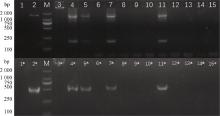
Fig. 1
Detection of suspected viral nucleic acid by RT-PCR M. DL 2000 DNA marker; 1, 1*.Negative; 2, 2*.Positive; 3-15, 3*-15*.Samples were inoculated with F10 intestinal tissues of chicken embryos; 1-15.Products generated from the S1 gene; 1*-15*.Products generated from the N gene"
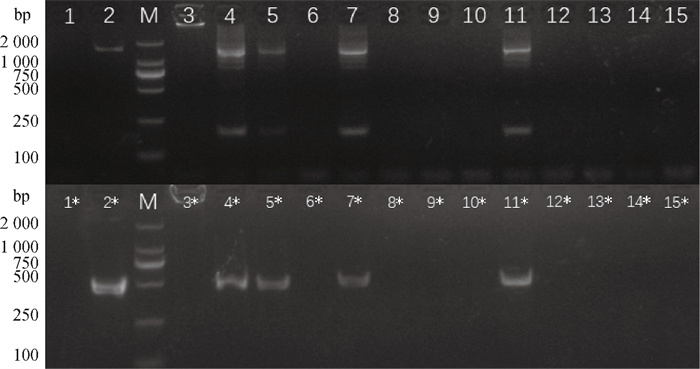
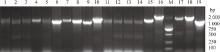
Fig. 2
Amplification of the genomic sequences of avian coronavirus AvCoV/CH/SD/24 strain M.DL2000 DNA marker; 1-19.Products generated from the F3 generation SPF chicken embryo intestinal grinding fluid by primer pairs in table 2 respectively"
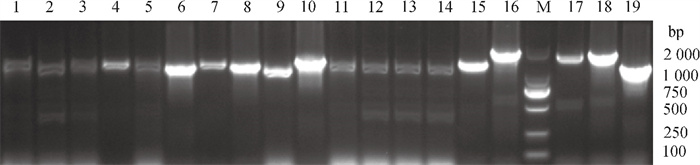
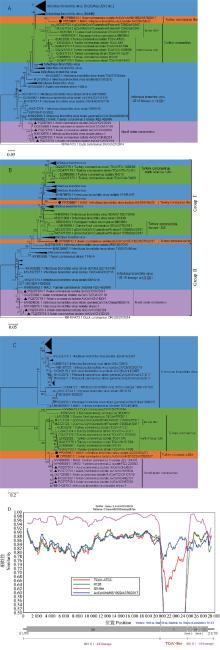
Fig. 3
Phylogenetic and recombination events analysis of avian coronavirus A.Phylogenetic relationship analysis based on the nucleotide sequences of the complete genome; B.Phylogenetic relationship analysis based on the nucleotide sequences of other genes; C.Phylogenetic relationship analysis based on the nucleotide sequences of S gene; D.Recombination events analysis of the novel avian coronavirus. ●.Reference strain of turkey coronavirus like; ▲.The novel avian coronavirus"
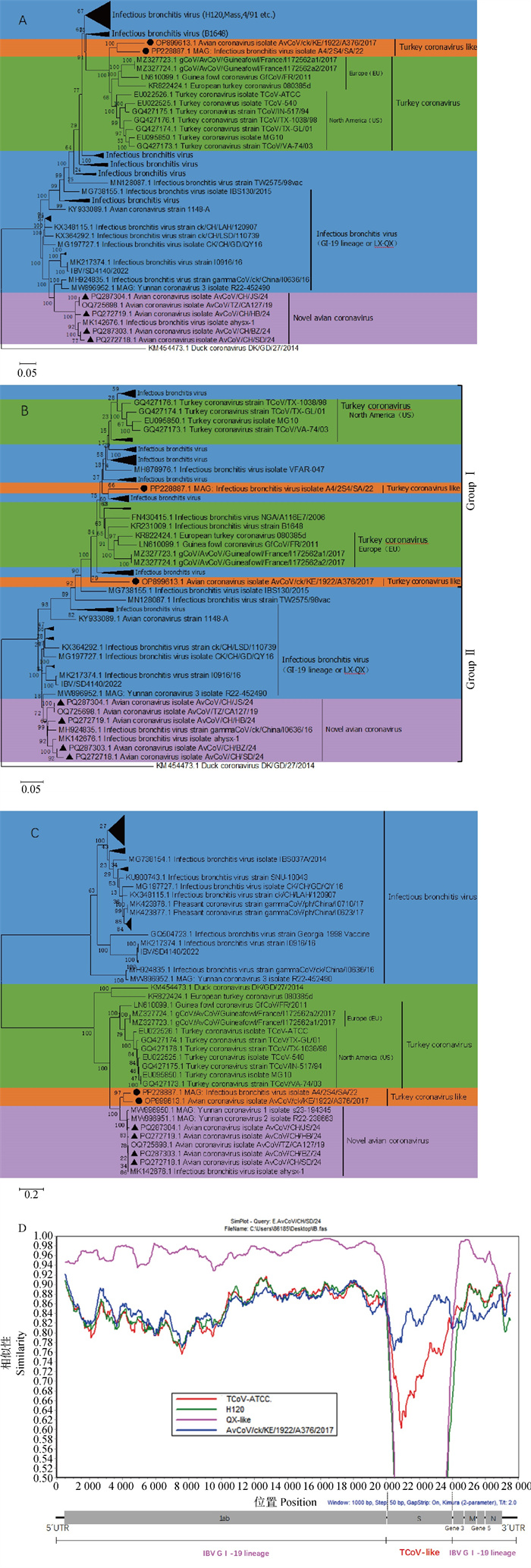

Fig. 4
Feces of SPF chickens on the 3rd day after challenge A.Feces are formed, brown, cylindrical and coated with a small amount of white urate; B.Feces are unformed grayish-green, loose with high moisture content and covered with mucoid material"
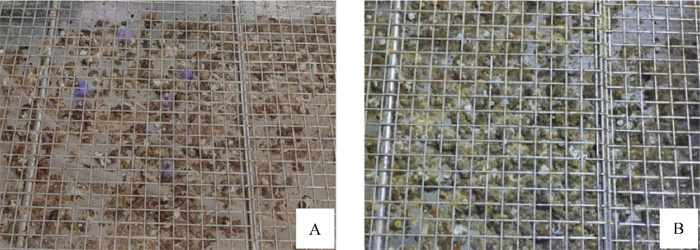
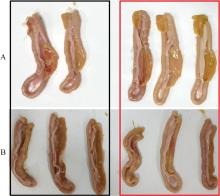
Fig. 5
Duodenal autopsy changes of SPF chickens at different time after challenge A.3dpi; B.5dpi; The black frame is control group; The red frame is challenge group 1"
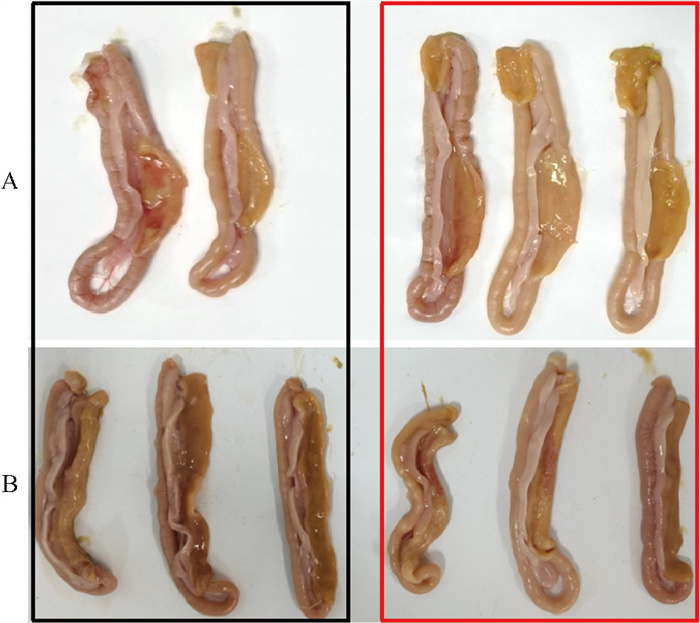
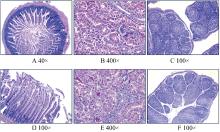
Fig. 6
Histopathological changes on the 5th day after challenge A, B, C.Control group; D, E, F.Challenge group 1"
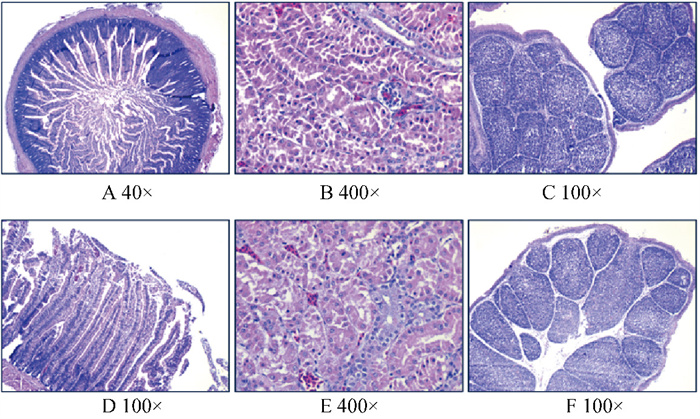
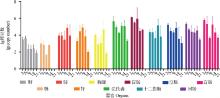
Fig. 7
Viral loads in different organs after challenge"
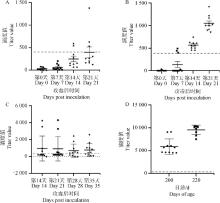
Fig. 8
Antibody titers at different time after challenge A.Specific Pathogen Free Chickens challenge group 1; B.Specific Pathogen Free Chickens challenge group 2; C.AA+ broiler challenge group; D.Hy-Line laying hens challenge group. The red dotted line is the threshold line of serum antibody titer, above the line means positive and below the line means negative"
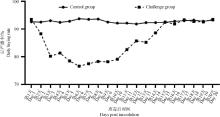
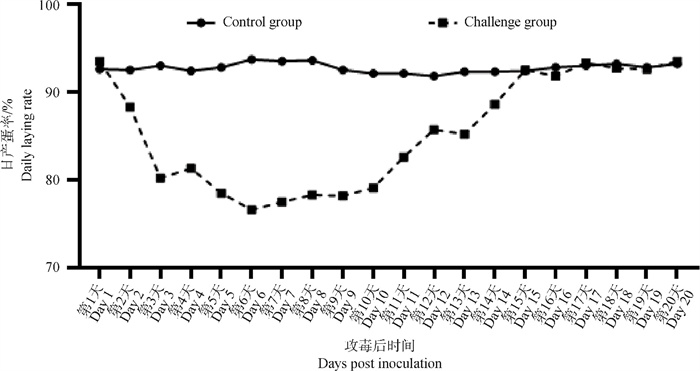
Fig. 9
The Laying performance of Hy-Line laying hens after challenge"
| 1 |
ZHONGN S,ZHENGB J,LIY M,et al.Epidemiology and cause of severe acute respiratory syndrome (SARS) in Guangdong, People's Republic of China, in February, 2003[J].Lancet,2003,362(9393):1353-1358.
doi: 10.1016/S0140-6736(03)14630-2 |
| 2 |
ZAKIA M,VAN BOHEEMENS,BESTEBROERT M,et al.Isolation of a noval coronavirus from a man with pneumonia in Saudi Arabia[J].N Engl J Med,2012,367(19):1814-1820.
doi: 10.1056/NEJMoa1211721 |
| 3 |
ELIZABETHA K,AMALK M,AZADR B.Impact of COVID-19 on mental health in Adolescents: A systematic review[J].Int J Environ Res Public Health,2021,18(5):2470.
doi: 10.3390/ijerph18052470 |
| 4 |
ZHANGQ,YUY.Epidemiological features of the 2019 noval coronavirus outbreak in China[J].Curr Top Med Chem,2020,20(13):1137-1140.
doi: 10.2174/1568026620999200511094117 |
| 5 |
BANDEF,ARSHADS S,OMARA R,et al.Global distributions and strain diversity of avian infectious bronchitis virus: a review[J].Anim Health Res Rev,2017,18(1):70-83.
doi: 10.1017/S1466252317000044 |
| 6 |
RAJG D,JONESR C.Infectious bronchitis virus: Immunopathogenesis of infection in the chicken[J].Avian Pathol,1997,26(4):677-706.
doi: 10.1080/03079459708419246 |
| 7 | 董志华,范文胜,赵长润,等.2009-2017年广西地区鸡传染性支气管炎流行病学调查[J].中国兽医学报,2019,39(9):1691-1696. |
| DONGZ H,FANW S,ZHAOC R,et al.Epidemiological investigation of infectious bronchitis virus in Guangxi during 2009-2017[J].Chinese Journal of Veterinary Science,2019,39(9):1691-1696. | |
| 8 |
LINS Y,CHENH W.Infectious bronchitis virus Variants: Molecular analysis and pathogenicity investigation[J].Int J Mol Sci,2017,18(10):2030.
doi: 10.3390/ijms18102030 |
| 9 |
YUANS,CHENGQ,GUOJ Y,et al.Detection and genetic characterization of novel infectious bronchitis viruses from recent outbreaks in broiler and layer chicken flocks in southern China, 2021[J].Poult Sci,2022,101(10):102082.
doi: 10.1016/j.psj.2022.102082 |
| 10 |
ZHANGX Z,DENGT W,LUJ Z,et al.Molecular characterization of variant infectious bronchitis virus in China, 2019:Implications for control programmes[J].Transbound Emerg Dis,2020,67(3):1349-1355.
doi: 10.1111/tbed.13477 |
| 11 | 斯韦恩D E. 禽病学[M]. 刘胜旺, 李慧昕, 陈化兰, 译. 第14版. 沈阳: 辽宁科学技术出版社, 2022: 417. |
| SWAYNE D E. Diseases of poultry[M]. LIU S W, LI H X, CHEN H L, translation. 14th ed. Shenyang: Liaoning Science and Technology Press, 2022: 417. (in Chinese) | |
| 12 | FERUGSONA E.Bluecomb transmisible enteritis in turkeys[J].Can poult Rev,1961,85,74-76. |
| 13 |
LINT L,LOAC C,TSAIS C,et al.Characterization of turkey coronavirus from turkey poults with acute enteritis[J].Vet Microbiol,2002,84(1-2):179-186.
doi: 10.1016/S0378-1135(01)00447-3 |
| 14 |
PETERSONE H,HYMAST A.Antibiotics in the treatment of an unfamiliar turkey disease[J].Poult Sci,1951,30(3):466-468.
doi: 10.3382/ps.0300466 |
| 15 | Centers for Disease Control and Prevention (CDC).New laboratory assay for diagnostic testing of avian influenza A/H5 (Asian Lineage)[J].MMWR Morb Mortal Wkly Rep,2006,55(5):127. |
| 16 | 杨仉生. 火鸡冠状病毒的分离和初步鉴定[D]. 北京: 中国农业大学, 2005: 12-13. |
| YANG Z S. Isolation and preliminary of turkey coronaviruses[D]. Beijing: China Agricultural University, 2005: 12-13. (in Chinese) | |
| 17 |
YANK,WANGX L,LIUZ F,et al.QX-type infectious bronchitis virus infection in roosters can seriously injure the reproductive system and cause sex hormone secretion disorder[J].Virulence,2023,14(1):2185380.
doi: 10.1080/21505594.2023.2185380 |
| 18 |
JIANGL,ZHAOW J,HANZ X,et al.Genome characterization, antigenicity and pathogenicity of a novel infectious bronchitis virus type isolated from south China[J].Infect Genet Evol,2017,54,437-446.
doi: 10.1016/j.meegid.2017.08.006 |
| 19 |
熊挺,何献铭,赵希雅,等.三株鸡传染性支气管炎病毒优势流行毒株全基因组分析及其致病性[J].畜牧兽医学报,2024,55(5):2109-2122.
doi: 10.11843/j.issn.0366-6964.2024.05.029 |
|
XIONGT,HEX M,ZHAOX Y,et al.Whole genome analysis of three predominant epidemic strains of chicken infectious bronchitis virus and their pathogenicity[J].Acta Veterinaria et Zootechnica Sinica,2024,55(5):2109-2122.
doi: 10.11843/j.issn.0366-6964.2024.05.029 |
|
| 20 | ROBERTSONM D,WILCOXG E.Avian reovirus[J].Vet Bull,1986,56,155-174. |
| 21 |
DIASJ B L,PINHEIROM S,PETRUCCIM P,et al.Rotavirus A and D circulating in commercial chicken flocks in southeastern Brazil[J].Vet Res Commu,2024,48(2):743-748.
doi: 10.1007/s11259-023-10246-3 |
| 22 |
XIAJ Y,LIAOJ Y,LIUC X,et al.Identification and characterization of a novel avian nephritis variant in chickens with enteritis in Hunan province, China[J].Arch Virol,2023,168(2):46.
doi: 10.1007/s00705-022-05659-5 |
| 23 |
BIX Q,SONGZ R,MENGF R,et al.Molecular characteristics and pathogenicity of a novel chicken astrovirus variant[J].Vet Res,2023,54(1):117.
doi: 10.1186/s13567-023-01250-1 |
| 24 |
ZSAKL,CHAR M,DAYJ M.Chicken parvovirus-induced runting-stunting syndrome in young broilers[J].Avian Dis,2013,57(1):123-127.
doi: 10.1637/10371-091212-ResNote.1 |
| 25 |
DEAS,VERBEEKA,TIJSSENP.Transmissible enteritis of turkeys: experimental inoculation studies with tissue-culture-adapted turkey and bovine coronaviruses[J].Avian Dis,1991,35(4):767-777.
doi: 10.2307/1591609 |
| 26 |
POMEROYK A,PATELB L,LARSENC T,et al.Combined immunofluorescence and transmission electron microscopic studies of sequential intestinal samples from turkey embryos and poults infected with turkey enteritis coronavirus[J].Am J Vet Res,1978,39(8):1348-1354.
doi: 10.2460/ajvr.1978.39.08.1348 |
| 27 |
PANIGRAHYB,NAQIS A,HALLC F.Isolation and characterization of viruses associated with transmissible enteritis (bluecomb) of turkeys[J].Avian Dis,1973,17(2):430-438.
doi: 10.2307/1589228 |
| 28 |
DE WITJ J.Detection of infectious bronchitis virus[J].Avian Pathol,2000,29(2):71-93.
doi: 10.1080/03079450094108 |
| 29 | LOOMISL N,CUNNINGHAMC H,GRAYM L,et al.Pathology of the chicken embryo infected with infectious bronchitis virus[J].Am J Vet Res,1950,11(40):245-251. |
| 30 |
WANGY,CUIX J,CHENX,et al.A recombinant infectious bronchitis virus from a chicken with a spike gene closely related to that of a turkey coronavirus[J].Arch Virol,2020,165(3):703-707.
doi: 10.1007/s00705-019-04488-3 |
| 31 |
KARIITHIH M,VOLKENINGJ D,GORAICHUKI V,et al.Unique variants of avian coronaviruses from indigenous chickens in Kenya[J].Viruses,2023,15(2):264.
doi: 10.3390/v15020264 |
| 32 |
KARIITHIH M,VOLKENINGJ D,CHIWANGAG H,et al.Molecular characterization of complete genome sequence of an avian coronavirus identified in a backyard chicken from Tanzania[J].Genes (Basel),2023,14(10):1852.
doi: 10.3390/genes14101852 |
| 33 |
NWOKOROGUV C,PILLAIS,SANJ E,et al.A metagenomic investigation of the faecal RNA virome structure of asymptomatic chickens obtained from a commercial farm in Durban, KwaZulu-Natal province, South Africa[J].BMC Genomics,2024,25(1):629.
doi: 10.1186/s12864-024-10517-6 |
| 34 |
CHENY M,SADIQS,TIANJ H,et al.RNA viromes from terrestrial sites across China expand environmental viral diversity[J].Nat Microbiol,2022,7(8):1312-1323.
doi: 10.1038/s41564-022-01180-2 |
| 35 |
GOMAAM H,BARTAJ R,OJKICD,et al.Complete genomic sequence of turkey coronavirus[J].Virus Res,2008,135(2):237-246.
doi: 10.1016/j.virusres.2008.03.020 |
| 36 |
BROWNP A,TOUZAINF,BRIANDF X,et al.First complete genome sequence of European Turkey coronavirus suggests complex recombination history related with US Turkey and guinea fowl coronaviruses[J].J Gen Virol,2016,97(1):110-120.
doi: 10.1099/jgv.0.000338 |
| 37 |
DUCATEZM F,LIAISE,CROVILLEG,et al.Full genome sequence of guinea fowl coronavirus associated with fulminating disease[J].Virus Genes,2015,50(3):514-517.
doi: 10.1007/s11262-015-1183-z |
| 38 |
杨仉生,赵立红,乔健,等.火鸡冠状病毒的分离和初步鉴定[J].畜牧兽医学报,2006,37(11):1241-1244.
doi: 10.3321/j.issn:0366-6964.2006.11.027 |
|
YANGZ S,ZHAOL H,QIAOJ,et al.Isolation and priliminary identification of turkey coronavirus[J].Acta Veterinaria et Zootechnica Sinica,2006,37(11):1241-1244.
doi: 10.3321/j.issn:0366-6964.2006.11.027 |
|
| 39 |
XUL W,HANZ X,JIANGL,et al.Genetic diversity of avian infectious bronchitis virus in China in recent years[J].Infect Genet Evol,2018,66,82-94.
doi: 10.1016/j.meegid.2018.09.018 |
| 40 | DE WITJ J,DE WITM K,COOKJ K A.Infectious bronchitis virus types affecting European Countries-A review[J].Avian Dis,2021,65(4):643-648. |
| 41 |
KHATABYK,SOUIRIA,KASMIY,et al.Current situation, genetic relationship and control measures of infectious bronchitis virus variants circulating in African regions[J].J Basic Appl Zool,2016,76,20-30.
doi: 10.1016/j.jobaz.2016.08.002 |
| 42 |
GUYJ S,SMITHL G,RRESLINJ J,et al.Development of a competitive enzyme-linked immunosorbent assay for detection of turkey coronavirus antibodies[J].Avian Dis,2002,46(2):334-341.
doi: 10.1637/0005-2086(2002)046[0334:DOACEL]2.0.CO;2 |
| 43 |
LOAC C,LINT L,WUC C,et al.Detection of antibody to turkey coronavirus by antibody-capture enzyme-linked immunosorbent assay utilizing infectious bronchitis virus antigen[J].Avian Dis,2000,44(3):498-506.
doi: 10.2307/1593088 |
| [1] | LI Huimin, LEI Mingkai, RUAN Shengnan, LI Panpan, LI Wentao, HE Qigai. Establishment of Fluorescent Microsphere Immunochromatographic Assay for Porcine Epidemic Diarrhea Virus Antigen Detection [J]. Acta Veterinaria et Zootechnica Sinica, 2025, 56(9): 4572-4580. |
| [2] | GUO Guihai, MA Rumeng, YIN Fangjie, LIU Xinzi, WANG Zi, MENG Weijing, LI Jiaxuan, CUI Wen, JIANG Yanping, TANG Lijie, ZHAO Haiyuan, WANG Xiaona. Study on the Expression of Recombinant Limosilactobacillus reuteri Expressing the S1 Gene of Porcine Epidemic Diarrhea Virus to Induce Specific Immune Responses in Piglets [J]. Acta Veterinaria et Zootechnica Sinica, 2025, 56(9): 4581-4592. |
| [3] | TIAN Ru, FU Xingwei, HU Leyu, ZHU Mingjun, TONG Dewen. Isolation and Pathogenicity Analysis of a GⅡa Porcine Epidemic Diarrhea Virus [J]. Acta Veterinaria et Zootechnica Sinica, 2025, 56(8): 4101-4111. |
| [4] | KONG Xianghe, SU Xinyu, ZHONG Yiming, LUZHAO Zixuan, LIAO Xianmao, ZHANG Zhe, ZHANG Xu, GAO Mengmeng, ZHOU Yulong, FAN Huqing. To Investigate the Prevalence, Virulence Genes and Drug Resistance of Pathogenic Escherichia coli Isolated from Calves with Diarrhea in Heilongjiang Province [J]. Acta Veterinaria et Zootechnica Sinica, 2025, 56(7): 3390-3398. |
| [5] | LI Zhiqiang, CHEN Xueqing, ZHANG Yuanshu. Detection of Angiotensin Converting Enzyme 2 in Intestinal Tissues of Clinically Infected Porcine Epidemic Diarrhea Virus Piglets and Analysis of Its Relationship with Intestinal Pathological Changes [J]. Acta Veterinaria et Zootechnica Sinica, 2025, 56(7): 3463-3473. |
| [6] | WANG Yunke, WANG Na, YUE Ke, HE Kunmiao, ZHANG Xing, LIU Yao, ZHANG Gaiping. Substances with Inhibitory Effects on Porcine Epidemic Diarrhea Virus Replication in vitro [J]. Acta Veterinaria et Zootechnica Sinica, 2025, 56(6): 2577-2589. |
| [7] | WU Chao, MING Wenhan, LU Shuwan, YANG Caimei, LIU Jinsong, MA Xiang, ZHANG Ruiqiang. Innate Immune Evasion Mechanisms of Porcine Epidemic Diarrhea Virus and Advances in Prevention and Control Strategies [J]. Acta Veterinaria et Zootechnica Sinica, 2025, 56(6): 2590-2599. |
| [8] | ZHOU Min, TANG Deyuan, ZENG Zhiyong, WANG Bin, HUANG Tao, HU Wenwen, MAO Yinming, ZHOU Piao, HE Song. Research Progress on the Interaction between Porcine Epidemic Diarrhea Virus Proteins and Host Proteins [J]. Acta Veterinaria et Zootechnica Sinica, 2025, 56(6): 2600-2612. |
| [9] | LI Chengcheng, ZHAO Yongxiang, CAO Qiuxia, SONG Xu, LI Yupeng, FAN Baochao, GUO Rongli, XU Yefen, LI Bin. Tight Junction Protein CLDN4 Promotes Porcine Epidemic Diarrhea Virus Infection [J]. Acta Veterinaria et Zootechnica Sinica, 2025, 56(6): 2826-2835. |
| [10] | CAO Liyan, KONG Xiangyu, YUAN Cong, DUAN Yueyue, MA Guoxiang, SHI Lei, ZHANG Yu, WAN Ying, LI Xiangtong, WANG Yating, DU Yu, ZHENG Haixue, WANG Qi. Identifcation of a Novel Linear B-cell Epitope in the Nucleocapsid Protein of Swine Acute Diarrhea Syndrome Coronavirus [J]. Acta Veterinaria et Zootechnica Sinica, 2025, 56(4): 1854-1864. |
| [11] | ZHANG Yanmin, LIU Shuai, TENG Zhanwei, XIE Hongbing, XIA Xiaojing, HE Yonghui, CHANG Meinan. Research Progress on the Mechanism of Functional Oligosaccharides Alleviating Calf Diarrhea [J]. Acta Veterinaria et Zootechnica Sinica, 2025, 56(3): 979-994. |
| [12] | WU Peiling, LI Yixuan, WANG Haojie, LI Yafei, LIU Shaomeng, LIU Qingyun, WANG Xiangru. Research Progress of Porcine Epidemic Diarrhea Vaccine for Pigs [J]. Acta Veterinaria et Zootechnica Sinica, 2025, 56(3): 1042-1058. |
| [13] | ZHAO Wanyue, XU Xiaowen, CHANG Shushu, XIANG Zhijie, GUO Aizhen, CHEN Yingyu. Epidemiologic Investigation of the Major Viruses of the Bovine Respiratory Disease Complex [J]. Acta Veterinaria et Zootechnica Sinica, 2025, 56(3): 1324-1335. |
| [14] | YU Xinya, HE Haijian, WANG Lei, NI Yuchen, DU Jing, ZHOU Yingshan, DONG Wanyu, WANG Xiaodu. Effect of lncRNA 18850 on Porcine Epidemic Diarrhea Virus Replication [J]. Acta Veterinaria et Zootechnica Sinica, 2025, 56(3): 1366-1375. |
| [15] | ZHANG Dongxuan, WANG Zhihao, QIAO Yan, ZHAO Xiaoxiao, FAN Songjie, ZHANG Chao. Prokaryotic Expression of S1 Protein in Porcine Epidemic Diarrhea Virus and Screening of Its Aptamers [J]. Acta Veterinaria et Zootechnica Sinica, 2025, 56(2): 839-850. |
| Viewed | ||||||
|
Full text |
|
|||||
|
Abstract |
|
|||||
