


畜牧兽医学报 ›› 2025, Vol. 56 ›› Issue (12): 6060-6072.doi: 10.11843/j.issn.0366-6964.2025.12.011
班曼曼1,2( ), 宗瑞1, 唐金梦1, 马雨辰1, 杜帅1, 袁一心1, 李文涛3, 杜文娟1,*(), 李永涛1,*()
收稿日期:2025-02-24
出版日期:2025-12-23
发布日期:2025-12-24
通讯作者:
杜文娟,李永涛
E-mail:274871781@qq.com;wenjuandu111@163.com;yongtaole@126.com
作者简介:班曼曼(1985-),女,河南夏邑人,高级兽医师,硕士,从事动物疫病防控与检疫工作,E-mail:274871781@qq.com
基金资助:
BAN Manman1,2(), ZONG Rui1, TANG Jinmeng1, MA Yuchen1, DU Shuai1, YUAN Yixin1, LI Wentao3, DU Wenjuan1,*(), LI Yongtao1,*()
Received:2025-02-24
Online:2025-12-23
Published:2025-12-24
Contact:
DU Wenjuan, LI Yongtao
E-mail:274871781@qq.com;wenjuandu111@163.com;yongtaole@126.com
摘要:
冠状病毒种类多,感染谱广,对人和动物健康危害严重。以猪流行性腹泻病毒(PEDV)为代表的猪肠道冠状病毒对全球养猪业构成严重威胁。近年来,新发现的猪丁型冠状病毒(PDCoV)已被证实具备突破物种屏障、感染人类的潜在风险。病毒是严格的胞内寄生物,其感染宿主涉及黏附、侵入、复制、组装以及释放等复杂过程。其中,病毒囊膜表面刺突蛋白与宿主细胞膜特异性受体/辅助因子的相互作用,不仅决定其组织嗜性和宿主范围,更是影响病毒跨物种传播能力的关键分子基础。本文主要介绍上述猪肠道冠状病毒的功能受体和入侵相关宿主因子的发现思路、研究现状、存在问题以及未来方向,以期为揭示冠状病毒的感染与致病机制提供借鉴,同时对发掘靶向受体的新型抗病毒药物以及基于基因编辑的抗病育种具有潜在意义。
中图分类号:
班曼曼, 宗瑞, 唐金梦, 马雨辰, 杜帅, 袁一心, 李文涛, 杜文娟, 李永涛. 猪肠道冠状病毒功能性受体及入侵相关宿主因子研究进展[J]. 畜牧兽医学报, 2025, 56(12): 6060-6072.
BAN Manman, ZONG Rui, TANG Jinmeng, MA Yuchen, DU Shuai, YUAN Yixin, LI Wentao, DU Wenjuan, LI Yongtao. Research Progress on Functional Receptors and Host Entry Factors of Porcine Enteric Coronaviruses[J]. Acta Veterinaria et Zootechnica Sinica, 2025, 56(12): 6060-6072.

表 1
冠状病毒分类"
| 属 Genus | 人类冠状病毒 Human coronavirus | 动物冠状病毒 Animal coronavirus | 主要宿主 Primary host |
| 甲型冠状病毒属 Alphacoronavirus,αCoV | HCoV-229E、HCoV-NL63 | PEDV、猪传染性胃肠炎病毒(TGEV)、猪急性腹泻综合征冠状病毒(SADS-CoV)、猫冠状病毒(FCoV)、犬冠状病毒(CCoV) | 人、猪、猫、犬 |
| 乙型冠状病毒属 Betacoronavirus,βCoV | SARS-CoV、MERS-CoV、SARS-CoV-2、HCoV-OC43、HCoV-HKU1 | BCoV、鼠肝炎病毒(MHV)、猪血凝性脑脊髓炎病毒(PHEV) | 人、蝙蝠、骆驼、鼠、猪、牛 |
| 丙型冠状病毒属 Gammacoronavirus,γCoV | 无 | IBV | 鸡、火鸡 |
| 丁型冠状病毒属 Deltacoronavirus,δCoV | 无 | PDCoV | 猪、鸟类、人 |
表 2
病毒受体及关键宿主因子鉴定方法"
| 分类 Classification | 技术示例 Technical examples | 准确性 Accuracy | 通量 Flux | 成本 Cost | 主要局限 Main limitations | 应用案例 Application cases |
| 蛋白互作技术 Protein-protein interaction technology | IP/MS、TurboID等 | 中-高 | 低-中 | 中 | 仅限蛋白类受体 | ACE2(SARS-CoV)[ |
| 过表达技术 Overexpression technique | cDNA过表达 | 低 | 高 | 低-中 | 假阳性率高 | ACE2(SARS-CoV)[ |
| 基因沉默技术 Gene silencing technology | siRNA沉默 | 低 | 高 | 低-中 | 假阳性率高 | AP2M1(泛冠状病毒)[ |
| 全基因组CRISPR筛选技术 Whole-genome CRISPR screening technology | GeCKO v2、Brunello文库 | 高 | 极高 | 高 | 数据分析复杂 | TMEM41B(泛冠状病毒)[ |
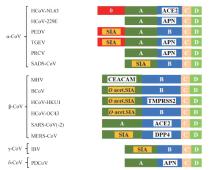
图 1
常见冠状病毒受体与黏附因子"
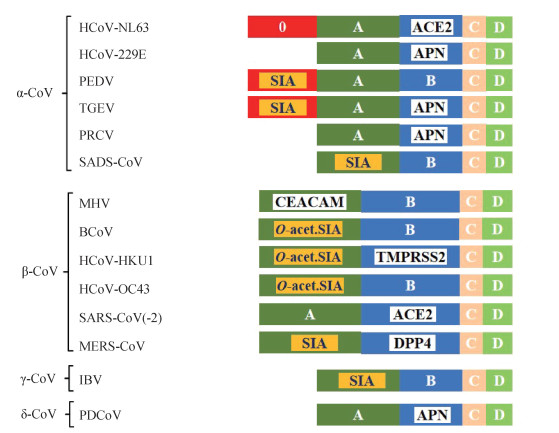
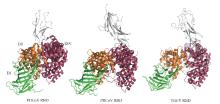
图 2
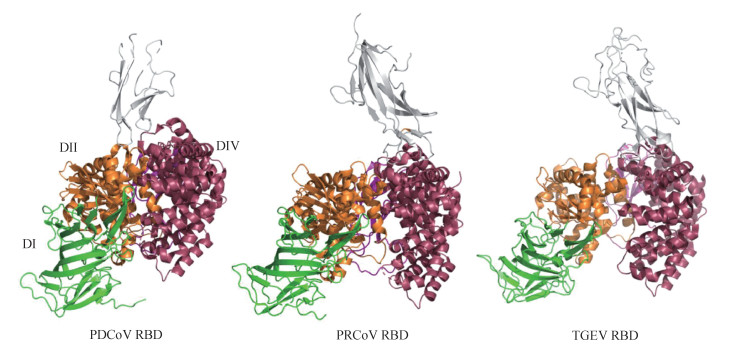
猪冠状病毒S蛋白RBD与pAPN受体复合物结构 PDCoV RBD与pAPN(左:PDB 7vpp)、PRCoV RBD与pAPN(中:PDB 4f5c)及TGEV RBD与dAPN(右:PDB 8z27)的复合体结构。RBD用灰色显示,APN结构域(D)Ⅰ、Ⅱ、Ⅲ、Ⅳ分别用绿色、橙色、洋红色及树莓色表示"
| 1 |
ZHOU Z , QIU Y , GE X . The taxonomy, host range and pathogenicity of coronaviruses and other viruses in the Nidovirales order[J]. Anim Dis, 2021, 1 (1): 5.
doi: 10.1186/s44149-021-00005-9 |
| 2 | HULSWIT R J , DE HAAN C A , BOSCH B J . Coronavirus spike protein and tropism changes[J]. Adv Virus Res, 2016, 96, 29- 57. |
| 3 |
YUAN H W , WEN H L . Research progress on coronavirus S proteins and their receptors[J]. Arch Virol, 2021, 166 (7): 1811- 1817.
doi: 10.1007/s00705-021-05008-y |
| 4 |
KOONIN E V , DOLJA V V , KRUPOVIC M . The logic of virus evolution[J]. Cell Host Microbe, 2022, 30 (7): 917- 929.
doi: 10.1016/j.chom.2022.06.008 |
| 5 |
KESHEH M M , HOSSEINI P , SOLTANI S , et al. An overview on the seven pathogenic human coronaviruses[J]. Rev Med Virol, 2022, 32 (2): e2282.
doi: 10.1002/rmv.2282 |
| 6 |
LIN C N , CHAN K R , OOI E E , et al. Animal coronavirus diseases: Parallels with COVID-19 in humans[J]. Viruses, 2021, 13 (8): 1507.
doi: 10.3390/v13081507 |
| 7 |
NOVA N . Cross-species transmission of coronaviruses in humans and domestic mammals, what are the ecological mechanisms driving transmission, spillover, and disease emergence?[J]. Front Public Health, 2021, 9, 717941.
doi: 10.3389/fpubh.2021.717941 |
| 8 |
RAJCÁNI J . Molecular mechanisms of virus spread and virion components as tools of virulence. A review[J]. Acta Microbiol Immunol Hung, 2003, 50 (4): 407- 431.
doi: 10.1556/AMicr.50.2003.4.8 |
| 9 | LI W , HULSWIT R J G , KENNEY S P , et al. Broad receptor engagement of an emerging global coronavirus may potentiate its diverse cross-species transmissibility[J]. Proc Natl Acad Sci U S A, 2018, 115 (22): E5135- E5143. |
| 10 |
LI W , MOORE M J , VASILIEVA N , et al. Angiotensin-converting enzyme 2 is a functional receptor for the SARS coronavirus[J]. Nature, 2003, 426 (6965): 450- 454.
doi: 10.1038/nature02145 |
| 11 |
RAJ V S , MOU H , SMITS S L , et al. Dipeptidyl peptidase 4 is a functional receptor for the emerging human coronavirus-EMC[J]. Nature, 2013, 495 (7440): 251- 254.
doi: 10.1038/nature12005 |
| 12 |
ZHANG Y , SHANG L , ZHANG J , et al. An antibody-based proximity labeling map reveals mechanisms of SARS-CoV-2 inhibition of antiviral immunity[J]. Cell Chem Biol, 2022, 29 (1): 5- 18.
doi: 10.1016/j.chembiol.2021.10.008 |
| 13 |
WANG P . Expression cloning of functional receptor used by SARS coronavirus[J]. Biochem Biophys Res Commun, 2004, 315, 439- 444.
doi: 10.1016/j.bbrc.2004.01.076 |
| 14 | WANG P G , TANG D J , HUA Z , et al. Sunitinib reduces the infection of SARS-CoV, MERS-CoV and SARS-CoV-2 partially by inhibiting AP2M1 phosphorylation[J]. Cell Discov, 2020, 6, 71. |
| 15 | 王文静, 李素, 肖书奇, 等. 基于CRISPR/Cas9技术的高通量筛选平台: 发掘病毒复制相关宿主分子的新途径[J]. 微生物学报, 2018, 58 (11): 1897- 1907. |
| WANG W J , LI S , XIAO S Q , et al. High-throughput screening platform based on CRISPR/Cas9 technology: a new approach to discover host molecules related to virus replication[J]. Acta Microbiologica Sinica, 2018, 58 (11): 1897- 1907. | |
| 16 | ZHU S , ZHOU Y , WEI W . Genome-wide CRISPR/Cas9 screening for high-throughput functional genomics in human cells[J]. Methods Mol Biol, 2017, 1656, 175- 181. |
| 17 |
HOFFMANN M , KLEINE-WEBER H , SCHROEDER S , et al. SARS-CoV-2 cell entry depends on ACE2 and TMPRSS2 and is blocked by a clinically proven protease inhibitor[J]. Cell, 2020, 181, 271- 280.
doi: 10.1016/j.cell.2020.02.052 |
| 18 |
WEI J , ALFAJARO M M , DEWEIRDT P C , et al. Genome-wide CRISPR screens reveal host factors critical for SARS-CoV-2 infection[J]. Cell, 2021, 184 (1): 76- 91.
doi: 10.1016/j.cell.2020.10.028 |
| 19 |
DANILOSKI Z , JORDAN T X , WESSELS H H , et al. Identification of required host factors for SARS-CoV-2 infection in human cells[J]. Cell, 2021, 184 (1): 92- 105.
doi: 10.1016/j.cell.2020.10.030 |
| 20 |
SCHNEIDER W M , LUNA J M , HOFFMANN H H , et al. Genome-scale identification of SARS-CoV-2 and pan-coronavirus host factor networks[J]. Cell, 2021, 184 (1): 120- 132.
doi: 10.1016/j.cell.2020.12.006 |
| 21 |
WANG R , SIMONEAU C R , KULSUPTRAKUL J , et al. Genetic screens identify host factors for SARS-CoV-2 and common cold coronaviruses[J]. Cell, 2021, 184 (1): 106- 119.
doi: 10.1016/j.cell.2020.12.004 |
| 22 |
MILLET J K , JAIMES J A , WHITTAKER G R . Molecular diversity of coronavirus host cell entry receptors[J]. FEMS Microbiol Rev, 2021, 45 (3): fuaa057.
doi: 10.1093/femsre/fuaa057 |
| 23 |
EVEREST H , STEVENSON-LEGGETT P , BAILEY D , et al. Known cellular and receptor interactions of animal and human coronaviruses: A review[J]. Viruses, 2022, 14 (2): 351.
doi: 10.3390/v14020351 |
| 24 |
LI W , SUI J , HUANG I C , et al. The S proteins of human coronavirus NL63 and severe acute respiratory syndrome coronavirus bind overlapping regions of ACE2[J]. Virology, 2007, 367 (2): 367- 374.
doi: 10.1016/j.virol.2007.04.035 |
| 25 |
SCHWEGMANN-WESSELS C , BAUER S , WINTER C , et al. The sialic acid binding activity of the S protein facilitates infection by porcine transmissible gastroenteritis coronavirus[J]. Virol J, 2011, 8, 435.
doi: 10.1186/1743-422X-8-435 |
| 26 |
LI W , VAN KUPPEVELD F J M , HE Q , et al. Cellular entry of the porcine epidemic diarrhea virus[J]. Virus Res, 2016, 226, 117- 127.
doi: 10.1016/j.virusres.2016.05.031 |
| 27 |
YANG Y L , WANG B , LI W , et al. Functional dissection of the spike glycoprotein S1 subunit and identification of cellular cofactors for regulation of swine acute diarrhea syndrome coronavirus entry[J]. J Virol, 2024, 98 (4): e0013924.
doi: 10.1128/jvi.00139-24 |
| 28 |
SAUNDERS N , FERNANDEZ I , PLANCHAIS C , et al. TMPRSS2 is a functional receptor for human coronavirus HKU1[J]. Nature, 2023, 624 (7990): 207- 214.
doi: 10.1038/s41586-023-06761-7 |
| 29 |
LAN J , GE J , YU J , et al. Structure of the SARS-CoV-2 spike receptor-binding domain bound to the ACE2 receptor[J]. Nature, 2020, 581 (7807): 215- 220.
doi: 10.1038/s41586-020-2180-5 |
| 30 |
VAN DOREMALEN N , MIAZGOWICZ K L , MILNE-PRICE S , et al. Host species restriction of Middle East respiratory syndrome coronavirus through its receptor, dipeptidyl peptidase 4[J]. J Virol, 2014, 88 (16): 9220- 9232.
doi: 10.1128/JVI.00676-14 |
| 31 |
STEINER S , KRATZEL A , BARUT G T , et al. SARS-CoV-2 biology and host interactions[J]. Nat Rev Microbiol, 2024, 22 (4): 206- 225.
doi: 10.1038/s41579-023-01003-z |
| 32 |
WINTER C , HERRLER G , NEUMANN U . Infection of the tracheal epithelium by infectious bronchitis virus is sialic acid dependent[J]. Microbes Infect, 2008, 10 (4): 367- 373.
doi: 10.1016/j.micinf.2007.12.009 |
| 33 |
AMBEPITIYA WICKRAMASINGHE I N , DE VRIES R P , WEERTS E A , et al. Novel receptor specificity of avian gammacoronaviruses that cause enteritis[J]. J Virol, 2015, 89 (17): 8783- 8792.
doi: 10.1128/JVI.00745-15 |
| 34 |
JI W , PENG Q , FANG X , et al. Structures of a deltacoronavirus spike protein bound to porcine and human receptors[J]. Nat Commun, 2022, 13 (1): 1467.
doi: 10.1038/s41467-022-29062-5 |
| 35 |
BOLEY P A , ALHAMO M A , LOSSIE G , et al. Porcine deltacoronavirus infection and transmission in poultry, United States[J]. Emerg Infect Dis, 2020, 26 (2): 255- 265.
doi: 10.3201/eid2602.190346 |
| 36 |
DELMAS B , GELFI J , L'HARIDON R , et al. Aminopeptidase N is a major receptor for the enteropathogenic coronavirus TGEV[J]. Nature, 1992, 357 (6377): 417- 419.
doi: 10.1038/357417a0 |
| 37 |
YEAGER C L , ASHMUN R A , WILLIAMS R K , et al. Human aminopeptidase N is a receptor for human coronavirus 229E[J]. Nature, 1992, 357 (6377): 420- 422.
doi: 10.1038/357420a0 |
| 38 | DELMAS B, GELFI J, SJÖSTRÖM H, et al. Further characterization of aminopeptidase-N as a receptor for coronaviruses[J]. Adv Exp Med Biol, 1993, 342: 293-: 298. |
| 39 | TRESNAN D B , HOLMES K V . Feline aminopeptidase N is a receptor for all group I coronaviruses[J]. Adv Exp Med Biol, 1998, 440, 69- 75. |
| 40 | WANG B , LIU Y , JI C M , et al. Porcine deltacoronavirus engages the transmissible gastroenteritis virus functional receptor porcine aminopeptidase N for infectious cellular entry[J]. J Virol, 2018, 92 (12): e00318- 18. |
| 41 | ZHU X , LIU S , WANG X , et al. Contribution of porcine aminopeptidase N to porcine deltacoronavirus infection[J]. Emerg Microbes Infect, 2018, 7 (1): 65. |
| 42 | LIANG Q Z, WANG B, JI C M, et al. Correction for Liang et al., "Chicken or porcine aminopeptidase N mediates cellular entry of pseudoviruses carrying spike glycoprotein from the avian deltacoronaviruses HKU11, HKU13, and HKU17"[J]. J Virol, 2024, 98(12): e0163124. |
| 43 |
STOIAN A , ROWLAND R R R , PETROVAN V , et al. The use of cells from ANPEP knockout pigs to evaluate the role of aminopeptidase N (APN) as a receptor for porcine deltacoronavirus (PDCoV)[J]. Virology, 2020, 541, 136- 140.
doi: 10.1016/j.virol.2019.12.007 |
| 44 |
YANG Y L , LIU J , WANG T Y , et al. Aminopeptidase N is an entry co-factor triggering porcine deltacoronavirus entry via an endocytotic pathway[J]. J Virol, 2021, 95 (21): e0094421.
doi: 10.1128/JVI.00944-21 |
| 45 |
TIAN Y , SUN J , HOU X , et al. Cross-species recognition of two porcine coronaviruses to their cellular receptor aminopeptidase N of dogs and seven other species[J]. PLoS Pathog, 2025, 21 (1): e1012836.
doi: 10.1371/journal.ppat.1012836 |
| 46 |
LI Y , ZHANG Z , YANG L , et al. The MERS-CoV receptor DPP4 as a candidate binding target of the SARS-CoV-2 spike[J]. iScience, 2020, 23 (6): 101160.
doi: 10.1016/j.isci.2020.101160 |
| 47 |
SHI J , HU S , WEI H , et al. Dipeptidyl peptidase 4 interacts with porcine coronavirus PHEV spikes and mediates host range expansion[J]. J Virol, 2024, 98 (7): e0075324.
doi: 10.1128/jvi.00753-24 |
| 48 |
WASIK B R , BARNARD K N , PARRISH C R . Effects of sialic acid modifications on virus binding and infection[J]. Trends Microbiol, 2016, 24 (12): 991- 1001.
doi: 10.1016/j.tim.2016.07.005 |
| 49 |
PARK Y J , WALLS A C , WANG Z , et al. Structures of MERS-CoV spike glycoprotein in complex with sialoside attachment receptors[J]. Nat Struct Mol Biol, 2019, 26 (12): 1151- 1157.
doi: 10.1038/s41594-019-0334-7 |
| 50 | LI W , HULSWIT R J G , WIDJAJA I , et al. Identification of sialic acid-binding function for the Middle East respiratory syndrome coronavirus spike glycoprotein[J]. Proc Natl Acad Sci U S A, 2017, 114 (40): E8508- E8517. |
| 51 |
YUAN Y , ZU S , ZHANG Y , et al. Porcine deltacoronavirus utilizes sialic acid as an attachment receptor and trypsin can influence the binding activity[J]. Viruses, 2021, 13 (12): 2442.
doi: 10.3390/v13122442 |
| 52 |
LAIRSON L L , HENRISSAT B , DAVIES G J , et al. Glycosyltransferases: structures, functions, and mechanisms[J]. Annu Rev Biochem, 2008, 77, 521- 555.
doi: 10.1146/annurev.biochem.76.061005.092322 |
| 53 |
SCHAUER R . Sialic acids as regulators of molecular and cellular interactions[J]. Curr Opin Struct Biol, 2009, 19 (5): 507- 514.
doi: 10.1016/j.sbi.2009.06.003 |
| 54 | DOOSTKAM A , MALEKMAKAN L , HOSSEINPOUR A , et al. Sialic acid: an attractive biomarker with promising biomedical applications[J]. Asian Biomed (Res Rev News), 2022, 16 (4): 153- 167. |
| 55 |
LI X , ZHAO S , PENG G , et al. Genome-scale CRISPR screen identifies TRIM2 and SLC35A1 associated with porcine epidemic diarrhoea virus infection[J]. Int J Biol Macromol, 2023, 250, 125962.
doi: 10.1016/j.ijbiomac.2023.125962 |
| 56 |
WANG X , JIN Q , XIAO W , et al. Genome-wide CRISPR/Cas9 screen reveals a role for SLC35A1 in the adsorption of porcine deltacoronavirus[J]. J Virol, 2022, 96 (24): e0162622.
doi: 10.1128/jvi.01626-22 |
| 57 |
HAN J , PEREZ J T , CHEN C , et al. Genome-wide CRISPR/Cas9 screen identifies host factors essential for influenza virus replication[J]. Cell Rep, 2018, 23 (2): 596- 607.
doi: 10.1016/j.celrep.2018.03.045 |
| 58 |
LI B X , GE J W , LI Y J . Porcine aminopeptidase N is a functional receptor for the PEDV coronavirus[J]. Virology, 2007, 365 (1): 166- 172.
doi: 10.1016/j.virol.2007.03.031 |
| 59 |
LIU C , TANG J , MA Y , et al. Receptor usage and cell entry of porcine epidemic diarrhea coronavirus[J]. J Virol, 2015, 89 (11): 6121- 6125.
doi: 10.1128/JVI.00430-15 |
| 60 |
LI W , LUO R , HE Q , et al. Aminopeptidase N is not required for porcine epidemic diarrhea virus cell entry[J]. Virus Res, 2017, 235, 6- 13.
doi: 10.1016/j.virusres.2017.03.018 |
| 61 |
JI C M , WANG B , ZHOU J , et al. Aminopeptidase-N-independent entry of porcine epidemic diarrhea virus into Vero or porcine small intestine epithelial cells[J]. Virology, 2018, 517, 16- 23.
doi: 10.1016/j.virol.2018.02.019 |
| 62 |
LUO L , WANG S , ZHU L , et al. Aminopeptidase N-null neonatal piglets are protected from transmissible gastroenteritis virus but not porcine epidemic diarrhea virus[J]. Sci Rep, 2019, 9 (1): 13186.
doi: 10.1038/s41598-019-49838-y |
| 63 |
ZHANG S , CAO Y , YANG Q . Transferrin receptor 1 levels at the cell surface influence the susceptibility of newborn piglets to PEDV infection[J]. PLoS Pathog, 2020, 16 (7): e1008682.
doi: 10.1371/journal.ppat.1008682 |
| 64 |
FENG Z , FU Y , YANG S , et al. Siglec-15 is a putative receptor for porcine epidemic diarrhea virus infection[J]. Cell Mol Life Sci, 2025, 82 (1): 136.
doi: 10.1007/s00018-025-05672-2 |
| 65 | 房元杰. 基因组CRISPR敲除文库筛选PEDV复制所需的宿主因子[D]. 广州: 仲恺农业工程学院, 2023. |
| FANG Y J. Screening of host factors required for PEDV replication using genome-wide CRISPR knockout library[D]. Guangzhou: Zhongkai University of Agriculture and Engineering, 2023. (in Chinese) | |
| 66 | 张雪. 基于CRISPR/Cas9文库筛选PEDV复制相关基因及功能研究[D]. 石河子: 石河子大学, 2023. |
| ZHANG X. Screening of PEDV replication-related genes based on CRISPR/Cas9 library and functional study[D]. Shihezi: Shihezi University, 2023. (in Chinese) | |
| 67 |
XU K , ZHOU Y , MU Y , et al. CD163 and pAPN double-knockout pigs are resistant to PRRSV and TGEV and exhibit decreased susceptibility to PDCoV while maintaining normal production performance[J]. Elife, 2020, 9, e57132.
doi: 10.7554/eLife.57132 |
| 68 |
JI Z , DONG H , JIAO R , et al. The TGEV membrane protein interacts with HSC70 to direct virus internalization through clathrin-mediated endocytosis[J]. J Virol, 2023, 97 (4): e0012823.
doi: 10.1128/jvi.00128-23 |
| 69 |
HOFFMANN H H , SCHNEIDER W M , ROZEN-GAGNON K , et al. TMEM41B is a pan-flavivirus host factor[J]. Cell, 2021, 184 (1): 133- 148.
doi: 10.1016/j.cell.2020.12.005 |
| 70 |
SUN L , ZHAO C , FU Z , et al. Genome-scale CRISPR screen identifies TMEM41B as a multi-function host factor required for coronavirus replication[J]. PLoS Pathog, 2021, 17 (12): e1010113.
doi: 10.1371/journal.ppat.1010113 |
| 71 |
FU Z , XIANG Y , FU Y , et al. DYRK1A is a multifunctional host factor that regulates coronavirus replication in a kinase-independent manner[J]. J Virol, 2024, 98 (1): e0123923.
doi: 10.1128/jvi.01239-23 |
| 72 |
HU W , ZHANG S , SHEN Y , et al. Epidermal growth factor receptor is a co-factor for transmissible gastroenteritis virus entry[J]. Virology, 2018, 521, 33- 43.
doi: 10.1016/j.virol.2018.05.009 |
| 73 |
ZHANG S , HU W , YUAN L , et al. Transferrin receptor 1 is a supplementary receptor that assists transmissible gastroenteritis virus entry into porcine intestinal epithelium[J]. Cell Commun Signal, 2018, 16 (1): 69.
doi: 10.1186/s12964-018-0283-5 |
| 74 |
JUNG K , HU H , SAIF L J . Porcine deltacoronavirus infection: Etiology, cell culture for virus isolation and propagation, molecular epidemiology and pathogenesis[J]. Virus Res, 2016, 226, 50- 59.
doi: 10.1016/j.virusres.2016.04.009 |
| 75 | 卢曼曼, 张家林, 王洪峰, 等. 猪氨基肽酶N不是猪德尔塔冠状病毒入侵宿主细胞的受体[J]. 中国预防兽医学报, 2017, 39 (9): 701- 706. |
| LU M M , ZHANG J L , WANG H F , et al. Porcine aminopeptidase N is not the receptor for porcine deltacoronavirus entry into host cells[J]. Chinese Journal of Preventive Veterinary Medicine, 2017, 39 (9): 701- 706. | |
| 76 |
MA N , ZHANG M , ZHOU J , et al. Genome-wide CRISPR/Cas9 library screen identifies C16orf62 as a host dependency factor for porcine deltacoronavirus infection[J]. Emerg Microbes Infect, 2024, 13 (1): 2400559.
doi: 10.1080/22221751.2024.2400559 |
| 77 |
XIAO W , CHEN C , XIA S , et al. Cell-surface D-glucuronyl C5-epimerase binds to porcine deltacoronavirus spike protein facilitating viral entry[J]. J Virol, 2024, 98 (8): e0088024.
doi: 10.1128/jvi.00880-24 |
| 78 |
GONG L , LI J , ZHOU Q , et al. A new bat-HKU2-like coronavirus in swine, China, 2017[J]. Emerg Infect Dis, 2017, 23 (9): 1607- 1609.
doi: 10.3201/eid2309.170915 |
| 79 |
ZHOU P , FAN H , LAN T , et al. Fatal swine acute diarrhoea syndrome caused by an HKU2-related coronavirus of bat origin[J]. Nature, 2018, 556 (7700): 255- 258.
doi: 10.1038/s41586-018-0010-9 |
| 80 |
YU D , ZHAO Z Y , YANG Y L , et al. The origin and evolution of emerged swine acute diarrhea syndrome coronavirus with zoonotic potential[J]. J Med Virol, 2023, 95 (3): e28672.
doi: 10.1002/jmv.28672 |
| 81 |
LUO Y , CHEN Y , GENG R , et al. Broad cell tropism of SADS-CoV in vitro implies its potential cross-species infection risk[J]. Virol Sin, 2021, 36 (3): 559- 563.
doi: 10.1007/s12250-020-00321-3 |
| 82 |
EDWARDS C E , YOUNT B L , GRAHAM R L , et al. Swine acute diarrhea syndrome coronavirus replication in primary human cells reveals potential susceptibility to infection[J]. Proc Natl Acad Sci U S A, 2020, 117 (43): 26915- 26925.
doi: 10.1073/pnas.2001046117 |
| 83 |
TSE L V , MEGANCK R M , ARABA K C , et al. Genomewide CRISPR knockout screen identified PLAC8 as an essential factor for SADS-CoVs infection[J]. Proc Natl Acad Sci U S A, 2022, 119 (18): e2118126119.
doi: 10.1073/pnas.2118126119 |
| 84 |
WANG N , SHI X , JIANG L , et al. Structure of MERS-CoV spike receptor-binding domain complexed with human receptor DPP4[J]. Cell Res, 2013, 23 (8): 986- 993.
doi: 10.1038/cr.2013.92 |
| 85 |
SONG X , SHI Y , DING W , et al. Cryo-EM analysis of the HCoV-229E spike glycoprotein reveals dynamic prefusion conformational changes[J]. Nat Commun, 2021, 12 (1): 141.
doi: 10.1038/s41467-020-20401-y |
| 86 |
WANG H , LIU X , ZHANG X , et al. TMPRSS2 and glycan receptors synergistically facilitate coronavirus entry[J]. Cell, 2024, 187 (16): 4261- 4271.
doi: 10.1016/j.cell.2024.06.016 |
| 87 |
MA W , FU H , JIAN F , et al. Immune evasion and ACE2 binding affinity contribute to SARS-CoV-2 evolution[J]. Nat Ecol Evol, 2023, 7 (9): 1457- 1466.
doi: 10.1038/s41559-023-02123-8 |
| 88 | 杜阳春, 唐菁兰, 王友军, 等. 活细胞内亚细胞结构蛋白质组学研究新技术——几种邻近标记策略的应用及比较[J]. 生物化学与生物物理进展, 2019, 46 (7): 641- 653. |
| DU Y C , TANG J L , WANG Y J , et al. New technologies for subcellular structural proteomics in living cells: application and comparison of several proximity labeling strategies[J]. Progress in Biochemistry and Biophysics, 2019, 46 (7): 641- 653. | |
| 89 |
LIU P , HUANG M L , GUO H , et al. Design of customized coronavirus receptors[J]. Nature, 2024, 635 (8040): 978- 986.
doi: 10.1038/s41586-024-08121-5 |
| [1] | 刘晨龙, 邓晓, 林克团, 万明春, 杨文清, 彭富贵, 周泉勇, 郑小明, 谭美芳, 季华员. 玉山黑猪及其不同杂交组合生产性能、肉质性状和血清生化指标的比较研究[J]. 畜牧兽医学报, 2026, 57(1): 120-135. |
| [2] | 许黎明, 张聪, 温墩, 饶肇玺, 郝韵, 刘俊逸, 杜陶然, 王文强, 李强, 李平华, 黄瑞华. 影响苏淮猪粗纤维表观消化率的宿主基因挖掘[J]. 畜牧兽医学报, 2026, 57(1): 136-145. |
| [3] | 王言, 顾以韧, 张进威, 杨雪梅, 梁艳, 刘锐, 陶璇, 杨跃奎, 安瑞, 杨坤, 张兴, 陈晓晖, 龚建军. 川乡黑猪、巴克夏猪、杜洛克猪肠道微生物多样性差异分析[J]. 畜牧兽医学报, 2026, 57(1): 146-154. |
| [4] | 郭震楠, 吕世政, 萧宗贤, 吴启吉, 包雨加, 李清, 李齐发, 李琦琦, 杜星. KLF5抑制氧化应激状态下猪卵泡颗粒细胞中miR-370与miR-219a的转录[J]. 畜牧兽医学报, 2026, 57(1): 234-245. |
| [5] | 王伏羲, 马翠, 黄康, 李蕊彤, 赵青余, 张军民, 闫益波, 司玮. 18β-甘草次酸可缓解D-半乳糖诱导断奶仔猪氧化应激肺损伤[J]. 畜牧兽医学报, 2026, 57(1): 305-316. |
| [6] | 顾小玉, 贾雪寅, 刘小惠, 于学祥, 李文涛, 何启盖. 猪伪狂犬病病毒gE蛋白单链抗体的制备及鉴定[J]. 畜牧兽医学报, 2026, 57(1): 317-326. |
| [7] | 罗润波, 吴丹, 李可欣, 钟亚男, 索朗斯珠, 商鹏. 藏猪源产气荚膜梭菌的分离与耐药状况分析[J]. 畜牧兽医学报, 2026, 57(1): 392-400. |
| [8] | 齐嘉慧, 付婷婷, 郑敏行, 王璇晶, 吴海洋, 卢嘉茵, 罗小毛, 于秀菊, 王海东, 闫艺. 过氧化物酶体增殖物激活受体α通过调控AMPK/P38 MAPK通路促进小鼠骨骼肌发育[J]. 畜牧兽医学报, 2026, 57(1): 443-453. |
| [9] | 赵琳, 邬昆富, 车思艳, 卢宇, 王梓, 吴苗苗. 三七茎叶提取物对脂多糖攻毒下仔猪生长性能、腹泻指数及肠道健康的影响[J]. 畜牧兽医学报, 2026, 57(1): 540-552. |
| [10] | 胡章玉, 张永青, 陈忆廉, 许发芝, 常馨月, 方富贵, 李亮, 孙裴, 刘雪兰. 基于多酶恒温快速扩增检测猪链球菌及其3种主要血清型方法的建立及应用[J]. 畜牧兽医学报, 2026, 57(1): 564-568. |
| [11] | 赵秀美, 赵海娜, 华姝, 程旭, 陈祥, 姜逸. 冠状病毒辅助蛋白功能研究进展[J]. 畜牧兽医学报, 2026, 57(1): 96-107. |
| [12] | 黎梦帆, 李青阳, 宋艳雯, 宋振辉, 张兴翠. 冠状病毒S蛋白的结构和功能研究进展[J]. 畜牧兽医学报, 2025, 56(9): 4241-4252. |
| [13] | 田姣, 龙菊烟, 陈霞, 岑晓丽, 牛熙, 黄世会, 王嘉福, 冉雪琴. 香猪ENTPD1基因3'UTR的SINE插入下调其基因表达[J]. 畜牧兽医学报, 2025, 56(9): 4303-4314. |
| [14] | 覃阳, 夏嗣廷, 何流琴, 王天丽, 刘宇炎, 姜肖翰, 刘智豪, 刘思危, 李铁军, 印遇龙. 慢性氧化应激对断奶仔猪器官组织微量元素含量的影响[J]. 畜牧兽医学报, 2025, 56(9): 4452-4460. |
| [15] | 茹敏, 蒋小丰, 罗国升, 武永厚. 饲粮添加枯草芽孢杆菌对大肠杆菌攻毒仔猪生长性能、血清免疫及抗氧化功能、肠道形态和微生物的影响[J]. 畜牧兽医学报, 2025, 56(9): 4461-4471. |
| 阅读次数 | ||||||
|
全文 |
|
|||||
|
摘要 |
|
|||||
