


Acta Veterinaria et Zootechnica Sinica ›› 2025, Vol. 56 ›› Issue (11): 5721-5731.doi: 10.11843/j.issn.0366-6964.2025.11.030
• Preventive Veterinary Medicine • Previous Articles Next Articles
LI Jiaren1,2( ), GUO Ya'nan1,*(), WANG Jiandong1, SHAO Xicheng3, WANG Xueyi3, HE Shenghu2
Received:2025-01-06
Online:2025-11-23
Published:2025-11-27
Contact:
GUO Ya'nan
E-mail:297219549@qq.com;gyn330@126.com
CLC Number:
LI Jiaren, GUO Ya'nan, WANG Jiandong, SHAO Xicheng, WANG Xueyi, HE Shenghu. Surveillance and Analysis of Mycoplasma bovis, Mannheimia hyopneumoniae, Pasteurella multocida and Klebsiella pneumonia in Ningxia Region[J]. Acta Veterinaria et Zootechnica Sinica, 2025, 56(11): 5721-5731.
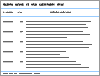
Table 1
Sample information statistics"
| 分组依据 Grouping basis | 组别 Group | 采集样本数/份 Number of collected samples |
| 区域 Area | 引黄灌区Yellow river irrigation district | 282 |
| 中部干旱带The central arid belt | 48 | |
| 南部山区Southern mountainous area | 127 | |
| 年份 Year | 2022年2022 | 261 |
| 2023年2023 | 56 | |
| 2024年2024 | 140 | |
| 季节 Season | 春季Spring | 106 |
| 夏季Summer | 243 | |
| 秋季Autumn | 64 | |
| 冬季Winter | 44 | |
| 年龄阶段 Age stage | 哺乳期Lactation period | 299 |
| 育成期Rearing period | 130 | |
| 成熟期Maturity period | 28 |
Table 2
Primer information for pathogen identification"
| 病原菌 Pathogenic bacteria | 目的基因 Target genes | 引物序列(5′→ 3′) Primer sequences | 产物大小/bp Product size | 退火温度/℃ Annealing temperature |
| 多杀性巴氏杆菌 Pm | kmt 1 | F: ATC CGC TAT TTA CCC AGT G | 456 | 56 |
| R: GCT GTA AAC GAA CTC GCC | ||||
| 溶血性曼氏杆菌 Mh | gcp | F: TGG GCA ATA CGA ACT ACG GG | 227 | 55 |
| R: CTT TAA TCG TAT TCG ACA GC | ||||
| 肺炎克雷伯菌 K.pn | Khe | F: TTC ATC TAC GTG CTG GAG GG | 192 | 56 |
| R: CGG GTA ATA AAT GCG GTT GT | ||||
| 牛支原体 M. bovis | uvrC | F: GAATTCAATGTGTCTACTAGTC-CTGG | 1 600 | 50 |
| R: AAGCTTAGCGT-CATAGATTTTTGCATA |
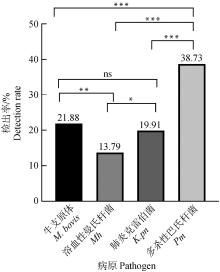
Fig. 1
The statistical results of the detection rates of different pathogens in the Ningxia region *. P < 0.05, **. P < 0.01, ***. P < 0.001, ns. P>0.05, the same as below"
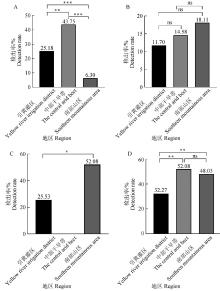
Fig. 2
The statistical results of the detection rates of different pathogens in different regions A. M. bovis Detection rate statistics in different regions; B. Mh Detection rate statistics in different regions; C. K.pn Detection rate statistics in different regions; D. Pm Detection rate statistics in different regions"
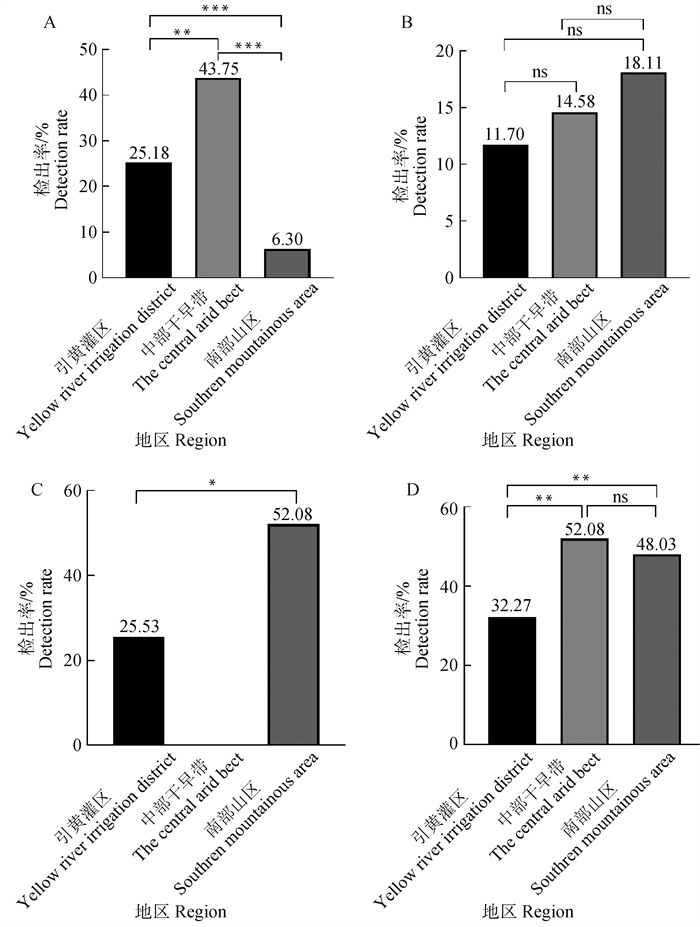
Fig. 3
Statistical results of pathogen detection rates in different years in Ningxia region A. M. bovis Statistics of detection rate in different years; B. Mh Statistics of detection rate in different years; C. K.pn Statistics of detection rate in different years; D. Pm Statistics of detection rate in different years."
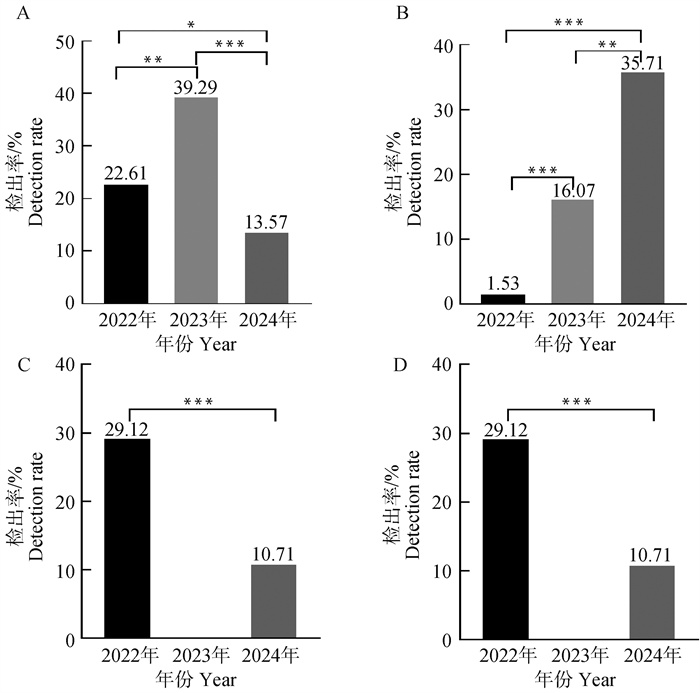
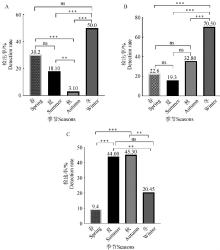
Fig. 4
Statistical results of pathogen detection rates in different years in Ningxia region A. M. bovis statistical results of detection rates in different seasons; B. K.pn statistical results of detection rates in different seasons; C. Pm statistical results of detection rates in different seasons"
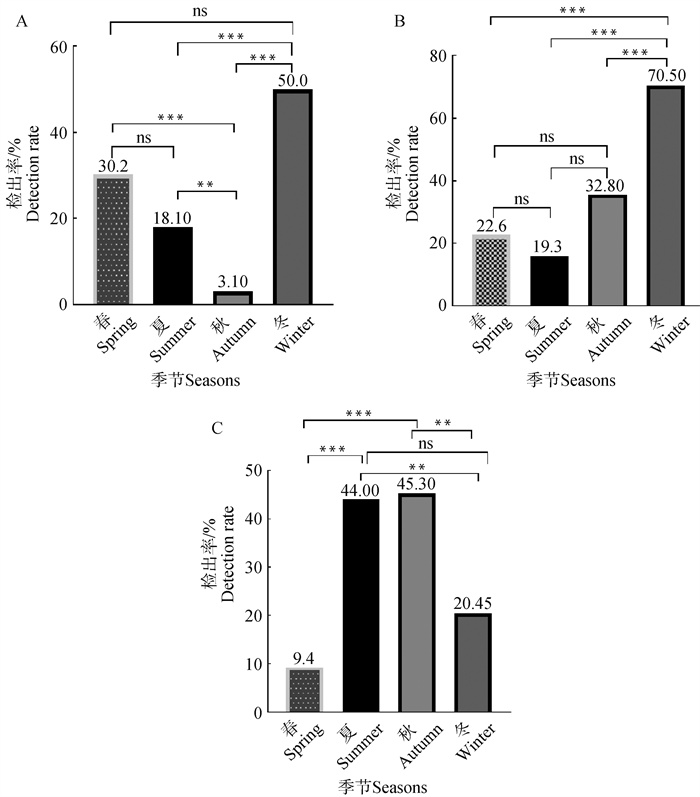
Fig. 5
Statistical results of pathogen detection rates at different growth stages in Ningxia region A. M. bovis Statistical results of detection rates at different growth stages; B. Mh Statistical results of detection rates at different growth stages; C. K.pn Statistical results of detection rates at different growth stages; D. Pm Statistical results of detection rates at different growth stages"
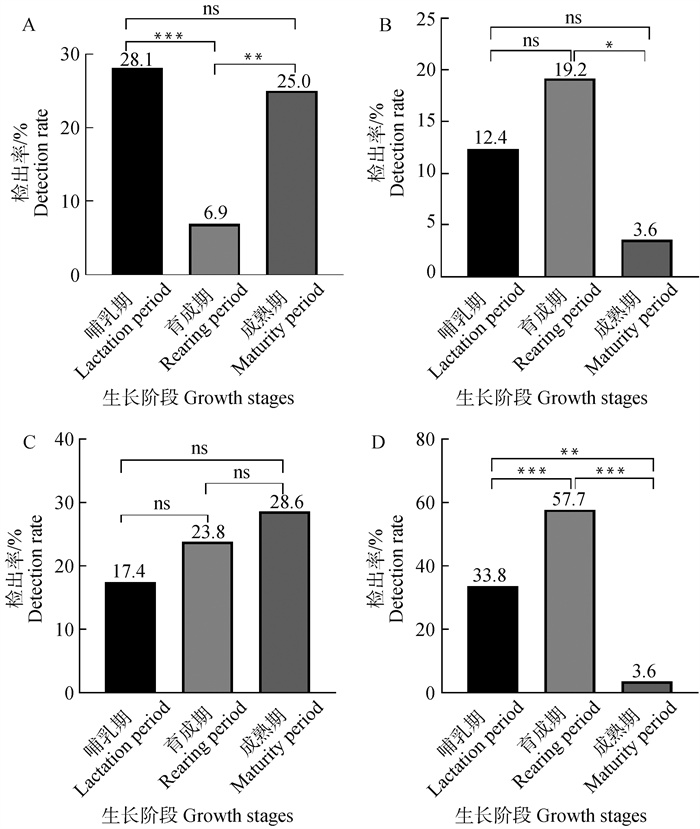
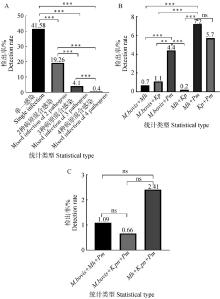
Fig. 6
Statistical results of mixed infection A. Statistical results of single infection and mixed infection; B. Statistical results of mixed infection with two pathogens; C. Statistical results of mixed infection with three pathogens"

| 1 | 邢小勇,程家海,包世俊,等.牛支原体、肺炎克雷伯菌与牛传染性鼻气管炎病毒多重PCR方法的建立与初步应用[J].农业生物技术学报,2021,29(5):1024-1030. |
| XINGX Y,CHENGJ H,BAOS J,et al.Establishment and preliminary application of multiplex PCR for Mycoplasma bovis, Klebsiella pneumoniae and bovine infectious rhinotracheitis virus[J].Journal of Agricultural Biotechnology,2021,29(5):10. | |
| 2 | 周玉龙,吴丹丹,周金玲,等.牛呼吸道综合症多重PCR检测方法的建立[J].黑龙江八一农垦大学学报,2016,28(6):97-101, 107. |
| ZHOUY L,WUD D,ZHOUJ L,et al.Establishment of multiple PCR detection method of bovine respiratory disease complex[J].Journal of Heilongjiang Bayi Agricultural University,2016,28(6):97-101, 107. | |
| 3 | 张学虎,赵兴绪,张勇,等.一例牛支原体与溶血性曼氏杆菌混合感染的诊断与治疗[J].黑龙江畜牧兽医,2023(16):83-87, 134-135. |
| ZHANGX H,ZHAOX X,ZHANGY,et al.Diagnosis and treatment of a case of mixed infection with Mycoplasma bovis and Mannheimia haemolytica[J].Heilongjiang Animal Science and Veterinary Medicine,2023(16):83-87, 134-135. | |
| 4 | 薛念宇,李中元,倪宏波.牛多杀性巴氏杆菌和肺炎克雷伯氏菌混合感染的实验室诊断[J].现代畜牧兽医,2020(2):41-44. |
| XUEN Y,LIZ Y,NIH B,et al.Laboratory diagnosis of mixed infection of Pasteurella and Klebsiella in cattle[J].Modern Journal of Animal Husbandry and Veterinary Medicine,2020(2):41-44. | |
| 5 | 蔺俐仲,邓珊珊,张海,等.一例牛支原体与巴氏杆菌混合感染的诊治[J].贵州畜牧兽医,2020,44(3):52-54. |
| LINL Z,DENS S,ZHANGH,et al.Diagnosis and treatment of a mixed infection of Mycoplasma bovis and Pasteurella mutocida[J].Guizhou Journal of Animal Husbandry & Veterinary Medicine,2020,44(3):52-54. | |
| 6 | 孙凌炜. 中国北方部分地区牛呼吸道综合征主要病原流行病学调查[D]. 呼和浩特: 内蒙古农业大学, 2021. |
| SUN L W. Epidemiological Survey of the main pathogens of bovine respiratory syndrome in parts of Northern China[D]. Hohhot: Inner Mongolia Agricultural University, 2021. (in Chinese) | |
| 7 | 李百云,许泽华,郭鑫年,等.宁夏不同生态类型区土壤养分状况比较分析[J].寒旱农业科学,2024,3(5):434-440. |
| LIB Y,XUZ H,GUOX N,et al.Comparative Analysis of soil nutrient status across different ecological zones in Ningxia[J].Journal of Cold-Arid Agricultural Sciences,2024,3(5):434-440. | |
| 8 | 岳康,王建东,唐玉林,等.宁夏主要肉牛养殖地区肉牛繁殖状况[J].上海畜牧兽医通讯,2022(3):43-46. |
| YUEK,WANGJ D,TANGY L,et al.Reproductive status of beef cattle in major cattle-raising areas of Ningxia[J].Shanghai Journal of Animal Husbandry and Veterinary Medicine,2022(3):43-46. | |
| 9 |
DUBROVSKYS A,VAN EENENNAAMA L,KARLEB M,et al.Epidemiology of bovine respiratory disease (BRD) in preweaned calves on California dairies: The BRD 10K study[J].J Dairy Sci,2019,102(8):7306-7319.
doi: 10.3168/jds.2018-14774 |
| 10 |
CALLANR J,GARRYF B.Biosecurity and bovine respiratory disease[J].Vet Clin North Am Food Anim Pract,2002,18(1):57-77.
doi: 10.1016/S0749-0720(02)00004-X |
| 11 |
TOWNSENDK M,FROSTA J,LEEC W,et al.Development of PCR assays for species-and type-specific identification of Pasteurella multocida isolates[J].J Clin Microbiol,1998,36(4):1096-1100.
doi: 10.1128/JCM.36.4.1096-1100.1998 |
| 12 | 张晓宇. 奶牛犊牛主要呼吸道疾病流行病学调查及牛支体肺炎防治的研究[D]. 呼和浩特: 内蒙古农业大学, 2018. |
| ZHANG X Y. Investigation on pathogens of main respiratory infectious diseases in dairy cows in China and research on main pathogen control[D]. Inner Mongolia Agricultural University, 2018. (in Chinese) | |
| 13 | 张金花,郭亚男,王建东,等.绵羊肺炎支原体和多杀性巴氏杆菌混合感染的诊断、病理组织学观察和耐药性分析[J].畜牧与兽医,2022,54(11):72-79. |
| ZHANGJ H,GUOY N,WANGJ D,et al.Diagnosis, histopathological observation and drug resistance analysis of mixed infection of Mycoplasma ovipneumoniae and Pasteurella multocida[J].Animal Husbandry & Veterinary Medicine,2022,54(11):72-79. | |
| 14 | 李聚才,杨正义,张生,等.宁夏中部干旱带肉牛产业发展现状、问题与对策——以同心县为例[J].宁夏农林科技,2012,53(1):96-100. |
| LIJ C,YANGZ Y,ZHANGS,et al.Developing status, problems and countermeas ure of beef cattle industry from the middle Part Arid Zone in Ningxia——Taking Tongxin Countyas an example[J].Ningxia Journal of Agriculture and Forestry Science and Tec hnology,2012,53(1):96-100. | |
| 15 | 刘汝亮,洪瑜,李友宏,等.推进农业绿色发展, 助推宁夏引黄灌区乡村振兴[J].宁夏农林科技,2019,60(9):75-77. |
| LIUR L,HONGY,LIY H,et al.Promoting the green development of agriculture to boost rural revitalization of Ningxia Yellow River irrigation area[J].Ningxia Journal of Agriculture and Forestry Science and Technology,2019,60(9):75-77. | |
| 16 | 郭亚男,闫背背,李勇,等.2020—2021年宁夏地区牛支原体血清流行病学调查与分析[J].黑龙江畜牧兽医,2023(21):72-77, 83. |
| GUOY N,YANB B,LIY,et al.Seroepidemiological investigation and analysis of Mycoplasma bovis in Ningxia region from 2020 to 2021[J].Heilongjiang Animal Science and Veterinary Medicine,2023(21):72-77, 83. | |
| 17 |
CALDERÓN BERNALJ M,FERNáNDEZA,ARNALJ L,et al.Cluster analysis of bovine respiratory disease (BRD)-associated pathogens shows the existence of two epidemiological patterns in BRD outbreaks[J].Vet Microbiol,2023,280,109701.
doi: 10.1016/j.vetmic.2023.109701 |
| 18 |
MARTINS W,SCHWABEC W,FRANTIC E.Dairy calf mortality rate: influence of management and housing factors on calf mortality rate in Tulare County, California[J].Am J Vet Res,1975,36(8):1111-1114.
doi: 10.2460/ajvr.1975.36.08.1111 |
| 19 | 哈力木别克·马勒哈买提.季节性气候变化对牛疾病的影响[J].养殖与饲料,2018(2):48-49. |
| HALIMUBIEKE·M.Effects of seasonal climate change on bovine diseases[J].Animals Breeding and Feed,2018(2):48-49. | |
| 20 | 袁敏明.牦牛巴氏杆菌病流行病学调查报告[J].农家参谋,2022(16):129-131. |
| YUANM M.Epidemiological investigation report on Pasteurellosis in yaks[J].The Farmers Consultant,2022(16):129-131. | |
| 21 | 李媛,闫磊,刘桐,等.中国西部和北部边境4省区牛支原体血清流行病学调查及分析[J].中国预防兽医学报,2021,43(7):717-721. |
| LIY,YANL,LIUT,et al.Seroprevalence and analysis of Mycoplasma bovis infection in four provinces of western and northern China[J].Chinese Journal of Preventive Veterinary Medicine,2021,43(7):717-721. | |
| 22 | 佘海瑞.牦牛犊牛溶血性曼氏杆菌与多杀性巴氏杆菌混合感染的病原分离鉴定及药敏实验[J].畜牧兽医杂志,2021,40(4):151-154. |
| SHEH R.Isolation, identification and drug sensitivity test of pathogens of mixed infection of Mannheimia haemolytica and Pasteurella multocida in yak calves[J].Journal of Animal Science and Veterinary Medicine,2021,40(4):151-154. | |
| 23 |
LACHOWICZ-WOLAKA,KLIMOWI CZ-B ODYSMD,PŁONECZKA-JANECZKOK,et al.The prevalence, coexistence, and correlations between seven pathogens detected by a PCR method from South-Western Poland dairy cattle suffering from bovine respiratory disease[J].Microorganisms,2022,10(8):1487.
doi: 10.3390/microorganisms10081487 |
| 24 |
HOUGHTONS B,GOURLAYR N.Synergism between Mycoplasma bovis and Pasteurella haemolytica in calf pneumonia[J].Vet Rec,1983,113(2):41-42.
doi: 10.1136/vr.113.2.41 |
| [1] | GU Rifei, ZHANG Siwei, ZHAO Zhijie, SONG Weishuo, ZHANG Junming, MA Xiaoru, GAO Yanjun, BU Shijin. Effectiveness Revaluation of Thiamphenicol Powder Oral Dosage Regimen in Chickens Based on PK/PD Model [J]. Acta Veterinaria et Zootechnica Sinica, 2025, 56(8): 4007-4017. |
| [2] | MA Caiping, ZHU Yao, LIU Hongdao, ZHOU Guangbin, XU Qiu, LIN Longhua, CHAI Jiyun, HOU Jie, SUN Hongfei, DU Susu, FAN Cuilong, XIA Lining, ZHANG Wanjiang. Typing and Antimicrobial Resistance Analysis of Thirty-four Pasteurella multocida Strains from Pigs [J]. Acta Veterinaria et Zootechnica Sinica, 2025, 56(8): 4074-4085. |
| [3] | WEI Yushi, SUN Wen, PANG Xiaomin, WANG Yulian. A Preliminary Study on the Mechanism of Tigecycline Resistance in ESBLs- and Carbapenemase-Producing Klebsiella pneumoniae [J]. Acta Veterinaria et Zootechnica Sinica, 2025, 56(7): 3507-3518. |
| [4] | ZHAO Yunhai, ZHANG Yangyang, MA Haiyun, WANG Qing, HE Xiaoxiao, LIU Kai, ZHANG Yuting, LIU Yudong, YANG Yongning, WU Xiaochun, XING Xiaoyong, QUAN Guomei, ZHANG Zhixiong, BAO Shijun. Prokaryotic Expression and Adhesion Characteristics of Molecular Chaperone Dnak of Mycoplasma bovis [J]. Acta Veterinaria et Zootechnica Sinica, 2025, 56(6): 2868-2878. |
| [5] | ZHAO Enhao, SHI Hongmei, GESANG Zhuoma, SUOLANG Sizhu, GONG Ga. Genetic Evolution, Virulence Genes, and Drug Resistance Analysis of Klebsiella pneumoniae from Yak in Gansu Province [J]. Acta Veterinaria et Zootechnica Sinica, 2025, 56(6): 2893-2905. |
| [6] | WANG Jinxiang, SU Jinbo, FU Huanru, SUN Shikun, GAO Chengfang, CHEN Dongjin, SANG Lei, XIE Xiping. Pathogenicity and Genomic Features of Rabbit Sourced Serogroup A Pasteurella multocida Isolates Pm3 and Pm6 [J]. Acta Veterinaria et Zootechnica Sinica, 2025, 56(5): 2340-2352. |
| [7] | FAN Wei, LIU Xinxin, ZHAI Yilu, ZHANG Xinyu, WANG Wei, FU Jiaqi, SUN Fuliang. Isolation and Identification of Klebsiella pneumoniae of Sheep Origin and Establishment of a Method for the Extraction of Its Outer Membrane Vesicles [J]. Acta Veterinaria et Zootechnica Sinica, 2025, 56(1): 353-364. |
| [8] | Qilin WANG, Runlai CAO, Weiyang WANG, Bo ZHANG, Zhijie LIU, Xiaoxu WANG. Isolation, Identification and Drug Resistance Analysis of Klebsiella pneumoniae in Aborted Fetuses of Fox [J]. Acta Veterinaria et Zootechnica Sinica, 2024, 55(8): 3640-3648. |
| [9] | Bohua LIU, Hanyu FU, Yuheng WANG, Suolangsizhu, Jiaqiang NIU, Yuhua BAO, Jiakui LI, Yefen XU. Isolation, Identification and Genome Analysis of Type B Pasteurella multocida Isolated from Yak in Tibetan Nakchu City [J]. Acta Veterinaria et Zootechnica Sinica, 2024, 55(7): 3105-3118. |
| [10] | LUO Ting, HAN Zhu, XU Yefen, CAI Lin, SUOLANG Sizhu, XU Jinhua, NIU Jiaqiang. Whole Genome Sequencing and Sequence Analysis on T10 of Mycoplasma bovis Strain from Yaks in Xizang [J]. Acta Veterinaria et Zootechnica Sinica, 2024, 55(5): 2154-2167. |
| [11] | LUO Xiaofen, XIE Xiaodong, ZHAO Chao, HU Qian, WANG Yongxuan, RAN Fangfei, HU Pengfei, WEN Ming, ZHU Erpeng, CHENG Zhentao. Initial Identification of Adhesion-related Proteins of Mycoplasma bovis of Guizhou Strains [J]. Acta Veterinaria et Zootechnica Sinica, 2024, 55(4): 1672-1683. |
| [12] | WU Wenying, XIA Qing, HU Mengjie, ZHAO Yixuan, WANG Chen, ZHANG Yuhao, HAO Chengwu, HE Sun, GUO Aizhen, CHEN Jianguo, CHEN Yingyu. Establishment of Rabbit Challenge Model of Mycoplasma bovis [J]. Acta Veterinaria et Zootechnica Sinica, 2024, 55(3): 1268-1277. |
| [13] | YANG Rongrong, ZHANG Ting, TANG Pingping, HE Shuangfang, ZHAO Miaomiao, LEI Liancheng, ZHANG Fuxian. Analysis of Drug Resistance and Pathogenicity of Metallo-β-Lactamase-producing Porcine ST201 Pasteurella multocida [J]. Acta Veterinaria et Zootechnica Sinica, 2024, 55(12): 5692-5705. |
| [14] | WU Sujuan, LIN Changcheng, WAN Peng, LI Jie, LU Yixing, HU Jianxin, PENG Xianfeng, ZENG Zhenling. Synergistic Antimicrobial Effect of Isopropoxy Benzene Guanidine Combined with Colistin on Klebsiella pneumoniae in vitro [J]. Acta Veterinaria et Zootechnica Sinica, 2024, 55(12): 5792-5801. |
| [15] | Xiangxiang SHEN, Lijun GUAN, Junfeng ZHANG, Yun XUE, Lifang SI, Zhanqin ZHAO. Research Progress on Iron Uptake Mechanism of Pasteurella multocida [J]. Acta Veterinaria et Zootechnica Sinica, 2024, 55(11): 4852-4862. |
| Viewed | ||||||
|
Full text |
|
|||||
|
Abstract |
|
|||||
