


Acta Veterinaria et Zootechnica Sinica ›› 2025, Vol. 56 ›› Issue (11): 5888-5900.doi: 10.11843/j.issn.0366-6964.2025.11.044
• Basic Veterinary Medicine • Previous Articles Next Articles
DOU Wanwan1( ), CUI Yan1,2, ZHANG Qian1, NIU Yueyue1, HE Junfeng1,*()
Received:2024-11-07
Online:2025-11-23
Published:2025-11-27
Contact:
HE Junfeng
E-mail:1978537683@qq.com;hejf@gsau.edu.cn;hejf@gsau.edu.cn
CLC Number:
DOU Wanwan, CUI Yan, ZHANG Qian, NIU Yueyue, HE Junfeng. Study on the Distribution and Expression of Lung Neuroendocrine Cells and Their Related Factors in Yak Lung Airway[J]. Acta Veterinaria et Zootechnica Sinica, 2025, 56(11): 5888-5900.

Table 1
Primer sequences of target gene and housekeeping gene"
| 基因名称 Gene name | GenBank登录号 GenBank accession number | 引物序列(5′→3′) Primer sequence | 片段长度/bp Fragment size |
| NSE | XM_005907488.1 | F: GGTCCAAGTTCACAGCCAATG R: ACCTTCAGCAGCAGACAGTT | 121 |
| S100A1 | XM_014483048.1 | F: AGACTCTCATCAATGTGTTCCA R: CCTCTCCATCTCCGTTCTCA | 180 |
| CGA | XM_005902885.1 | F: CCAAGAACATCACCTCGGAAG R: GAGCAAGTCAGCCATCATCAG | 171 |
| NEUROD1 | XM_005905941.2 | F: GAGGAGCACGAGACAGACA R: CGCCTTCGTCATCTTCTTCTT | 189 |
| β-actin | XM_005887322.2 | F: CCGTGACATCAAGGAGAAG R: AGGAAGGAAGGCTGGAAG | 174 |
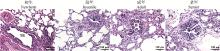
Fig. 1
HE staining of lungs of newborn, juvenile, adult and old yak B. Bronchioles; TB. Terminal bronchiole; PA. Pulmonary artery"
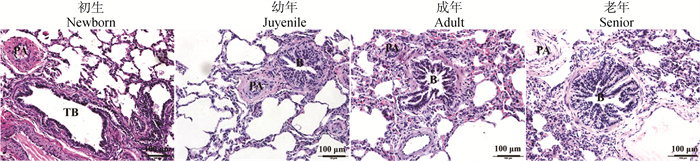
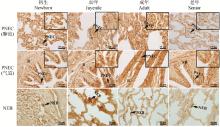
Fig. 2
Grimelius silver staining of the lungs of newborn, juvenile, adult and old yak B. Bronchioles; TB. Terminal bronchiole; PNEC. Neuroendocrine cell; NEB. Neuroepithelial bodies; PA. Pulmonary artery"
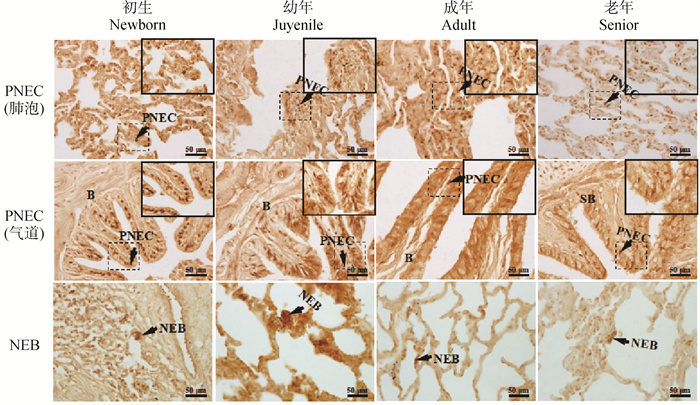
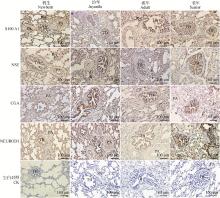
Fig. 3
Immunohistochemical staining of S100A1, NSE, CGA and NEUROD1 in terminal bronchioles and alveoli of yak lungs at different ages TB. Terminal bronchiole; PA. Pulmonary artery; AT. Type Ⅱ alveolar epithelial cells"

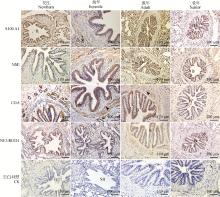
Fig. 4
Immunohistochemical staining of S100A1, NSE, CGA and NEUROD1 in the airway of yak lungs at different ages SB. Bronchioles; B. Bronchioles; ↓. Tracheal glandular epithelial cells; ▼. Smooth muscle cells"

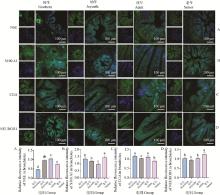
Fig. 5
Immunofluorescence staining and fluorescence intensity of NSE, S100A1, CGA and NEUROD1 in bronchioles and bronchioles of yak lungs A. The fluorescence intensity of NSE in yak bronchioles and bronchioles of different ages; B. The fluorescence intensity S100A1 in yak bronchioles and bronchioles of different ages; C. The fluorescence intensity CGA in yak bronchioles and bronchioles of different ages; D. The fluorescence intensity NEUROD1 in yak bronchioles and bronchioles of different ages, different lowercase letters mean significant difference (P < 0.05)"
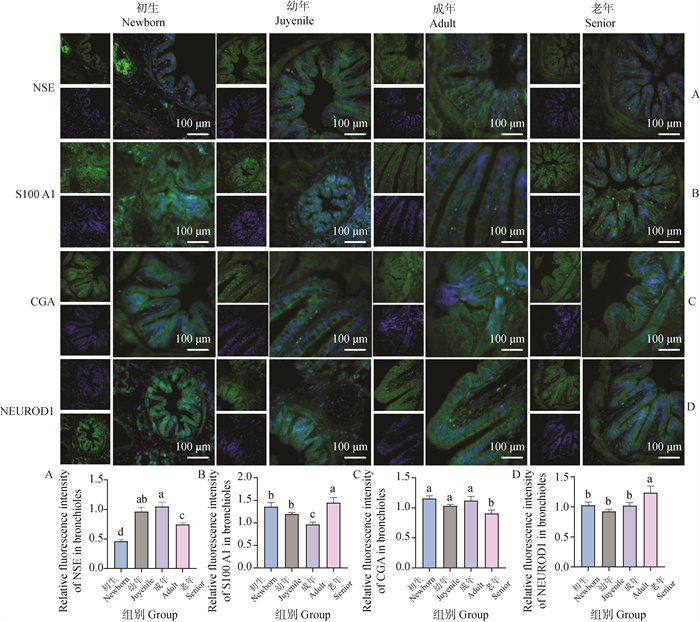
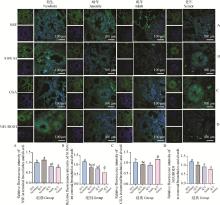
Fig. 6
Immunofluorescence staining and fluorescence intensity of NSE, S100, CGA and NEUROD1 in yak lung terminal bronchioles and alveoli A. The fluorescence intensity of NSE in terminal bronchioles and alveoli of yak at different ages; B. The fluorescence intensity of S100A1 in terminal bronchioles and alveoli of yak at different ages; C. The fluorescence intensity of CGA in terminal bronchioles and alveoli of yak at different ages; D. The fluorescence intensity of NEUROD1 in terminal bronchioles and alveoli of yak at different ages, different lowercase letters mean significant difference (P < 0.05)"
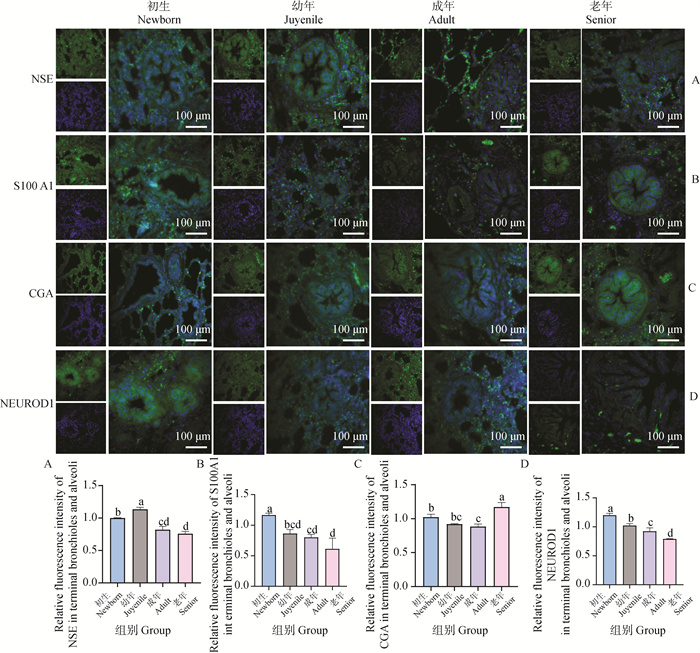
Fig. 7
Transcription levels of NSE、S100A1、CGA and NEUROD1 genes in the lungs of yaks of different ages A. Expression of NSE mRNA level in the lungs of yaks of different ages; B. Expression of S100A1 mRNA level in the lungs of yaks of different ages; C. Expression of CGA mRNA level in the lungs of yaks of different ages; D. Expression of NEUROD1 mRNA level in the lungs of yaks of different ages. Different lowercase letters mean significant difference (P < 0.05)"
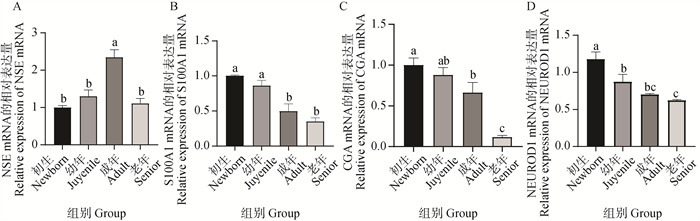
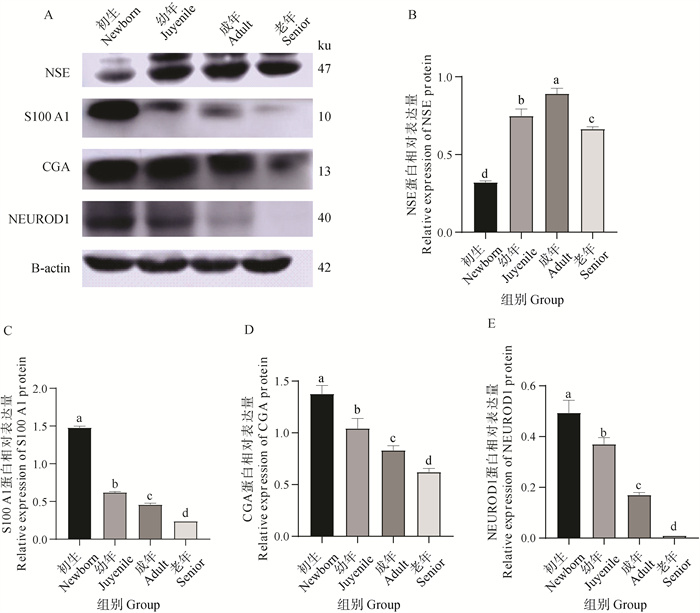
Fig. 8
Expression analysis of NSE, S100A1, CGA and NEUROD1 proteins in the lungs of yaks of different ages A. The Western blot results of NSE, S100 A1, CGA and NEUROD1 proteins; B. Expression of NSE protein in the lungs of yaks of different ages; C. Expression of S100 A1 protein in the lungs of yaks of different ages; D. Expression of CGA protein in the lungs of yaks of different ages; E. Expression of NEUROD1 protein in the lungs of yaks of different ages. Different lowercase letters mean significant difference (P < 0.05)"
| 1 |
NOGUCHI M , FURUKAWA K T , MORIMOTO M . Pulmonary neuroendocrine cells: physiology, tissue homeostasis and disease[J]. Dis Model Mech, 2020, 13 (12): dmm046920.
doi: 10.1242/dmm.046920 |
| 2 |
CUTZ E , JACKSON A . Neuroepithelial bodies as airway oxygen sensors[J]. Respir Physiol, 1999, 115 (2): 201- 214.
doi: 10.1016/S0034-5687(99)00018-3 |
| 3 | GARG A , SUI P , VERHEYDEN J M , et al. Consider the lung as a sensory organ: A tip from pulmonary neuroendocrine cells[J]. Curr Top Dev Biol, 2019, 132, 67- 89. |
| 4 |
BREUER O , COHEN-CYMBERKNOH M , PICARD E , et al. The use of infant pulmonary function tests in the diagnosis of neuroendocrine cell hyperplasia of infancy[J]. Chest, 2021, 160 (4): 1397- 1405.
doi: 10.1016/j.chest.2021.05.032 |
| 5 |
HEWITT R J , LLOYD C M . Regulation of immune responses by the airway epithelial cell landscape[J]. Nat Rev Immunol, 2021, 21 (6): 347- 362.
doi: 10.1038/s41577-020-00477-9 |
| 6 | SOUNTOULIDIS A , MARCO S S , BRAUN E , et al. A topographic atlas defines developmental origins of cell heterogeneity in the human embryonic lung[J]. Nat Cell Biol, 2023, 25 (2): 351- 365. |
| 7 | DONG Y , LI Y , LIU R , et al. Secretagogin, a marker for neuroendocrine cells, is more sensitive and specific in large cell neuroendocrine carcinoma compared with the markers CD56, CgA, Syn and Napsin A[J]. Oncol Lett, 2020, 19 (3): 2223- 2230. |
| 8 |
ZHENG C , ZHONG Y , ZHANG W , et al. Chlorogenic acid ameliorates post-infectious irritable bowel syndrome by regulating extracellular vesicles of gut microbes[J]. Adv Sci (Weinh), 2023, 10 (28): e2302798.
doi: 10.1002/advs.202302798 |
| 9 |
NGUYEN V , TAINE E G , MENG D , et al. Chlorogenic acid: A systematic review on the biological functions, mechanistic actions, and therapeutic potentials[J]. Nutrients, 2024, 16 (7): 924.
doi: 10.3390/nu16070924 |
| 10 |
LEŚNIAK W , GRACZYK-JARZYNK A . The S100 proteins in epidermis: Topology and function[J]. Biochim Biophys Acta, 2015, 1850 (12): 2563- 2572.
doi: 10.1016/j.bbagen.2015.09.015 |
| 11 |
XIA P , JI X , YAN L , et al. Roles of S100A8, S100A9 and S100A12 in infection, inflammation and immunity[J]. Immunology, 2024, 171 (3): 365- 376.
doi: 10.1111/imm.13722 |
| 12 |
BABKINA A S , LYUBOMUDROV M A , GOLUBEV M A , et al. Neuron-specific enolase-what are we measuring[J]. Int J Mol Sci, 2024, 25 (9): 5040.
doi: 10.3390/ijms25095040 |
| 13 |
MA Q , JIANG H , MA L , et al. The moonlighting function of glycolytic enzyme enolase-1 promotes choline phospholipid metabolism and tumor cell proliferation[J]. Proc Natl Acad Sci USA, 2023, 120 (15): e2209435120.
doi: 10.1073/pnas.2209435120 |
| 14 |
MA N , PULS B , CHEN G . Transcriptomic analyses of NeuroD1-mediated astrocyte-to-neuron conversion[J]. Dev Neurobiol, 2022, 82 (5): 375- 391.
doi: 10.1002/dneu.22882 |
| 15 |
BOHUSLAVOVA R , FABRICIOVA V , SMOLIK O , et al. NEUROD1 reinforces endocrine cell fate acquisition in pancreatic development[J]. Nat Commun, 2023, 14 (1): 5554.
doi: 10.1038/s41467-023-41306-6 |
| 16 | AYALEW W , CHU M , LIANG C , et al. Adaptation mechanisms of yak (Bos grunniens) to high-altitude environmental stress[J]. Animals (Basel), 2021, 11 (8): 2344. |
| 17 |
ZHENG Q , WU X , MA X , et al. Genetic structure analysis of yak breeds and their response to adaptive evolution[J]. Genomics, 2024, 116 (5): 110933.
doi: 10.1016/j.ygeno.2024.110933 |
| 18 |
LI J , HUANG N , ZHANG X , et al. Changes of collagen content in lung tissues of plateau yak and its mechanism of adaptation to hypoxia[J]. PeerJ, 2024, 12, e18250.
doi: 10.7717/peerj.18250 |
| 19 |
TROTTA R J , HARMON D L , KLOTZ J L . Serotonin receptor-mediated vasorelaxation occurs primarily through 5-HT4 activation in bovine lateral saphenous vein[J]. Physiol Rep, 2024, 12 (13): e16128.
doi: 10.14814/phy2.16128 |
| 20 |
CANDELI N , DAYTON T . Investigating pulmonary neuroendocrine cells in human respiratory diseases with airway models[J]. Dis Model Mech, 2024, 17 (5): dmm050620.
doi: 10.1242/dmm.050620 |
| 21 |
PRITCHARD D M . New mouse model suggests that some neuroendocrine tumors may originate from neural crest-derived cells[J]. Cell Mol Gastroenterol Hepatol, 2022, 14 (5): 1170- 1171.
doi: 10.1016/j.jcmgh.2022.08.005 |
| 22 |
ACOSTA S , DIZEYI N , PIERZYNOWSKI S , et al. Neuroendocrine cells and nerves in the prostate of the guinea pig: effects of peripheral denervation and castration[J]. Prostate, 2001, 46 (3): 191- 199.
doi: 10.1002/1097-0045(20010215)46:3<191::AID-PROS1023>3.0.CO;2-D |
| 23 |
KVINNSLAND I H , TADOKORO O , HEYERAAS K J , et al. Neuroendocrine cells in Malassez epithelium and gingiva of the cat[J]. Acta Odontol Scand, 2000, 58 (3): 107- 112.
doi: 10.1080/000163500429226 |
| 24 |
MOU H , YANG Y , RIEHS M A , et al. Airway basal stem cells generate distinct subpopulations of PNECs[J]. Cell Rep, 2021, 35 (3): 109011.
doi: 10.1016/j.celrep.2021.109011 |
| 25 |
TAYLOR W . Pulmonary argyrophil cells at high altitude[J]. J Pathol, 1977, 122 (3): 137- 144.
doi: 10.1002/path.1711220304 |
| 26 |
GOSNEY J R . Pulmonary neuroendocrine cells in species at high altitude[J]. Anat Rec, 1993, 236 (1): 105- 112.
doi: 10.1002/ar.1092360114 |
| 27 |
GOSNEY J R . Pulmonary endocrine cells in native Peruvian guinea-pigs at low and high altitude[J]. J Comp Pathol, 1990, 102 (1): 7- 12.
doi: 10.1016/S0021-9975(08)80002-3 |
| 28 |
THAKUR A , MEI S , ZHANG N , et al. Pulmonary neuroendocrine cells: crucial players in respiratory function and airway-nerve communication[J]. Front Neurosci, 2024, 18, 1438188.
doi: 10.3389/fnins.2024.1438188 |
| 29 |
KEITH I M , WILL J A . Hypoxia and the neonatal rabbit lung: neuroendocrine cell numbers, 5-HT fluorescence intensity, and the relationship to arterial thickness[J]. Thorax, 1981, 36 (10): 767- 773.
doi: 10.1136/thx.36.10.767 |
| 30 |
VAN LOMMEL A T , LAUWERYNS J M . Ultrastructure and innervation of neuroepithelial bodies in the lungs of newborn cats[J]. Anat Rec, 1993, 236 (1): 181- 190.
doi: 10.1002/ar.1092360122 |
| 31 |
BALAGUER L , ROMANO J . Solitary neuroendocrine cells and neuroepithelial bodies in the lower airways of embryonic, fetal, and postnatal sheep[J]. Anat Rec, 1991, 231 (3): 333- 338.
doi: 10.1002/ar.1092310306 |
| 32 |
LINGAMALLU S M , DESHPANDE A , JOY N , et al. Neuroepithelial bodies and terminal bronchioles are niches for distinctive club cells that repair the airways following acute notch inhibition[J]. Cell Rep, 2024, 43 (9): 114654.
doi: 10.1016/j.celrep.2024.114654 |
| 33 |
MCDONALD D M , BLEWETT R W . Location and size of carotid body-like organs (paraganglia) revealed in rats by the permeability of blood vessels to Evans blue dye[J]. J Neurocytol, 1981, 10 (4): 607- 643.
doi: 10.1007/BF01262593 |
| 34 | KIM T , GONDRÉ-LEWIS M C , ARNAOUTOVA I , et al. Dense-core secretory granule biogenesis[J]. Physiology (Bethesda), 2006, 21, 124- 133. |
| 35 |
KIM T , TAO-CHENG J H , EIDEN L E , et al. Large dense-core secretory granule biogenesis is under the control of chromogranin A in neuroendocrine cells[J]. Ann N Y Acad Sci, 2002, 971, 323- 331.
doi: 10.1111/j.1749-6632.2002.tb04487.x |
| 36 |
ZENG T , REN W , ZENG H , et al. TFAP2A activates S100A2 to mediate glutamine metabolism and promote lung adenocarcinoma metastasis[J]. Clin Respir J, 2024, 18 (8): e13825.
doi: 10.1111/crj.13825 |
| 37 |
GONZALEZ L L , GARRIE K , TURNER M D . Role of S100 proteins in health and disease[J]. Biochim Biophys Acta Mol Cell Res, 2020, 1867 (6): 118677.
doi: 10.1016/j.bbamcr.2020.118677 |
| 38 | ISGRÒ M A , BOTTONI P , SCATENA R . Neuron-specific enolase as a Biomarker: biochemical and clinical aspects[J]. Adv Exp Med Biol, 2015, 867, 125- 143. |
| 39 |
PIAST M , KUSTRZEBA-WÓJCICKA I , MATUSIEWICZ M , et al. Molecular evolution of enolase[J]. Acta Biochim Pol, 2005, 52 (2): 507- 513.
doi: 10.18388/abp.2005_3466 |
| 40 |
CHAN J M , QUINTANAL-VILLALONGA A , GAO V R , et al. Signatures of plasticity, metastasis, and immunosuppression in an atlas of human small cell lung cancer[J]. Cancer Cell, 2021, 39 (11): 1479- 1496.
doi: 10.1016/j.ccell.2021.09.008 |
| 41 |
PAVLINKOVA G , SMOLIK O . NEUROD1: transcriptional and epigenetic regulator of human and mouse neuronal and endocrine cell lineage programs[J]. Front Cell Dev Biol, 2024, 12, 1435546.
doi: 10.3389/fcell.2024.1435546 |
| [1] | YUAN Yue, ZHOU Jianxu, LUO Xiaolin, GUAN Jiuqiang, AN Tianwu, ZHAO Hongwen, BAI Qin, REN Zili, ZHANG Xiangfei, ZHAO Yanling. Effect of Rumen-Protected Fat on Growth Performance, Serum Biochemistry and Slaughter Performance of Fattening Yaks [J]. Acta Veterinaria et Zootechnica Sinica, 2025, 56(8): 3849-3860. |
| [2] | BAI Yuanyuan, CAI Wenyi, XING Jiayi, JIANG Yuting, MA Zhiwei, JI Wenhui, LAN Daoliang. Comparative Transcriptome Mapping of the Lungs of Yak, Dzho, and Cattle [J]. Acta Veterinaria et Zootechnica Sinica, 2025, 56(7): 3226-3243. |
| [3] | ZHANG Qian, MA Rui, CUI Yan, YU Sijiu. Molecular Mechanism of AMPK/SIRT1 Mediating Adiponectin Promoting Lactate Transport in Yak Sertoli Cells [J]. Acta Veterinaria et Zootechnica Sinica, 2025, 56(7): 3495-3506. |
| [4] | NIU Yueyue, CUI Yan, YU Sijiu, HE Junfeng, YANG Shanshan, QI Zhengman, DOU Wanwan, CHEN Chunyan, DENG Yanjiang. Analysis of JAK2, STAT3, P-JAK2/STAT3 and PCNA Proteins Expression in the Lungs of Yaks of Different Ages [J]. Acta Veterinaria et Zootechnica Sinica, 2025, 56(6): 2957-2967. |
| [5] | QIU Qian, SANG Rui, WANG Wei, LIU Xinman, YU Minghong, LIU Xiaotong, YU Tian, ZHANG Xuemei. Study on the Activity of Huning Powder against Chicken Lung-derived E. coli and the in vitro Effects of Anti-inflammation and Anti-oxidation [J]. Acta Veterinaria et Zootechnica Sinica, 2025, 56(4): 1969-1980. |
| [6] | XIAO Wei, DONG Jiaqi, ZHANG Xiaosong, ZHOU Ke, WEI Yanming. The Effects of Sheng Mai San on the AMPK-mTOR Pathway and Autophagy in the Lungs of Rats under Heat Stress [J]. Acta Veterinaria et Zootechnica Sinica, 2025, 56(10): 5277-5288. |
| [7] | Zenghua LU, Yan CUI, Sijiu YU, Xuefeng BAI, Hongqin LU, Junfeng HE, Kai LU, Guoliang ZHAI, Zhengman QI. Effect of Erythropoietin on the Expression of Apoptotic Factor in Yak Renal Interstitial Fibroblasts [J]. Acta Veterinaria et Zootechnica Sinica, 2024, 55(8): 3460-3471. |
| [8] | Milan MA, Qi WANG, Qiu YAN, Tianan LI, Xingxu ZHAO, Yong ZHANG. Expression of HIG1 Hypoxia Inducible Domain Family Member 1C in Cryptorchidism of Yak and Its Regulatory Mechanism [J]. Acta Veterinaria et Zootechnica Sinica, 2024, 55(7): 2983-2994. |
| [9] | Bohua LIU, Hanyu FU, Yuheng WANG, Suolangsizhu, Jiaqiang NIU, Yuhua BAO, Jiakui LI, Yefen XU. Isolation, Identification and Genome Analysis of Type B Pasteurella multocida Isolated from Yak in Tibetan Nakchu City [J]. Acta Veterinaria et Zootechnica Sinica, 2024, 55(7): 3105-3118. |
| [10] | LUO Ting, HAN Zhu, XU Yefen, CAI Lin, SUOLANG Sizhu, XU Jinhua, NIU Jiaqiang. Whole Genome Sequencing and Sequence Analysis on T10 of Mycoplasma bovis Strain from Yaks in Xizang [J]. Acta Veterinaria et Zootechnica Sinica, 2024, 55(5): 2154-2167. |
| [11] | HUANG Xianpeng, XING Jiayi, BAI Yuanyuan, JIANG Yuting, MA Zhiwei, FU Wei, LAN Daoliang. Cloning of Six Pluripotent Related Transcription Factors OSKMNL in Yak and Construction of Polycistron Lentiviral Vector [J]. Acta Veterinaria et Zootechnica Sinica, 2024, 55(4): 1579-1591. |
| [12] | SHANG Kaiyuan, JIANG Mingfeng, GUAN Jiuqiang, AN Tianwu, ZHAO Hongwen, BAI Qin, WU Weisheng, LI Huade, XIE Rongqing, SHA Quan, LUO Xiaolin, ZHANG Xiangfei. Effects of Maternal Nutritional Regulation in Transition Period on Growth and Development, Serum Biochemistry and Immune Function of Yak Calves [J]. Acta Veterinaria et Zootechnica Sinica, 2024, 55(4): 1638-1648. |
| [13] | ZUO Zizhen, WANG Haibo, CHAI Zhixin, FU Jianhui, ZHANG Xiangfei, LUO Xiaolin, ZHONG Jincheng. Effects of Rumen-protected Methionine on Meat Quality, Volatile Flavor Compounds and Fatty Acid Composition of Yak Semitendinosus [J]. Acta Veterinaria et Zootechnica Sinica, 2024, 55(3): 1102-1114. |
| [14] | LIU Yanchen, ZHOU Shiying, ZHANG Yang, GAO Yang, GUAN Weijun. Isolation, Culture and Biological Characteristics Study of Holstein Bovine Lung Stem Cells [J]. Acta Veterinaria et Zootechnica Sinica, 2024, 55(2): 540-551. |
| [15] | LIU Bin, WANG Meng, PAN Yangyang, WANG Jinglei, XU Gengquan. Effect of LPA on the Expression of HAS2, PTGS2 and PTX3 in Cumulus Cells of Yak (Bos grunniens) [J]. Acta Veterinaria et Zootechnica Sinica, 2024, 55(2): 552-561. |
| Viewed | ||||||
|
Full text |
|
|||||
|
Abstract |
|
|||||
