


Acta Veterinaria et Zootechnica Sinica ›› 2025, Vol. 56 ›› Issue (11): 5512-5530.doi: 10.11843/j.issn.0366-6964.2025.11.014
• Animal Genetics and Breeding • Previous Articles Next Articles
ZHU Gongquan1( ), ZHANG Yuehong1, WANG Jun2, LI Xiaoming2, GE Jing1, MU Xiaohui2, ZHAO Hongchang2, ZHAO Minmeng1, LIU Long1, GONG Daoqing1, WANG Jian2,3,*(), GENG Tuoyu1,*()
Received:2025-04-21
Online:2025-11-23
Published:2025-11-27
Contact:
WANG Jian, GENG Tuoyu
E-mail:1635908337@qq.com;tzwjian@126.com;tygeng@yzu.edu.cn
CLC Number:
ZHU Gongquan, ZHANG Yuehong, WANG Jun, LI Xiaoming, GE Jing, MU Xiaohui, ZHAO Hongchang, ZHAO Minmeng, LIU Long, GONG Daoqing, WANG Jian, GENG Tuoyu. Screening of Genetic Markers and Preliminary Exploration of Molecular Basis for the Traits of the Eyelid-Colobomus and the Dark/Light Yellow Feathers in Goose[J]. Acta Veterinaria et Zootechnica Sinica, 2025, 56(11): 5512-5530.
Table 1
Information of the PCR primers"
| 基因 Gene | 引物 Primer | 序列(5′→3′) Sequence | 产物大小/bp Products size | 备注 Note |
| FREM1 | F R | GTTGCCACTGCTGTCCATTC ATCTGAACAGGGAGCCAAGC | 828 | 扩增CDS片段1 |
| FREM1 | F R | TCAAATTCCCAAACCTGCTC CAGGATCATCTGTCCCTCGT | 742 | 扩增CDS片段2 |
| FREM1 | F R | TTACCAAACCACCACAGGCT TCACCTTCGCTCATGGGAAC | 826 | 扩增CDS片段3 |
| FREM1 | F R | GTGGACACAAAACAGGAGCA AGCCCATCGGTGACATAAAG | 977 | 扩增CDS片段4 |
| FREM1 | F R | AAATGGAGCCAACGACAGAC TGTCTCCCTTTTCCATGTCC | 846 | 扩增CDS片段5 |
| FREM1 | F R | TGTGGGATGGGTACAACAGA CAGAACAGCAGTGGAGGTGA | 801 | 扩增CDS片段6 |
| FREM1 | F R | TCACCTCCACTGCTGTTCTG ACTCTCAGCCTGGTCCTTGA | 885 | 扩增CDS片段7 |
| FREM1 | F R | CTTCACAGTGACTCCCTCCA TGCCTTATCAGCTTGTGGGA | 720 | 扩增CDS片段8 |
| FREM1 | F R | AACCAAGCACAAACGCAGAT GTTCCGTTTGACCTTCCTGC | 603 | 扩增CDS片段9 |
| FREM1 | F R | AGTTCCCAAAGCAAGGAGGT CTTTGGGCAGAGTTCAAAGC | 633 | 扩增CDS片段10 |
| FREM1 | F R | CATGAAGTCTGAAGCTGCCC TGCACTTTCACAGGGATCCT | 554 | 扩增含SNP6的基因组序列 |
| FREM1 | F R | GCAGTATCACCACAGGCAAG TTTCCAGGCTCTGTTTGCAC | 847 | 扩增含SNP10的基因组序列 |
| FREM1 | F R | CTTCACAGTGACTCCCTCCA TGCCTTATCAGCTTGTGGGA | 628 | 扩增含SNP14的基因组序列 |
| FREM1 | F R | AACCAAGCACAAACGCAGAT GTTCCGTTTGACCTTCCTGC | 603 | 扩增含SNP15的基因组序列 |
| PTPRM | F R | GAGAGGGACGAGAAGGAGAG TCCTGCTGCCCCATCTAAAA | 867 | 扩增CDS片段1 |
| PTPRM | F R | AGCCCTCCTCAGATCAATGG TACAGTCCAGTCAGCTTCCC | 851 | 扩增CDS片段2 |
| PTPRM | F R | TGCGGAACTGATAGTCAAAGG TTCTTCAGTGGAGAGAGCCA | 985 | 扩增CDS片段3 |
| PTPRM | F R | TGGAGGACAAGAGCAAGTGA ACACCATACATTCGCATCGC | 945 | 扩增CDS片段4 |
| PTPRM | F R | TGCAGAGTTTCCAGCCAATG TGAAGGCGAAACAAGCTCTG | 983 | 扩增CDS片段5 |
| PTPRM | F R | ACCGTGGGATTCAGCTAAGA GCCTGCCTTTCCTCATAACG | 964 | 扩增CDS片段6 |
| PTPRM | F R | TGAAGGCGAAACAAGCTCTG TCTCAATGTTACGCTTCTACTGC | 926 | 扩增CDS片段7 |
| PTPRM | F R | CGCAGCTTAGTACCAAATGC ACTTCTCACTCCTCACCCTG | 745 | 扩增含SNP5的基因组序列 |
| SLC45A2 | F R | AGTTCCCAAAGCAAGGAGGT CTTTGGGCAGAGTTCAAAGC | 633 | 扩增CDS片段1 |
| SLC45A2 | F R | CATGCCATCCCACTATCGCT AAGCACCAGTGCTACTGACC | 715 | 扩增CDS片段2 |
| SLC45A2 | F R | GTGGATTTGGTCTGCACTGG AGTTTATCGAGGGTGGCACA | 515 | 扩增含SNP2的基因组序列 |
| TYRP1 | F R | GAGAGAAGAGAGGGAGCTGG ACACGCCACTGAGAGAAGAT | 962 | 扩增CDS片段1 |
| TYRP1 | F R | CATGAGGGACCAGCTTTTGT GCTTGGTGTTGCTATGCCAT | 957 | 扩增CDS片段2 |
| TYRP1 | F R | TGGAAGGGGCAGATTGAAGG GCAGAACTTCATTGTAAATGCACCT | 603 | 扩增含SNP1的基因组序列 |
| TYRP1 | F R | GGATTACACATGCTAGGGACA TTCTCACCCCACTGACATCC | 600 | 扩增含SNP2的基因组序列 |
| PRLR | F R | CAAGCTCAACCACTCTGTTATCAA TGGAGTTTCTCTTCAGCCCTA | 557 | 扩增含插入/缺失突变位点的的基因组序列 |
Table 2
The information of the primers for quantitative PCR"
| 基因 Gene | 引物 Primer | 序列(5′→3′) Sequence | 产物大小/bp Products size | 登录号 Accession number |
| DUSP12 | F R | GGCGCTCTCTATTCCGTAGT CACAAGAACACTGCTCACCC | 255 | XM_066990420 |
| ACTC1 | F R | TGTGACAACAGCTGAACGTG CGTTGTTAGCGTACAGGTCC | 246 | XM_048058696 |
| MC3R | F R | GGCACCTTTCTTCCTTCACC CCACACTCATGCCGTAACAG | 203 | XM_048072592 |
| GRM8 | F R | GGGATCCACAGACTAGAGGC GTGAAAATAGGTGGGTCGCC | 212 | XM_048080808 |
| NPSR1 | F R | GAGCAGCTGGTGACTCTTTG GACCACCTGTAAGTAGCGGA | 240 | XM_066991189 |
| FZD10 | F R | CCAGCCCATAGAAATCCCCA CGGTGTAGAAACTTGCTCCG | 205 | XM_013173432 |
| WNT3 | F R | TTTCAAGCCACCAACAGAGC ACTCACATAGCAGCACCAGT | 229 | XM_013201438 |
| CACNA1I | F R | CATCATCTGCCTCAACGTGG TCTTCCAGTGTGATGCCCAT | 225 | XM_048069774 |
| MRPS10 | F R | TCAGAGGAGCCAGAAACACT ACTCCAAGTACACTGCAGCA | 283 | XM_048057518 |
| ANO2 | F R | CATTCCCAAGGACATCAGCG ACGCTGCCTTTCTGACTTTG | 201 | XM_048046752 |
| OBSCN | F R | TCATTGTGTGGGAAGGAGCT CTGAATCTTCCCGTTCGTGC | 231 | XM_066991378 |
| ODF2L | F R | TTGGCAAGCACAGTAGAAGC GCAGCTTTTCGTTTCTGGGA | 221 | XM_048059125 |
| TTN | F R | TCCGCTGTGCAAAAGATCAC GCCTTCTTTCTGCAACACCA | 219 | XM_066999168 |
| PDCD1 | F R | AGTACCTGCTCTCCAACCAC CCTGTAGGTGACGATGCAGT | 296 | XM_048076630 |
| SLITRK4 | F R | CTCCGAGCTGACACTTTCCT TTCCAGGGGTTGTCTTCCAG | 284 | XM_067004832 |
| COL9A1 | F R | TCTCCAGGTGTGAAAGGCAT TGAACCCCTGTCACCCTTAC | 273 | XM_066994732 |
| VIT | F R | GAGATCAGACATCGCCGGTA AGTGCCCCTGAATGCTGTAT | 296 | XM_013170623 |
| UBAP1L | F R | CCATCCTCACCCTCCAGAAG TCTCTCTGGTTCCCGCAAAG | 244 | XM_048076334 |
| PROCR | F R | CATCAACTACACGCAGAGCC GGTGTTGAGGAAATGCTGCA | 235 | XM_048077345 |
| FHAD1 | F R | GACCACAACCTCAGGCAATG GCCATCGCTGCAATTTTGTC | 204 | XM_066982271 |
Table 3
The SNP loci in the coding sequence of FREM1 gene in Huoyan goose"
| 位点 Locus | 位置 Location | 侧翼序列 Flanking sequence | 突变类型 Mutation type |
| SNP1 | c.246T>C | TGCCA(C/T)TTCCT | 同义突变 |
| SNP2 | c.272C>G | ATATA(C/G)TCACA | 同义突变 |
| SNP3 | c.273T>C | TATAC(C/T)CACAA | 同义突变 |
| SNP4 | c.305T>A | AGACA(A/T)GGTCA | 同义突变 |
| SNP5 | c.1976A>C | TGCTC(A/C)CCTCA | 错义突变 |
| SNP6 | c.2502T>C | GAAGG(C/T)GACAG | 同义突变 |
| SNP7 | c.2823G>T | AAAGC(G/T)GGCGT | 错义突变 |
| SNP8 | c.3822G>T | GATGA(G/T)AAACC | 错义突变 |
| SNP9 | c.4304C>T | AACTT(C/T)CCCAC | 错义突变 |
| SNP10 | c.4514T>C | CCAAG(C/T)TTTGC | 错义突变 |
| SNP11 | c.5049T>C | GAAAA(C/T)GTAAC | 同义突变 |
| SNP12 | c.5566A>G | AGTGC(A/G)GCTCT | 错义突变 |
| SNP13 | c.5567G>C | GTGCA(G/C)CTCTT | 错义突变 |
| SNP14 | c.6330C>T | GACTT(C/T)AGTGG | 同义突变 |
| SNP15 | c.6348T>C | GGACA(C/T)TGGGA | 同义突变 |
Table 4
Association analysis between candidate SNPs in coding sequence of FREM1 and the eyelid-colobomus trait of Huoyan goose"
| 位点 Locus | 表型 Phenotype | 样本数 Sample size | 等位基因频率 Allele frequency | P值 P-value | 基因型频率 Genotype frequency | P值 P-value | |||
| C | T | CC | CT | TT | |||||
| SNP6 | 豁眼 | 56 | 0.16 | 0.84 | 0.240 0 | 0.09 | 0.14 | 0.77 | 2.87 |
| 正常 | 19 | 0.21 | 0.79 | 0.05 | 0.32 | 0.63 | |||
| SNP10 | 豁眼 | 72 | 0.75 | 0.25 | 0.007 3 | 0.69 | 0.11 | 0.19 | 0.022 |
| 正常 | 19 | 0.53 | 0.47 | 0.37 | 0.32 | 0.32 | |||
| SNP14 | 豁眼 | 69 | 0.29 | 0.71 | 0.007 2 | 0.19 | 0.20 | 0.61 | 0.043 |
| 正常 | 18 | 0.53 | 0.47 | 0.33 | 0.39 | 0.28 | |||
| SNP15 | 豁眼 | 67 | 0.79 | 0.21 | 0.000 48 | 0.72 | 0.15 | 0.13 | 0.009 0 |
| 正常 | 18 | 0.50 | 0.50 | 0.33 | 0.33 | 0.33 | |||
Table 5
The SNP loci in the coding sequence of PTPRM gene in Huoyan goose"
| 位点 Locus | 位置 Location | 侧翼序列 Flanking sequence | 突变类型 Mutation type |
| SNP1 | c.1131G>A | GATCC(A/G)ATGCG | 同义突变 |
| SNP2 | c.1200G>T | GAACC(G/T)TTTGG | 同义突变 |
| SNP3 | c.2174G>T | CACTC(G/T)AAAAC | 错义突变 |
| SNP4 | c.2202G>C | AAGCA(C/G)ACCGA | 错义突变 |
| SNP5 | c.2625C>T | AGCAG(C/T)CTGGT | 同义突变 |
| SNP6 | c.2997T>A | GAGAC(A/T)ATATA | 同义突变 |
| SNP7 | c.3351T>C | TGCAG(C/T)GCTGG | 同义突变 |
Table 6
Association analysis between SNP5 in the coding sequence of PTPRM gene and the eyelid-colobomus trait of Huoyan goose"
| 表型Phenotype | 样本数 Sample size | 等位基因频率 Allele frequency | P值 P-value | 基因型频率 Genotype frequency | P值 P-value |
| 豁眼Eyelid-colobomus | 70 | C: T=0.54:0.46 | 0.039 | CC: CT: TT=0.30:0.49:0.21 | 0.11 |
| 正常Normal | 20 | C: T=0.72:0.28 | CC: CT: TT=0.55:0.35:0.10 |
Table 7
The SNP loci in the coding sequence of SLC45A2 gene in Huoyan goose"
| 位点 Locus | 位置 Location | 侧翼序列 Flanking sequence | 突变类型 Mutation type |
| SNP1 | c.50A>G | GCAGC(A/G)ACAAG | 错义突变 |
| SNP2 | c.78G>C | GGGCT(G/C)ATCCT | 同义突变 |
| SNP3 | c.113T>A | TCCCA(A/T)TGTAG | 错义突变 |
| SNP4 | c.119C>G | TGTAG(G/C)TTTCA | 错义突变 |
| SNP5 | c.205T>G | CTGAC(G/T)TTATT | 错义突变 |
| SNP6 | c.255G>T | CATCA(G/T)GATAA | 错义突变 |
| SNP7 | c.736T>A | TCTTC(A/T)TCACG | 错义突变 |
| SNP8 | c.738C>G | TTCTT(G/C)ACGGA | 错义突变 |
| SNP9 | c.749T>G | TTTCA(G/T)GGGAC | 错义突变 |
| SNP10 | c.752G>T | CATGG(G/T)ACAGG | 错义突变 |
| SNP11 | c.1038G>A | ACGCT(A/G)TACAC | 错义突变 |
Table 8
Association analysis between SNP2 in the coding sequence of SLC45A2 gene and the trait of dark/light yellow feathers in Huoyan goose"
| 表型 Phenotype | 样本数 Sample size | 等位基因频率 Allele frequency | P值 P-value | 基因型频率 Genotype frequency | P值 P-value |
| 深羽Dark feathers | 27 | G: C=0.85:0.15 | 0.45 | GG: GC: CC=0.82:0.07:0.11 | 0.66 |
| 浅羽Light feather | 69 | G: C=0.89:0.11 | GG: GC: CC=0.84:0.10:0.06 |
Table 9
The nucleotide polymorphism loci in the intron of PRLR gene in Huoyan goose"
| 位点 Locus | 位置 Location | 插入/缺失碱基 Insertion/Deletion bases | 突变类型 Mutation type |
| INS1 | G.126358→G.126359 | AACT | 插入 |
| INS2 | G.126568→G.126569 | TA | 插入 |
| DEL | G.126611→G.126621 | TAAGAATTTGT | 缺失 |
Table 10
Association analysis between nucleotide polymorphism loci in PRLR intron and the trait of dark/light yellow feathers in Huoyan geese"
| 位点 Locus | 表型 Phenotype | 样本数 Sample size | 等位基因频率 Allele frequency | P值 P-value | 基因型频率 Genotype frequency | P值 P-value | |||
| INDEL | 野生型Wild | INDEL | 杂合 Heterozygous | 野生型 Wild | |||||
| INS1 | 深羽 | 29 | 0.34 | 0.66 | 2.35×10⁻⁵ | 0.21 | 0.28 | 0.52 | 0.001 7 |
| 浅羽 | 61 | 0.09 | 0.91 | 0.03 | 0.11 | 0.85 | |||
| DEL | 深羽 | 29 | 0.40 | 0.60 | 0.014 | 0.38 | 0.03 | 0.59 | 0.003 8 |
| 浅羽 | 61 | 0.22 | 0.78 | 0.11 | 0.21 | 0.67 | |||
Table 11
The SNP loci in the coding sequence of TYRP1 gene in Huoyan goose"
| 位点 Locus | 位置 Location | 侧翼序列 Flanking sequence | 突变类型 Mutation type |
| SNP1 | c.195G>A | TGTGT(G/A)CAGGT | 同义突变 |
| SNP2 | c.1161A>G | ACAGG(A/G)GGACA | 同义突变 |
Table 12
Association analysis between the SNP loci in the coding sequence of TYRP1 gene and the trait of dark/light yellow feathers in Huoyan goose"
| 位点 Locus | 羽色 Feather color | 样本数 Sample size | 等位基因频率 Allele frequency | P值 P-value | 基因型频率 Genotype frequency | P值 P-value |
| SNP1 | 深羽 | 27 | G: A=0.74:0.26 | 0.050 | GG: GA: AA=0.67:0.15:0.19 | 0.081 |
| 浅羽 | 68 | G: A=0.86:0.14 | GG: GA: AA=0.77:0.19:0.04 | |||
| SNP2 | 深羽 | 27 | A: G=0.74:0.26 | 0.050 | AA: AG: GG=0.67:0.15:0.19 | 0.081 |
| 浅羽 | 68 | A: G=0.86:0.14 | AA: AG: GG=0.77:0.19:0.04 |
Table 13
The top 10 (the smallest P-value) up- and down-regulated DEGs related to the eyelid-colobomus trait in Huoyan goose"
| 基因 Gene | 豁眼 Eyelid colobomus | 正常 Normal | 倍数的对数 log2fold change | P值 P-value |
| 上调Up-regulation | ||||
| LOC106044829 | 46.9 | 177.7 | 1.92 | 4.72×10⁻⁵ |
| LOC106029457 | 14.6 | 143.3 | 3.29 | 3.51×10⁻⁴ |
| ODF2L | 98.1 | 309.7 | 1.66 | 5.07×10⁻⁴ |
| LOC106029573 | 137.3 | 544.7 | 1.99 | 5.75×10⁻⁴ |
| FHAD1 | 116.2 | 406.6 | 1.81 | 5.97×10⁻⁴ |
| LOC106033930 | 24.4 | 73.7 | 1.60 | 7.43×10⁻⁴ |
| ZNFX1 | 1155.9 | 3510.1 | 1.60 | 9.49×10⁻⁴ |
| LOC106030924 | 3.4 | 42.9 | 3.65 | 1.23×10⁻³ |
| APOBEC1 | 23.8 | 149.8 | 2.65 | 1.49×10⁻³ |
| LOC106041921 | 89.9 | 346.3 | 1.95 | 1.69×10⁻³ |
| 下调Down-regulation | ||||
| MYOC | 141.0 | 17.9 | -2.98 | 5.62×10⁻⁹ |
| LOC106029652 | 81.0 | 0.0 | -8.66 | 1.60×10⁻⁸ |
| MRAP | 322.7 | 108.4 | -1.57 | 5.01×10⁻⁸ |
| STEAP2 | 518.1 | 181.4 | -1.52 | 1.54×10⁻⁷ |
| MEGF10 | 246.2 | 87.1 | -1.50 | 9.79×10⁻⁶ |
| RPL38 | 307.4 | 86.3 | -1.83 | 1.44×10⁻⁵ |
| COL6A6 | 542.9 | 141.6 | -1.94 | 2.75×10⁻⁴ |
| CDH13 | 398.6 | 133.1 | -1.58 | 5.78×10⁻⁴ |
| RAB3C | 72.6 | 21.7 | -1.74 | 6.90×10⁻⁴ |
| LOC106045060 | 498.9 | 157.1 | -1.67 | 6.93×10⁻⁴ |
Table 14
The top 10 (the smallest P-value) up- and down-regulated DEGs related to the trait of dark/light yellow feathers in Huoyan goose"
| 基因 Gene | 深羽 Dark yellow feathers | 浅羽 Light yellow feathers | 倍数的对数 log2fold change | P值 P-value |
| 上调Up-regulation | ||||
| ACTC1 | 1 166.8 | 377.5 | 1.63 | 8.20×10⁻⁵ |
| HGD | 41.7 | 0.0 | 7.83 | 5.94×10⁻⁴ |
| UBB | 1 192.9 | 377.8 | 1.66 | 8.25×10⁻⁴ |
| TM4SF4 | 35.2 | 0.0 | 7.58 | 8.67×10⁻⁴ |
| HMGCS2 | 246.0 | 27.5 | 3.16 | 9.76×10⁻⁴ |
| GC | 335.5 | 38.3 | 3.13 | 1.09×10⁻³ |
| KNG1 | 133.6 | 17.3 | 2.95 | 2.29×10⁻⁴ |
| APOH | 266.8 | 30.1 | 3.15 | 2.37×10⁻³ |
| DUSP12 | 176.6 | 39.0 | 2.18 | 2.74×10⁻³ |
| LOC106037939 | 207.2 | 27.1 | 2.94 | 2.83×10⁻³ |
| 下调Down-regulation | ||||
| LOC106040172 | 3.9 | 245.5 | -5.90 | 2.92×10⁻¹² |
| LOC106030726 | 2.9 | 292.9 | -6.83 | 5.46×10⁻¹² |
| VWA3B | 0.0 | 276.5 | -10.59 | 1.15×10⁻¹⁰ |
| B3GNT7 | 0.0 | 225.1 | -10.29 | 1.99×10⁻¹⁰ |
| LOC106033866 | 0.0 | 200.2 | -10.12 | 3.02×10⁻⁹ |
| MC3R | 0.0 | 174.5 | -9.93 | 6.36×10⁻⁹ |
| LOC106041797 | 0.0 | 173.5 | -9.92 | 8.65×10⁻⁹ |
| MYT1 | 0.0 | 143.3 | -9.64 | 1.32×10⁻⁸ |
| PKHD1 | 0.0 | 150.6 | -9.71 | 1.34×10⁻⁸ |
| COL9A1 | 0.0 | 150.7 | -9.71 | 2.09×10⁻⁸ |
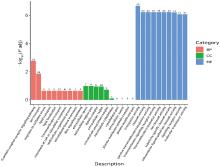
Fig. 1
GO functional enrichment analysis of DEGs related to the trait of dark/light yellow feathers Histogram of GO enrichment analysis: The abscissa is GO term, and the ordinate is the significance level of GO term enrichment, which is expressed as-log10(P adj), with different colors indicating different functional classifications"
Fig. 2
GO functional enrichment analysis of DEGs related to the eyelid-colobomus trait Histogram of GO enrichment analysis: The abscissa is GO term, and the ordinate is the significance level of GO term enrichment, which is expressed as-log10(P adj), with different colors indicating different functional classifications"
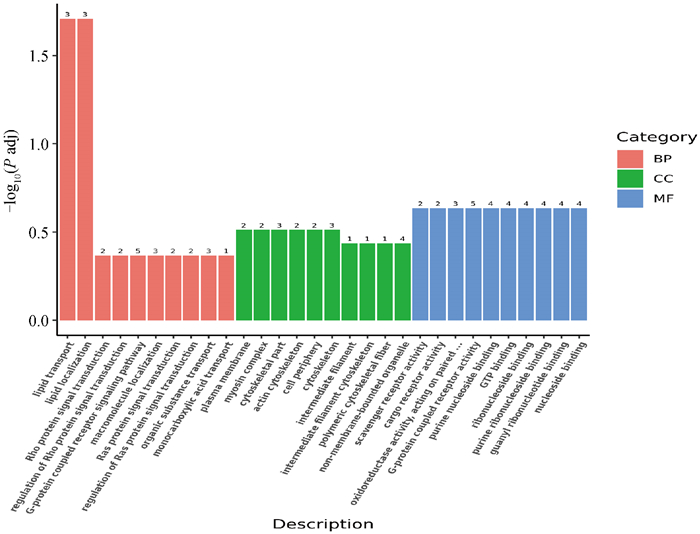
Fig. 3
The KEGG pathway enrichment analysis of DEGs related to the trait of dark/light yellow feathers The scatter diagram showing the KEGG enrichment analysis of the DEGs, the abscissa is the ratio of the number of DEGs annotated to the KEGG pathway to the total number of the DEGs, the ordinate is the KEGG pathways, the sizes of the points represent the number of genes annotated to the KEGG pathway, and the colors from red to purple represent the significant level of enrichment"
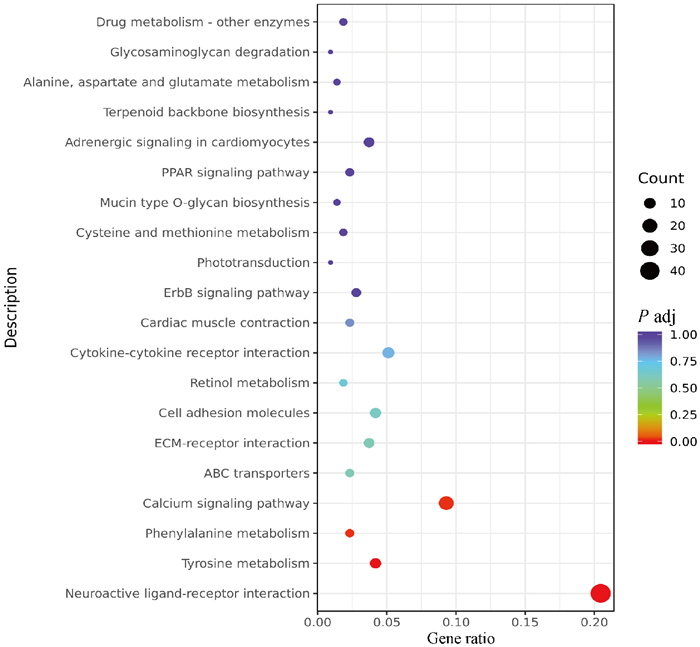
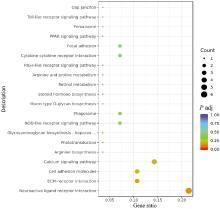
Fig. 4
The KEGG pathway enrichment analysis of DEGs related to the eyelid-colobomus trait The scatter diagram showing the KEGG enrichment analysis of the DEGs, the abscissa is the ratio of the number of DEGs annotated to the KEGG pathway to the total number of the DEGs, the ordinate is the KEGG pathways, the sizes of the points represent the number of genes annotated to the KEGG pathway, and the colors from red to purple represent the significant level of enrichment"
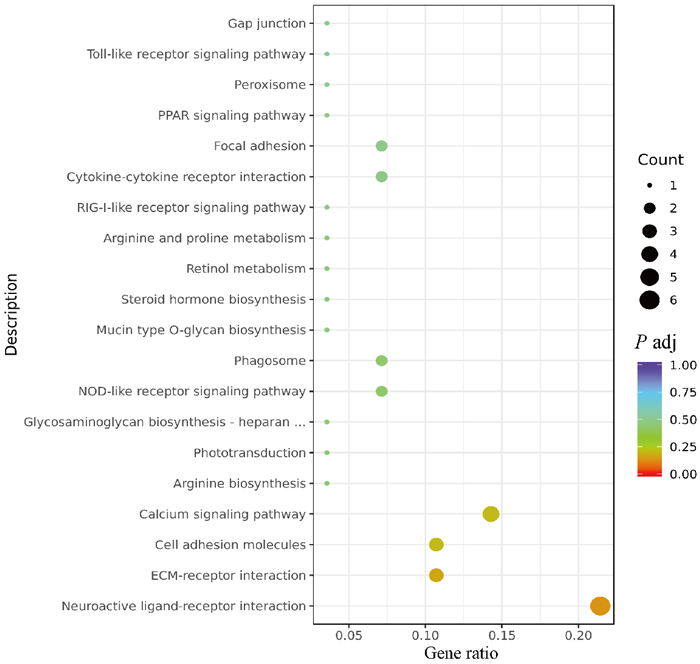
Fig. 5
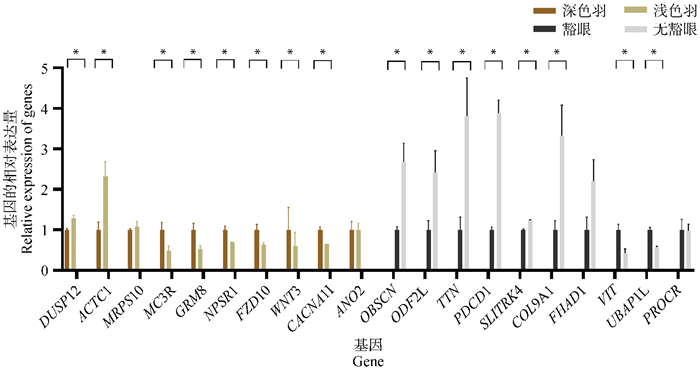
The verification of randomly selected DEGs by RT-qPCR analysis(n=6)"
| 1 | 侯水生, 刘灵芝. 2023年水禽产业与技术发展报告[J]. 中国畜牧杂志, 2024, 60 (3): 318- 321. |
| HOU S S , LIU L Z . Report on the development of waterfowl industry and technology in 2023[J]. Chinese Journal of Animal Husbandry, 2024, 60 (3): 318- 321. | |
| 2 | XU X , WANG S , FENG Z , et al. Sex identification of feather color in geese and the expression of melanin in embryonic dorsal skin feather follicles[J]. Animals(Basel), 2022, 12 (11): 1427. |
| 3 | 于金成, 李喆, 于宁, 等. 基于F2群体的豁眼鹅豁眼性状遗传分析[J]. 中国农业科学, 2016, 49 (19): 3845- 3851. |
| YU J C , LI Z , YU N , et al. Genetic analysis of huoyan trait based on F2 resource population in huoyan goose[J]. Scientia Agricultura Sinica, 2016, 49 (19): 3845- 3851. | |
| 4 | 于金成, 于宁, 赵辉, 等. 鹅豁眼性状H基因座候选基因FREM1的验证分析[J]. 中国农业科学, 2017, 50 (12): 2371- 2379. |
| YU J C , YU N , ZHAO H , et al. Candidate gene FREM1 of H locus of huoyan trait in goose[J]. Scientia Agricultura Sinica, 2017, 50 (12): 2371- 2379. | |
| 5 |
BECK T F , SHCHELOCHKOV O A , YU Z , et al. Novel frem1-related mouse phenotypes and evidence of genetic interactions with gata4 and slit3[J]. PLoS One, 2013, 8 (3): e58830.
doi: 10.1371/journal.pone.0058830 |
| 6 |
CHEN X , YU B , WANG Z , et al. Two novel mutations within FREM1 gene in patients with bifid nose[J]. BMC Pediatr, 2023, 23 (1): 631.
doi: 10.1186/s12887-023-04453-9 |
| 7 | NATHANSON J , SWARR D T , SINGER A , et al. Novel FREM1 mutations expand the phenotypic spectrum associated with Manitoba-oculo-tricho-anal (MOTA) syndrome and bifid nose renal agenesis anorectal malformations (BNAR) syndrome[J]. Am J Med Genet A, 2013, 161a (3): 473- 478. |
| 8 |
SLAVOTINEK A M , BARANZINI S E , SCHANZE D , et al. Manitoba-oculo-tricho-anal (MOTA) syndrome is caused by mutations in FREM1[J]. J Med Genet, 2011, 48 (6): 375- 382.
doi: 10.1136/jmg.2011.089631 |
| 9 |
MITTER D , SCHANZE D , STERKER I , et al. MOTA syndrome: Molecular genetic confirmation of the diagnosis in a newborn with previously unreported clinical features[J]. Mol Syndromol, 2012, 3 (3): 136- 139.
doi: 10.1159/000341501 |
| 10 |
ESHO T , KOBBE B , TUFA S F , et al. The fraser complex proteins (frem1, frem2, and fras1) can form anchoring cords in the absence of AMACO at the dermal-epidermal junction of mouse skin[J]. Int J Mol Sci, 2023, 24 (7): 6782.
doi: 10.3390/ijms24076782 |
| 11 |
CHEN X , YU B , WANG Z , et al. Two novel mutations within FREM1 gene in patients with bifid nose[J]. BMC Pediatr, 2023, 23 (1): 631.
doi: 10.1186/s12887-023-04453-9 |
| 12 | PETROU P , MAKRYGIANNIS A K , CHALEPAKIS G . The Fras1/Frem family of extracellular matrix proteins: structure, function, and association with fraser syndrome and the mouse bleb phenotype[J]. Connect Tissue Res, 2008, 49 (3): 277- 282. |
| 13 |
PAVLAKIS E , CHIOTAKI R , CHALEPAKIS G . The role of FRAS1/FREM proteins in the structure and function of basement membrane[J]. Int J Biochem Cell Biol, 2011, 43 (4): 487- 495.
doi: 10.1016/j.biocel.2010.12.016 |
| 14 | WEN J , YU J , ZHANG L , et al. Genomic analysis reveals candidate genes underlying sex-linked eyelid coloboma, feather color traits, and climatic adaptation in huoyan geese[J]. Animals(Basel), 2023, 13 (23): 3608. |
| 15 |
SUN P H , YE L , MASON M D , et al. Protein tyrosine phosphatase μ (PTP μ or PTPRM), a negative regulator of proliferation and invasion of breast cancer cells, is associated with disease prognosis[J]. PLoS One, 2012, 7 (11): e50183.
doi: 10.1371/journal.pone.0050183 |
| 16 | 于金成, 李喆, 于宁, 等. 鹅伴性羽色性状的遗传分析[J]. 中国农业科学, 2019, 52 (5): 949- 954. |
| YU J C , LI Z , YU N , et al. Genetic analysis of sex-linked plumage color traits of goose[J]. Scientia Agricultura Sinica, 2019, 52 (5): 949- 954. | |
| 17 | 蒋明. 乌鸡黑色素沉积机理及分子标记筛选的研究[D]. 长沙: 湖南农业大学, 2016. |
| JIANG M. The mechanism of melanin deposition and selection for molecular markers in black-bone Chicken[D]. Changsha: Hunan Agricultural University, 2016. (in Chinese) | |
| 18 | 刘喜魁, 郑明德, 林晓, 等. 白来航蛋鸡SLC45A2基因不同位点突变与银羽性状关联研究[J]. 畜牧与兽医, 2023, 55 (3): 14- 21. |
| LIU X K , ZHENG M D , LIN X , et al. Association of mutations at different loci of the SLC45A2 gene with silver feather traits in white Laihang laying hens[J]. Animal Husbandry & Veterinary Medicine, 2023, 55 (3): 14- 21. | |
| 19 | LI R , WANG Y , LIU Y , et al. Effects of SLC45A2 and GPNMB on melanin deposition based on transcriptome sequencing in chicken feather follicles[J]. Animals (Basel), 2023, 13 (16): 2608. |
| 20 |
D'ISCHIA M , WAKAMATSU K , CICOIRA F , et al. Melanins and melanogenesis: from pigment cells to human health and technological applications[J]. Pigment Cell Melanoma Res, 2015, 28 (5): 520- 544.
doi: 10.1111/pcmr.12393 |
| 21 | 崔梦笛, 倪慧勇, 刘华格, 等. 鸡金银羽位点基因型PCR-RFLP鉴定方法的建立及其应用研究[J]. 中国家禽, 2023, 45 (2): 8- 14. |
| CUI M D , NI H Y , LIU H G , et al. Establishment and application of PCR-RFLP method for genotype identification of golden-and silver-feather locus in chicken[J]. China Poultry, 2023, 45 (2): 8- 14. | |
| 22 | 张静, 刘毅, 刘安芳. 畜禽羽色候选基因ASIP和TYRP1的研究进展[J]. 中国家禽, 2015, 37 (1): 55- 58. |
| ZHANG J , LIU Y , LIU A F . progress of candidate genes asip and tyrp1 for plumage color in animal[J]. China Poultry, 2015, 37 (1): 55- 58. | |
| 23 |
LIU Y , LI G , GUO Z , et al. Transcriptome analysis of sexual dimorphism in dorsal down coloration in goslings[J]. BMC Genomics, 2024, 25 (1): 505.
doi: 10.1186/s12864-024-10394-z |
| 24 |
BOUTIN J M , EDERY M , SHIROTA M , et al. Identification of a cDNA encoding a long form of prolactin receptor in human hepatoma and breast cancer cells[J]. Mol Endocrinol, 1989, 3 (9): 1455- 1461.
doi: 10.1210/mend-3-9-1455 |
| 25 |
BRISKEN C , ATACA D . Endocrine hormones and local signals during the development of the mouse mammary gland[J]. Wiley Interdiscip Rev Dev Biol, 2015, 4 (3): 181- 195.
doi: 10.1002/wdev.172 |
| 26 | 邱莫寒, 余春林, 张增荣, 等. 鸡快慢羽速基因研究进展[J]. 当代畜牧, 2024 (6): 41- 43. |
| QIU M H , YU C L , ZHANG Z R , et al. Research progress of chicken fast and slow feathering gene[J]. Contemporary Animal Husbandry, 2024 (6): 41- 43. | |
| 27 | 李媛媛, 宋鹏琰, 周荣艳. 鸡快慢羽的分子基础及其应用[J]. 北方牧业, 2022 (4): 21. |
| LI Y Y , SONG P Y , ZHOU R Y . Molecular basis and application of fast and slow feathers in chicken[J]. Northern Animal Husbandry, 2022 (4): 21. | |
| 28 | 付华丽, 莫国东, 伍子放, 等. 地方品种鸡ev21基因和JS序列分布对鸡羽速表型的影响[J]. 中国家禽, 2021, 43 (3): 11- 15. |
| FU L H , MO G D , WU Z F , et al. Effect of ev21 gene and JS sequence of distribution local breed chickens on feather speed phenotype[J]. China Poultry, 2021, 43 (3): 11- 15. | |
| 29 | 杜小龙. 太行鸡PRLR基因表达与羽型关系研究[D]. 保定: 河北农业大学, 2021. |
| DU X L. Research of the relationship between PRLR expression and feather types in taihang chickens[D]. Baodin: Hebei Agricultural University, 2021. (in Chinese) | |
| 30 | 杜小龙, 张乐超, 赵丽杰, 等. 太行鸡胚PRLR基因表达与主翼羽和覆主翼羽长关系[J]. 中国兽医学报, 2020, 40 (9): 1847- 1853. |
| DU X L , ZHANG L C , ZHAO L J , et al. Expression of PRLR gene and feather length variation in taihang chicken embryos research background[J]. Chinese Journal of Veterinary Science, 2020, 40 (9): 1847- 1853. | |
| 31 |
OETTING W S , CHURILLA A M , YAMAMOTO H , et al. C pigment locus mutants of the fowl produce enzymatically inactive tyrosinase-like molecules[J]. J Exp Zool, 1985, 235 (2): 237- 245.
doi: 10.1002/jez.1402350210 |
| 32 | 丁颖, 邢娅, 王倩倩, 等. TYRP1和MLANA影响朗德鹅羽色形成的机制研究[J]. 中国家禽, 2018, 40 (9): 6- 10. |
| DING Y , XING Y , WANG Q Q , et al. Involvement of TYRP1 and MLANA in formation of feather color of landes goose[J]. China Poultry, 2018, 40 (9): 6- 10. | |
| 33 | 赵净颖, 李丰耘, 豆腾飞, 等. 动物黑色素形成及调控机制研究进展[J]. 中国畜牧杂志, 2022, 58 (10): 65- 71. |
| ZHAO J Y , LI F Y , DOU T F , et al. Research progress on the formation and regulation mechanism of animal melanin[J]. Chinese Journal of Animal Science, 2022, 58 (10): 65- 71. | |
| 34 |
NAKAMURA H , FUKUDA M . Establishment of a synchronized tyrosinase transport system revealed a role of TYRP1 in efficient melanogenesis by promoting tyrosinase targeting to melanosomes[J]. Sci Rep, 2024, 14 (1): 2529.
doi: 10.1038/s41598-024-53072-6 |
| 35 |
SMYTH I , DU X , TAYLOR M S , et al. The extracellular matrix gene FREM1 is essential for the normal adhesion of the embryonic epidermis[J]. Proc Natl Acad Sci U S A, 2004, 101 (37): 13560- 13565.
doi: 10.1073/pnas.0402760101 |
| [1] | LIN Xiao, LI Ruijie, LIU Long, GENG Tuoyu, GONG Daoqing. Research Progress on Sex Determining Genes and Their Methylation Regulation in Animals [J]. Acta Veterinaria et Zootechnica Sinica, 2025, 56(9): 4129-4142. |
| [2] | MIAO Junjie, ZHANG Riquan, WU Houyi, YOU Xinming, HUANG Yiwen, HUANG Xiaoying, GUO Zhenyang, LIU Jianlin, XIAO Weihua, GUO Tianhua, CHEN Hao, KANG Dongliu. Genome-Wide SNP Analysis Revealed the Characteristics of Germplasm Resources and Genetic Diversity of Jinggang Black-Palm Geese [J]. Acta Veterinaria et Zootechnica Sinica, 2025, 56(7): 3199-3209. |
| [3] | WANG Yuqing, XING Ya, ZHOU Xiaoyi, GONG Haizhou, ZHAO Minmeng, LIU Long, GONG Daoqing, GE Jing, GENG Tuoyu. Mitochondrial AMPK (mAMPK) Regulates Mitochondrial Function and Participates in the Formation of Goose Fatty Liver [J]. Acta Veterinaria et Zootechnica Sinica, 2025, 56(7): 3210-3225. |
| [4] | SU Meng, LIU Sha, SONG Danli, GAO Qianmei, ZHENG Maiqing, WEN Jie, ZHAO Guiping, LI Qinghe. Identification of Candidate Genes Associated with Ascites Syndrome in Broilers Based on Transcriptome Sequencing [J]. Acta Veterinaria et Zootechnica Sinica, 2025, 56(2): 559-570. |
| [5] | WAN Weican, HE Xu, LIU Yang, MA Yuyong, JIANG Yuzhang, DAI Qiuzhong, YAN Haifeng, JIANG Guitao, LI Chuang. Evaluation of Daozhou Gray Goose Conservation Based on Whole Genome Resequencing Analysis [J]. Acta Veterinaria et Zootechnica Sinica, 2025, 56(2): 633-642. |
| [6] | YU Bingyu, YE Yitong, CHEN Yixing, ZHANG Meilin, YANG Zhican, CHEN Jidang, ZHU Wanjun, ZHANG Jipei. Antimicrobial Resistance Analysis of Escherichia coli from Goose in Guangdong [J]. Acta Veterinaria et Zootechnica Sinica, 2025, 56(10): 5202-5211. |
| [7] | Zijin YUAN, Wanxin WANG, Ya XING, Jiahui LI, Ying XUE, Jing GE, Minmeng ZHAO, Long LIU, Daoqing GONG, Tuoyu GENG. HDLBP Is Involved in Goose Fatty Liver Formation by Regulating the Level of Oxidative Stress and the Expression of Inflammatory Factors [J]. Acta Veterinaria et Zootechnica Sinica, 2024, 55(9): 3897-3913. |
| [8] | Hongyan HUANG, Liyun ZHANG, Zhirong HUANG, Zhongping WU, Xumeng ZHANG, Hongjia OUYANG, Junpeng CHEN, Zhenping LIN, Yunbo TIAN, Xiujin LI, Yunmao HUANG. The Study on Population Genetic Diversity and Genome-wide Association Study of Body Weight and Size Traits for Lion-head Geese [J]. Acta Veterinaria et Zootechnica Sinica, 2024, 55(9): 3914-3924. |
| [9] | Yan WANG, Yadong GAO, Chenghui JIANG, Qiaoying ZENG. Isolation and Pathogenicity of a Goose Derived Fowl Adenovirus Type 4 [J]. Acta Veterinaria et Zootechnica Sinica, 2024, 55(9): 4232-4240. |
| [10] | CHEN Zhe, QU Xiaolu, GUO Binbin, SUN Xuefeng, YAN Leyan. Study on Candidate Genes for Green Light Affecting Early Development of Goose Embryo Heart Based on Transcriptome Sequencing [J]. Acta Veterinaria et Zootechnica Sinica, 2024, 55(5): 1978-1988. |
| [11] | GAO Yawei, PENG Di, SUN Zhaoyang, YAN Ziyue, CUI Kai, MA Zefang. Mining the Molecular Mechanism of Exogenous Melatonin Affecting the Development of Mink Ovary Based on Transcriptome Data [J]. Acta Veterinaria et Zootechnica Sinica, 2024, 55(2): 607-618. |
| [12] | Wanxin WANG, Zijin YUAN, Gongquan ZHU, Yuqing WANG, Ying XUE, Jing GE, Minmeng ZHAO, Long LIU, Daoqing GONG, Tuoyu GENG. ACSBG2 Gene Mediates the Response of Goose Liver to Nutritional Changes through Steroid Hormone Synthesis and Cell Adhesion-related Pathways [J]. Acta Veterinaria et Zootechnica Sinica, 2024, 55(11): 5018-5034. |
| [13] | Yinliang ZHANG, Ran ZHANG, Wenjun WANG, Dehe WANG, Lanhui LI, Rongyan ZHOU. Mining of Key Candidate Genes Involved in Bone Metabolism Differences at Pre- and Post-laying Stage Based on Transcriptome Data in Laying Hens [J]. Acta Veterinaria et Zootechnica Sinica, 2024, 55(10): 4455-4465. |
| [14] | QING Enhua, TANG Bincheng, NIU Tian, WANG Junqi, CHEN Zhaoyan, HU Jiwei, HE Hua, LI Liang, WANG Jiwen, HU Shenqiang. Effects of Different Dry Rearing Systems on Histomorphology of Goose Testis and External Genitalia [J]. Acta Veterinaria et Zootechnica Sinica, 2023, 54(7): 2872-2885. |
| [15] | WANG Zixuan, WANG Qiao, ZHANG Jin, Astrid Lissette Barreto Sánchez, ZHENG Maiqing, LI Qinghe, CUI Huanxian, AN Bingxing, ZHAO Guiping, WEN Jie, LI Hegang. Transcriptome Based Screening of Functional Genes Related to Heat Stress Resistance in Beijing You Chickens and Guangming Broilers [J]. Acta Veterinaria et Zootechnica Sinica, 2023, 54(5): 1905-1914. |
| Viewed | ||||||
|
Full text |
|
|||||
|
Abstract |
|
|||||
