


畜牧兽医学报 ›› 2025, Vol. 56 ›› Issue (12): 6487-6501.doi: 10.11843/j.issn.0366-6964.2025.12.049
杨文慧1( ), 王菲菲1, 李晨雷1, 孙宇1, 秦俊杰2, 朱浩2, 郭延生1,*()
收稿日期:2025-02-27
出版日期:2025-12-23
发布日期:2025-12-24
通讯作者:
郭延生
E-mail:ywh2425796178@163.com;guoyansheng1978@163.com
作者简介:杨文慧(2000-),女,河南信阳人,硕士生,主要从事中兽医学研究,E-mail:ywh2425796178@163.com
基金资助:
YANG Wenhui1(), WANG Feifei1, LI Chenlei1, SUN Yu1, QIN Junjie2, ZHU Hao2, GUO Yansheng1,*()
Received:2025-02-27
Online:2025-12-23
Published:2025-12-24
Contact:
GUO Yansheng
E-mail:ywh2425796178@163.com;guoyansheng1978@163.com
摘要:
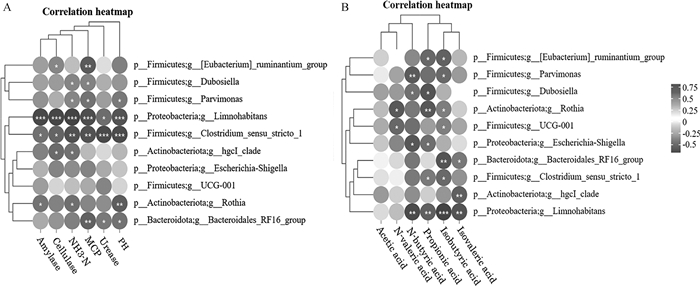
本试验旨在研究四君子散对产后奶牛瘤胃菌群及其发酵能力的调节作用,以揭示其健脾效应的作用机制。试验将16头体重(600 kg±30 kg)、体况(3.0~3.5)、胎次相近的待产荷斯坦奶牛随机均分为试验组和对照组。试验组奶牛待分娩后于每天晨饲前灌服300 g四君子散,对照组奶牛灌服等体积干净饮用水,连续灌服7 d。在第8天晨饲前采集两组奶牛瘤胃液,采用ELISA法检测瘤胃发酵参数,气相色谱法测定瘤胃挥发性脂肪酸含量,16S rRNA高通量测序技术分析瘤胃菌群数量和结构变化。结果表明:灌服四君子散后,瘤胃pH无显著性变化(P>0.05),氨态氮(NH3-N)、微生物蛋白(MCP)、纤维素酶和α-淀粉酶含量增加(P<0.01),脲酶活性升高(P < 0.05);瘤胃丙酸和异丁酸的含量降低(P < 0.05),正丁酸的含量增高(P<0.01);瘤胃优势菌群在门水平无显著变化(P>0.05),仍为拟杆菌门(Bacteroidota)和厚壁菌门(Firmicutes),但在属水平上,普雷沃氏菌属、理研菌科RC9菌属增多,Muribaculaceae菌属减少,另外10种非优势菌群在丰度上也发生了显著改变,6种有益菌属显著上调(P<0.05),包括[Eubacterium]_ruminantium_group、Rothia、Bacteroidales_RF16_group、Limnohabitans、hgcI_clade和Escherichia-Shigella,4种有害菌属显著下调(P<0.05),包括UCG-001、Clostridium_sensu_stricto_1、Dubosiella和Parvimonas。相关性分析显示,Rothia与α-淀粉酶、丙酸和异丁酸呈正相关(P<0.05);Limnohabitans与脲酶、纤维素酶、α-淀粉酶、NH3-N、MCP、丙酸、异丁酸含量呈正相关(P<0.05),与pH呈负相关(P<0.001);HgcI_clade与NH3-N呈正相关(P<0.05);Clostridium_sensu_stricto_1与pH呈负相关(P<0.001);Dubosiella与MCP、NH3-N和丙酸呈负相关(P<0.05);Parvimonas与MCP和NH3-N呈负相关(P<0.05)。结果提示,四君子散健脾效应可能与调节瘤胃菌群丰度和增强瘤胃内消化酶活性密切相关。
中图分类号:
杨文慧, 王菲菲, 李晨雷, 孙宇, 秦俊杰, 朱浩, 郭延生. 基于奶牛瘤胃菌群分析四君子散健脾效应的作用机制[J]. 畜牧兽医学报, 2025, 56(12): 6487-6501.
YANG Wenhui, WANG Feifei, LI Chenlei, SUN Yu, QIN Junjie, ZHU Hao, GUO Yansheng. Study on the Mechanism of Sijunzi San to Strengthen Spleen based on Rumen Flora of Dairy Cows[J]. Acta Veterinaria et Zootechnica Sinica, 2025, 56(12): 6487-6501.
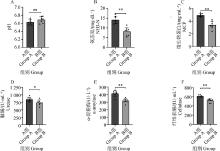
图 1
四君子散对产后奶牛瘤胃相关发酵参数的影响 A. 瘤胃液pH;B. NH3-N浓度;C. MCP;D. 脲酶;E. α-淀粉酶;F. 纤维素酶。*.P < 0.05;**.P < 0.01;ns.P>0.05"
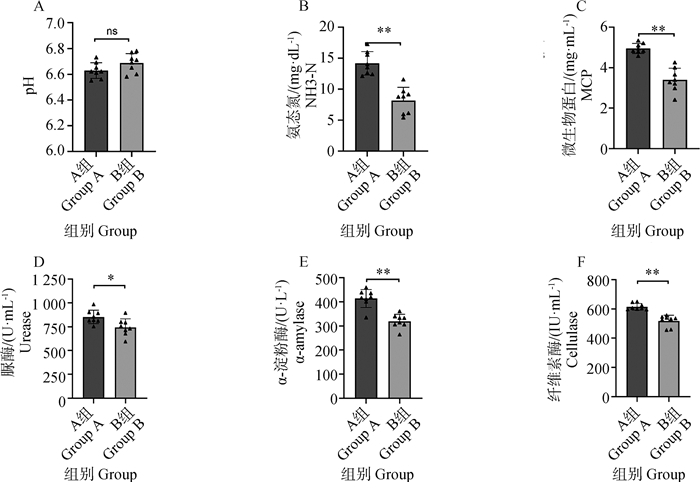
表 1
四君子散对奶牛VFA的影响($\bar x \pm s$)"
| 样品名称 Sample name | A组 Group A | B组 Group B | P值 P-value |
| 乙酸Acetic acid | 53.06±11.70 | 59.43±19.10 | >0.05 |
| 丙酸Propionic acid | 22.89±5.35 | 30.30±5.88 | <0.05 |
| 异丁酸Isobutyric acid | 0.34±0.18 | 0.45±0.16 | <0.05 |
| 正丁酸N-butyric acid | 17.66±3.58 | 13.81±2.47 | <0.01 |
| 异戊酸Isovaleric acid | 1.67±0.53 | 1.81±0.57 | >0.05 |
| 正戊酸N-valeric acid | 1.85±0.48 | 2.29±0.70 | >0.05 |
| 总挥发性脂肪酸Total VFA | 97.49±15.14 | 108.12±25.62 | >0.05 |
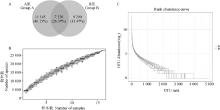
图 2
四君子散对奶牛瘤胃菌群OTU的影响 A.两组瘤胃液样本OTUs韦恩图;B.Specaccum物种累积曲线图;C.丰度等级曲线图。图B的横坐标表示样本数量,纵坐标表示观测到的物种数(ASV/OTU),蓝色区域展示了样本曲线的置信区间。图C中,横坐标按丰度排序的ASV/OTU编号;纵坐标显示的是每个ASV/OTU在样本(组)中的丰度(平均值)的对数(以2为底)。每条折线代表一个样本"
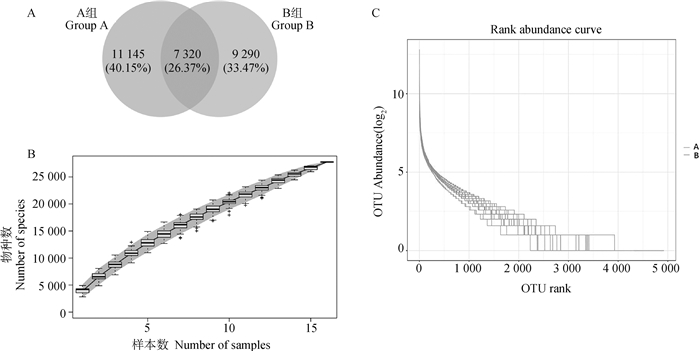
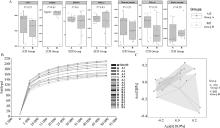
图 3
四君子散对瘤胃菌群多样性的影响 A.Alpha多样性指数箱线图; B.Alpha多样性指数稀疏曲线图;C.PCoA可视化分析图"
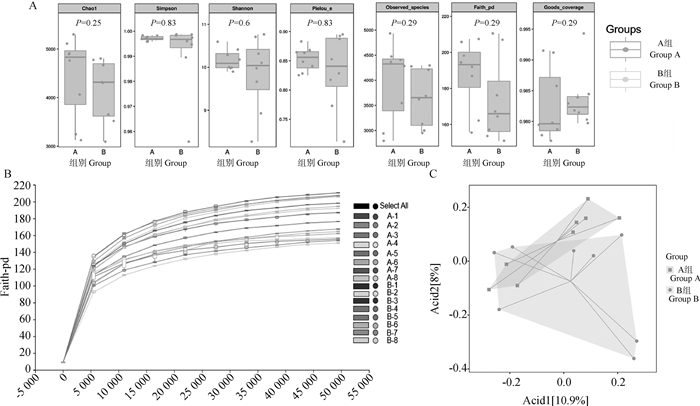
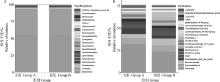
图 4
四君子散对奶牛瘤胃菌群结构的影响 A.物种分布柱状图(门水平); B.特种分布柱状图(属水平)"
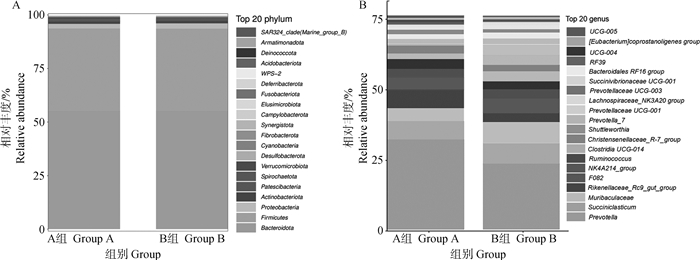
表 2
四君子散对产后奶牛瘤胃菌群属水平相对丰度的影响(前10位,$\bar x \pm s$)"
| 项目 Item | A组 Group A | B组 Group B | P值 P-value |
| Prevotella | 31.12±4.19 | 20.77±3.15 | <0.05 |
| Succiniclasticum | 6.66±1.70 | 6.80±1.44 | >0.05 |
| Rikenellaceae_RC9_gut_group | 6.35±0.98 | 2.94±1.42 | <0.05 |
| Muribaculaceae | 4.57±0.88 | 6.61±0.50 | <0.05 |
| F082 | 4.36±0.64 | 4.34±1.21 | >0.05 |
| NK4A214_group | 3.13±0.93 | 3.07±0.55 | >0.05 |
| Ruminococcus | 3.43±0.81 | 2.52±0.38 | >0.05 |
| Clostridia_UCG-014 | 1.91±0.14 | 3.10±0.65 | >0.05 |
| Christensenellaceae_R-7_group | 2.83±0.85 | 2.07±0.56 | >0.05 |
| Shuttleworthia | 0.65±0.25 | 3.40±2.38 | >0.05 |
图 5
四君子散对奶牛瘤胃菌群组成差异的影响 A. LDA效应值柱状图;B. 物种分类学分枝图, 分类学分枝图展示了样本群落中从门到属(从内圈到外圈)主要分类单元的分类等级关系"
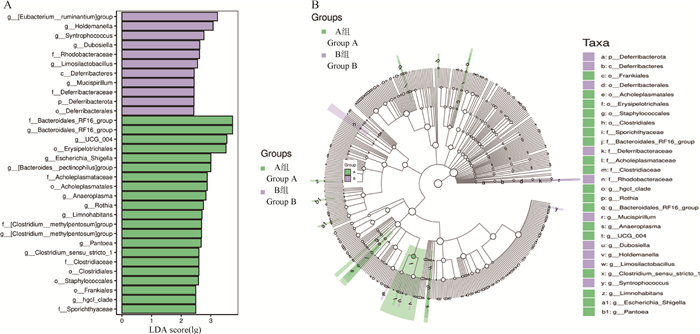
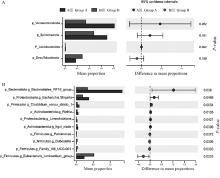
图 6
组间物种STAMP分析图 A. 组间物种STAMP分布柱状图(门水平);B. 组间物种STAMP分析图(属水平)"
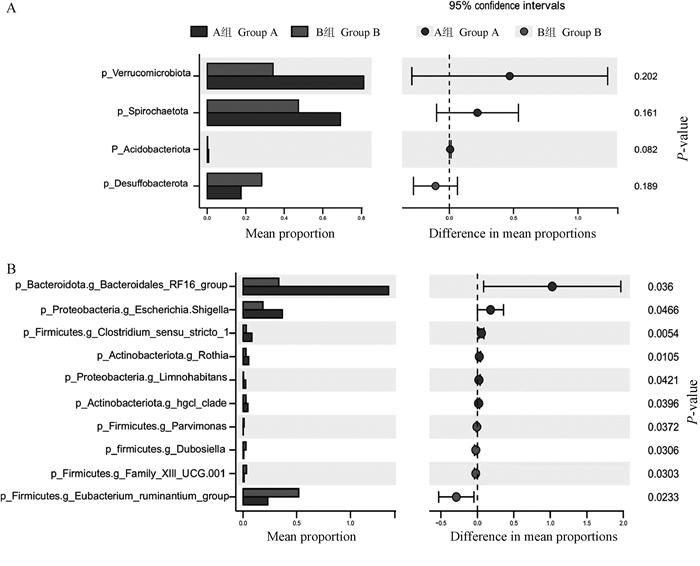
图 7
瘤胃差异菌群与瘤胃发酵参数和VFA的相关性分析 A.瘤胃差异菌群与瘤胃发酵参数Spearman相关性热图;B.瘤胃差异菌群与VFASpearman相关性热图。图A中横坐标依次是α-淀粉酶、纤维素酶、NH3-N、MCP、脲酶、pH;图B中横坐标依次是乙酸、正戊酸、正丁酸、丙酸、异丁酸、异戊酸。A、B两图纵坐标都是瘤胃差异菌群。红色表示呈正相关,蓝色表示呈负相关。*.P < 0.05;**.P < 0.01;***.P<0.001"
| 1 |
ESPOSITO G , IRONS C P , WEBB C E , et al.Interactions between negative energy balance, metabolic diseases, uterine health and immune response in transition dairy cows[J].Anim Reprod Sci,2014,144(3-4):60-71.
doi: 10.1016/j.anireprosci.2013.11.007 |
| 2 |
WANG P , ZHAO S , NAN X , et al.Influence of hydrolysis rate of urea on ruminal bacterial diversity level and cellulolytic bacteria abundance in vitro[J].Peer J,2018,6,e5475.
doi: 10.7717/peerj.5475 |
| 3 |
ZHANG Q , MA L , ZHANG X , et al.Feeding live yeast (Saccharomyces cerevisiae) improved performance of mid-lactation dairy cows by altering ruminal bacterial communities and functions of serum antioxidation and immune responses[J].BMC Vet Res,2024,20(1):245.
doi: 10.1186/s12917-024-04073-0 |
| 4 |
ZEINELDIN M , BARAKAT R , ELOLIMY A , et al.Synergetic action between the rumen microbiota and bovine health[J].Microb Pathog,2018,124,106-115.
doi: 10.1016/j.micpath.2018.08.038 |
| 5 |
ZHIGANG Z , JOAN S N , FRANK G D , et al.Community structure of the metabolically active rumen bacterial and archaeal communities of dairy cows over the transition period[J].PLoS One,2017,12(11):e0187858.
doi: 10.1371/journal.pone.0187858 |
| 6 |
DONG B , PENG Y , WANG M , et al.Multi-omics integrated analysis indicated that non-polysaccharides of Sijunzi decoction ameliorated spleen deficiency syndrome via regulating microbiota-gut-metabolites axis and exerted synergistic compatibility[J].J Ethnopharmacol,2024,331,118276.
doi: 10.1016/j.jep.2024.118276 |
| 7 | 于文会, 李子佳, 姜晓文, 等.牛前胃弛缓的群体辨证及治疗[J].中兽医医药杂志,2016,35(4):69-71. |
| YU W H , LI Z J , JIANG X W , et al.Group differentiation and treatment of bovine forestomach relaxations[J].Journal of Traditional Chinese Veterinary Medicine,2016,35(4):69-71. | |
| 8 | 刘琳, 李岩.四君子汤对胃肠道药理作用的研究进展[J].医学综述,2019,25(5):5. |
| LIU L , LI Y .Research progress of Sijunzi Decoction on pharmacological action of gastrointestinal tract[J].Medical Recapitulate,2019,25(5):5. | |
| 9 |
WANG F , MAO Y , LI C , et al.Sijunzi San alleviates the negative energy balance in postpartum dairy cows by regulating rumen fermentation capacity[J].Front Vet Sci,2024,11,1512081.
doi: 10.3389/fvets.2024.1512081 |
| 10 | 冯宗慈, 高民.通过比色测定瘤胃液氨氮含量方法的改进[J].畜牧与饲料科学,2010,31(Z1):37. |
| FENG Z C , GAO M .Improvement of a colorimetric method for determination of ammonia nitrogen in rumen fluid[J].Animal Husbandry and Feed Science,2010,31(Z1):37. | |
| 11 |
BRADFORD M M .A rapid and sensitive method for the quantitation of microgram quantities of protein utilizing the principle of protein-dye binding[J]. Analyt Biochem,1976,72(1-2):248-254.
doi: 10.1016/0003-2697(76)90527-3 |
| 12 | 马丽琴, 温万, 田佳, 等.荷斯坦奶牛产犊前后瘤胃发酵参数及微生物区系变化规律的研究[J].动物营养学报,2023,35(12):7852-7864. |
| MA L Q , WEN W , TIAN J , et al.Study on rumen fermentation parameters and microflora changes before and after calving of Holstein dairy cows[J].Chinese Journal of Animal Nutrition,2023,35(12):7852-7864. | |
| 13 | 杨宝钰, 王娇, 颜轶男, 等.奶牛瘤胃pH, 消化酶活性及原虫数量的日动态变化研究[J].动物营养学报,2021,33(3):1534-1544. |
| YANG B Y , WANG J , YANG Y N , et al.Study on diurnal dynamics of rumen pH, digestive enzyme activity and protozoa number in dairy cows[J].Chinese Journal of Animal Nutrition,2021,33(3):1534-1544. | |
| 14 |
PITT R E , VAN K J S , FOX D G , et al.Prediction of ruminal volatile fatty acids and pH within the net carbohydrate and protein system[J]. J Anim Sci,1996,74(1):226-244.
doi: 10.2527/1996.741226x |
| 15 |
ROJEN B A , LUND P , KRISTENSEN N B .Urea and short-chain fatty acids metabolism in Holstein cows fed a low-nitrogen grass-based diet[J].Animal,2008,2(4):500-513.
doi: 10.1017/S1751731108001547 |
| 16 |
PECKA-KIEŁB E , MIŚTA D , KRÓLICZEWSKA B , et al.Changes in the in vitro ruminal fermentation of diets for dairy cows based on selected sorghum cultivars compared to maize, rye and grass silage[J].Agriculture,2021,11(6):492.
doi: 10.3390/agriculture11060492 |
| 17 |
JIANG X , GENG H , ZHANG C , et al.Circadian rhythm enhances mTORC1/AMPK pathway-mediated milk fat synthesis in dairy cows via the microbial metabolite acetic acid[J].J Agric Food Chem,2024,72(50):28178-28193.
doi: 10.1021/acs.jafc.4c07488 |
| 18 |
LOUIS P , FLINT H J .Formation of propionate and butyrate by the human colonic microbiota[J].Environ Microbiol,2017,19(1):29-41.
doi: 10.1111/1462-2920.13589 |
| 19 |
PORTINCASA P , BONFRATE L , VACCA M , et al.Gut microbiota and short chain fatty acids: Implications in glucose homeostasis[J]. Int J Mol Sci,2022,23(3):1105.
doi: 10.3390/ijms23031105 |
| 20 | 宋旺弟. 甘草多糖介导的肠道菌群与免疫响应机制研究[D]. 石河子: 石河子大学, 2024. |
| SONG W D. Research on the mechanism of intestinal flora and immune response mediated by glycyrrhiza polysaccharides[D]. Shihezi: Shihezi University, 2024. (in Chinese) | |
| 21 | 李文波, 刘占发, 穆巍, 等.不同能量水平日粮对中卫山羊瘤胃内环境指标的影响[J].宁夏农林科技,2009(1):5. |
| LI W B , LIU Z F , MU W , et al.Effects of different energy levels on rumen environmental indexes of Zhongwei goats[J].Journal of Ningxia Agriculture and Forestry Science and Technology,2009(1):5. | |
| 22 | CORREDDU F , NUDDA A , BATTACONE G , et al.Effects of grape seed supplementation, alone or associated with linseed, on ruminal metabolism in Sarda dairy sheep[J].Anim Feed Sci Technol,2015,19961-19972. |
| 23 |
CLAASSEN R M , CHRISTENSEN D A , MUTSVANGWA T .Effects of extruding wheat dried distillers grains with solubles with peas or canola meal on ruminal fermentation, microbial protein synthesis, nutrient digestion, and milk production in dairy cows[J].J Dairy Sci,2016,99(9):7143-7158.
doi: 10.3168/jds.2015-10808 |
| 24 |
SEANKAMSORN A , CHERDTHONG A , SO S , et al.Influence of chitosan sources on intake, digestibility, rumen fermentation, and milk production in tropical lactating dairy cows[J].Trop Anim Health Prod,2021,53(2):241-250.
doi: 10.1007/s11250-021-02697-0 |
| 25 | HACKMANN T J , FIRKINS J L .Maximizing efficiency of rumen microbial protein production[J].Front Microbiol,2015,6,465-478. |
| 26 |
ZHU W , FU Y , WANG B , et al.Effects of dietary forage sources on rumen microbial protein synthesis and milk performance in early lactating dairy cows[J].J Dairy Sci,2013,96(3):1727-1734.
doi: 10.3168/jds.2012-5756 |
| 27 | 赵燕飞, 汪以真.白术、微米白术和白术多糖对断奶仔猪生长性能和肠道形态及微生态区系的影响[J].中国畜牧杂志,2015,51(1):65-69. |
| ZHAO Y F , WANG Y Z .Effects of Atractylodes macrocephala, micron Atractylodes macrocephala and Atractylodes macrocephala polysaccharides on growth performance, intestinal morphology and microecological flora of weaned piglets[J].Chinese Journal of Animal Science,2015,51(1):65-69. | |
| 28 |
ZHANG S , ZHHENG N , ZHHAO S , et al.Allicin enhances urea-N conversion to microbial-N by inhibiting urease activity and modulating the rumen microbiome in cattle[J].Microbiome,2025,13(1):124.
doi: 10.1186/s40168-025-02111-z |
| 29 |
MOBLEY H L , ISLAND M D , HAUSINGER R P .Molecular biology of microbial ureases[J].Microbiol Rev,1995,59(3):451-480.
doi: 10.1128/mr.59.3.451-480.1995 |
| 30 |
BERGLUND J , ANGLES D T , VILAPLANA F , et al.A molecular dynamics study of the effect of glycosidic linkage type in the hemicellulose backbone on the molecular chain flexibility[J].Plant J,2016,88(1):56-70.
doi: 10.1111/tpj.13259 |
| 31 | ANUSHKA S , RAHUL D , RITU B , et al.An insight on medicinal attributes of 1, 2, 3- and 1, 2, 4-triazole derivatives as alpha-amylase and alpHa-glucosidase inhibitors[J].Mol Divers,2023,28(5):28. |
| 32 |
BUGONI M , TAKIYA C S , GRIGOLETTO N , et al.Feeding amylolytic and proteolytic exogenous enzymes: Effects on nutrient digestibility, ruminal fermentation, and performance in dairy cows[J].J Dairy Sci,2023,106(5):3192-3202.
doi: 10.3168/jds.2022-22610 |
| 33 | 李家军. 乳酸菌发酵四君子散/汤的剂型选择及对肉鸡生长性能的影响[D]. 太谷: 山西农业大学, 2021. |
| LI J J. Selection of formulation of sijunzi powder/decoction fermented by lactic acid bacteria and its effect on growth performance of broilers[D]. Taigu: Shanxi Agricultural University, 2021. (in Chinese) | |
| 34 |
BICKHART D M , WEIMER P J .Symposium review: Host-rumen microbe interactions may be leveraged to improve the productivity of dairy cows[J].J Dairy Sci,2018,101(8):7680-7689.
doi: 10.3168/jds.2017-13328 |
| 35 |
MEI S , HE G , CHEN Z , et al.Probiotic-fermented distillers grain alters the rumen microbiome, metabolome, and enzyme activity, enhancing the immune status of finishing cattle[J].Animals,2023,13(24):3774.
doi: 10.3390/ani13243774 |
| 36 | 温红瑞, 高昌鹏, 杨万彪, 等.单宁和裂壶藻粉对滩羊生长性能及瘤胃菌群多样性的影响[J].动物营养学报,2023,35(10):6546-6559. |
| WEN H R , GAO C P , YANG W B , et al.Effects of tannin and Schizochytrium powder on growth performance and rumen flora diversity of Tan sheep[J].Chinese Journal of Animal Nutrition,2023,35(10):6546-6559. | |
| 37 |
DUBIN K , CALLAHAN M K , REN B , et al.Intestinal microbiome analyses identify melanoma patients at risk for checkpoint-blockade-induced colitis[J].Nat Commun,2016,7,10391.
doi: 10.1038/ncomms10391 |
| 38 | 金鹿, 李胜利, 桑丹, 等.沙蒿多糖组合制剂对滩羊羔羊瘤胃菌群多样性的影响[J].动物营养学报,2021,33(1):317-329. |
| JIN L , LI S L , SANG D , et al.Effects of Artemisia artemisia polysaccharide combination on rumen flora diversity of Tan sheep lambs[J].Chinese Journal of Animal Nutrition,2021,33(1):317-329. | |
| 39 | 朱寿谦. 高产和低产奶牛不同泌乳阶段养分表观消化率、瘤胃发酵参数和乳品质的比较研究[D]. 呼和浩特: 内蒙古农业大学, 2021. |
| ZHU S Q. Comparative study on apparent nutrient digestibility, rumen fermentation paramaters and bacterial structure of high-yield and low-yield cows[D]. Hohhot: Inner Mongolia Agricultural University, 2021. (in Chinese) | |
| 40 |
ZHENG X , WANG L , YOU L , et al.Dietary licorice enhances in vivo cadmium detoxification and modulates gut microbial metabolism in mice[J].Imeta,2022,1(1):e7.
doi: 10.1002/imt2.7 |
| 41 | ROSENBERG E, DELONG E F, LORY S, et al. The prokaryotes: other major lineages of Bacteria and the Archaea[R]. Springer Berlin Heidelberg, 2014. |
| 42 | ZHU Y, CHEN B, ZHANG X, et al. Exploration of the muribaculaceae family in the gut microbiota: Diversity, metabolism, and function[J]. Nutrients. 2024 Aug 12;16(16): 2660. |
| 43 |
WU Y , ZHENG Y , WANG X , et al.Ginseng-containing Sijunzi decoction ameliorates ulcerative colitis by orchestrating gut homeostasis in microbial modulation and intestinal barrier integrity[J]. Am J Chin Med,2023,51(3):677-699.
doi: 10.1142/S0192415X23500325 |
| 44 | 陈新君. 复方四君子汤及党参多糖调节溃疡性结肠炎小鼠肠道菌群的作用研究[D]. 兰州: 兰州大学, 2016. |
| CHEN X J. Study on the effect of compound four gentlemen decoction and codonopsis polysaccharides in regulating intestinal flora in mice with ulcerative colitis[D]. Lanzhou: Lanzhou University, 2016. (in Chinese) | |
| 45 | 李建房. 甘草多糖对断奶仔猪生长性能和肠道健康的影响[D]. 扬州: 扬州大学, 2022. |
| LI J F. Effects of glycyrrhiza polysaccharides on growth performance and intestinal health of weaned piglets[D]. Yangzhou: Yangzhou University, 2022. (in Chinese) | |
| 46 |
NICHOLSON J K , HOLMES E , KINROSS J , et al.Host-gut microbiota metabolic interactions[J].Science,2012,336(6086):1262-1267.
doi: 10.1126/science.1223813 |
| 47 |
ZAMAKHCHARI M , WEI G , DEWHIRST F , et al.Identification of Rothia bacteria as gluten-degrading natural colonizers of the upper gastro-intestinal tract[J].PLoS One,2011,6(9):e24455.
doi: 10.1371/journal.pone.0024455 |
| 48 |
LE GALL M , GALLOIS M , SōVE B , et al.Comparative effect of orally administered sodium butyrate before or after weaning on growth and several indices of gastrointestinal biology of piglets[J].Br J Nutr,2009,102(9):1285-1296.
doi: 10.1017/S0007114509990213 |
| 49 | 李玲, 孙小红, 连旭, 等.凉茶渣替代象草对育肥牛空肠组织形态, 屏障功能以及菌群结构的影响[J].动物营养学报,2022(2):1087-1097. |
| LI L , SUN X H , LIAN X , et al.Effects of herbal tea residue on ileum morphology, barrier function and flora structure of fattening cattle[J].Chinese Journal of Animal Nutrition,2022(2):1087-1097. | |
| 50 | 赵志方, 秦松, 王莉, 等.慢性乙型肝炎患者肠道菌群与肝脏生化指标的相关性[J].生物工程学报,2021,37(1):301-311. |
| ZHAO Z F , QIN S , WANG L , et al.Correlation between gut microbiota and liver biochemical indicators in patients with chronic hepatitis B[J].Chinese Journal of Biotechnology,2021,37(1):301-311. | |
| 51 |
JIANG S , ZOU X , MAO M , et al.Low Ca diet leads to increased Ca retention by changing the gut flora and ileal pH value in laying hens[J].Anim Nutr,2023,13,270-281.
doi: 10.1016/j.aninu.2023.02.006 |
| 52 |
GRZEŚKOWIAK A , DADI T H , ZENTEK J , et al.Developing gut microbiota exerts colonisation resistance to Clostridium (syn. Clostridioides) difficile in piglets[J].Microorganisms,2019,7(8):218.
doi: 10.3390/microorganisms7080218 |
| 53 | 邓富丽, 申丹, 钟儒清, 等.体外法优化玉米——杂粕型饲粮的非淀粉多糖酶谱及其对育肥猪肠道微生物的影响[J].中国农业科学,2022,55(16):3242-3255. |
| DENG F L , SHEN D , ZHONG R Q , et al.Non-starch polysaccharide enzymes cocktail of corn-miscellaneous meal-based diet optimization by in vitro method and its effects on intestinal microbiome in finishing pigs[J].Scientia Agricultura Sinica,2022(016):55. | |
| 54 | 叶瑞, 董贤凤, 郑明辉.旋毛虫感染和色氨酸补充对长爪沙鼠肠道菌群的影响[J].中国病原生物学杂志,2023,18(10):1162-1168. |
| YE R , DONG X F , ZHENG M H .Effects of Trichinella spiralis infection and tryptophan supplementation on intestinal flora in Mongolian gerbil[J]. Journal of Pathogen Biology,2023,18(10):1162-1168. | |
| 55 | 周文斌, 郑越, 尚佳, 等.二乙基亚硝胺诱导肝细胞癌模型鼠肠道微生态研究[J].浙江大学学报: 医学版,2022,51(4):438-453. |
| ZHOU W B , ZHENG Y , SHANG J , et al.Intestinal microecology in mice bearing diethylnitrosamineinduced primary hepatocellular carcinoma[J].Journal of Zhejiang University: Medical Sciences,2022,51(4):438-453. | |
| 56 |
SIQUEIRA J J , RÔÇAS I N .Microbiology and treatment of acute apical abscesses[J]. Clin Microbiol Rev,2013,26(2):255-273.
doi: 10.1128/CMR.00082-12 |
| 57 |
CESTA N , FOROGHI B L , NERI B , et al.Multiple hepatic and brain abscesses caused by Parvimonas micra: A case report and literature review[J].Anaerobe,2021,69,102366.
doi: 10.1016/j.anaerobe.2021.102366 |
| [1] | 宋琳, 赵小伟, 齐英杰, 张养东. 短链脂肪酸对奶牛瘤胃微生物菌群的影响研究进展[J]. 畜牧兽医学报, 2025, 56(5): 2082-2092. |
| [2] | 张仕琦, 郑楠, 王加启, 赵圣国. 饲粮NFC/NDF比例对奶牛瘤胃中微生物尿素氮代谢流的影响[J]. 畜牧兽医学报, 2025, 56(3): 1302-1312. |
| [3] | 马天一, 郭同军, 万发春, 王祚. 霉菌毒素对反刍动物瘤胃微生物发酵的影响及其可能机制[J]. 畜牧兽医学报, 2025, 56(12): 6034-6045. |
| [4] | 李玮, 吴禧龙, 赵兴瑞, 许兰娇, 杨小斌, 宋小珍. 中药健脾四胃方剂对断奶湖羊生长性能、瘤胃发酵及菌群组成的影响[J]. 畜牧兽医学报, 2025, 56(1): 466-478. |
| [5] | 李陇平, 李托, 曹培文, 朱海鲸, 张小玲, 张宸, 肖普辉, 董书伟, 冯平, 屈雷, 毕台飞. 饲粮不同能量水平对陕北白绒山羊断奶公羔瘤胃发酵特性和微生物组成的影响[J]. 畜牧兽医学报, 2024, 55(7): 3011-3023. |
| [6] | 龙唐晖, 周江汇, 詹彦波, 张健, 赵向辉, 李艳娇, 欧阳克蕙, 邱清华. 反刍动物瘤胃微生物LuxS/AI-2群体感应研究进展[J]. 畜牧兽医学报, 2024, 55(5): 1893-1903. |
| [7] | 熊程坤, 张道亮, 杨悦, 丁红研, 赵杰, 李玉, 王希春, 冯士彬, 赵畅, 汤继顺, 吴金节. 芦丁对围产期湖羊瘤胃发酵、瘤胃菌群结构及抗氧化性能的影响[J]. 畜牧兽医学报, 2023, 54(7): 2898-2909. |
| [8] | 赵威, Mahmoud M. Abdelsattar, 柴建民, 王昕, 刁其玉, 张乃锋. 瘤胃微生物移植及应用研究进展[J]. 畜牧兽医学报, 2023, 54(5): 1792-1803. |
| [9] | 颜琼娴, 陈文勋, 惠浩阳, 彭灿, 汤少勋, 周小玲, 谭支良. 玉米赤霉烯酮对山羊生长性能、胃肠道发酵模式和菌群结构的影响研究[J]. 畜牧兽医学报, 2023, 54(3): 1109-1123. |
| [10] | 胡立萍, 沈子亮, 王全, 于紫桐, 张琦绮, 毛永江, 杨章平, 张慧敏. 泌乳早期奶牛瘤胃微生物与牛奶脂肪酸组成的变化[J]. 畜牧兽医学报, 2022, 53(9): 3018-3028. |
| [11] | 韦肖, 张建童, 龙唐晖, 李开嵘, 李艳娇, 欧阳克蕙, 邱清华. 日粮能量水平对湖羊瘤胃发酵特性和微生物组成的影响[J]. 畜牧兽医学报, 2022, 53(9): 3042-3051. |
| [12] | 车大璐, 程素彩, 张伟涛, 赵娟娟, 刘爱瑜, 李晓宇, 周英昊, 高玉红, 孙新胜, 李雪梅. 热应激条件下藿朴蒲苓散对育肥羔羊生长性能、消化性能和血清生化指标的影响[J]. 畜牧兽医学报, 2022, 53(6): 1829-1840. |
| [13] | 刘志豪, 贾鹏, 赖琦, 董利锋, 吴秋珏, 高彦华, 田忠红, 刁其玉. 泌乳牛不同胎次干奶期瘤胃发酵指标与甲烷产量的特征[J]. 畜牧兽医学报, 2022, 53(12): 4296-4305. |
| [14] | 任曼, 刘欣, 唐玉林, 张瑞雪, 秦俊杰, 朱浩, 郭延生. 归芪益母复方制剂对产后奶牛瘤胃微生物和短链脂肪酸的调节[J]. 畜牧兽医学报, 2022, 53(12): 4461-4469. |
| [15] | 姜君, 孙美杰, 申军士, 刁其玉, 朱伟云. 不同蛋白源日粮添加乳酸链球菌素对育肥湖羊瘤胃发酵及微生物菌群结构的影响[J]. 畜牧兽医学报, 2021, 52(9): 2534-2544. |
| 阅读次数 | ||||||
|
全文 |
|
|||||
|
摘要 |
|
|||||
