


畜牧兽医学报 ›› 2025, Vol. 56 ›› Issue (11): 5670-5682.doi: 10.11843/j.issn.0366-6964.2025.11.026
聂莲花1,2( ), 樊文燕1,2, 李梦雅1,2, 丁纯海3, 吴自豪2, 王志豪2, 李芳芳1,2, 蒋蔚2, 韩先干2,*(), 王海东1,*()
收稿日期:2025-02-20
出版日期:2025-11-23
发布日期:2025-11-27
通讯作者:
韩先干,王海东
E-mail:15110991273@163.com;hanxgan@shvri.ac.cn;wanghaidong@sxau.edu.cn
作者简介:聂莲花(1999-),女,青海海东人,硕士生,主要从事禽致病性大肠杆菌遗传演化、感染机制及新型防控靶标研究,E-mail:15110991273@163.com
基金资助:
NIE Lianhua1,2(), FAN Wenyan1,2, LI Mengya1,2, DING Chunhai3, WU Zihao2, WANG Zhihao2, LI Fangfang1,2, JIANG Wei2, HAN Xiangan2,*(), WANG Haidong1,*()
Received:2025-02-20
Online:2025-11-23
Published:2025-11-27
Contact:
HAN Xiangan, WANG Haidong
E-mail:15110991273@163.com;hanxgan@shvri.ac.cn;wanghaidong@sxau.edu.cn
摘要:
金黄色葡萄球菌是禽养殖业常见的病原菌,因其携带多种毒力因子及多重耐药性,对禽养殖业造成严重的经济损失。为探究辽宁沈阳地区鸡关节炎源金黄色葡萄球菌的流行特征,对2023—2024年分离的78株鸡关节炎性金黄色葡萄球菌进行毒力基因与耐药基因的分析。通过聚合酶链式反应(PCR)对毒力基因分布、耐药基因进行检测,采用K-B法检测其耐药性,通过结晶紫染色法对生物被膜形成能力进行检测。通过对15种毒力基因进行检测,黏附基因clfA检出率最高为100%,随后依次为黏附基因clfB(98.7%)和溶血素基因hlA(82%),而中毒性休克综合征毒素基因tssT(12.8%)、肠毒素基因seA(3.8%)和剥脱毒素基因etA(1.3%)的检出率低。对10种抗生素耐药性检测显示,78株金黄色葡萄球菌均呈现不同程度的耐药,对四环素(100%)、青霉素G(98.7%)、诺氟沙星(96.2%)、克林霉素(89.7%)、复方新诺明(84.6%)、庆大霉素(82.1%)、红霉素(79.5%)的耐药率较高,但对头孢西丁和利福平(97.4%)敏感。对15种耐药基因进行检测,显示分离菌携带多种耐药基因,氨基糖苷类耐药基因aac(6')/aph(2')和ant(4')的检出率分别为92.3%和80.8%,大环内酯类耐药基因ermC和ermB检出率分别为53.8%和50.0%,但四环素类耐药基因tetM检出率仅为19.2%。对分离菌株生物被膜形成能力检测表明,有73株金黄色葡萄球菌具有生物被膜形成能力,占比为93.6%。对耐药基因与耐药表型的相关性分析结果显示,氨基糖苷类耐药基因aac(6')/aph(2″)和ant(4')、大环内酯类耐药基因ermB和ermC及多重耐药基因cfr分别与庆大霉素耐药菌株、红霉素耐药菌株、红霉素和青霉素G耐药菌株有显著相关性(P < 0.05)。对生物被膜表型与耐药表型进行相关性分析,结果显示红霉素及氯霉素耐药株的产生与生物被膜的形成具有显著相关性(P < 0.05)。78株鸡关节炎源金黄色葡萄球菌的耐药性强,易形成生物被膜,可为该地区金黄色葡萄球菌引起的鸡关节炎防控提供了参考。
中图分类号:
聂莲花, 樊文燕, 李梦雅, 丁纯海, 吴自豪, 王志豪, 李芳芳, 蒋蔚, 韩先干, 王海东. 78株鸡关节炎源金黄色葡萄球菌毒力基因与耐药基因分析[J]. 畜牧兽医学报, 2025, 56(11): 5670-5682.
NIE Lianhua, FAN Wenyan, LI Mengya, DING Chunhai, WU Zihao, WANG Zhihao, LI Fangfang, JIANG Wei, HAN Xiangan, WANG Haidong. Analysis of Virulence and Antibiotic Resistance Genes in 78 Strains of Staphylococcus aureus from Chicken Arthritis Sources[J]. Acta Veterinaria et Zootechnica Sinica, 2025, 56(11): 5670-5682.
表 1
本研究所用引物"
| 分类 Classification | 基因名称 Gene name | 引物序列(5′→3′) Primer sequence | 产物大小/bp Length |
| 特异性基因 Specific gene | nuc | GCGATTGATGGTGATACGGTT | 279 |
| AGCCAAGCCTTGACGAACTAAAGC | |||
| 肠毒素 Enterotoxin | seA | GCA GGG AAC AGC TTT AGG C | 521 |
| GTT CTG TAG AAG TAT GAAACA CG | |||
| seC | CTT GTA TGT ATG GAG GAA TAA CAA | 284 | |
| TGC AGG CAT CAT ATC ATA CCAA | |||
| seH | CAA CTG CTG ATT TAG CTC AG | 359 | |
| GTC GAA TGA GTAATC TCT AGG | |||
| seJ | CAT CAG AAC TGT TGT TCC GCT AG | 142 | |
| CTG AAT TTT ACC ATC AAA GGT AC | |||
| 中毒性休克综合征毒素 Toxic shock syndrome toxin | tssT | GCT TGC GAC AAC TGC TAC AG | 559 |
| TGG ATC CGT CAT TCA TTG TTA | |||
| 剥脱毒素 Exfoliative toxin | pvL | ATC ATT AGG TAAAAT GTC TGG ACAT GAT CCA | 433 |
| GCA TCA AST GTA TTG GAT AGC AAAAGC | |||
| etA | CGC TGC GGA CAT TCC TAC ATG G | 676 | |
| TAC ATG CCC GCC ACT TGC TTG T | |||
| etB | CAG ATAAAG AGC TTT ATA CAC ACA TTA | 612 | |
| AGT GAA CTT ATC TTT CTA TTG AAA AAC ACT C | |||
| 溶血素 Hemolysin | hlA | CTG ATT ACT ATC CAA GAA ATT CGA TTG | 209 |
| CTT TCC AGC CTA CTT TTT TAT CAG T | |||
| hlB | GTG CAC TTA CTG ACA ATA GTG C | 309 | |
| GTT GAT GAG TAG CTA CCT TCA GT | |||
| 纤连蛋白结合蛋白 Fibronectin-binding protein | fnbA | GTG AAG TTT TAG AAG GTG GAAAGA TTA G | 634 |
| GCT CTT GTAAGA CCA TTT TTC TTC AC | |||
| fnbB | GTAACA GCT AAT GGT CGA ATT GAT ACT | 524 | |
| CAA GTT CGA TAG GAG TAC TAT GTT C | |||
| 黏附因子 Adhesion factor | clfA | ATT GGC GTG GCT TCA GTG CT | 292 |
| CGT TTC TTC CGT AGT TGC ATT TG | |||
| clfB | TGC AAG TGC AGA TTC CGA AAA AAA C | 194 | |
| CCG TCG GTT GAG GTG TTT CAT TTG | |||
| 胶原蛋白黏附素 Collagen adhesin | cnA | AAA GCG TTG CCT AGT GGA GAC | 228 |
| AGT GCC TTC CCA AAC CTT TT | |||
| 多重耐药基因 Multidrug-resistant gene | Cfr | TGAAGTATAAAGCAGGTTGGGAGTCA | 746 |
| ACCATATAATTGACCACAAGCAGC | |||
| 氨基糖苷类 Aminoglycoside | aac(6′)/aph(2′) | CCAAGAGCAATAAGGGCATA | 220 |
| CACTATCATAACCACTACCG | |||
| aph(3′)-Ⅲa | CACTATCATAACCACTACCG | 523 | |
| GCCGATGTGGATTGCGAAAA | |||
| ant(4′) | GCAAGGACCGACAACATTTC | 294 | |
| TGGCACAGATGGTCATAACC | |||
| ant(6′) | ACTGCTTAATCAATTGG | 597 | |
| GCCTTTCCGCCACCTCACCG | |||
| ant(3′) | TGATTTGCTGGTTACGGTGAC | 284 | |
| CGCTATGTTCTCTTGCTTTTG | |||
| 大环内酯类 Macrolide | ermA | TCAGGAAAAGGACATTTTACC | 423 |
| ATACTTTTTGTAGTCCTTCTT | |||
| ermB | TGGTATTCCAAATGCGTAATG | 745 | |
| CTGTGGTATGGCGGGTAAGT | |||
| ermC | CGTAACTGCCATTGAAATAGACC | 246 | |
| AATAATCTTTTAGCAAACCCGTA | |||
| 四环素类 Tetracycline | tetM | GTGGACAAAGGTACAACGAG | 406 |
| CGGTAAAGTTCGTCACACAC | |||
| tetO | AACTTAGGCATTCTGGCTCAC | 515 | |
| TCCCACTGTTCCATATCGTCA | |||
| 万古霉素 Vancomycin | vanA | GCTATTCAGCTGTACTC | 783 |
| CAGCGGCCATCATACGG | |||
| vanB | CATCGCCGTCCCCGAATTTCAAA | 297 | |
| GATGCGGAAGATACCGTGGCT | |||
| vanC | GGTATCAAGGAAACCTC | 822 | |
| CTTCCGCCATCATAGCT | |||
| β-内酰胺类 β-lactam | femA | TTACTACGCTGGTGGAACTTCA | 191 |
| CATCGGCATCATAGCCCTTT |
表 2
药物敏感性判定标准"
抗菌药物 Antibacterial drug | 抑菌圈直径/mm Inhibition circle diameter | ||
| 敏感(S) Sensitivity | 中介(I) Intermediary | 耐药(R) Resistance | |
| 克林霉素 Clindamycin | ≥21 | 15~20 | ≤14 |
| 庆大霉素 Gentamicin | ≥15 | 13~14 | ≤12 |
| 四环素 Tetracycline | ≥19 | 15~18 | ≤14 |
| 青霉素G Penicillin G | ≥29 | — | ≤28 |
| 红霉素 Erythromycin | ≥23 | 14~22 | ≤13 |
| 诺氟沙星 Norfloxacin | ≥17 | 13~16 | ≤12 |
| 利福平 Rifampicin | ≥20 | 17~19 | ≤16 |
| 复方新诺明 Compound sulfamethoxazole | ≥17 | 13~16 | ≤12 |
| 氯霉素 Chloramphenicol | ≥18 | 13~17 | ≤12 |
| 头孢西丁 Cefoxitin | ≥22 | — | ≤21 |
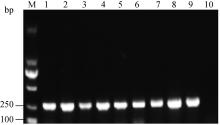
图 1
金黄色葡萄球菌的分离鉴定 部分金黄色葡萄球菌耐热核酸酶nuc基因PCR扩增结果。M. 2000 DNA相对分子质量标准;1~8. 待检菌株;9. ATCC 29213;10. 阴性对照"
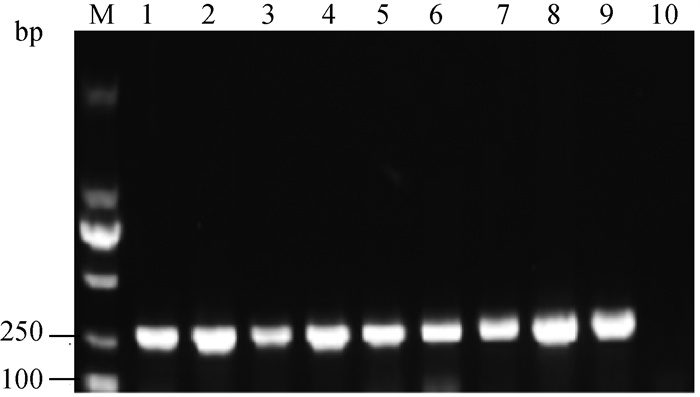
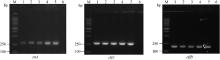
图 2
部分毒力基因PCR扩增结果 M. 5000 DNA相对分子质量标准;1~5. 待检菌株;6. 阴性对照"
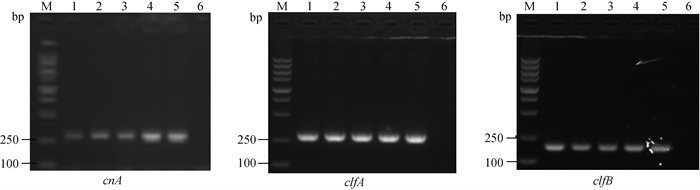
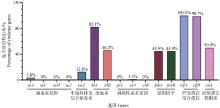
图 3
毒力基因检测结果"
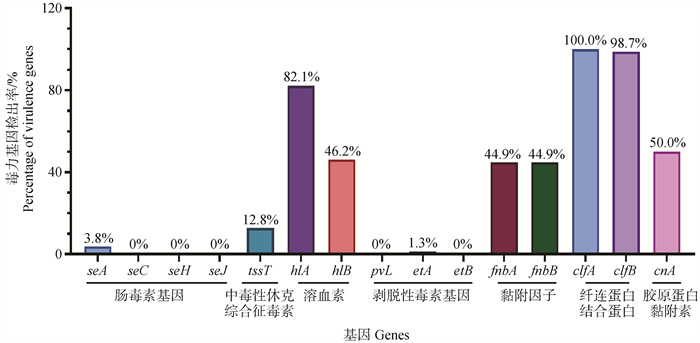
表 3
金黄色葡萄球菌药物敏感性结果"
| 抗生素分类 Classification of antibiotics | 药物名称 Drug name | 敏感菌株比例/% Percentage of sensitivity (%)(n/n) | 中介菌株比例/% Percentage of intermediate (%)(n/n) | 耐药菌株比例/% Percentage of resistance(%)(n/n) |
| 林可霉素类 Lincomamides | 克林霉素 | 0.0(0/78) | 10.3(8/78) | 89.7(70/78) |
| 氨基糖苷类 Aminoglycosides | 庆大霉素 | 14.1(11/78) | 3.8(3/78) | 82.1(64/78) |
| 四环素类 Tetracyclines | 四环素 | 0.0(0/78) | 0.0(0/78) | 100.0(78/78) |
| β-内酰胺类 β-lactam class | 青霉素G | 1.3(1/78) | 0.0(0/78) | 98.7(77/78) |
| 头孢西丁 | 100.0(78/78) | 0.0(0/78) | 0.0(0/78) | |
| 大环内酯类 Macrolides | 红霉素 | 17.9(14/78) | 2.6(2/78) | 79.5(62/78) |
| 氟喹诺酮类 Fluoroquinolones | 诺氟沙星 | 2.6(2/78) | 1.3(1/78) | 96.2(75/78) |
| 安莎霉素类 Ansamycins | 利福平 | 97.4(76/78) | 0.0(0/78) | 2.6(2/78) |
| 叶酸途径拮抗剂 Folic acid antagonists | 复方新诺明 | 14.1(11/78) | 1.3(1/78) | 84.6(66/78) |
| 氯霉素类 Chloramphenicols | 氯霉素 | 30.8(24/78) | 23.1(18/78) | 46.2(36/78) |
表 4
金黄色葡萄球菌多重耐药性结果"
| 耐药菌株号 Resistant strain number | 耐药重数 Multiple | 耐药菌株数 Number of resistance | 耐药菌株比例/% Percentage of resistant strains |
| LN-68 | 9 | 1 | 1.3 |
| LN-1,4,7,9,13,14,15,18,21,26,29,31,33,34,35,45,46,47,49,52,53,55,57,60,63,65,66,70,71,72 | 8 | 30 | 38.5 |
| LN-3,8,16,17,20,22,25,28,32,39,44,56,69,73,74,75,76 | 7 | 17 | 21.8 |
| LN-10,19,24,36,38,41,43,51,54,58,61,62,67 | 6 | 13 | 16.7 |
| LN-2,5,6,11,12,23,27,30,37,40,42,50,59,64,77,78 | 5 | 16 | 20.5 |
| LN-48 | 4 | 1 | 1.3 |
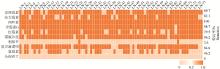
图 4
金黄色葡萄球菌多重耐药性菌株统计 图例中1.0代表检测结果阳性,0代表检测结果阴性"
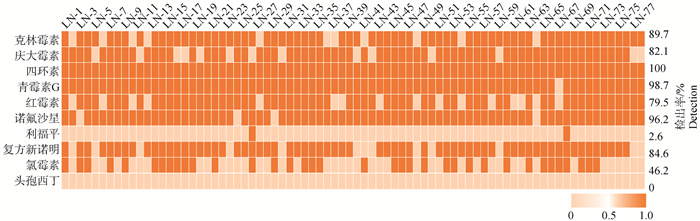
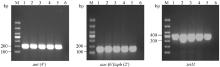
图 5
部分耐药基因PCR扩增结果 M. 1000 DNA相对分子质量标准;1~5. 待检菌株;6. 阴性对照"
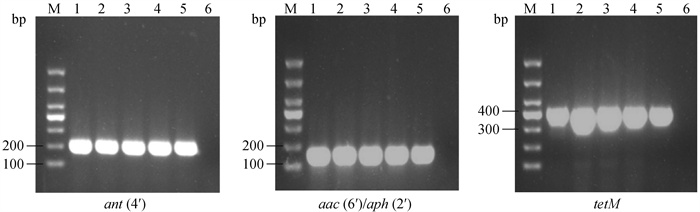
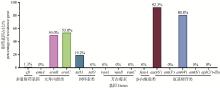
图 6
耐药基因检测结果"
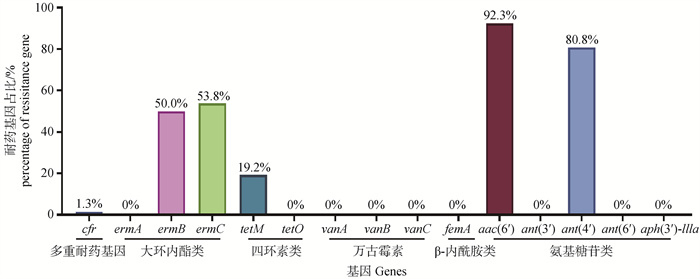
图 7
部分菌株生物被膜形成能力检测结果 ODc=阴性对照的平均OD值+3s,OD570 nm>4 ODc为强成膜能力,2 ODc < OD570 nm≤4 ODc为中等成膜能力,1 ODc < OD570 nm≤2 ODc为弱成膜能力,OD570 nm≤1 ODc则判定无成膜能力"
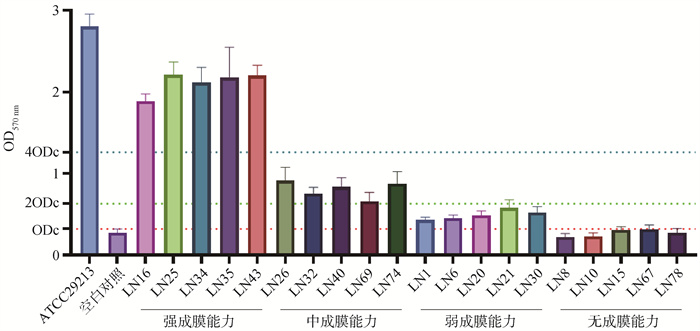
表 5
耐药相关性数据分析结果"
| 基因类别 Gene category | 基因名称 Gene name | 药物名称 Drug name | 敏感/% Sensitive | 中介/% Intermediate resistance | 耐药/% Resistant | χ2 | P |
| 氨基糖苷类 Aminoglycosides | aac(6′)/aph(2′) | 庆大霉素 | 5/11(45.45) | 3/3(100.00) | 64/64(100.00) | 39.591 | 0.000** |
| ant(4′) | 11/11(100.00) | 1/3(33.33) | 51/64(79.69) | 7.013 | 0.030* | ||
| 大环内酯类 Macrolides | ermB | 红霉素 | 1/14(7.14) | 0/2(0.00) | 38/62(61.29) | 15.447 | 0.000** |
| ermC | 1/14(7.14) | 1/2(50.00) | 40/62(64.52) | 15.14 | 0.001** | ||
| 多重耐药类 Multi drug resistance class | cfr | 氯霉素 | 0/24(0.00) | 0/18(0.00) | 1/36(2.78) | 1.182 | 0.554 |
| 复方新诺明 | 0/11(0.00) | 0/11(0.00) | 1/66(1.52) | 0.184 | 0.912 | ||
| 利福平 | 1/76(1.32) | 0/0(0.00) | 0/2(0.00) | 0.027 | 0.87 | ||
| 诺氟沙星 | 0/2(0.00) | 0/1(0.00) | 1/75(1.33) | 0.041 | 0.98 | ||
| 红霉素 | 0/14(0.00) | 1/2(50.00) | 0/62(0.00) | 38.494 | 0.000** | ||
| 庆大霉素 | 0/11(0.00) | 0/3(0.00) | 1/64(1.56) | 0.222 | 0.895 | ||
| 克林霉素 | 0/0(0.00) | 0/8(0.00) | 1/70(1.43) | 0.116 | 0.734 | ||
| 青霉素G | 1/1(100.00) | 0/0(0.00) | 0/77(0.00) | 78 | 0.000** |
表 6
生物被膜表型与耐药表型相关性分析结果"
| 抗生素 Antibiotics | 分类 Classification | 生物被膜/% Biofilm | 总计 Total | χ2 | P | |||
| 无 None | 弱 Weak | 中 Moderate | 强 Strong | |||||
克林霉素 Clindamycin | 敏感Sensitivity | 0(0.00) | 0(0.00) | 0(0.00) | 1(4.00) | 1(1.28) | 4.343 | 0.227 |
| 中介Intermediary | 0(0.00) | 1(3.85) | 2(9.09) | 5(20.00) | 8(10.26) | |||
| 耐药Resistance | 5(100.00) | 25(96.15) | 20(90.91) | 20(80.00) | 70(89.74) | |||
| 总计Total | 5 | 26 | 22 | 25 | 78 | |||
庆大霉素 Gentamicin | 敏感Sensitivity | 1(20.00) | 4(15.38) | 5(22.73) | 1(4.00) | 11(14.10) | 6.967 | 0.324 |
| 中介Intermediary | 0(0.00) | 1(3.85) | 2(9.09) | 0(0.00) | 3(3.85) | |||
| 耐药Resistance | 4(80.00) | 21(80.77) | 15(68.18) | 24(96.00) | 64(82.05) | |||
| 总计Total | 5 | 26 | 22 | 25 | 78 | |||
青霉素G Penicillin G | 敏感Sensitivity | 0(0.00) | 0(0.00) | 0(0.00) | 1(4.00) | 1(1.28) | 2.148 | 0.542 |
| 中介Intermediary | 0(0.00) | 0(0.00) | 0(0.00) | 1(4.00) | 1(1.28) | |||
| 耐药Resistance | 5(100.00) | 26(100.00) | 22(100.00) | 24(96.00) | 77(98.72) | |||
| 总计Total | 5 | 26 | 22 | 25 | 78 | |||
红霉素 Erythromycin | 敏感Sensitivity | 0(0.00) | 1(3.85) | 2(9.09) | 11(44.00) | 14(17.95) | 23.086 | 0.001** |
| 中介Intermediary | 0(0.00) | 0(0.00) | 0(0.00) | 2(8.00) | 2(2.56) | |||
| 耐药Resistance | 5(100.00) | 25(96.15) | 20(90.91) | 12(48.00) | 62(79.49) | |||
| 总计Total | 5 | 26 | 22 | 25 | 78 | |||
诺氟沙星 Norfloxacin | 敏感Sensitivity | 0(0.00) | 0(0.00) | 1(4.55) | 1(4.00) | 2(2.56) | 3.546 | 0.738 |
| 中介Intermediary | 0(0.00) | 0(0.00) | 0(0.00) | 1(4.00) | 1(1.28) | |||
| 耐药Resistance | 5(100.00) | 26(100.00) | 21(95.45) | 23(92.00) | 75(96.15) | |||
| 总计Total | 5 | 26 | 22 | 25 | 78 | |||
利福平 Rifampicin | 敏感Sensitivity | 5(100.00) | 26(100.00) | 21(95.45) | 24(96.00) | 76(97.44) | 1.368 | 0.713 |
| 中介Intermediary | 0(0.00) | 0(0.00) | 0(0.00) | 1(4.00) | 1(1.28) | |||
| 耐药Resistance | 0(0.00) | 0(0.00) | 1(4.55) | 1(4.00) | 2(2.56) | |||
| 总计Total | 5 | 26 | 22 | 25 | 78 | |||
复方新诺明 Compound sulfamethoxazole | 敏感Sensitivity | 1(20.00) | 4(15.38) | 5(22.73) | 1(4.00) | 11(14.10) | 6.432 | 0.377 |
| 中介Intermediary | 0(0.00) | 0(0.00) | 1(4.55) | 0(0.00) | 1(1.28) | |||
| 耐药Resistance | 4(80.00) | 22(84.62) | 16(72.73) | 24(96.00) | 66(84.62) | |||
| 总计Total | 5 | 26 | 22 | 25 | 78 | |||
氯霉素 Chloramphenicol | 敏感Sensitivity | 1(20.00) | 6(23.08) | 8(36.36) | 9(36.00) | 24(30.77) | 26.915 | 0.000** |
| 中介Intermediary | 2(40.00) | 2(7.69) | 1(4.55) | 13(52.00) | 18(23.08) | |||
| 耐药Resistance | 2(40.00) | 18(69.23) | 13(59.09) | 3(12.00) | 36(46.15) | |||
| 总计Total | 5 | 26 | 22 | 25 | 78 | |||
| 1 |
MCNAMEEP T,SMYTHJ A.Bacterial chondronecrosis with osteomyelitis ('femoral head necrosis') of broiler chickens: a review[J].Avian Pathol,2000,29(4):253-270.
doi: 10.1080/03079450050118386 |
| 2 |
NAIRNM E,WATSONA R.Leg weakness of poultry--a clinical and pathological characterisation[J].Aust Vet J,1972,48(12):645-656.
doi: 10.1111/j.1751-0813.1972.tb09237.x |
| 3 |
WYERSM,CHERELY,PLASSIARTG.Late clinical expression of lameness related to associated osteomyelitis and tibial dyschondroplasia in male breeding turkeys[J].Avian Dis,1991,35(2):408-414.
doi: 10.2307/1591199 |
| 4 |
CHAOG,ZHANGX,ZHANGX,et al.Phenotypic and genotypic characterization of methicillin-resistant Staphylococcus aureus (MRSA) and methicillin-susceptible Staphylococcus aureus (MSSA) from different sources in China[J].Foodborne Pathog Dis,2013,10(3):214-221.
doi: 10.1089/fpd.2012.1205 |
| 5 |
DONGQ,WANGQ,ZHANGY,et al.Prevalence, antimicrobial resistance, and staphylococcal toxin genes of bla(TEM-1a)-producing Staphylococcus aureus isolated from animals in Chongqing, China[J].Vet Med Sci,2023,9(1):513-522.
doi: 10.1002/vms3.1028 |
| 6 | 洪捷,曹阳,谈忠鸣,等.江苏地区金黄色葡萄球菌耐药及分子分型研究[J].中国人兽共患病学报,2019,35(7):604-609. |
| HONGJ,CAOY,TANZ M,et al.Study on drug resistance and molecular typing of Staphylococcus aureus in Jiangsu region[J].Chinese Journal of Zoonoses,2019,35(7):604-609. | |
| 7 | 李新圃,王胜义,杨峰,等.金黄色葡萄球菌生物膜感染机制及药物作用研究进展[J].动物医学进展,2020,41(4):99-103. |
| LIX P,WANGS Y,YANGF,et al.Research progress on the infection mechanisms of Staphylococcus aureus biofilms and drug effects[J].Progress in Veterinary Medicine,2020,41(4):99-103. | |
| 8 |
LOWDERB V,GUINANEC M,BEN ZAKOURN L,et al.Recent human-to-poultry host jump, adaptation, and pandemic spread of Staphylococcus aureus[J].Proc Natl Acad Sci U S A,2009,106(46):19545-19550.
doi: 10.1073/pnas.0909285106 |
| 9 |
SZAFRANIECG M,SZELESZCZUKP,DOLKAB.Review on skeletal disorders caused by Staphylococcus spp. in poultry[J].Vet Q,2022,42(1):21-40.
doi: 10.1080/01652176.2022.2033880 |
| 10 | MONTANAROL,RAVAIOLIS,RUPPITSCHW,et al.Molecular Characterization of a prevalent ribocluster of methicillin-sensitive Staphylococcus aureus from orthopedic implant infections. Correspondence with MLST CC30[J].Front Cell Infect Microbiol,2016,6,8. |
| 11 |
KÄPPELIN,MORACHM,CORTIS,et al.Staphylococcus aureus related to bovine mastitis in Switzerland: Clonal diversity, virulence gene profiles, and antimicrobial resistance of isolates collected throughout 2017[J].J Dairy Sci,2019,102(4):3274-3281.
doi: 10.3168/jds.2018-15317 |
| 12 | 杨慧君,王艺晖,李晓娜,等.宁夏地区牛源金黄色葡萄球菌毒力基因和大环内酯类抗生素耐药基因的检测及诱导耐药[J].中国兽医学报,2018,38(5):962-967, 985. |
| YANGH J,WANGY H,LIX N,et al.Detection of virulence genes and macrolide resistance genes in bovine Staphylococcus aureus in Ningxia region and induced drug resistance[J].Chinese Journal of Veterinary Science,2018,38(5):962-967, 985. | |
| 13 |
MANNINGS D,KIM,MARRSC F,et al.The frequency of genes encoding three putative group B streptococcal virulence factors among invasive and colonizing isolates[J].BMC Infect Dis,2006,6,116.
doi: 10.1186/1471-2334-6-116 |
| 14 |
CHUANCHUENR,PADUNGTODP.Antimicrobial resistance genes in Salmonella enterica isolates from poultry and swine in Thailand[J].J Vet Med Sci,2009,71(10):1349-1355.
doi: 10.1292/jvms.001349 |
| 15 |
POETAP,COSTAD,SÁENZY,et al.Characterization of antibiotic resistance genes and virulence factors in faecal enterococci of wild animals in Portugal[J].J Vet Med B Infect Dis Vet Public Health,2005,52(9):396-402.
doi: 10.1111/j.1439-0450.2005.00881.x |
| 16 |
KIMD H,CHUNGY S,PARKY K,et al.Antimicrobial resistance and virulence profiles of Enterococcus spp. isolated from horses in korea[J].Comp Immunol Microbiol Infect Dis,2016,48,6-13.
doi: 10.1016/j.cimid.2016.07.001 |
| 17 | 谢常红,刘桂兰,王颖,等.鸡源金黄色葡萄球菌、大肠杆菌、奇异变形杆菌的分离鉴定及生物学特性研究[J].中国畜牧兽医,2024(12):5549-5559. |
| XIEC H,LIUG L,WANGY,et al.Isolation, identification and biological characteristics of Staphylococcus aureus, Escherichia coli and Proteus mirabilis from poultry[J].China Animal Husbandry & Veterinary Medicine,2024(12):5549-5559. | |
| 18 |
PIMENTEL DE ARAUJOF,PIROLOM,MONACOM,et al.Virulence determinants in Staphylococcus aureus clones causing osteomyelitis in Italy[J].Front Microbiol,2022,13,846167.
doi: 10.3389/fmicb.2022.846167 |
| 19 | ZAREI KOOSHAR,MAHMOODZADEH HOSSEINIH,MEHDIZADEH AGHDAME,et al.Distribution of tsst-1 and mecA genes in Staphylococcus aureus isolated from clinical specimens[J].Jundishapur J Microbiol,2016,9(3):e29057. |
| 20 |
ZENGM,GUOZ,SHENS,et al.Value of serum procalcitonin and interleukin-6 in patients with bullous impetigo and staphylococcal scalded skin syndrome[J].J Dermatol,2014,41(11):1028-1029.
doi: 10.1111/1346-8138.12638 |
| 21 | 陶欣月,马曦.饲用贝莱斯芽孢杆菌的分离及竞争性抑制金黄色葡萄球菌粘附的研究[J].中国畜牧杂志,2022,58(12):240-246. |
| TAOX Y,MAX.Isolation of feed-grade Bacillus velezensis and its competitive inhibition against Staphylococcus aureus adhesion[J].Chinese Journal of Animal Science,2022,58(12):240-246. | |
| 22 |
LOZANOC,GHARSAH,BEN SLAMAK,et al. Staphylococcus aureus in animals and food: methicillin resistance, prevalence and population structure. A Review in the African continent[J].Microorganisms,2016,4(1):12.
doi: 10.3390/microorganisms4010012 |
| 23 | ALONZO F, 3rd, TORRES V J. The bicomponent pore-forming leucocidins of Staphylococcus aureus[J]. Microbiol Mol Biol Rev, 2014, 78(2): 199-230. |
| 24 |
NHANT X,LECLERCQR,CATTOIRV.Prevalence of toxin genes in consecutive clinical isolates of Staphylococcus aureus and clinical impact[J].Eur J Clin Microbiol Infect Dis,2011,30(6):719-725.
doi: 10.1007/s10096-010-1143-4 |
| 25 |
LEEA S,DE LENCASTREH,GARAUJ,et al.Methicillin-resistant Staphylococcus aureus[J].Nat Rev Dis Primers,2018,4,18033.
doi: 10.1038/nrdp.2018.33 |
| 26 | 朱德妹,汪复,胡付品,等.2010年中国CHINET细菌耐药性监测[J].中国感染与化疗杂志,2011,11(5):321-329. |
| ZHUD M,WANGF,HUF P,et al.Surveillance of bacterial resistance in China CHINET in 2010[J].Chinese Journal of Infection and Chemotherapy,2011,11(5):321-329. | |
| 27 |
XUZ,CHENX,TANW,et al.Prevalence and antimicrobial resistance of Salmonella and Staphylococcus aureus in fattening pigs in Hubei Province, China[J].Microb Drug Resist,2021,27(11):1594-1602.
doi: 10.1089/mdr.2020.0585 |
| 28 |
LIUY,ZHENGX,XUL,et al.Prevalence, antimicrobial resistance, and molecular characterization of Staphylococcus aureus isolated from animals, meats, and market environments in Xinjiang, China[J].Foodborne Pathog Dis,2021,18(10):718-726.
doi: 10.1089/fpd.2020.2863 |
| 29 |
PUW,SUY,LIJ,et al.High incidence of oxacillin-susceptible mecA-positive Staphylococcus aureus (OS-MRSA) associated with bovine mastitis in China[J].PLoS One,2014,9(2):e88134.
doi: 10.1371/journal.pone.0088134 |
| 30 |
崔恒洁,覃金珑,朱志豪,等.金黄色葡萄球菌对苯扎溴铵敏感性与生物被膜形成能力相关性分析[J].畜牧兽医学报,2024,55(8):3669-3677.
doi: 10.11843/j.issn.0366-6964.2024.08.038 |
|
CUIH J,QINJ L,ZHUZ H,et al.Correlation analysis of benzalkonium bromide sensitivity and biofilm formation ability in Staphylococcus aureus[J].Acta Veterinaria et Zootechnica Sinica,2024,55(8):3669-3677.
doi: 10.11843/j.issn.0366-6964.2024.08.038 |
|
| 31 |
HALL-STOODLEYL,COSTERTONJ W,STOODLEYP.Bacterial biofilms: from the natural environment to infectious diseases[J].Nat Rev Microbiol,2004,2(2):95-108.
doi: 10.1038/nrmicro821 |
| 32 |
CAMPOCCIAD,MIRZAEIR,MONTANAROL,et al.Hijacking of immune defences by biofilms: a multifront strategy[J].Biofouling,2019,35(10):1055-1074.
doi: 10.1080/08927014.2019.1689964 |
| 33 |
ARCHERN K,MAZAITISM J,COSTERTONJ W,et al.Staphylococcus aureus biofilms: properties, regulation, and roles in human disease[J].Virulence,2011,2(5):445-459.
doi: 10.4161/viru.2.5.17724 |
| 34 |
JIANGX,HED,GAOL,et al.Synergistic pathogenicity of avian orthoreovirus and Staphylococcus aureus on SPF chickens[J].Poult Sci,2023,102(10):102996.
doi: 10.1016/j.psj.2023.102996 |
| 35 | 高玲. 鸡呼肠孤病毒和金黄色葡萄球菌对SPF鸡的协同致病作用研究[D]. 泰安: 山东农业大学, 2022. |
| GAO L. Synergistic pathogenic effects of avian reovirus and Staphylococcus aureus in SPF chickens[D]. Taian: Shandong Agricultural University, 2022. (in Chinese) |
| [1] | 马彩萍, 祝瑶, 刘红道, 周光斌, 许秋, 林龙华, 柴霁芸, 侯杰, 孙宏飞, 杜素素, 范翠龙, 夏利宁, 张万江. 三十四株猪源多杀性巴氏杆菌的分型及耐药性分析[J]. 畜牧兽医学报, 2025, 56(8): 4074-4085. |
| [2] | 向令娴, 季倩宇, 单新新, 李琳. 细菌双组分系统的耐药性及致病性研究进展[J]. 畜牧兽医学报, 2025, 56(7): 3116-3128. |
| [3] | 孔祥鹤, 苏欣雨, 钟一铭, 卢赵梓暄, 廖献茂, 张哲, 张旭, 高萌萌, 周玉龙, 樊祜卿. 黑龙江省地区犊牛腹泻源致病性大肠杆菌流行情况调查、毒力基因及耐药性分析[J]. 畜牧兽医学报, 2025, 56(7): 3390-3398. |
| [4] | 舒静超, 张菡, 彭志锋, 乔宏兴. 猪源致病性格氏乳球菌的分离鉴定及毒力基因分析[J]. 畜牧兽医学报, 2025, 56(7): 3399-3407. |
| [5] | 李文超, 李维俏, 李欣, 王家庆, 张雅为, 李俊平. 动物源细菌耐药性及中药消减耐药性的研究进展[J]. 畜牧兽医学报, 2025, 56(6): 2555-2576. |
| [6] | 赵恩浩, 石红梅, 格桑卓玛, 索朗斯珠, 贡嘎. 甘肃牦牛源肺炎克雷伯菌的遗传进化、毒力基因及耐药性分析[J]. 畜牧兽医学报, 2025, 56(6): 2893-2905. |
| [7] | 石金川, 孙淼, 孟令浩, 王永强, 耿超, 齐朝鲁蒙, 陈亨利, 王梓, 刘锴. 赛鸽源大肠杆菌耐药性检测及多重耐药菌株的全基因组测序分析[J]. 畜牧兽医学报, 2025, 56(5): 2372-2382. |
| [8] | 吴俊杰, 吕世明, 龙小霞, 王忠, 王立琦. 中药及活性成分抗耐药菌作用及其机制研究进展[J]. 畜牧兽医学报, 2025, 56(4): 1632-1647. |
| [9] | 李案本, 符娜娜, 罗晓平, 李军燕, 刘阳. 捻转血矛线虫的耐药性及其干预途径研究进展[J]. 畜牧兽医学报, 2025, 56(2): 523-533. |
| [10] | 李真亚, 刘洁, 李允, 王飞, 孔嫄嫄, 李泳, 贾荣玲. 猪肺炎支原体强弱毒株的生物学特性及比较基因组学分析[J]. 畜牧兽医学报, 2025, 56(2): 851-859. |
| [11] | 白怡馨, 张梦菲, 迪娜拉·叶尔波力, 王磊, 靳婉婧, 黄颖, 谢金鑫, 郑晓风, 王美玲, 王传锋, 苏战强, 张炜, 佟盼盼. 新疆幼畜致泻性大肠埃希菌的毒力基因、耐药性和生物膜的相关性分析[J]. 畜牧兽医学报, 2025, 56(10): 5125-5136. |
| [12] | 张蕾, 陈亮, 冯万宇, 兰世捷, 苗艳, 田秋丰, 白长胜, 张备, 董佳强, 江波涛, 王洪宝, 史同瑞, 黄宣凯. 生物被膜在动物细菌感染致病机理中的作用[J]. 畜牧兽医学报, 2025, 56(1): 107-114. |
| [13] | 王佳宁, 张自强, 王帅帅, 刘玉梅. 兔源大肠杆菌、奇异变形杆菌和球虫混合感染及药物敏感性分析[J]. 畜牧兽医学报, 2024, 55(9): 4204-4212. |
| [14] | 王奇林, 曹润来, 王威阳, 张博, 刘志杰, 王晓旭. 狐狸流产胎儿体内肺炎克雷伯菌的分离鉴定及耐药性分析[J]. 畜牧兽医学报, 2024, 55(8): 3640-3648. |
| [15] | 崔恒洁, 覃金珑, 朱志豪, 鲍雪, 栗绍文, 孟宪荣. 金黄色葡萄球菌对苯扎溴铵敏感性与生物被膜形成能力相关性分析[J]. 畜牧兽医学报, 2024, 55(8): 3669-3677. |
| 阅读次数 | ||||||
|
全文 |
|
|||||
|
摘要 |
|
|||||
