


畜牧兽医学报 ›› 2025, Vol. 56 ›› Issue (11): 5531-5544.doi: 10.11843/j.issn.0366-6964.2025.11.015
张怡然1( ), 毛楠楠1, 王韵龙1, 周荣艳1,*(), 臧素敏1, 谢辉2,3, 王文君1, 张维娅1,*()
收稿日期:2025-04-02
出版日期:2025-11-23
发布日期:2025-11-27
通讯作者:
周荣艳,张维娅
E-mail:2285436351@qq.com;rongyanzhou@126.com;syzwy@hebau.edu.cn
作者简介:张怡然(2000-),女,河北石家庄人,硕士生,主要从事畜禽遗传资源种质特性挖掘、保存与利用研究,E-mail:2285436351@qq.com
基金资助:
ZHANG Yiran1(), MAO Nannan1, WANG Yunlong1, ZHOU Rongyan1,*(), ZANG Sumin1, XIE Hui2,3, WANG Wenjun1, ZHANG Weiya1,*()
Received:2025-04-02
Online:2025-11-23
Published:2025-11-27
Contact:
ZHOU Rongyan, ZHANG Weiya
E-mail:2285436351@qq.com;rongyanzhou@126.com;syzwy@hebau.edu.cn
摘要:
旨在通过分析2个种群鸽的全基因组SNPs位点及胸肌的转录组数据,鉴定与28日龄乳鸽胸肌率相关的候选基因。本研究选取M系和B系鸽各10只进行全基因组测序,提取并筛选SNPs位点后进行全基因组选择信号分析。选取两个种群中胸肌率存在显著差异的10只28日龄乳鸽,采集胸肌进行转录组测序,分析胸肌中基因表达水平以及差异表达基因,并结合选择信号分析筛选与28日龄乳鸽胸肌率相关的关键基因。利用实时荧光定量PCR对9个与肌肉发育有关的差异表达基因的表达水平进行检测,并与转录组数据进行比较分析。基于全基因组11 577 846个SNPs位点的PCA分析发现M系和B系鸽各自形成独立的一类,滑窗Fst和pFst分析筛选到29个与肌肉发育有关的基因。转录组分析筛选到28日龄乳鸽的胸肌差异表达基因共192个,包含68个上调基因和124个下调基因,差异表达基因主要富集在细胞核组分、细胞凋亡通路、Foxo信号通路、PI3K-Akt信号通路。全基因组和转录组联合分析共筛选到4个基因,其中LTBP1、DPP4和TNFSF10与肌肉发育有关,为解析乳鸽胸肌率差异提供了数据基础。9个差异表达基因的荧光定量PCR表达水平检测结果与转录组基因表达数据间的相关系数为0.50~0.95,表明有较高的相关性。本研究通过联合分析全基因组和转录组数据,揭示了与乳鸽胸肌率差异相关的候选基因,为研究鸽子胸肌发育的分子机制提供了新的视角。
中图分类号:
张怡然, 毛楠楠, 王韵龙, 周荣艳, 臧素敏, 谢辉, 王文君, 张维娅. 基于全基因组选择信号和转录组鉴定28日龄乳鸽胸肌率相关关键基因[J]. 畜牧兽医学报, 2025, 56(11): 5531-5544.
ZHANG Yiran, MAO Nannan, WANG Yunlong, ZHOU Rongyan, ZANG Sumin, XIE Hui, WANG Wenjun, ZHANG Weiya. Identification of Key Genes Associated with Breast Muscle Rate in 28-day-old Squabs Based on Genome-wide Selection Signal and Transcriptome[J]. Acta Veterinaria et Zootechnica Sinica, 2025, 56(11): 5531-5544.
表 1
"
| 品系 Species | 活体重/g Body weight | 胸肌重/g Breast muscle weight | 胸肌率/% Breast muscle rate |
| M系M line | 575.48±41.74a | 120.91±9.12A | 33.11±2.11A |
| B系B line | 489.24±41.82b | 83.46±11.61B | 19.22±0.99B |
表 2
基因及对应引物序列"
| 基因 Gene | 引物序列(5′→3′) Primer sequence | 目的基因长度/bp Products size | 退火温度/℃ Annealing temperature |
| MCL1 | F: GGCTTAGACCCACGAGGATT R: TCTCGCCTTCTGCTCTGAAA | 198 | 60 |
| SIK1 | F: CATTTGAGCTGGCCTTTGCT R: TAGAAGGTGAGCTGCTGAGG | 95 | 60 |
| SLC16A10 | F: TGACTCGTTCTCCTTTGGCT R: GGGCTGTGGCTATTGAAAGG | 186 | 60 |
| TRIB2 | F: GCTGTACATCTGCACAGTGG R: AACTCCTGGTAGCAGCCAAT | 68 | 60 |
| PIK3R3 | F: CTTCACAAAGCCAGGCAACT R: AACCAAGAGCCTCCTCCTTC | 97 | 60 |
| IGF2BP3 | F: GTAAAGTGGAGCTGCATGGG R: TACAACTGCAGTCTCCGTGT | 191 | 60 |
| LTBP1 | F: GTGCCAGATCCTACCCTCTC R: TGCTGAGCTGAACAGACAGA | 127 | 60 |
| DPP4 | F: TCTGCAGTGGCTGAGAAGAA R: CGTTGTCAGGTGCAAAGTGA | 170 | 60 |
| TNFSF10 | F: AGTAAAGTGGCACCTGGGAA R: TTGCTGTTGCCTGTCAGATG | 168 | 60 |
| β-actin | F: CTACAGCTTCACCACCACAGCC R: GCTGTGGCCATCTCCTGCTCAA | 99 | 60 |
图 1
B系和M系的SNP密度图和主成分图 A.SNP密度图;B.主成分图"
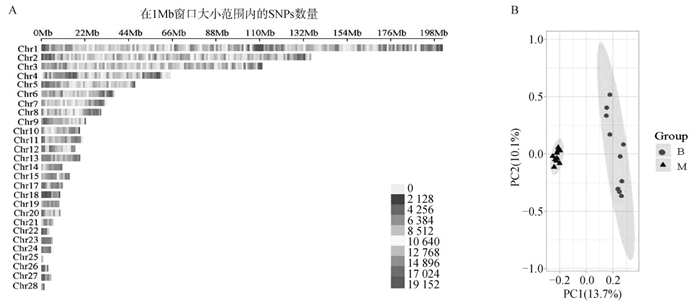
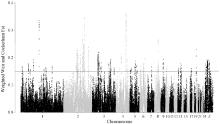
图 2
基于滑动窗口Fst的曼哈顿图"
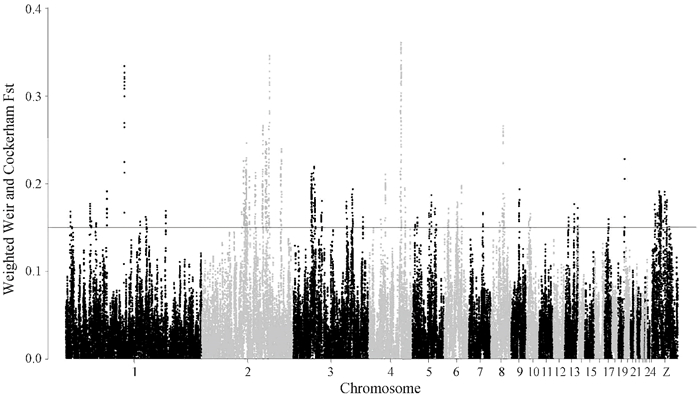
图 3
基于pFst分析的曼哈顿图"
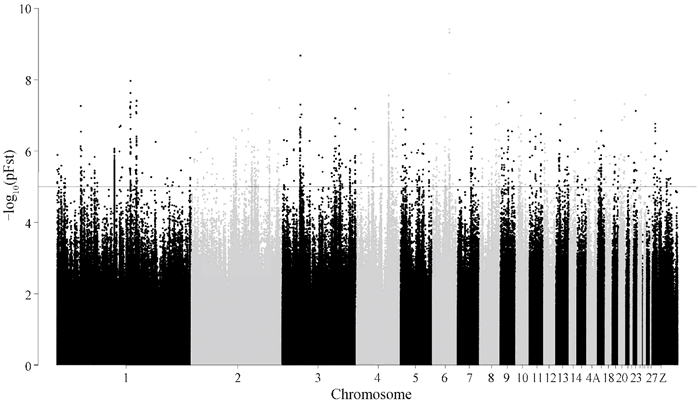
表 3
Fst>0.15和pFst<10-5中与肌肉发育有关的共有基因"
| 染色体 Chromosome | 基因ID Gene ID | 基因 Gene | 功能 Function |
| 1 | A306_00003116 | ZIC2 | 肌肉分化[ |
| 2 | A306_00001266 | ANGPT1 | 骨骼肌卫星细胞增殖[ |
| 2 | A306_00001269 | OXR1 | 产肉量[ |
| 2 | A306_00001475 | NSMAF | 胴体性状[ |
| 2 | A306_00001476 | SDCBP | 胴体重量[ |
| 2 | A306_00001478 | UBXN2B | 胴体性状[ |
| 2 | A306_00001489 | LYN | 胴体性状[ |
| 2 | A306_00001490 | TGS1 | 胴体产量[ |
| 2 | A306_00001491 | TMEM68 | 生长性状[ |
| 2 | A306_00001493 | XKR4 | 胴体产量[ |
| 2 | A306_00001503 | ST18 | 肌肉发育[ |
| 2 | A306_00001717 | GRB10 | 肌肉生长和发育[ |
| 2 | A306_00001726 | UPP1 | 生长性状[ |
| 3 | A306_00000998 | KLHL31 | 肌肉生长和发育[ |
| 3 | A306_00000999 | GCLC | 生长性状[ |
| 3 | A306_00001095 | APOB | 肌肉发育[ |
| 3 | A306_00010435 | LTBP1 | 生长性状[ |
| 4 | A306_00003396 | EVC2 | 肉质[ |
| 4 | A306_00003397 | STK32B | 肉质[ |
| 4 | A306_00003399 | MSX1 | 成肌细胞分化[ |
| 4 | A306_00006969 | EDNRA | 肌肉生长[ |
| 6 | A306_00003890 | ITGB6 | 骨骼肌卫星细胞增殖[ |
| 6 | A306_00003896 | DPP4 | 成肌细胞分化[ |
| 8 | A306_00004220 | ROR1 | 骨骼肌卫星细胞增殖[ |
| 8 | A306_00004246 | MYSM1 | 肌肉生成[ |
| 9 | A306_00007726 | GHSR | 生长性状[ |
| 9 | A306_00007727 | TNFSF10 | 肌肉萎缩[ |
| 10 | A306_00006896 | PRTG | 日增重[ |
| Z | A306_00011946 | SMAD2 | 成肌细胞增殖分化[ |
表 4
转录组数据质量评估及Clean reads与参考基因组比对结果"
| 样品 Sample | 质控后reads/M Clean reads | 质控后测序量/G Clean data | Q30/% | GC含量/% GC content | 比对率/% Mapped reads rate |
| B1 | 87.89 | 13.18 | 93.65 | 49.62 | 61.49 |
| B2 | 72.82 | 10.92 | 93.94 | 49.19 | 59.22 |
| B3 | 77.07 | 11.56 | 94.78 | 48.31 | 66.40 |
| B4 | 80.79 | 12.12 | 94.70 | 49.43 | 62.99 |
| B5 | 85.46 | 12.82 | 94.43 | 48.59 | 60.32 |
| M1 | 111.22 | 16.68 | 95.98 | 49.62 | 60.37 |
| M2 | 90.73 | 13.61 | 94.77 | 49.19 | 60.20 |
| M3 | 67.07 | 10.06 | 95.35 | 48.31 | 38.80 |
| M4 | 109.00 | 16.35 | 95.44 | 49.43 | 66.04 |
| M5 | 82.10 | 12.32 | 94.34 | 48.59 | 54.74 |
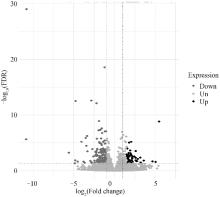
图 4
差异表达基因火山图"
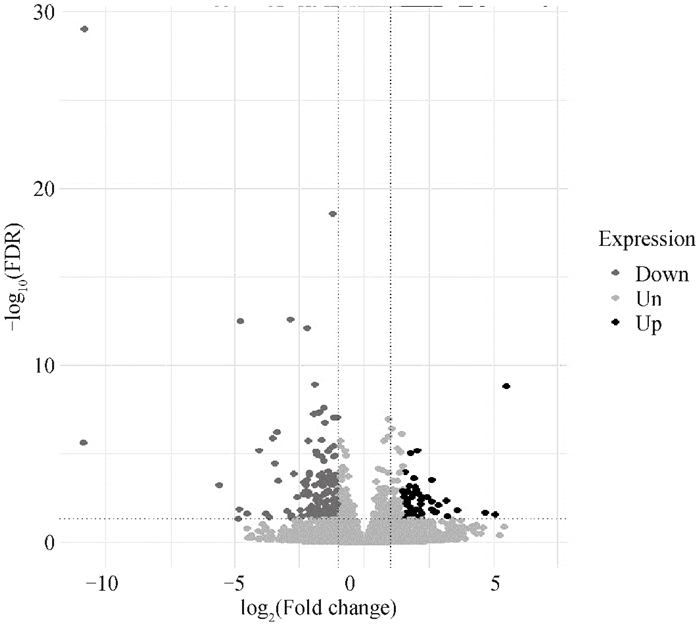
图 5
差异表达基因GO和KEGG富集分析气泡图 A.差异表达基因GO富集分析气泡图;B.差异表达基因KEGG富集分析气泡图"
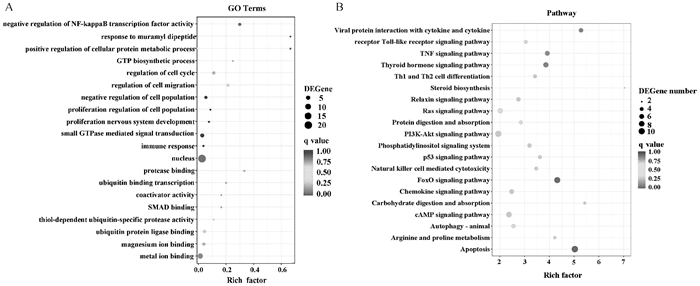
表 5
细胞核组分与细胞凋亡通路中富集到与肌肉发育有关的基因"
| 基因ID Gene ID | 基因 Gene | 功能 Function |
| A306_00011622 | MCL1 | 肌肉生长[ |
| A306_00004203 | GADD45A | 肌肉萎缩[ |
| A306_00013720 | GADD45B | 肌源性分化[ |
| A306_00009707 | SIK1 | 肌肉生长[ |
| A306_00001065 | TRIB2 | 肌生成[ |
| A306_00002651 | IGF2BP3 | 成肌细胞增殖和分化[ |
| A306_00004566 | TIMP3 | 肌生成[ |
| A306_00010314 | PIK3R3 | 骨骼肌生长发育[ |
| A306_00006126 | PIK3CD | 成肌细胞增殖[ |
| A306_00013901 | CTSK | 肌肉损伤或坏死[ |
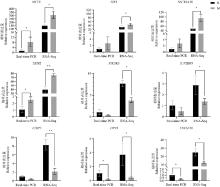
图 6
差异表达基因实时荧光定量PCR验证 *.P<0.05;**.P<0.01"
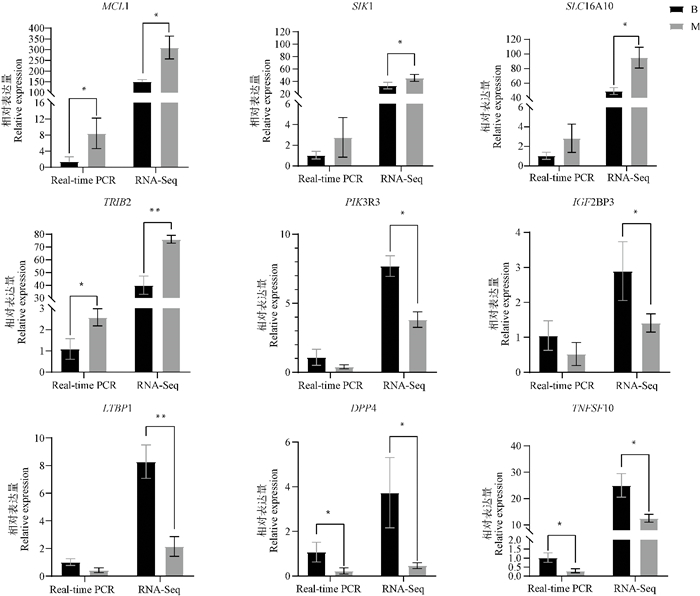
表 6
9个差异表达基因的荧光定量PCR数据与RNA-Seq测序数据之间的相关系数"
| 基因ID Gene ID | MCL1 | SIK1 | SLC16A10 | TRIB2 | PIK3R3 | IGF2BP3 | LTBP1 | DPP4 | TNFSF10 |
| 相关系数 Correlation coefficient | 0.95 | 0.69 | 0.53 | 0.95 | 0.83 | 0.50 | 0.86 | 0.86 | 0.95 |
| 1 | 陈益填. 我国肉鸽业养殖现状、投资效益及发展趋势分析[J]. 中国家禽, 2012, 34 (4): 8- 11. |
| CHEN Y T . China's meat pigeon industry breeding status, investment efficiency and development trend analysis[J]. China Poultry, 2012, 34 (4): 8- 11. | |
| 2 | 陈益填. 我国鸽业市场现状及未来展望[J]. 畜牧产业, 2025 (2): 31- 32. |
| CHEN Y T . Current situation and prospects of pigeon market in China[J]. Livestock Industry, 2025 (2): 31- 32. | |
| 3 | 肖长峰, 吕文纬, 朱丽慧, 等. 我国肉鸽养殖产业存在的问题与对策分析[J]. 上海畜牧兽医通讯, 2020 (2): 56- 57. |
| XIAO C F , LV W W , ZHU L H , et al. Problems and Countermeasures Analysis of Meat Pigeon Farming Industry in China[J]. Shanghai Journal of Animal Husbandry and Veterinary Medicine, 2020 (2): 56- 57. | |
| 4 | 汤青萍, 卜柱, 穆春宇, 等. 中国肉鸽养殖种质资源状况及介绍[J]. 中国畜禽种业, 2018, 14 (10): 165- 168. |
| TANG Q P , BU Z , MU C Y , et al. Status and introduction of germplasm resources for broiler pigeon breeding in China[J]. The Chinese Livestock and Poultry Breeding, 2018, 14 (10): 165- 168. | |
| 5 | 卜柱, 厉宝林, 赵振华, 等. 中国肉鸽主要品种资源与育种现状[J]. 中国畜牧兽医, 2010, 37 (6): 116- 119. |
| BU Z , LI B L , ZHAO Z H , et al. Resources and breeding status of the main varieties of pigeons in China[J]. China Animal Husbandry& Veterinary Medicine, 2010, 37 (6): 116- 119. | |
| 6 | 毛楠楠, 孙勇胜, 臧素敏, 等. 不同种群肉鸽生长与繁殖性能比较[J]. 家禽科学, 2022 (10): 3- 9. |
| MAO N N , SUN Y S , ZANG S M , et al. Comparison of growth and reproductive performance of different populations of meat pigeons[J]. Poultry Science, 2022 (10): 3- 9. | |
| 7 | 梁勇, 陈益填, 韩联众, 等. "天翔"肉鸽专门化品系培育及杂交配套研究[J]. 养禽与禽病防治, 2017 (4): 2- 3. |
| LIANG Y , CHEN Y T , HAN L Z , et al. Breeding and crossbreeding of "Tianxiang" pigeon specialization lines[J]. Poultry Husbandry and Disease Control, 2017 (4): 2- 3. | |
| 8 | 汤青萍, 卜柱, 宋迟, 等. 欧洲肉鸽不同品系生产性能测定[J]. 家畜生态学报, 2018, 39 (1): 73- 76. |
| TANG Q P , BU Z , SONG C , et al. Determination of production performance of different strains of European pigeons[J]. Journal of Domestic Animal Ecology, 2018, 39 (1): 73- 76. | |
| 9 | 汤青萍, 卜柱, 穆春宇, 等. 肉鸽实用选育技术[J]. 中国家禽, 2018, 40 (4): 69- 72. |
| TANG Q P , BU Z , MU C Y , et al. Practical selective breeding techniques for flesh pigeons[J]. China Poultry, 2018, 40 (4): 69- 72. | |
| 10 | 陈军. 对姜堰市肉鸽产业发展情况的调查分析[J]. 中国禽业导刊, 2008, 25 (18): 14- 15. |
| CHEN J . Investigation and analysis on the development of meat pigeon industry in Jiangyan City[J]. Guide To Chinese Poultry, 2008, 25 (18): 14- 15. | |
| 11 | 韩占兵, 黄炎坤. 肉种鸽品种退化原因及提纯复壮措施[J]. 中国家禽, 2004 (10): 52. |
| HAN Z B , HUANG Y K . Reasons for the degradation of meat pigeon breeds and measures for purification and rejuvenation[J]. China Poultry, 2004 (10): 52. | |
| 12 | 闫俊书, 周维仁, 宦海林, 等. 家禽肌纤维的生长发育规律及其调控[J]. 江苏农业科学, 2010 (5): 276- 279. |
| YAN J S , ZHOU W L , HUAN H L , et al. Growth and developmental patterns of poultry muscle fibers and their regulation[J]. Jiangsu Agricultural Sciences, 2010 (5): 276- 279. | |
| 13 | BENTZINGER C F , WANG Y X , RUDNICKI M A . Building muscle: molecular regulation of myogenesis[J]. Cold Spring Harb Perspect Biol, 2012, 4 (2): a008342. |
| 14 | JANSEN K M , PAVLATH G K . Molecular control of mammalian myoblast fusion[J]. Methods Mol Biol, 2008, 475, 115- 133. |
| 15 |
LI H , LI S J , ZHANG H , et al. Integrated GWAS and transcriptome analysis reveals key genes associated with muscle fibre and fat traits in Gushi chicken[J]. Br Poult Sci, 2025, 66 (1): 31- 41.
doi: 10.1080/00071668.2024.2400685 |
| 16 |
ZHAO D , LIU R R , TAN X D , et al. Large-scale transcriptomic and genomic analyses reveal a novel functional gene SERPINB6 for chicken carcass traits[J]. J Anim Sci Biotechnol, 2024, 15 (1): 70.
doi: 10.1186/s40104-024-01026-3 |
| 17 |
HU S Q , CHENG L M , WANG J W , et al. Genome-wide transcriptome profiling reveals the mechanisms underlying muscle group-specific phenotypic changes under different raising systems in ducks[J]. Poult Sci, 2020, 99 (12): 6723- 6736.
doi: 10.1016/j.psj.2020.09.027 |
| 18 | 付梦思, 李发达, 余梓榆, 等. 不同品种乳鸽胸肌发育的差异比较及转录组分析[J]. 中国家禽, 2023, 45 (7): 1- 10. |
| FU M S , LI F D , YU Z Y , et al. Comparison and transcriptome analysis of breast muscle development in different breeds of pigeon squabs[J]. China Poultry, 2023, 45 (7): 1- 10. | |
| 19 | YIN Z Z , ZHOU W , MAO H G , et al. Identification of genes related to squab muscle growth and lipid metabolism from transcriptome profiles of breast muscle and liver in domestic pigeon (Columba livia)[J]. Animals (Basel), 2022, 12 (9): 1061. |
| 20 |
DE LAS HERAS-SALDANA S , CHUNG KY , LEE S H , et al. Gene expression of Hanwoo satellite cell differentiation in longissimus dorsi and semi-membranosus[J]. BMC Genomics, 2019, 20 (1): 156.
doi: 10.1186/s12864-019-5530-7 |
| 21 | MOHAN NH , PATHAK P , BURAGOHAIN L , et al. Comparative muscle transcriptome of Mali and Hampshire breeds of pigs: a preliminary study[J]. Anim Biotechnol, 2023, 34 (8): 3946- 3961. |
| 22 |
ZHANG R , MIAO J , SONG Y X , et al. Genome-wide association study identifies the PLAG1-OXR1 region on BTA14 for carcass meat yield in cattle[J]. Physiol Genomics, 2019, 51 (5): 137- 144.
doi: 10.1152/physiolgenomics.00112.2018 |
| 23 | ALAM M Z , HAQUE M A , IQBAL A , et al. Genome-wide association study to identify QTL for carcass traits in Korean Hanwoo cattle[J]. Animals (Basel), 2023, 13 (17): 2737. |
| 24 |
ZHAO Y , YANG X , QI J J , et al. Genome-wide association studies reveal the genetic basis of growth and carcass traits in Sichuan Shelduck[J]. Poult Sci, 2024, 103 (11): 104211.
doi: 10.1016/j.psj.2024.104211 |
| 25 |
YU J Z , ZHOU J , YANG F X , et al. Genome-wide association analysis identifies candidate genes for carcass yields in Peking ducks[J]. Anim Genet, 2024, 55 (6): 833- 837.
doi: 10.1111/age.13480 |
| 26 |
SONG X Y , YAO Z , ZHANG Z J , et al. Whole-genome sequencing reveals genomic diversity and selection signatures in Xia'nan cattle[J]. BMC Genomics, 2024, 25 (1): 559.
doi: 10.1186/s12864-024-10463-3 |
| 27 |
GODOY T F , MOREIRA G C , BOSCHIERO C , et al. SNP and INDEL detection in a QTL region on chicken chromosome 2 associated with muscle deposition[J]. Anim Genet, 2015, 46 (2): 158- 163.
doi: 10.1111/age.12271 |
| 28 |
HU Z G , CAO J T , LIU G Y , et al. Comparative transcriptome profiling of skeletal muscle from Black Muscovy duck at different growth stages using RNA-seq[J]. Genes (Basel), 2020, 11 (10): 1228.
doi: 10.3390/genes11101228 |
| 29 |
WANG X X , XIAO Y P , HUA Y , et al. Transcriptome analysis reveals the genes involved in growth and metabolism in Muscovy ducks[J]. BioMed Research International, 2021, 2021 (1): 6648435.
doi: 10.1155/2021/6648435 |
| 30 | HU Z G , CAO J T , GE L Y , et al. Characterization and comparative transcriptomic analysis of skeletal muscle in Pekin Duck at different growth stages using RNA-Seq[J]. Animals (Basel), 2021, 11 (3): 834. |
| 31 | BO D D , FENG Y Q , BAI Y L , et al. Whole-genome resequencing reveals genetic diversity and growth trait-related genes in Pinan cattle[J]. Animals (Basel), 2024, 14 (15): 2163. |
| 32 |
ZHANG Y C , LU Y L , YU M L , et al. Transcriptome profiling identifies differentially expressed genes in skeletal muscle development in native Chinese ducks[J]. Genes (Basel), 2023, 15 (1): 52.
doi: 10.3390/genes15010052 |
| 33 |
ZHANG S L , LI J , ZHAO Y H , et al. Whole-genome resequencing reveals genetic diversity, differentiation, and selection signatures of yak breeds/populations in southwestern China[J]. Front Genet, 2024, 15, 1382128.
doi: 10.3389/fgene.2024.1382128 |
| 34 |
LIU Z C , QIN Q , ZHANG C Y , et al. Effects of nonsynonymous single nucleotide polymorphisms of the KIAA1217, SNTA1 and LTBP1 genes on the growth traits of Ujumqin sheep[J]. Front Vet Sci, 2024, 11, 1382897.
doi: 10.3389/fvets.2024.1382897 |
| 35 |
WANG S H , YI X H , WU M L , et al. Detection of key gene InDels in TGF-β pathway and its relationship with growth traits in four sheep breeds[J]. Anim Biotechnol, 2021, 32 (2): 194- 204.
doi: 10.1080/10495398.2019.1675682 |
| 36 |
LEAL-GUTIERREZ J D , ELZO M A , JOHNSON D D , et al. Genome wide association and gene enrichment analysis reveal membrane anchoring and structural proteins associated with meat quality in beef[J]. BMC Genomics, 2019, 20 (1): 151.
doi: 10.1186/s12864-019-5518-3 |
| 37 |
WANG H H , ZHANG L , CAO J X , et al. Genome-wide specific selection in three domestic sheep breeds[J]. PLoS One, 2015, 10 (6): e0128688.
doi: 10.1371/journal.pone.0128688 |
| 38 | LEE J H , LI Y , KIM J J . Detection of QTL for carcass quality on chromosome 6 by exploiting linkage and linkage disequilibrium in Hanwoo[J]. Asian-Australas J Anim Sci, 2012, 25 (1): 17- 21. |
| 39 |
ZHOU G Q , YANG Y N , ZHANG X M , et al. Msx1 cooperates with Runx1 for inhibiting myoblast differentiation[J]. Protein Expr Purif, 2021, 179, 105797.
doi: 10.1016/j.pep.2020.105797 |
| 40 |
ZHU X L , LI M R , JIA X , et al. The homeoprotein Msx1 cooperates with Pkn1 to prevent terminal differentiation in myogenic precursor cells[J]. Biochimie, 2019, 162, 55- 65.
doi: 10.1016/j.biochi.2019.04.003 |
| 41 |
LEE H , HABAS R , ABATE-SHEN C . MSX1 cooperates with histone H1b for inhibition of transcription and myogenesis[J]. Science, 2004, 304 (5677): 1675- 1678.
doi: 10.1126/science.1098096 |
| 42 |
KODAKA Y , TANAKA K , KITAJIMA K , et al. LIM homeobox transcription factor Lhx2 inhibits skeletal muscle differentiation in part via transcriptional activation of Msx1 and Msx2[J]. Exp Cell Res, 2015, 331 (2): 309- 319.
doi: 10.1016/j.yexcr.2014.11.009 |
| 43 |
XIONG H L , ZHANG Y , ZHAO Z Y . Investigation of single nucleotide polymorphisms in differentially expressed genes and proteins reveals the genetic basis of skeletal muscle growth differences between Tibetan and Large White pigs[J]. Anim Biosci, 2024, 37 (12): 2021- 2032.
doi: 10.5713/ab.24.0135 |
| 44 |
QIAO H X , WANG S S , ZHOU J , et al. ITGB6 inhibits the proliferation of porcine skeletal muscle satellite cells[J]. Cell Biol Int, 2022, 46 (1): 96- 105.
doi: 10.1002/cbin.11702 |
| 45 |
KOLANOWSKI T J , ROZWADOWSKA N , ZIMNA A , et al. Chromatin and transcriptome changes in human myoblasts show spatio-temporal correlations and demonstrate DPP4 inhibition in differentiated myotubes[J]. Sci Rep, 2020, 10 (1): 14336.
doi: 10.1038/s41598-020-70756-x |
| 46 |
KAMIZAKI K , DOI R , HAYASHI M , et al. The Ror1 receptor tyrosine kinase plays a critical role in regulating satellite cell proliferation during regeneration of injured muscle[J]. J Biol Chem, 2017, 292 (38): 15939- 15951.
doi: 10.1074/jbc.M117.785709 |
| 47 | HUANG R Q , CHEN J H , XU D , et al. Transcriptome data revealed the circRNA-miRNA-mRNA regulatory network during the proliferation and differentiation of myoblasts in Shitou goose[J]. Animals (Basel), 2024, 14 (4): 576. |
| 48 |
CAI Z B , LI M , ZHANG Y W , et al. Comparative transcriptome analyses of longissimus thoracis between pig breeds differing in muscle characteristics[J]. Front Genet, 2020, 11, 526309.
doi: 10.3389/fgene.2020.526309 |
| 49 |
ZHOU Z J , REN Y , YANG J X , et al. Acetyl-coenzyme A synthetase 2 potentiates macropinocytosis and muscle wasting through metabolic reprogramming in pancreatic cancer[J]. Gastroenterology, 2022, 163 (5): 1281- 1293.
doi: 10.1053/j.gastro.2022.06.058 |
| 50 |
MANCIN E , TULIOZI B , PEGOLO S , et al. Genome wide association study of beef traits in local alpine breed reveals the diversity of the pathways involved and the role of time stratification[J]. Front Genet, 2022, 12, 746665.
doi: 10.3389/fgene.2021.746665 |
| 51 |
LU J W , LIU Y L , LI H X . oar-miR-411a-5p promotes proliferation and differentiation in Hu sheep myoblasts under heat stress by targeting SMAD2[J]. J Cell Physiol, 2025, 240 (2): e31515.
doi: 10.1002/jcp.31515 |
| 52 |
CHEN F X , WU P F , SHEN M M , et al. Transcriptome analysis of differentially expressed genes related to the growth and development of the Jinghai Yellow chicken[J]. Genes (Basel), 2019, 10 (7): 539.
doi: 10.3390/genes10070539 |
| 53 |
LIU Y , MA Y , TU Z , et al. Mcl-1 inhibits Mff-mediated mitochondrial fragmentation and apoptosis[J]. Biochem Biophys Res Commun, 2020, 523 (3): 620- 626.
doi: 10.1016/j.bbrc.2019.12.104 |
| 54 |
EHMSEN J T , KAWAGUCHI R , KAVAL D , et al. GADD45A is a protective modifier of neurogenic skeletal muscle atrophy[J]. JCI Insight, 2021, 6 (13): e149381.
doi: 10.1172/jci.insight.149381 |
| 55 |
DENG K P , FAN Y X , LIANG Y X , et al. FTO-mediated demethylation of GADD45B promotes myogenesis through the activation of p38 MAPK pathway[J]. Mol Ther Nucleic Acids, 2021, 26, 34- 48.
doi: 10.1016/j.omtn.2021.06.013 |
| 56 |
BERDEAUX R , GOEBEL N , BANASZYNSKI L , et al. SIK1 is a class Ⅱ HDAC kinase that promotes survival of skeletal myocytes[J]. Nat Med, 2007, 13 (5): 597- 603.
doi: 10.1038/nm1573 |
| 57 |
STEWART R , AKHMEDOV D , ROBB C , et al. Regulation of SIK1 abundance and stability is critical for myogenesis[J]. Proc Natl Acad Sci U S A, 2013, 110 (1): 117- 122.
doi: 10.1073/pnas.1212676110 |
| 58 |
WANG K , LIUFU S , YU Z , et al. miR-100-5p regulates skeletal muscle myogenesis through the Trib2/mTOR/S6K signaling pathway[J]. Int J Mol Sci, 2023, 24 (10): 8906.
doi: 10.3390/ijms24108906 |
| 59 |
WANG X T , LIN J Y , JIAO Z H , et al. Circular RNA circIGF2BP3 promotes the proliferation and differentiation of chicken primary myoblasts[J]. Int J Mol Sci, 2023, 24 (21): 15545.
doi: 10.3390/ijms242115545 |
| 60 |
LIN S M , LUO W , YE Y Q , et al. Let-7b regulates myoblast proliferation by inhibiting IGF2BP3 expression in dwarf and normal chicken[J]. Front Physiol, 2017, 8, 477.
doi: 10.3389/fphys.2017.00477 |
| 61 |
HOU H B , WANG X L , LI X , et al. Genome-wide association study of growth traits and validation of key mutations (MSTN c.C861T) associated with the muscle mass of meat pigeons[J]. Anim Genet, 2024, 55 (1): 110- 122.
doi: 10.1111/age.13382 |
| 62 | LIU H J , CHE S Y , JIN B W , et al. TIMP3: a physiological regulator of adult myogenesis[J]. J Cell Sci, 2010, 123 (Pt 17): 2914- 2921. |
| 63 | XU X L , LU H , XU D , et al. miR-708-5p regulates myoblast proliferation and differentiation[J]. Vet Sci, 2022, 9 (11): 641. |
| 64 |
YUE Y W , JIN C F , CHEN M M , et al. A lncRNA promotes myoblast proliferation by up-regulating GH1[J]. In Vitro Cell Dev Biol Anim, 2017, 53 (8): 699- 705.
doi: 10.1007/s11626-017-0180-z |
| 65 |
KIMURA S , MIYAKE N , OZASA S , et al. Increase in cathepsin K gene expression in Duchenne muscular dystrophy skeletal muscle[J]. Neuropathology, 2024, 44 (6): 411- 421.
doi: 10.1111/neup.12995 |
| 66 |
ZHANG B , MA J , SHEN L , et al. Genomic insights into pigeon breeding: GWAS for economic traits and the development of a high-throughput liquid phase array chip[J]. Poult Sci, 2025, 104 (3): 104872.
doi: 10.1016/j.psj.2025.104872 |
| 67 |
MAO H G , DONG X Y , CAO H Y , et al. Association of DGAT2 gene polymorphisms with carcass and meat quality traits in domestic pigeons (Columba livia)[J]. Br Poult Sci, 2018, 59 (2): 149- 153.
doi: 10.1080/00071668.2017.1413232 |
| 68 |
MAO H G , CAO H Y , LIU H H , et al. Association of ADSL gene polymorphisms with meat quality and carcass traits in domestic pigeons (Columba livia)[J]. Br Poult Sci, 2018, 59 (5): 604- 607.
doi: 10.1080/00071668.2018.1493188 |
| 69 |
BUCKINGHAM M . Myogenic progenitor cells and skeletal myogenesis in vertebrates[J]. Curr Opin Genet Dev, 2006, 16 (5): 525- 532.
doi: 10.1016/j.gde.2006.08.008 |
| 70 |
WAGERS A , CONBOY I M . Cellular and molecular signatures of muscle regeneration: current concepts and controversies in adult myogenesis[J]. Cell, 2005, 122 (5): 659- 667.
doi: 10.1016/j.cell.2005.08.021 |
| 71 |
HOCHREITER-HUFFORD A E , LEE C S , KINCHEN J M , et al. Phosphatidylserine receptor BAI1 and apoptotic cells as new promoters of myoblast fusion[J]. Nature, 2013, 497 (7448): 263- 267.
doi: 10.1038/nature12135 |
| [1] | 白锋, 玛尔孜娅·亚森, 阿米妮古丽·阿不来孜, 滕文, 罗春彦, 纳扎开提·艾尼万尔, 张耘韬, 纪新民, 张艳花. 吐鲁番黑羊体重和体尺性状全基因组关联分析[J]. 畜牧兽医学报, 2025, 56(9): 4315-4327. |
| [2] | 李佳鹏, 刘庆, 孙佳钰, 马泽芳, 崔凯. 基于转录组和蛋白质组分析筛选银黑狐毛色形成的关键基因[J]. 畜牧兽医学报, 2025, 56(9): 4379-4392. |
| [3] | 余秋蓉, 蔡旭航, 何艺, 李基棕, 毛立, 许信刚, 李彬. 一株羊冠状病毒的分离鉴定及全基因组序列分析[J]. 畜牧兽医学报, 2025, 56(9): 4604-4614. |
| [4] | 刘昕玥, 李丹妮, 宗颖, 时坤, 李健明, 刁乃超, 曾范利, 杜锐. Rv3435c重组耻垢分枝杆菌感染小鼠RAW264.7巨噬细胞的转录组分析[J]. 畜牧兽医学报, 2025, 56(9): 4657-4672. |
| [5] | 范婧, 李伟, 朱妍, 勿都巴拉, 史佳慧, 胡斯乐, 吴江鸿. 湖羊不同发育期瘤胃形态学变化及基因表达差异研究[J]. 畜牧兽医学报, 2025, 56(8): 3773-3786. |
| [6] | 任千姿, 张佰忠, 王真勍, 王向林, 龚颖, 胡仁科, 浦亚斌, 苏鹏, 李业芳, 马月辉, 李昊帮, 蒋琳. 基于全基因组重测序对武雪山羊的遗传进化分析[J]. 畜牧兽医学报, 2025, 56(8): 3787-3801. |
| [7] | 张嘉良, 黄畅, 杨永林, 杨华, 白文林, 马月辉, 赵倩君. 基于50K液相芯片的中国绵羊群体遗传结构与羊毛性状选择信号分析[J]. 畜牧兽医学报, 2025, 56(7): 3164-3176. |
| [8] | 缪俊杰, 张日泉, 吴厚义, 游新明, 黄奕雯, 黄小英, 郭震洋, 刘建林, 肖卫华, 郭田华, 陈浩, 康冬柳. 全基因组SNPs揭示井冈黑掌鹅种质资源特性与遗传多样性特征[J]. 畜牧兽医学报, 2025, 56(7): 3199-3209. |
| [9] | 刘莎, 苏蒙, 高倩梅, 宋丹丽, 赵桂苹, 李建慧, 李庆贺. SIRT1基因激活后鸡巨噬细胞转录组分析[J]. 畜牧兽医学报, 2025, 56(6): 2661-2671. |
| [10] | 陈艳茹, 马小春, 王明慧, 唐瑶瑶, 白露, 赵桂苹, 文杰, 刘冉冉. 白羽肉鸡胸肌意大利面肉和木质肉发生率及其对肉品质影响研究[J]. 畜牧兽医学报, 2025, 56(6): 2672-2684. |
| [11] | 高林娜, 蒋影影, 王悦, 史倩倩, 安振江, 王慧利, 沈阳阳, 陈坤琳, 张乐颖. 基于CRISPR/Cas9技术的牛乳腺上皮细胞全基因组敲除文库的构建[J]. 畜牧兽医学报, 2025, 56(6): 2711-2723. |
| [12] | 刘子龙, 李乔, 吴怡, 王慧慧, 李讨讨, 马友记. 肝转录组揭示中草药饲料添加剂可能影响湖羊肝组织胆汁酸代谢和免疫功能[J]. 畜牧兽医学报, 2025, 56(6): 3014-3026. |
| [13] | 王勤倩, 高振东, 陆颖, 马若珊, 邓卫东, 和晓明. 全基因组重测序在中国地方黄牛上的研究进展[J]. 畜牧兽医学报, 2025, 56(5): 2026-2037. |
| [14] | 朱海燕, 张菁怡, 晏雪勇, 梁海平, 魏庆, 曹际, 黄建珍. 基于转录组探究光周期对泰和乌鸡产蛋性能影响的分子机制[J]. 畜牧兽医学报, 2025, 56(5): 2123-2135. |
| [15] | 孙国欣, 李蕴华, 赛音, 郭文华, 赵艳红, 张满新, 刘佳森. 湖羊群体结构分析与经济性状相关选择信号检测[J]. 畜牧兽医学报, 2025, 56(5): 2168-2181. |
| 阅读次数 | ||||||
|
全文 |
|
|||||
|
摘要 |
|
|||||
