


Acta Veterinaria et Zootechnica Sinica ›› 2026, Vol. 57 ›› Issue (1): 30-45.doi: 10.11843/j.issn.0366-6964.2026.01.004
• REVIEW • Previous Articles Next Articles
TIAN Ziqi1,2( ), TU Yan1, JIANG Linshu2, BI Yanliang1()
Received:2024-12-30
Online:2026-01-23
Published:2026-01-26
Contact:
BI Yanliang
E-mail:1847378700@qq.com;biyanliang@caas.cn
CLC Number:
TIAN Ziqi, TU Yan, JIANG Linshu, BI Yanliang. Biological Characteristics of Enterococcus faecalis and Its Application in Animal Husbandry[J]. Acta Veterinaria et Zootechnica Sinica, 2026, 57(1): 30-45.
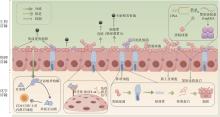
Fig.1
Schematic diagram of Enterococcus faecalis regulating intestinal microbiota balance and enhancing intestinal barrier function (Draw using figdraw.com)"

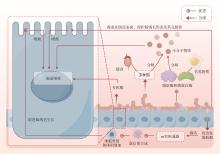
Fig.2
Schematic diagram of Enterococcus faecalis promoting intestinal nutrient absorption (Drawn by figdraw.com)"
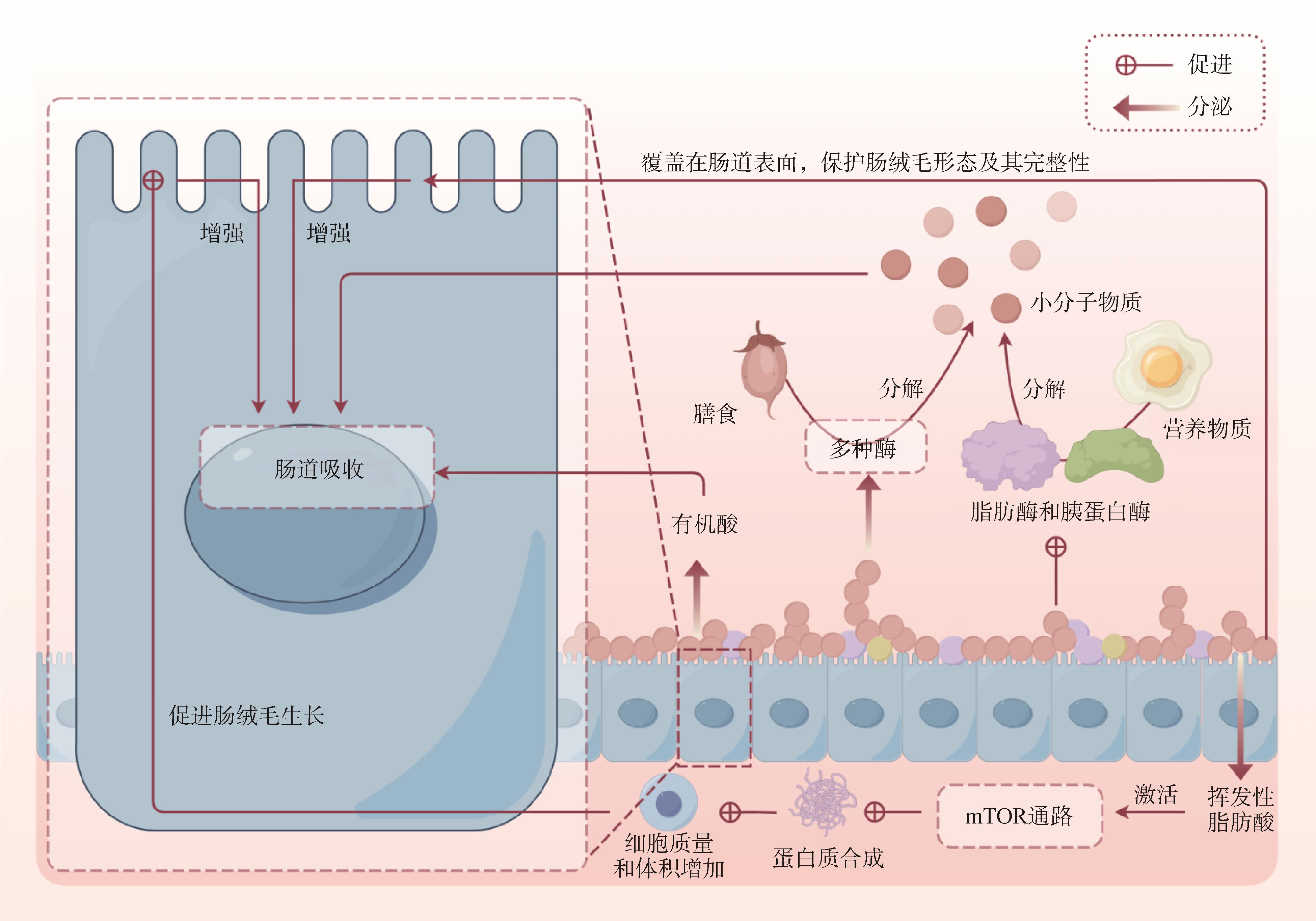
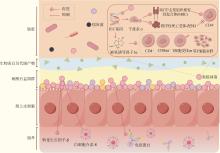
Fig.3
Schematic diagram of Enterococcus faecalis enhancing host immune function (Drawn by figdraw.com)"

| [1] | 王家迎,王灿宇,包淋斌,等.乳酸粪肠球菌对锦江黄牛生长性能及养分消化率的影响[J].江西饲料,2014(3):1-3. |
| WANG J Y,WANG C Y,BAO L B,et al.Effect of Enterococcus faecalis on growth performance and nutrient digestibility of jinjiang cattle[J].JiangXi Feed,2014(3):1-3.(in Chinese) | |
| [2] | 王蕾蕾,许金新.饲料“禁抗令”施行后养殖业面临的挑战及对策[J].中国动物保健,2021,23(9):3-5. |
| WANG L L,XU J X.Challenges and countermeasures faced by the aquaculture industry after the implementation of the feed “Ban”.[J].Animal Health in China,2021,23(9):3-5.(in Chinese) | |
| [3] | MAMUAD L L,KIM S H,BISWAS A A,et al.Rumen fermentation and microbial community composition influenced by live Enterococcus faecium supplementation[J].AMB Express,2019,9(1):123. |
| [4] | WANG K,CAO G,ZHANG H,et al.Effects of Clostridium butyricum and Enterococcus faecalis on growth performance,immune function,intestinal morphology,volatile fatty acids,and intestinal flora in a piglet model[J].Food Funct,2019,10(12):7844-7854. |
| [5] | 张 霄,李 一,喻大鹏,等.一株卵形鲳鲹肠道源粪肠球菌的分离鉴定与生物学特性研究[J].广东农业科学,2024,51(7):47-56. |
| ZHANG X,LI Y,YU D P,et al.Isolation,identification and biological characteristics analysis of Enterococcus faecalis from the intestinal tract of trachinotus ovatus[J].Guangdong Agricultural Sciences,2024,51(7):47-56.(in Chinese) | |
| [6] | 雷喜玲,叶金云,陈丽仙,等.屎肠球菌的作用机制及其在水产动物中的应用[J].饲料工业,2022,43(22):9-15. |
| LEI X L,YE J Y,CHEN L X,et al.The mechanisms and its application of Enterococcus faecium in aquatic animals[J].Feed Industry,2022,43(22):9-15.(in Chinese) | |
| [7] | 安玉亭,解生彬,王立波,等.粪肠球菌的生物学特性及其在养殖业中的应用[C]//中国畜牧兽医学会动物微生态学分会.中国畜牧兽医学会动物微生态学分会第五届第十三次全国学术研讨会论文集.广州:江苏省大丰麋鹿国家级自然保护区管理处,2018:22. |
| AN Y T,XIE S B,WANG L B,et al.Biological characteristics of Enterococcus faecalis and their application in aquaculture[C] Animal Microecology Branch of Chinese Association of Animal Science and Veterinary Medicine.Proceedings of the 13th National Academic Symposium of the 5th and 13th National Academic Symposium of the Animal Microecology Branch of the Chinese Association of Animal Husbandry and Veterinary Medicine.Guangzhou:Dafeng Milu National Nature Reserve Administration of Jiangsu Province,Animal Microecology Branch of Chinese Association of Animal Science and Veterinary Medicine,2018:22.(in Chinese) | |
| [8] | 杨 艳,潘宝海.粪肠球菌在畜牧生产中的应用研究进展[J].饲料研究,2015(21):30-32. |
| YANG Y,PAN B H.Research progress on the application of Enterococcus faecalis in animal husbandry production[J].Feed Research,2015(21):30-32.(in Chinese) | |
| [9] | 鲍延娥,董晓芳,佟建明,等.粪肠球菌益生特性的体外评价[J].西北农业学报,2013,22(11):202-207. |
| BAO Y E,DONG X F,TONG J M,et al.Evaluation of probiotic characteristics of Enterococcus faecalis in Vitro[J].Acta Agriculturae Boreali-occidentalis Sinica,2013,22(11):202-207.(in Chinese) | |
| [10] | 向盈盈,于鸿滨,周 静,等.致病性粪肠球菌YN771的分离鉴定及其生物学特性[J].昆明医科大学学报,2020,41(05):46-51. |
| XIANG Y Y,YU H B,ZHOU J,et al.Isolation and identification of pathogenic Enterococcus faecalis YN771 and analysis of its biological characteristics[J].Journal of Kunming Medical University,2020,41(05):46-51.(in Chinese) | |
| [11] | JUAN W,RONG D,XIAOHONG T,et al.Probiotic and safety properties screening of Enterococcus faecalis from healthy Chinese infants[J].Probiotics Antimicrob Proteins,2019,12(3):1115-1125. |
| [12] | 刘慧慧.粪肠球菌DUT1805高温发酵生产乳酸[D].大连:大连理工大学,2019. |
| LIU H H.Lactic acid production with an isolated high-thermotolerant Enterococcus faecalis DUT1805[D].Dalian:Dalian University of Technology,2019.(in Chinese) | |
| [13] | 董佩佩,徐海燕,辛国芹,等.5种饲用乳酸菌耐热性能的研究[J].饲料广角,2015(18):28-30. |
| DONG P P,XU H Y,XIN G Q,et al.Study on the heat resistance of five kinds of lactic acid bacteria for feeding[J].Feed Wide Angle,2015(18):28-30.(in Chinese) | |
| [14] | 白天天,郭雪峰.屎肠球菌的特性及其在畜牧生产中的应用研究进展[J].中国畜牧杂志,2021,57(2):16-20. |
| BAI T T,GUO X F.Research progress on the role of microalgal-bacterial consortia in nutrients removal of piggery wastewater and its interaction mechanism[J].Chinese Journal of Animal Science,2021,57(2):16-20.(in Chinese) | |
| [15] | 王佳慧,姜仲文,满永恒,等.粪肠球菌BN6株的体外益生特性评价[J].中国兽医科学,2021,51(3):337-342. |
| WANG J H,JIANG Z W,MAN Y H,et al.Evaluation of probiotic characteristics of Enterococcus faecalis BN6 isolate in vitro[J].Chinese Veterinary Science,2021,51(3):337-342.(in Chinese) | |
| [16] | 许喜林,段龙辉,周晓莉,等.粪肠球菌EF-ZA1107-06的增殖培养基优化及其特性研究[J].食品与发酵科技,2024,60(3):35-41. |
| XU X L,DUAN L H,ZHOU X L,et al.Optimization of the proliferation medium of Enterococcus faecalis EF-ZA1107-06 and research of its characterization[J].Sichuan Food and Fermentation,2024,60(3):35-41.(in Chinese) | |
| [17] | 曹 珂.高耐胆盐乳酸菌的筛选、鉴定及在豆粕发酵中的应用[D].南昌:江西农业大学,2015. |
| CAO K.Isolation,characterization of a lactic acid bacteria with high bile salt tolerance and its application in soyabean meal fermentation[D].Nanchang:Jiangxi Agricultural University,2015.(in Chinese) | |
| [18] | 刘明珠.乳酸粪肠球菌耐受性、抑菌作用及其对瘤胃发酵功能影响研究[D].南昌:江西农业大学,2013. |
| LIU M Z.Research on the tolerability and bacteriostasis of Enterococcus faecalis and its effect on rumen fermentation[D].Nanchang:Jiangxi Agricultural University,2013.(in Chinese) | |
| [19] | 杭州远大生物制药有限公司.粪肠球菌及其应用:CN,201911419590.0[P].2021-07-16. |
| Hangzhou Yuanda Biotechnology Pharmaceutical Co.,Ltd.Enterococcus faecalis and its applications:CN,201911419590.0[P].2021-07-16.(in Chinese) | |
| [20] | 许光胜,王喜亮,吴 涛,等.猪源粪肠球菌的分离、鉴定及应用[J].中国兽医学报,2012,32(11):1645-1650. |
| XU G S,WANG X L,WU T,et al.Screening and application of Enterococcus faecalis from pigs[J].Chinese Journal of Veterinary Medicine,2012,32(11):1645-1650.(in Chinese) | |
| [21] | 张海欧,张安生.五倍子水提取物抑制粪肠球菌粘附能力的体外实验[J].牙体牙髓牙周病学杂志,2017,27(4):198-200,214. |
| ZHANG H O,ZHANG A S.In vitro study on the effect of the aqueous extract of Galla chinensis on adhesion ability of E.faecalis[J].Chinese Journal of Conservative Dentistry,2017,27(4):198-200,214.(in Chinese) | |
| [22] | VERGAUWEN H.The IPEC-J2 cell line[M]//VERHOECKX K,COTTER P,LÓPEZ-EXPÓSITO I,et al.The impact of food bioactives on health:in vitro and ex vivo models.Cham (CH):Springer; 2015.125-134.. |
| [23] | 金 钺,李滨洲,郭珍珍,等.猪源粪肠球菌对猪小肠上皮细胞黏附及致炎作用的影响[J].河南农业大学学报,2023,57(4):623-631. |
| JIN Y,LI B Z,GUO Z Z,et al.Adhesion and inflammatory effect of Enterococcus faecalis to intestinal porcine epithelial cells[J].Journal of Henan Agricultural University,2023,57(4):623-631.(in Chinese) | |
| [24] | 和春昊,武二丽,李滨洲,等.共培养对猪源粪肠球菌N41株部分生物学特性的影响[J].中国预防兽医学报,2018,40(1):74-77. |
| HE C H,WU E L,LI B Z,et al.Influence of co-cultivation on some biological characteristics of Enterococcus faecalis isolate N41[J].Chinese Journal of Preventive Veterinary Medicine,2018,40(1):74-77.(in Chinese) | |
| [25] | 强 华,宋立罡,林任玺,等.粪肠球菌胶原黏附素ace基因对生物被膜形成的影响[J].福建医科大学学报,2019,53(6):382-385. |
| QIANG H,SONG L G,LIN R X,et al.Influence of E.faecalis collagen adhesion gene ace on biofilm formation[J].Journal of Fujian Medical University,2019,53(6):382-385.(in Chinese) | |
| [26] | 李学如,贾文祥,杨 春.细菌生物膜的形成及其相关感染与防治[J].中国抗生素杂志,2003,28(1):55-59. |
| LI X R,JIA W Y,YANG C.The formation of the bacterial biofilm and its relative infection and treatment[J].Chinese Journal of Antibiotics,2003,28(1):55-59.(in Chinese) | |
| [27] | 安玉亭,胡浩孙,王智刚,等.粪肠球菌的生物学特性及其在养殖业中的应用[J].安徽农业科学,2015,27(43):115-117. |
| AN Y T,HU H S,WANG Z G,et al.The Biological characteristice of Entemcoccus faecalis and its application in breeding industry[J].Journal of Anhui Agricultural Sciences,2015,27(43):115-117.(in Chinese) | |
| [28] | HAI D,KONG LY,HUANG X Q,et al.Inhibitory effect of different Chicken-derived lactic acid bacteria isolates on drug resistant Salmonella SE47 isolated from eggs[J].Lett Appl Microbiol,2021,73(1):54-63. |
| [29] | 车笑吟,涂会鑫,杨舒涵,等.产细菌素粪肠球菌EF-3的分离鉴定及其细菌素理化特性[J].中国兽医杂志,2023,59(9):73-76. |
| CHE X Y,TU H X,YANG S H,et al.Isolation and identification of bacteriocin-producing Enterococcus faecalis EF-3 and its bacteriocin physicochemical characteristics[J].Chinese Journal of Veterinary Medicine,2023,59(9):73-76.(in Chinese) | |
| [30] | 石丽颖,孙凯鑫,王友元,等.15株健康奶牛生殖道乳酸菌的分离鉴定及抑菌活性[J].吉林农业大学学报,2022,44(2):189-197. |
| SHI L Y,SUN K X,WANG Y Y,et al.Isolation,Identification and antibacterial activity of 15 lactic acid bacteria strains from reproductive tract of healthy dairy cows[J].Journal of Jilin Agricultural University,2022,44(2):189-197.(in Chinese) | |
| [31] | 孟晓林,李文均,聂国兴.鱼类肠道菌群影响因子研究进展[J].水产学报,2019,43(1):143-155. |
| MENG X L,LI W Y,NIE G X.Effect of different factors on the fish intestinal microbiota[J].Journal of Fisheries of China,2019,43(1):143-155.(in Chinese) | |
| [32] | 王灿宇,付戴波,包淋斌,等.乳酸粪肠球菌对锦江黄牛免疫功能及粪便菌群的影响[J].饲料研究,2015(7):36-38. |
| WANG C Y,FU D B,BAO L B,et al.Effects of Enterococcus faecalis on immune function and fecal microbiota of Jinjiang cattle[J].Feed Research,2015(7):36-38.(in Chinese) | |
| [33] | 艾 玉.饲料中添加不同形式的粪肠球菌F7对凡纳滨对虾生长、免疫和肠道菌群的影响[D].海口:海南大学,2022. |
| AI Y.Effects of different forms of Enterococcus faecalis F supplementation in feed on growth,immunity and intestinal microbiota of Litopenaeus vannamei[D].Haikou:Hainan University,2022.in Chinese | |
| [34] | 杨培培,刘虎传,郝海玉,等.粪肠球菌的作用机制及其在养猪业中的应用[J].山东畜牧兽医,2020,41(4):74,78. |
| YANG P P,LIU H Z,HAO H Y,et al.Mechanism of action of Enterococcus faecalis and its application in swine farming[J].Shandong Animal Husbandry and Veterinary Medicine,2020,41(4):74,78.(in Chinese) | |
| [35] | 肖百言.半导体激光对粪肠球菌生物膜形成和粘附的影响[D].天津:天津医科大学,2020. |
| XIAO B Y.Exposure to diode laser affects the bacterial adherence and biofilm formation in a E.faecalis biofilm model[D].Tianjin:Tianjin Medical University,2020.(in Chinese) | |
| [36] | SONG X,ZHANG H,ZHANG Y,et al.Gut microbial fatty acid isomerization modulates intraepithelial T cells[J].Nature,2023,619(7971):837-843. |
| [37] | 饶志勇,李 玥,杨孝鹏,等.蛋白酶和益生菌组合添加对肉鸡生长性能、肠道健康和盲肠微生物区系的影响[J].动物营养学报,2023,35(06):3659-3672. |
| RAO Z Y,LI Y,YANG X P,et al.Effects of protease and probiotic combination supplementation on growth performance,intestinal health and cecal microbiota of broilers[J].Chinese Journal of Animal Nutrition,2023,35(06):3659-3672.(in Chinese) | |
| [38] | CHICHLOWSKI M,CROOM W J,EDENS F W,et al.Microarchitecture and spatial relationship between bacteria and ileal,cecal,and colonic epithelium in chicks fed a direct-fed microbial,PrimaLac,and salinomycin[J].Poult Sci,2007,86(6):1121-1132. |
| [39] | 李翠茹,彭买姣,谭周进.肠道菌群相关短链脂肪酸的研究进展[J].世界华人消化杂志,2022,30(13):562-570. |
| LI C R,PENG M J,TAN Z J.Progress in research of intestinal microbiota related short chain fatty acids[J].World Chinese Journal of Digestology,2022,30(13):562-570.(in Chinese) | |
| [40] | 荆 祎,李光玉,刘晗璐,等.不同乳酸杆菌添加剂对水貂生长性能、营养物质消化率、氮平衡及血清生化指标的影响[J].动物营养学报,2013,25(9):2160-2167. |
| JING Y,LI G Y,LIU H L,et al.Effects of different lactobacillus additives on growth performance,nutrient digestibility,nitrogen balance and serum biochemical indices of minks[J].Chinese Journal of Animal Nutrition,2013,25(9):2160-2167.(in Chinese) | |
| [41] | 李莹莹,纪巧荣.肠道菌群及其代谢物短链脂肪酸与肠黏膜免疫关系的研究进展[J].微生物学免疫学进展,2023,51(6):67-73. |
| LI Y Y,JI Q R.Progress on the relationship between intestinal microbiota and metabolites short chain fatty acid with intestinal mucosal immunity[J].Progress in Microbiology and Immunology,2023,51(6):67-73.(in Chinese) | |
| [42] | LIU C,WONG P Y,WANG Q,et al.Short-chain fatty acids enhance muscle mass and function through the activation of mTOR signalling pathways in sarcopenic mice[J].J Cachexia Sarcopenia Muscle,2024,15(6):2387-2401. |
| [43] | 杨珍珠,陶乐仁,赵陆恺,等.产细菌素Enterocin Y3粪肠球菌对小鼠肠道菌群及代谢功能的影响[J].中国食品学报,2024,24(2):99-109. |
| YANG Z Z,TAO L R,ZHAO L K,et al.Effects of an Enterocin Y3 producing strain of Enterococcus faecalis DH9003 on intestinal flora modification and metabolic function of mice[J].Journal of Chinese Institute of Food Science and Technology,2024,24(2):99-109.(in Chinese) | |
| [44] | WORTHINGTON J J,REIMANN F,GRIBBLE F M.Enteroendocrine cells-sensory sentinels of the intestinal environment and orchestrators of mucosal immunity[J].Mucosal Immunology,2018,11(1):3-20. |
| [45] | CASTRO M S,MOLINA M A,AZPIROZ M B,et al.Probiotic activity of Enterococcus faecalis CECT7121:effects on mucosal immunity and intestinal epithelial cells[J].Journal of Applied Microbiology,2016,121(4):1117-1129. |
| [46] | WANG S,NG L H,CHOW W L,et al.Infant intestinal Enterococcus faecalis down-regulates inflammatory responses in human intestinal cell lines[J].World Journal of Gastroenterology,2008,14(7):1067-1076. |
| [47] | 冯 超,邵美玲,王景霖,等.粪肠球菌B-8和棒状乳杆菌W-17对鲫鱼非特异性免疫基因表达的影响[J].吉林农业大学学报,2023,45(5):617-624. |
| FENG C,SHAO M L,WANG J L,et al.Effects of Enterococcus faecalis B-8 and Lactobacillus coryniformis W-17 on non-specific immune gene expression of carassius auratus[J].Journal of Jilin Agricultural University,2023,45(5):617-624.(in Chinese) | |
| [48] | TARABEES R,EL-SAYED M S,SHEHATA A A,et al.Effects of the probiotic candidate E.faecalis-1,the poulvac E.coli vaccine,and their combination on growth performance,caecal microbial composition,immune response,and protection against E.coli O78 challenge in broiler chickens[J].Probiotics and Antimicrobial Proteins,2020,12(3):860-872. |
| [49] | PEDICORD V A,LOCKHART A A K,RANGAN K J,et al.Exploiting a host-commensal interaction to promote intestinal barrier function and enteric pathogen tolerance[J].Sci Immunol.2016;1(3):eaai7732. |
| [50] | 侯 璐.猪源粪肠球菌的特性及对仔猪生长性能和免疫力影响的研究[D].呼和浩特:内蒙古农业大学,2010. |
| HOU L.The study of characteristics of Enterococcus faecalis from pigs and it's effects on growth performance and immunity of piglets[D].Hohhot:Inner Mongolia Agricultural University,2010.(in Chinese) | |
| [51] | 史自涛,姚焰础,江 山,等.粪肠球菌替代抗生素对断奶仔猪生长性能、腹泻率、血液生化指标和免疫器官的影响[J].动物营养学报,2015,27(06):1832-1840. |
| SHI Z T,YAO Y C,JIANG S,et al.Effects of Enterococcus faecalis substitute for antibiotic on growth performance,diarrhea rate,blood biochemical parameters and immune organs of weaner piglets[J].Chinese Journal of Animal Nutrition,2015,27(06):1832-1840.(in Chinese) | |
| [52] | 刘 辉,季海峰,王四新,等.2种乳酸菌制剂对断奶仔猪生产性能的影响[J].饲料研究,2011(11):49-51. |
| LIU H,JI H F,WANG S X,et al.Effects of two lactic acid bacteria preparations on the performance of weaned piglets[J].Feed Research,2011(11):49-51.(in Chinese) | |
| [53] | 朱孟玲,陈 华,张 超,等.干酪乳杆菌和粪肠球菌对乳猪生长性能、免疫功能的影响[J].中国饲料,2019(10):55-58. |
| ZHU M L,CHEN H,ZHANG C,et al.Effeets of Lactobacillus casei and Enterococcus faecalis on growth performance,immune function of suckling piglets[J].Chinese Feed,2019(10):55-58.(in Chinese) | |
| [54] | GIANNENAS I,DOUKAS D,KARAMOUTSIOS A,et al.Effects of Enterococcus faecium,mannan oligosaccharide,benzoic acid and their mixture on growth performance,intestinal microbiota,intestinal morphology and blood lymphocyte subpopulations of fattening pigs[J].Animal Feed Science and Technology,2016,220:159-167. |
| [55] | 唐 磊.利用16S_rDNA测序技术分析腹泻仔猪肠道菌群结构特征及灌服粪肠球菌对其调节作用[D].南京:南京农业大学,2015. |
| TANG L.Analysis of structure characteristics of intestinal flora of diarrheal piglets and the regulation effect of drenching with Enterococus faecalis on piglets through 16SrDNA sequencing technique[D].Nanjing:Nanjing Agricultural University,2015.(in Chinese) | |
| [56] | 王汉星,虎千力,杨建涛,等.饲粮中添加粪链球菌与枯草芽孢杆菌对断奶仔猪生长性能和肠道健康的影响[J].动物营养学报,2020,32(5):2074-2086. |
| WANG H X,HU Q L,YANG J T,et al.Effects of dietary Streptococcus faecalis and Bacillus subtilis on growth performance and intestinal health of weaned piglets[J].Chinese Journal of Animal Nutrition,2020,32(5):2074-2086.(in Chinese) | |
| [57] | 魏清甜,李平华,汪 涵,等.粪肠球菌替代抗生素对保育仔猪生长性能、腹泻率、体液免疫指标和肠道微生物数量的影响[J].南京农业大学学报,2014,37(6):143-148. |
| WEI Q T,LI P H,WANG H,et al.Effect of dietary Enterococcus faecalis replacing of antibiotic on growth performance,diarrhea rate,humoral immunity and intestinal microflora of nursery pigs[J].Journal of Nanjing Agricultural University,2014,37(6):143-148.(in Chinese) | |
| [58] | 刘先高,蔡锐芳,袁建祥,等.粪肠球菌对仔猪后期生长性能的影响[J].当代畜牧,2012(6):27-28. |
| LIU X G,CAI R F,YUAN J X,et al.Effect of Enterococcus faecalis on late growth performance of piglets[J].Contemporary Animal Husbandry,2012(6):27-28.(in Chinese) | |
| [59] | 薛 洋.腹泻仔猪脏器指数、肠道形态和胃肠道内容物pH特征及灌服粪肠球菌对其影响[D].南京:南京农业大学,2015. |
| XUE Y.Characteristics of organ indices,intestinal morphology and gastrointestinal contentsphin diarrhea piglets and the effect of drenching with of Enterococcus faecalis on them[D].Nanjing:Nanjing Agricultural University,2015.(in Chinese) | |
| [60] | 王林庚,辛均祥,李秋云.浅谈粪肠球菌发酵后的代谢产物在养猪上的应用[J].江西畜牧兽医杂志,2020(6):37-38. |
| WANG L G,XIN J X,LI Q Y.Discussion on the application of metabolites after fermentation of Enterococcus faecalis in pig breeding[J].Jiangxi Journal of Animal Husbandry and Veterinary Medicine,2020(6):37-38.(in Chinese) | |
| [61] | 王禹盟,崔一博,宋 阳,等.母源粪菌移植联合粪肠球菌对雏鸡早期生长发育的影响[J].中国饲料,2024(21):1-8. |
| WANG Y M,CUI Y B,SONG Y,et al.Effects of maternal fecal microbiota transplantation combined with Enterococcus faecalis on the early growth and development of chicks[J].China Feed,2024(21):1-8.(in Chinese) | |
| [62] | 于会民,王瑞生,陈宝江,等.葡萄糖氧化酶及粪肠球菌对肉仔鸡生长性能、血液抗氧化指标及养分表观消化率的影响[J].中国畜牧杂志,2016,52(23):60-64. |
| YU H M,WANG R S,CHEN B J,et al.Effects of glucose oxidase and Enterococcus faecalis on growth performance,serum antioxidant parameters and apparent digestibility of nutrients in broilers[J].Chinese Journal of Animal Husbandry,2016,52(23):60-64.(in Chinese) | |
| [63] | 胥彩玉.饲粮中添加粪肠球菌对肉仔鸡生产性能、肉品质和血浆代谢组的影响[D].兰州:甘肃农业大学,2015. |
| XU C Y.Effect of Enterococcus faecalis on growth performance,meat quality and plasma metabolism in broiler chickens[D].Lanzhou:Gansu Agricultural University,2015.(in Chinese) | |
| [64] | 温建新,邵 峰,单 虎.乳酸L-68型粪肠球菌对肉鸡生产性能和免疫功能的影响[J].中国微生态杂志,2008,20(2):161-163. |
| WEN J X,SHAO F,SHAN H.Effects of Enterococcus faecium cernelle68 on the growth performance and immune function of the broiler[J].Chinese Journal of Microecology,2008,20(2):161-163.(in Chinese) | |
| [65] | 甘利平,李 追,郭双双,等.饲喂复合脂肪酸酯及粪肠球菌对改善肉鸡早期肠道健康的影响[J].饲料研究,2016(23):1-8. |
| GAN L P,LI Z,GUO S S,et al.Effect of feeding complex fatty acid esters and Enterococcus faecalis on improving early intestinal health in broilers[J].Feed Research,2016(23):1-8.(in Chinese) | |
| [66] | HUANG S,RONG X,LIU M,et al.Intestinal mucosal immunity-mediated modulation of the gut microbiome by oral delivery of Enterococcus faecium against salmonella enteritidis pathogenesis in a laying hen model[J].Front Immunol.2022;13:853954. |
| [67] | 刘 松,董晓芳,佟建明,等.饲粮添加粪肠球菌对蛋鸡生产性能、蛋品质、脂质代谢和肠道微生物数量的影响[J].动物营养学报,2017,29(1):202-213. |
| LIU S,DONG X F,TONG J M,et al.Effects of dietary Enterococcus faecalis on performance,egg quality,lipid metabolism and intestinal microflora numbers of laying hens[J].Chinese Journal of Animal Nutrition,2017,29(1):202-213.(in Chinese) | |
| [68] | LI D,YANG X,LA TENG ZHU LA A,et al.An Enterococcus faecalis isolate harboring both aerobic and anaerobic uric acid metabolic pathways alleviates hyperuricemia in mice [J/OL].Food Science and Human Wellness,2024. |
| [69] | 李晓彤,杨 凯,张瑞阳,等.反刍动物瘤胃发育规律及其调控机制研究进展[J].中国畜牧兽医,2020,47(7):2055-2062. |
| LI X T,YANG K,ZHANG R Y,et al.Research progress of rumen development and its regulation mechanism of ruminants[J].China Animal Husbandry and Veterinary Medicine,2020,47(7):2055-2062.(in Chinese) | |
| [70] | 岳林芳,成立新,李蕴华,等.益生菌在反刍动物生产中应用的研究进展[J].畜牧与饲料科学,2019,40(9):54-62. |
| YUE L F,CHENG L X,LI Y H,et al.Research advances in application of probiotics in ruminant production[J].Animal Husbandry and Feed Science,2019,40(9):54-62.(in Chinese) | |
| [71] | 邓梦婷.粪肠球菌对奶牛产奶量及粪样中粗蛋白含量的影响[J].上海畜牧兽医通讯,2016(6):22-23. |
| DENG M T.Effect of Enterococcus faecalis on milk yield and crude protein content in fecal samples of dairy cows[J].Shanghai Animal Husbandry and Veterinary Newsletter,2016(6):22-23.(in Chinese) | |
| [72] | 包淋斌,刘明珠,瞿明仁,等.不同水平复合益生菌对锦江黄牛瘤胃体外发酵的影响[J].饲料研究,2013(9):11-14. |
| BAO L B,LIU M Z,QU M R,et al.Effect of different levels of compound probiotics on in vitro fermentation of rumen in Jinjiang cattle[J].Feed Research,2013(9):11-14.(in Chinese) | |
| [73] | 毕金凤.微生态制剂治疗奶牛瘤胃酸中毒的效果分析[J].中国乳业,2024(7):69-72,77. |
| BI J F.Analysis of the therapeutic effect of probiotics on rumen acidosis of cows[J].China Dairy,2024(7):69-72,77.(in Chinese) | |
| [74] | 张洪伟,赵伍祥,于 滨,等.利用微生态制剂治疗奶牛瘤胃酸中毒[J].饲料博览,2022(3):33-36. |
| ZHANG H W,ZHAO W X,YU B,et al.Treatment of rumen acidosis in dairy cows with microecologics[J].Feed Review,2022(3):33-36.(in Chinese) | |
| [75] | 王相花.奶牛瘤胃酸中毒的微生态制剂疗法[J].特种经济动植物,2023,26(11):85-86. |
| WANG X H.Microecological agent therapy for rumen acidosis in dairy cows[J].Special Economic Animals and Plants,2023,26(11):85-86.(in Chinese) | |
| [76] | 包维臣,崔景丽,姚国强,等.奶牛瘤胃和肠道微生态系统中乳酸菌的种类及益生机理[J].中国奶牛,2014(17):21-25. |
| BAO W C,CUI J L,YAO G Q,et al.The diversity and probiotic mechanism of lactic acid bacteria in rumen and gastrointestinal tract of dairy cows[J].China Dairy Cattle,2014(17):21-25.(in Chinese) | |
| [77] | 孙 艳,冯晓微,刘佳玮,等.健康奶牛生殖道乳酸菌的分离鉴定及其抑菌活性研究[J].中国畜牧兽医,2022,49(5):1852-1859. |
| SUN Y,FENG X W,LIU J W,et al.Isolation,identification and antibacterial activity of lactic acid bacteria from reproductive tract of healthy dairy cows[J].China Animal Husbandry and Veterinary Medicine,2022,49(5):1852-1859.(in Chinese) | |
| [78] | ARCHAMBAUD C,NUNEZ N,DA SILVA R A G,et al.Enterococcus faecalis :an overlooked cell invader[J].Microbiology and Molecular Biology Reviews,2024,88(3):e0006924. |
| [79] | 辛娇娇,高桂琴,赵小龙,等.青藏高原4省牦牛源肠球菌分离鉴定及其毒力耐药基因与生物被膜检测作者[J].中国兽医学报,2025,45(2):289-297. |
| XIN J J,GAO G Q,ZHAO X L,et al.Isolation and identification of yak-derived Enterococcus from four provinces of the Tibetan Plateau and detection of virulence resistance genes and biofilms[J].Chinese Journal of Veterinary Science,2025,45(2):289-297.(in Chinese) | |
| [80] | SHEHATA A A,TARABEES R,BASIOUNI S,et al.Effect of a potential probiotic candidate Enterococcus faecalis-1 on growth performance,intestinal microbiota,and immune response of commercial broiler chickens[J].Probiotics and Antimicrobial Proteins,2020,12(2):451-460. |
| [81] | AALAEI M,KHATIBJOO A,ZAGHARI M,et al.Comparison of single- and multi-strain probiotics effects on broiler breeder performance,egg production,egg quality and hatchability[J].British poultry science,2018,59(5):531-538. |
| [82] | 刘 艳.一株功能性益生菌生物学功能的初步研究[D].大连:大连工业大学,2008. |
| YAN L.Preliminary studies on the biological functional probiotics strain[D].Dalian:Dalian Technology University,2008.(in Chinese) | |
| [83] | 王锂韫,贺银凤,李少英,等.酸马奶酒中粪肠球菌抑菌特性的研究[J].食品科技,2006,31(12):15-18. |
| WANG L Y,HE Y F,LI S Y,et al.Study on antibacterial biochemical characterization of Enterococcus faecalis in the koumiss[J].Food Science and Technology,2006,31(12):15-18.(in Chinese) | |
| [84] | 刘静慧,吴峰洋,陈宝江,等.粪肠球菌的益生特性和毒副作用研究[C]//中国畜牧业协会,新疆维吾尔自治区和田地区行政公署.第九届(2019)中国兔业发展大会论文集.和田:河北农业大学动物科技学院;国家北方山区农业工程技术研究中心;河北省山区农业工程技术研究中心;河北农业大学山区研究所,2019:157-161. |
| LIU J H,WU F Y,CHEN B J,et al.Study on probiotics characteristics and virulence of Enterococcus faecalis[C]//China Animal Husbandry Association,Administrative Office of Hotan Prefecture,Xinjiang Uygur Autonomous Region.Proceedings of the 9th (2019) China Rabbit Industry Development Conference.Hotan:College of Animal Science and Technology,Hebei Agricultural University;National Engineering Research Center for Agricultural Technology in Northern Mountainous Areas;Hebei Engineering Research Center for Agricultural Technology in Mountainous Areas;Institute of Mountainous Areas,Hebei Agricultural University,2019:157-161.(in Chinese) | |
| [85] | 董家君.共感染时多细菌的致病性及对粪肠球菌转录水平的影响[D].郑州:河南农业大学,2021. |
| DONG J J.Pathogenicity of multi-bacterial during co-infection and its effect on transcriptional level of Enterococcus faecalis[D].Zhengzhou:Henan Agricultural University,2021.(in Chinese) | |
| [86] | SHAH D,VARAHAN S.Enterococcus faecalis[J].Trends in Microbiology,2024,32(9):925-926. |
| [87] | 狄婷婷,高 原.粪肠球菌主要毒力因子研究进展[J].中国病原生物学杂志,2012,7(3):231-234. |
| DI T T,GAO Y.Advances in research on pathogenicity islands of Enterococcus faecalis[J].Journal of Pathogen Biology,2012,7(3):231-234.(in Chinese) | |
| [88] | RODRIGUES D S,LANNES-COSTA P S,SANTOS G S,et al.Antimicrobial resistance,biofilm production and invasion of mammary epithelial cells by Enterococcus faecalis and Enterococcus mundtii strains isolated from bovine subclinical mastitis in Brazil[J].Lett Appl Microbiol,2022,75(2):184-194. |
| [89] | 刘燕霏,杨建德,赵瑞利.粪肠球菌动物致病的研究进展[J].家畜生态学报,2013,34(11):75-77. |
| LIU Y F,YANG J D,ZHAO R L.Research progress of animal diseases caused by Enterococcus faecalis[J].Journal of Domestic Animal Ecology,2013,34(11):75-77.(in Chinese) | |
| [90] | 桑 微,李国花,赵 馨,等.健康婴儿粪便中粪肠球菌的分离鉴定与体外安全性评价[J].现代食品科技,2024,40(3):83-90. |
| SANG W,LI G H,ZHAO X,et al.Isolation,Identification,and in vitro safety evaluation of Enterococcus faecalis in the stool of healthy infants[J].Modern Food Science and Technology,2024,40(3):83-90.(in Chinese) | |
| [91] | 林倩颖,侯铭源,贾 丽,等.保定地区羊源致病性粪肠球菌的分离鉴定及其毒力性与耐药性分析[J].中国兽医学报,2023,43(4):733-740. |
| LIN Q Y,HOU M Y,JIA L,et al.Isolation,identification,resistance and virulence of pathogenic Enterococcus faecalis from sheep in Baoding area[J].Chinese Journal of Veterinary Science,2023,43(4):733-740.(in Chinese) | |
| [92] | 吕 娜,高 原.粪肠球菌致病因子的研究进展[J].内蒙古民族大学学报(自然科学版),2015(4):323-326. |
| LV N,GAO Y.Advances in research on pathogenic factor of Enterococcus Faecalis[J].Journal of Mongolia University for Nationalities (Natural Sciences),2015(4):323-326.(in Chinese) | |
| [93] | 郑旭东.抗多药耐药菌药物筛选模型的建立与应用[D].北京:北京协和医学院,2010. |
| ZHENG X D.Establishment and application of drug screening model for anti-multidrug-resistant bacteria[D].Beijing:Peking Union Medical College,2010.(in Chinese) | |
| [94] | 高敬宇,钟忻桐,洪志杰,等.猪源粪肠球菌的分离鉴定及耐药性分析[J].吉林畜牧兽医,2024,45(9):28-30. |
| GAO J Y,ZHONG X T,HONG Z J,et al.Isolation and identification of Enterococcus faecalis from swine and analysis of drug resistance[J].Jilin Animal Husbandry and Veterinary Medicine,2024,45(9):28-30.(in Chinese) | |
| [95] | 王 东,陈万昭,李宏博,等.新疆阿克苏地区猪场optrA/lsa(E)阳性粪肠球菌的耐药情况及传播特点分析[J].中国农业科学,2023,56(16):3213-3225. |
| WANG D,CHEN W Z,LI H B,et al.Analysis of drug resistance and epidemic characteristics of optrA/lsa(E)in Enterococcus faecalis from pig farms in Aksu area of Xinjiang[J].Scientia Agricultura Sinica,2023,56(16):3213-3225.(in Chinese) | |
| [96] | 甘富斌,洛桑旦达,琼 达,等.林芝市某养殖场牦牛源粪肠球菌的分离鉴定与耐药性分析[J].中南农业科技,2024,45(10):47-50. |
| GAN F B,DANDA L S,QIONG D,et al.Isolation and identification of Enterococcus faecalis from yak in a farm in Nyingchi City and analysis of drug resistance[J].South-Central Agricultural Science and Technology,2024,45(10):47-50.(in Chinese) | |
| [97] | MILLER W R,ARIAS C A.ESKAPE pathogens:antimicrobial resistance,epidemiology,clinical impact and therapeutics[J].Nature Reviews Microbiology,2024,22(10):598-616. |
| [98] | 李 雯,王伟军,舒蓝婕,等.乳酸菌后生元的制备、分析方法及其活性[J].中国食品学报,2025,25(1):455-468. |
| LI W,WANG W J,SHU L J,et al.The preparation,analysis and the activity of postbiotics from lactic acid bacteria[J].Journal of Chinese Institute of Food Science and Technology,2025,25(1):455-468.(in Chinese) |
| [1] | WANG Luyao, WANG Wenyue, WANG Chan, WANG Yanxing, LI Jinghong, LIN Jianying, WANG Lili, FU Guangqing, LIU Jun, LU Bingyou. Trend, Potential and Countermeasures of Livestock and Poultry Food Supply and Demand in China from the Big Food Perspective [J]. Acta Veterinaria et Zootechnica Sinica, 2025, 56(9): 4191-4203. |
| [2] | ZHEN Aoning, LI Senyang, CHEN Longfei, LI Juanfeng, JIAN Fuchun. Plant Extracts with Anti-Coccidial Properties [J]. Acta Veterinaria et Zootechnica Sinica, 2025, 56(8): 3690-3700. |
| [3] | ZHAO Jingyu, LI Dan, ZHANG Bing, ZHANG Qianyi, ZHANG Jinhua, SONG Yafen, YANG Chenghuai. Genome Sequencing and Pathogenicity Analysis of Infectious Bronchitis Virus M41 Strain [J]. Acta Veterinaria et Zootechnica Sinica, 2025, 56(8): 3967-3975. |
| [4] | ZHAO Qiuyun, SHEN Huanjun, SONG Houhui, JIANG Hongxia, XU Chenggang. Isolation and Characterization of Salmonella Phage P1-CTX Carrying blaCTX-M-27 [J]. Acta Veterinaria et Zootechnica Sinica, 2025, 56(7): 3519-3527. |
| [5] | LIU Zilong, LI Qiao, WU Yi, WANG Huihui, LI Taotao, MA Youji. Transcriptomics Reveals the Effects of Chinese Herbal Feed Additives on Bile Acids Metabolism and Immune Function in Hu Sheep Liver Tissue [J]. Acta Veterinaria et Zootechnica Sinica, 2025, 56(6): 3014-3026. |
| [6] | QIAO Yarui, MIAO Yuhang, HUANG Qian, ZHOU Xuezhang. Research on the Biological Characteristics of Enterococcus faecalis in Dairy Cow Mastitis in Ningxia [J]. Acta Veterinaria et Zootechnica Sinica, 2025, 56(5): 2325-2339. |
| [7] | WANG Zhuo, ZHAO Yuwei, TU Yan, DIAO Qiyu, CUI Kai. Research Progress on Biological Characteristics of β-defensins and Their Roles in Regulating Intestinal Barrier in Animals [J]. Acta Veterinaria et Zootechnica Sinica, 2025, 56(3): 995-1005. |
| [8] | YAN Yan, LIU Yanchen, WANG Zhongfa, LI Minjuan, HE Yunan, GUAN Weijun, JIANG Yunliang. Isolation, Culture and Differentiation Potential of Mesenchymal Stem Cells of Yolk Sacs from Rhode Island Red Chicken [J]. Acta Veterinaria et Zootechnica Sinica, 2025, 56(3): 1252-1263. |
| [9] | Wei LIU, Jiayi MA, Haoyu GENG, Tian XIE, Sunan MIAO, Zongjie LIAO, Shizhong GENG. Isolation, Identification and Characterization of a Broad Spectrum Salmonella Phage [J]. Acta Veterinaria et Zootechnica Sinica, 2024, 55(9): 4061-4068. |
| [10] | Huanqin ZHENG, Xiaomin JIANG, Hong YUE, Baoyan WANG, Yang LIU, Xingxiao ZHANG, Jianlong ZHANG, Hongwei ZHU. Isolation, Identification and Partial Biological Characteristics Analysis of Feline Herpesvirus-1 [J]. Acta Veterinaria et Zootechnica Sinica, 2024, 55(7): 3040-3048. |
| [11] | GAO Jie, LI Xiaocheng, MU Yang, ZHANG Hui, WEI Rong, LI Jie. Biological Characteristics and Immune Effect Evaluation of Outer Membrane Vesicles of Capsular Type B Pasteurella multocida [J]. Acta Veterinaria et Zootechnica Sinica, 2024, 55(5): 2168-2175. |
| [12] | ZHOU Zhiyu, DU Jige, XIN Ruolan, ZHANG Jiawen, PAN Chenfan, YIN Chunsheng, CHEN Xiaoyun, ZHU Zhen. Isolation and Identification of Three Lumpy Skin Disease Viruses in China and Their GPCR Gene Analysis [J]. Acta Veterinaria et Zootechnica Sinica, 2024, 55(12): 5620-5630. |
| [13] | ZHANG Gaofeng, WEI Jiayang, FENG Helong, LI Li, ZENG Zhe, TIAN Guangming, NIE Renfeng, LUO Qingping, WEN Guoyuan, WEI Hongbo, SHANG Yu. Effects of Biomineralization on the Biological Characteristics and Immunogenicity of the LaSota Strain of Newcastle Disease Virus [J]. Acta Veterinaria et Zootechnica Sinica, 2024, 55(12): 5663-5671. |
| [14] | Menglei CAI, Dongxu ZHAO, Zhenggang ZHANG, Donghai LIU, Tingting JIANG, Shixuan SU, Xuemin YAN, Xiaoyang XUE, Guolin CUI. The Effect of GreA Protein on the Biological Characteristics and Pathogenicity of Salmonella Enteritidis [J]. Acta Veterinaria et Zootechnica Sinica, 2024, 55(11): 5173-5182. |
| [15] | Zeqing LIU, Yiwen GENG, Longlong ZHU, Chao MA, Guoshun CHEN, Jing WANG. Progress in Research and Application of Fermented Chinese Herbal Feed Additives in Livestock and Poultry Production [J]. Acta Veterinaria et Zootechnica Sinica, 2024, 55(10): 4250-4262. |
| Viewed | ||||||
|
Full text |
|
|||||
|
Abstract |
|
|||||
