


Acta Veterinaria et Zootechnica Sinica ›› 2026, Vol. 57 ›› Issue (1): 234-245.doi: 10.11843/j.issn.0366-6964.2026.01.020
• ANIMAL BIOTECHNOLOGY AND REPRODUCTION • Previous Articles Next Articles
GUO Zhennan1( ), LÜ Shizheng1, XIAO Zongxian1, WU Qiji1, BAO Yujia1, LI Qing1, LI Qifa1, LI Qiqi2, DU Xing1()
Received:2025-06-03
Online:2026-01-23
Published:2026-01-26
Contact:
DU Xing
E-mail:gzn@stu.njau.edu.cn;duxing@njau.edu.cn
CLC Number:
GUO Zhennan, LÜ Shizheng, XIAO Zongxian, WU Qiji, BAO Yujia, LI Qing, LI Qifa, LI Qiqi, DU Xing. KLF5 Inhibits the Transcription of miR-370 and miR-219a in Sow Follicular Granulosa Cells under Oxidative Stress[J]. Acta Veterinaria et Zootechnica Sinica, 2026, 57(1): 234-245.
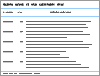
Table 1
The sequence information of primers involved in this study"
引物 Primer | 引物序列(5′→3′) Sequence | 片段长度/bp Length | 用途 Usage |
|---|---|---|---|
| miR-370 stem-loop | CTCAACTGGTGTCGTGGAGTCGGCAATTCAGTTGAGACCAGGTT | — | 成熟miRNAs反转录 |
| miR-219a stem-loop | CTCAACTGGTGTCGTGGAGTCGGCAATTCAGTTGAGCGGGACGT | — | |
| miR-7136 stem-loop | CTCAACTGGTGTCGTGGAGTCGGCAATTCAGTTGAGGCTCCACA | — | |
| miR-9860 stem-loop | CTCAACTGGTGTCGTGGAGTCGGCAATTCAGTTGAGGCGGTCCA | — | |
| Mature miR-370-F | GCCGAGGCCTGCTGGGGTGG | 64 | 成熟miRNAs 定量PCR |
| Mature miR-219a-F | GCCGAGAGAGTTGAGTCTGG | 64 | |
| Mature miR-7136-F | GCCGAGTCTGGTCCAGACAC | 64 | |
| Mature miR-9860-F | GCCGAGTTGCCCGAGAGCT | 64 | |
| Common miRNA-R | CTCAACTGGTGTCGTGGA | — | |
| Pri-miR-370-F | TCTCGAATCAGATTGGTGGC | 145 | 初级miRNAs 定量PCR |
| Pri-miR-370-R | CAGGCACTCGTGAGCTGTGTA | ||
| Pri-miR-219a-F | TCAGACATTCGGCCCCTTGT | 140 | |
| Pri-miR-219a-R | CTCGAGAATTGCGTTTGGAC | ||
| Pre-miR-370-F | AAGACAGAGAAGCCAGGTCAC | 75 | 前体miRNAs 定量PCR |
| Pre-miR-370-R | GACAGACCAGGTTCCACCCC | ||
| Pre-miR-219a-F | CCGCGGCTCTTGATTGTC | 76 | |
| Pre-miR-219a-R | GCTCGGGACGTCCAGACT | ||
| miR-370 promoter-F | 314 | 荧光素酶报告载体构建 | |
| miR-370 promoter-R | |||
| miR-219a promoter-F | 320 | ||
| miR-219a promoter-R | |||
| miR-370 promoter-F1 | AACGACCCTCCGCTGCTG | 150 | 染色质免疫沉淀 |
| miR-370 promoter-R1 | CTCCCACCGCCACCCCTG | ||
| miR-219a promoter-F2 | TCCCCGTCCCCTTCCTT | 200 | |
| miR-219a promoter-R2 | CATGCGGAAGCAGGGAC |
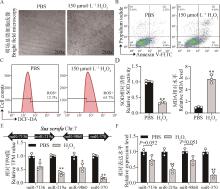
Fig.1
Effects of oxidative stress on the expression of miR-370 and miR-219a in sow GCsA. Effect of 150 μmol·L‒1 H2O2 on the morphology of sow GCs;B. Effect of 150 μmol·L‒1 H2O2 on the apoptosis of sow GCs;C. Effect of 150 μmol·L‒1 H2O2 on the ROS level in sow GCs;D. Effect of 150 μmol·L‒1 H2O2 on the SOD activity and MDA level in sow GCs;E. Effect of oxidative stress on the abundance of 4 miRNAs in sow GCs was analyzed by RNA-seq;F. Effect of oxidative stress on the expression of 4 miRNAs in sow GCs was detected by RT-qPCR"
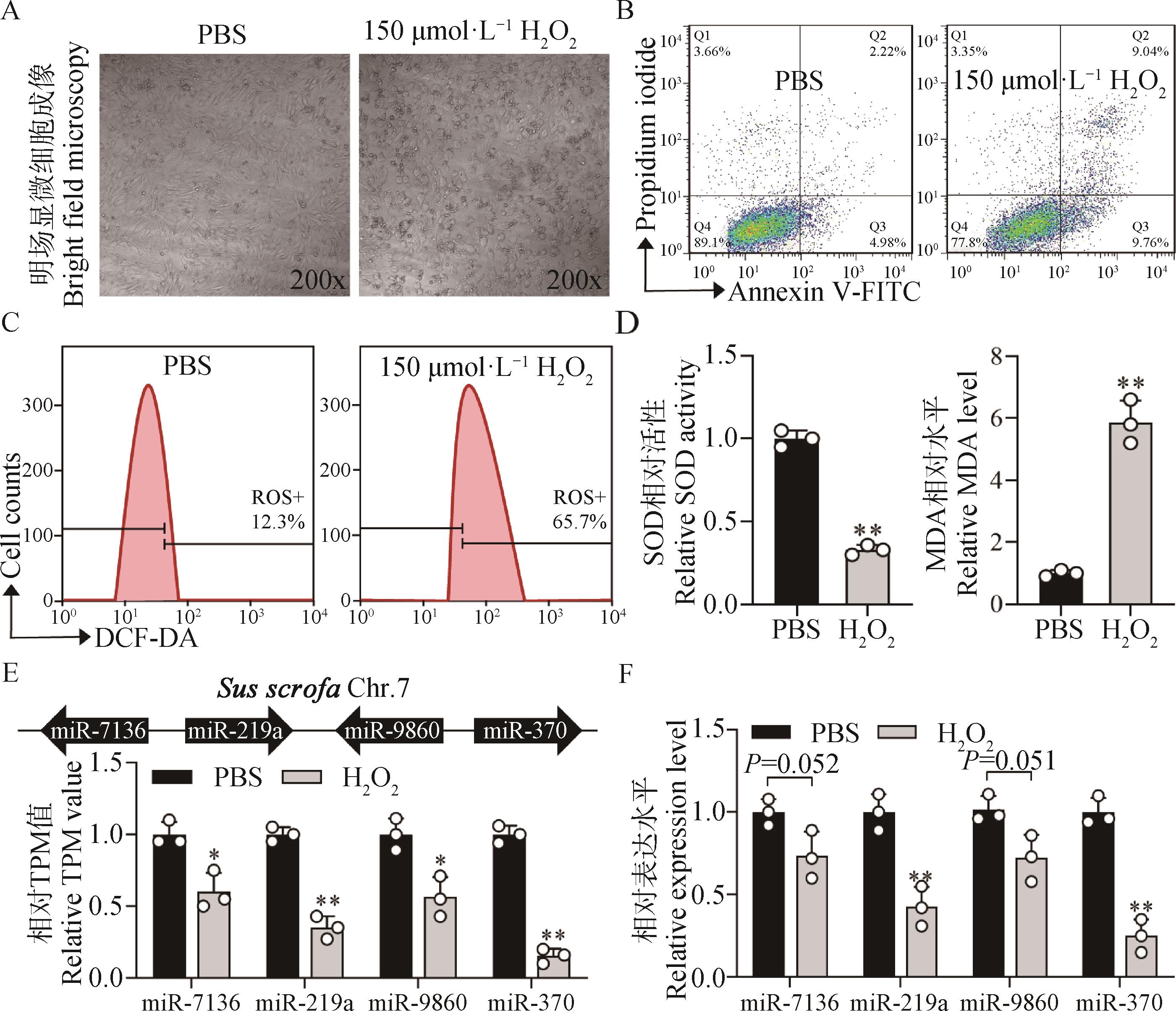
Fig.2
Conserved miR-370 and miR-219a are highly expressed in sow ovarian tissueA. Sequence alignment of the pre- and mature miR-370 and miR-219a among species;B. Chromosome location and neighbouring coding genes of miR-370 and miR-219a across species;C. Tissue expression profiles of the mature miR-370 and miR-219a established by high-throughput sequencing;D. The expression levels of mature miR-370 and miR-219a in different sow tissues. U6 is an internal reference gene"

Fig.3
Overexpression of miR-370 and miR-219a inhibits the oxidative damage in sow GCsA. Correlation of miR-370 expression with the levels of SOD and MDA in GCs;B. Correlation of miR-219a expression with the levels of SOD and MDA in GCs;C. Overexpression efficiency of miR-370 and miR-219a (OE);D. Effect of overexpression of miR-370 or miR-219a on the ROS accumulation in GCs under oxidative stress;E. Effect of overexpression of miR-370 or miR-219a on the levels of SOD and MDA in GCs under oxidative stress;F. Effect of overexpression of miR-370 or miR-219a on the apoptosis of GCs under oxidative stress"
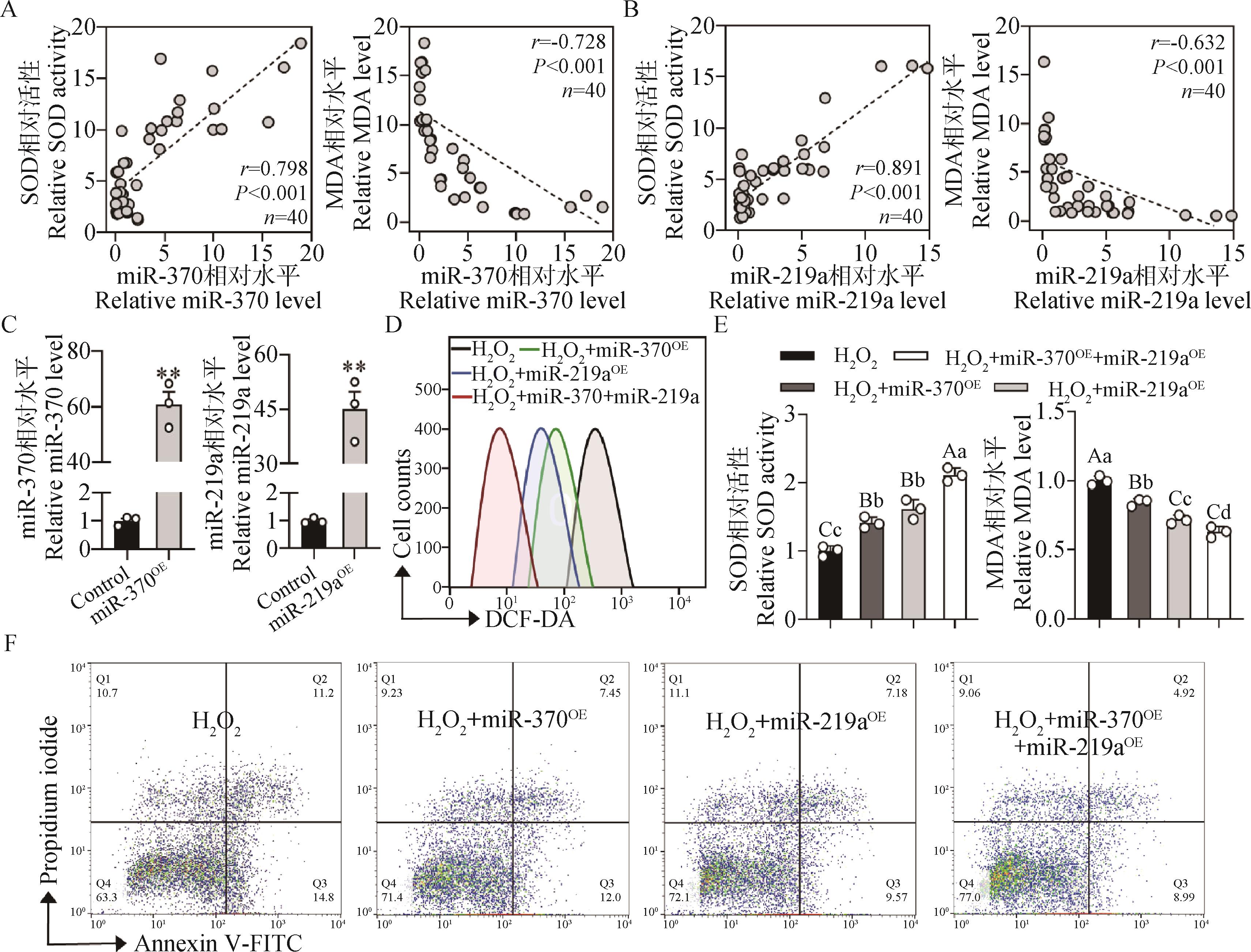
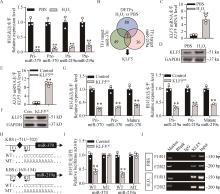
Fig.4
KLF5 inhibits the transcription of miR-370 and miR-219a in sow GCs by acting as a transcriptional repressorA. Effect of oxidative stress on the expression of pri- and pre- miR-370 and miR-219a in sow GCs;B. KLF5 potentially mediates the inhibitory effect of oxidative stress on the expression of miR-370 and miR-219a;C, D. Effect of oxidative stress on the expression level of KLF5 in sow GCs;E, F. Overexpression efficiency detection of KLF5;G. Effect of KLF5 overexpression on the expression levels of pri-, pre- and mature miR-370 and miR-219a in sow GCs;H. Schematic diagram showing the construction of reporter vectors;I. Effect of KLF5 overexpression on the luciferase activities of wild-type or mutant-type reporter vectors;J. Binding abundance of KLF5 on the promoters of miR-370 and miR-219a under different conditions was detected by ChIP"

| [1] | JO M,BRANNSTROM M,AKINS J W,et al.New insights into the ovulatory process in the human ovary[J].Hum Reprod Update,2025,31(1):21-47. |
| [2] | LIU M,CHEN J,LIU S,et al.LH-stimulated periodic lincRNA HEOE regulates follicular dynamics and influences estrous cycle and fertility via miR-16-ZMAT3 and PGF2alpha in pigs[J].Int J Biol Macromol,2024,281(Pt 3):136426. |
| [3] | KNOX R V.PHYSIOLOGY AND ENDOCRINOLOGY SYMPOSIUM:Factors influencing follicle development in gilts and sows and management strategies used to regulate growth for control of estrus and ovulation1[J].J Anim Sci,2019,97(4):1433-1445. |
| [4] | COSTERMANS N G J,TEERDS K J,KEIJER J,et al.Follicular development of sows at weaning in relation to estimated breeding value for within-litter variation in piglet birth weight[J].Animal,2019,13(3):554-563. |
| [5] | WANG M,SHENG W,ZHANG J,et al.A mutation losing an RBP-binding site in the lncRNA NORSF transcript influences granulosa cell apoptosis and sow fertility[J].Adv Sci (Weinh),2024,11(40):e2404747. |
| [6] | DU X,LIU L,LI Q,et al.NORFA,long intergenic noncoding RNA,maintains sow fertility by inhibiting granulosa cell death[J].Commun Biol,2020,3(1):131. |
| [7] | 赵顺然,付桂鑫,庞钊琪,等.猪颗粒细胞在卵泡闭锁中的作用机制研究进展[J].畜牧兽医学报,2025,56(6):2537-2545. |
| ZHAO S R,FU G X,PANG Z Q,et al.Research progress on the mechanism of porcine granulosa cells in follicular atresia[J].Acta Veterinaria et Zootechnica Sinica,2025,56(6):2537-2545.(in Chinese) | |
| [8] | NI Z,LI Y,SONG D,et al.Iron-overloaded follicular fluid increases the risk of endometriosis-related infertility by triggering granulosa cell ferroptosis and oocyte dysmaturity[J].Cell Death Dis,2022,13(7):579. |
| [9] | CHEN M,HE C,ZHU K,et al.Resveratrol ameliorates polycystic ovary syndrome via transzonal projections within oocyte-granulosa cell communication[J].Theranostics,2022,12(2):782-795. |
| [10] | SUNAK N,GREEN D F,ABEYDEERA L R,et al.Implication of cortisol and 11beta-hydroxysteroid dehydrogenase enzymes in the development of porcine (Sus scrofa domestica) ovarian follicles and cysts[J].Reproduction,2007,133(6):1149-1158. |
| [11] | SIES H.Oxidative stress:a concept in redox biology and medicine[J].Redox Biol,2015,4:180-183. |
| [12] | LAURIDSEN C.From oxidative stress to inflammation:redox balance and immune system[J].Poult Sci,2019,98(10):4240-4246. |
| [13] | YAN L.Positive oxidative stress in aging and aging-related disease tolerance[J].Redox Biol,2014,2:165-169. |
| [14] | 陈 翠,龚 蕾,徐 晢,等.AMPK对过氧化氢诱导细胞衰老的阻遏研究[J].中国畜牧兽医,2023,50(6):2255-2264. |
| CHEN C,GONG L,XU Z,et al.Study on the inhibition of hydrogen peroxide-induced cellular aging by AMPK[J].China Animal Husbandry & Veterinary Medicine,2023,50(6):2255-2264.(in Chinese) | |
| [15] | MATYAS C,HASKO G,LIAUDET L,et al.Interplay of cardiovascular mediators,oxidative stress and inflammation in liver disease and its complications[J].Nat Rev Cardiol,2021,18(2):117-135. |
| [16] | HUANG Y,CHENG Y,ZHANG M,et al.Oxidative stress and inflammatory markers in ovarian follicular fluid of women with diminished ovarian reserve during in vitro fertilization[J].J Ovarian Res,2023,16(1):206. |
| [17] | 李 媛,张依莎,游 典,等.氧化应激在卵巢功能障碍中的作用机制研究进展[J].中国实验动物学报,2024,32(12):1606-1615. |
| LI Y,ZHANG Y S,YOU D,et al.Research on mechanisms of oxidative stress in ovarian dysfunction[J].Acta Laboratorium Animalis Scientia Sinica,2024,32(12):1606-1615.(in Chinese) | |
| [18] | CHEN Y,YANG J,ZHANG L.The impact of follicular fluid oxidative stress levels on the outcomes of assisted reproductive therapy[J].Antioxidants (Basel),2023,12(12):2117. |
| [19] | WANG L,TANG J,WANG L,et al.Oxidative stress in oocyte aging and female reproduction[J].J Cell Physiol,2021,236(12):7966-7983. |
| [20] | DU X,LI Q,CAO Q,et al.Integrated analysis of miRNA-mRNA interaction network in porcine granulosa cells undergoing oxidative stress[J].Oxid Med Cell Longev,2019,2019:1041583. |
| [21] | CHEN M,YAO Y L,YANG Y,et al.Comprehensive profiles of mRNAs and miRNAs reveal molecular characteristics of multiple organ physiologies and development in pigs[J].Front Genet,2019,10:756. |
| [22] | 霍泱安,李小雪,孙 郴,等.猪卵泡发育过程中颗粒细胞内参基因表达稳定性分析[J].南京农业大学学报,2024,47(4):710-720. |
| HUO Y A,LI X X,SUN C,et al.Stability analysis of reference gene expression in granulosa cells during porcine follicular development[J].Journal of Nanjing Agriculture University,2024,47(4):710-720.(in Chinese) | |
| [23] | GUO Z,ZENG Q,LI Q,et al.LncRNA NORFA promotes the synthesis of estradiol and inhibits the apoptosis of sow ovarian granulosa cells through SF-1/CYP11A1 axis[J].Biol Direct,2024,19(1):107. |
| [24] | LIU Z,SONG K,TU B,et al.Crosstalk between oxidative stress and epigenetic marks:New roles and therapeutic implications in cardiac fibrosis[J].Redox Biol,2023,65:102820. |
| [25] | LAN J,HUANG Z,HAN J,et al.Redox regulation of microRNAs in cancer[J].Cancer Lett,2018,418:250-259. |
| [26] | DUTTA S,SENGUPTA P,MOTTOLA F,et al.Crosstalk between oxidative stress and epigenetics:Unveiling new biomarkers in human infertility[J].Cells,2024,13(22):1846. |
| [27] | ZHU X,LI W,LU M,et al.M(6)A demethylase FTO-stabilized exosomal circBRCA1 alleviates oxidative stress-induced granulosa cell damage via the miR-642a-5p/FOXO1 axis[J].J Nanobiotechnol,2024,22(1):367. |
| [28] | 卢清侠,王献伟,马 强,等.原花青素下调miR-181a抑制颗粒细胞氧化损伤的作用机制[J].畜牧与兽医,2023,55(10):29-36. |
| LU Q X,WANG X W,MA Q,et al.Grape seed procyanidins protect granulosa cells from oxidative stress-induced injury by down-regulating miR-181a expression[J].Animal Husbandry & Veterinary Medicine,2023,55(10):29-36.(in Chinese) | |
| [29] | LIN Z,GONG Y,YU C,et al.IGF2BP3 curbed by miR-15c-3p restores disrupted lipid storage and progesterone secretion in chicken granulosa cells under oxidative stress through AKT-Raf1-ERK1/2 signaling pathway[J].Poult Sci,2025,104(2):104761. |
| [30] | ZHANG J,REN Q,CHEN J,et al.Downregulation of miR-192 alleviates oxidative stress-induced porcine granulosa cell injury by directly targeting Acvr2a[J].Cells,2022,11(15):2362. |
| [31] | WANG S,LI Y,ZENG Q,et al.A mutation in endogenous saRNA miR-23a influences granulosa cells response to oxidative stress[J].Antioxidants (Basel),2022,11(6):1174. |
| [32] | YU L,XIA K,ZHOU J,et al.circ_0003204 regulates the osteogenic differentiation of human adipose-derived stem cells via miR-370-3p/HDAC4 axis[J].Int J Oral Sci,2022,14(1):30. |
| [33] | GU Y,BECKER V,ZHAO Y,et al.miR-370 inhibits the angiogenic activity of endothelial cells by targeting smoothened (SMO) and bone morphogenetic protein (BMP)-2[J].FASEB J,2019,33(6):7213-7224. |
| [34] | SHI Y,DAI S,QIU C,et al.MicroRNA-219a-5p suppresses intestinal inflammation through inhibiting Th1/Th17-mediated immune responses in inflammatory bowel disease[J].Mucosal Immunol,2020,13(2):303-312. |
| [35] | MA S,MA F,DING N,et al.Homocysteine promotes the pathogenesis of atherosclerosis through the circ-PIAS1-5/miR-219a-2-3p/TEAD1 axis[J].Adv Sci (Weinh),2025,12(18):e2415563. |
| [36] | ZHOU X,HE Y,PAN X,et al.DNMT1-mediated lncRNA IFFD controls the follicular development via targeting GLI1 by sponging miR-370[J].Cell Death Differ,2023,30(2):576-588. |
| [37] | DU M,WU C,YU R,et al.A novel circular RNA,circIgfbp2,links neural plasticity and anxiety through targeting mitochondrial dysfunction and oxidative stress-induced synapse dysfunction after traumatic brain injury[J].Mol Psychiatry,2022,27(11):4575-4589. |
| [38] | TIAN D,SHA Y,LU J,et al.MiR-370 inhibits vascular inflammation and oxidative stress triggered by oxidized low-density lipoprotein through targeting TLR4[J].J Cell Biochem,2018,119(7):6231-6237. |
| [39] | FU R,ZHOU J,WANG R,et al.Protocatechuic acid-mediated miR-219a-5p activation inhibits the p66shc oxidant pathway to alleviate alcoholic liver injury[J].Oxid Med Cell Longev,2019,2019:3527809. |
| [40] | SHANG R,LEE S,SENAVIRATHNE G,et al.microRNAs in action:biogenesis,function and regulation[J].Nat Rev Genet,2023,24(12):816-833. |
| [41] | PESTAL K,SLAYDEN L C,BARTON G M.KLF family members control expression of genes required for tissue macrophage identities[J].J Exp Med,2025,222(5):e20240379. |
| [42] | ZHENG B,YIN W,SUZUKI T,et al.Exosome-mediated miR-155 transfer from smooth muscle cells to endothelial cells induces endothelial injury and promotes atherosclerosis[J].Mol Ther,2017,25(6):1279-1294. |
| [43] | ZHENG B,ZHENG C,ZHANG Y,et al.Regulatory crosstalk between KLF5,miR-29a and Fbw7/CDC4 cooperatively promotes atherosclerotic development[J].Biochim Biophys Acta Mol Basis Dis,2018,1864(2):374-386. |
| [44] | MYLONAS N,SIOKATAS G,ZACHARIA E,et al.Cardiac ischemia/reperfusion increases cardiomyocyte KLF5 in pigs and mice that aggravates tissue injury and remodeling[J].Cardiovasc Res,2025,121(6):900-914. |
| [45] | KYRIAZIS I D,HOFFMAN M,GAIGNEBET L,et al.KLF5 is induced by FOXO1 and causes oxidative stress and diabetic cardiomyopathy[J].Circ Res,2021,128(3):335-357. |
| [46] | LI L,WANG H,CHEN X,et al.Oxidative stress-induced hypermethylation of KLF5 promoter mediated by DNMT3B impairs osteogenesis by diminishing the interaction with beta-catenin[J].Antioxid Redox Signal,2021,35(1):1-20. |
| [47] | YANG Y,BHARGAVA D,CHEN X,et al.KLF5 and p53 comprise an incoherent feed-forward loop directing cell-fate decisions following stress[J].Cell Death Dis,2023,14(5):299. |
| [1] | WANG Fuxi, MA Cui, HUANG Kang, LI Ruitong, ZHAO Qingyu, ZHANG Junmin, YAN Yibo, SI Wei. 18β-glycyrrhetinic Acid can Alleviate Oxidative Stress Induced Lung Injury in Weaned Piglets Induced by D-galactose [J]. Acta Veterinaria et Zootechnica Sinica, 2026, 57(1): 305-316. |
| [2] | MENG Yunlong, DENG Yuankun, TAN Bi’e, WANG Jing. Research Progress on Tryptophan Metabolites in Alleviating Intestinal Oxidative Stress [J]. Acta Veterinaria et Zootechnica Sinica, 2026, 57(1): 46-57. |
| [3] | DENG Wenxin, LI Yihan, WANG Qian, ZHU Raoxi, LI Hanting, ZHANG Jiaojiao. Research Progress on m6A Modification Regulation of miRNAs Affecting Cellular Energy Metabolism [J]. Acta Veterinaria et Zootechnica Sinica, 2026, 57(1): 80-95. |
| [4] | QIN Yang, XIA Siting, HE Liuqin, WANG Tianli, LIU Yuyan, JIANG Xiaohan, LIU Zhihao, LIU Siwei, LI Tiejun, YIN Yulong. Effect of Chronic Oxidative Stress on Trace Elements in Organ Tissues of Weaned Piglets [J]. Acta Veterinaria et Zootechnica Sinica, 2025, 56(9): 4452-4460. |
| [5] | GUI Ruohong, CAO Hongzhan, LIU Songzan, LIU Jixiang, ZHAO Jialong, LU Chunlian. Effects of Different Dietary Metabolizable Energy and Standard Ileal Digestible Lysine Levels on Performance of High-Producing Lactating Shenxian Sows [J]. Acta Veterinaria et Zootechnica Sinica, 2025, 56(9): 4472-4490. |
| [6] | WANG Chaohui, LIU Xiaoying, YANG Xiaojun, LIU Yanli. The Mechanism of Betaine in Alleviating Abnormal Lipid Metabolism and Oxidative Stress Induced by Oleic Acid in Chicken Embryo Liver Cells [J]. Acta Veterinaria et Zootechnica Sinica, 2025, 56(9): 4741-4749. |
| [7] | XIONG Pingwen, XU Chuanhui, AI Gaoxiang, JI Huayuan, HU Yan, CHEN Jiang, SONG Qiongli, SONG Wenjing, CHEN Xiaolian, CHEN Xiaolian, ZOU Zhiheng, CHEN Hehong. Effects of Golden Buckwheat Stem and Leaf Meal on Nutrient Apparent Digestibility, Serum Biochemical Indices, Fecal Microflora Composition of Gannan Tibetan Sows [J]. Acta Veterinaria et Zootechnica Sinica, 2025, 56(7): 3290-3304. |
| [8] | LU Le, LUO Xianzu, HUANG Xinyu, ZOU Hui, GU Jianhong, LIU Xuezhong, BIAN Jianchun, LIU Zongping, YUAN Yan. Cadmium Can Induce Oxidative Stress in the Cerebral Cortices by Affecting the Intestinal Flora of Rats [J]. Acta Veterinaria et Zootechnica Sinica, 2025, 56(7): 3540-3547. |
| [9] | SHI Shanshan, WAN Qiongfei, XU Yingxin, WANG Qiushuo, ZHANG Linlin, GUO Yiwen, HU Debao, GUO Hong, DING Xiangbin, LI Xin. Sequencing and Bioinformatics Analysis of miRNAs at Different Developmental Stages of Bovine Skeletal Muscle [J]. Acta Veterinaria et Zootechnica Sinica, 2025, 56(6): 2701-2710. |
| [10] | ZHU Aiwen, WANG Jian, ZHU Gehui, LIU Haixia, PINGCUO Bandan, WANG Jun, DEQING Zhuoga, YAN Wei, HAN Dayong. Zearalenone Induced Proliferation, Apoptosis, Oxidative Stress and NAC Protective Mechanism of Sertoli Cells in Pengbo Semi-fine Wool Sheep [J]. Acta Veterinaria et Zootechnica Sinica, 2025, 56(6): 2752-2764. |
| [11] | GU Bo, WANG Anqi, YU Xinmiao, GUO Juntong, YANG Yi, DENG Yijie, JIANG Huaizhi. Construction of Ovarian ceRNA Networks and Screening of Key miRNA in Two Different Breeds of Sheep Based on Whole Transcription Sequencing [J]. Acta Veterinaria et Zootechnica Sinica, 2025, 56(6): 2765-2777. |
| [12] | CHEN Zhihua, WANG Qi, ZHANG Jin, YANG Liandi, YANG Tianqing, WANG Jing, LONG Dingbiao, HUANG Jinxiu, HUANG Wenming. Effects of Dietary Net Energy and Lysine Levels on Reproductive Performance, Serum Hormone, Lactation Performance and Fecal Flora Diversity of Rongchang Sows in Late Pregnancy [J]. Acta Veterinaria et Zootechnica Sinica, 2025, 56(6): 2801-2815. |
| [13] | LUO Jia, PU Qiang, CHAI Jie, CHEN Li, WANG Jinyong. Biological Effects and Genetic Mechanisms of Intrauterine Heat Stress in Swine [J]. Acta Veterinaria et Zootechnica Sinica, 2025, 56(5): 2004-2014. |
| [14] | CHEN Yun, CHEN Liyuan, SONG Wenjing, ZHANG Xinke, XU Han, WU Jiayi, ZHAO Cuiyan, ZHANG Shouquan. Research Progress on the Mechanism of T-2 Toxin 's Impact on Male Animal Reproduction [J]. Acta Veterinaria et Zootechnica Sinica, 2025, 56(5): 2038-2046. |
| [15] | WANG Ying, ZHANG Jiaojiao, WANG Xianzhong, QUAN Fusheng. Advances in Autophagy of Ovarian Granulosa Cells [J]. Acta Veterinaria et Zootechnica Sinica, 2025, 56(4): 1508-1517. |
| Viewed | ||||||
|
Full text |
|
|||||
|
Abstract |
|
|||||
