


Acta Veterinaria et Zootechnica Sinica ›› 2025, Vol. 56 ›› Issue (11): 5697-5705.doi: 10.11843/j.issn.0366-6964.2025.11.028
• Preventive Veterinary Medicine • Previous Articles Next Articles
REN Wenhao1,2( ), YAO Mengxin1,2, ZHANG Qianyi1,2, XU Yimei3, GUO Wei4, CHEN Chuangfu1,2, MA Zhongchen1,2,*(), WANG Yong1,2,*()
Received:2024-10-08
Online:2025-11-23
Published:2025-11-27
Contact:
MA Zhongchen, WANG Yong
E-mail:r15254362709@163.com;zhongchen_ma@163.com;yongwang@shzu.edu.cn
CLC Number:
REN Wenhao, YAO Mengxin, ZHANG Qianyi, XU Yimei, GUO Wei, CHEN Chuangfu, MA Zhongchen, WANG Yong. Preparation of Brucella BtpA Protein Subunit Vaccine and Evaluation of Its Immune Efficacy in Mice[J]. Acta Veterinaria et Zootechnica Sinica, 2025, 56(11): 5697-5705.

Fig. 1
Construction and identification results of Brucella btpA gene prokaryotic expression system A. PCR identification results of pET-22b-BtpA/BL21(DE3) bacterial solution: M. DL5000 DNA Marker; 1-4. Bacterial liquid PCR identification results of btpA gene; -. Negative control. B. Double enzyme digestion identification of recombinant plasmid pET-22b-BtpA: M. DL10000 DNA Marker; 1. pET-22b-BtpA BamHⅠ/XhoⅠ Double enzyme digestion identification"
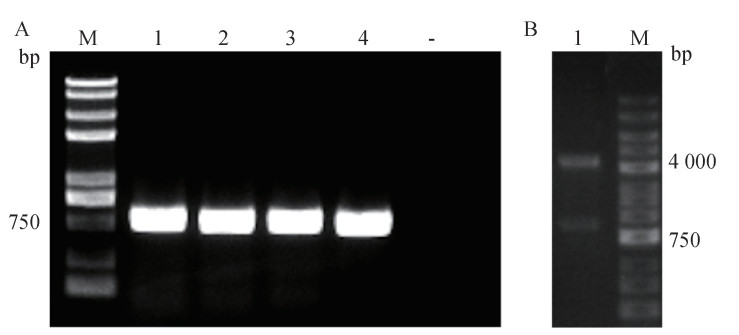
Fig. 2
Expression, purification, and identification results of BtpA A. SDS-PAGE identification results of affinity purified rBtpA: M. Protein molecular weight marker; 1. Sedimentation after fragmentation; 2. Broken supernatant; 3. Effluent; 4. Cleaning samples; 5. Wash the sample. B. Western blot identifies the specific binding of rBtpA to Brucella positive serum: M. Protein molecular weight marker; 3. Specific binding of rBtpA to Brucella positive serum"
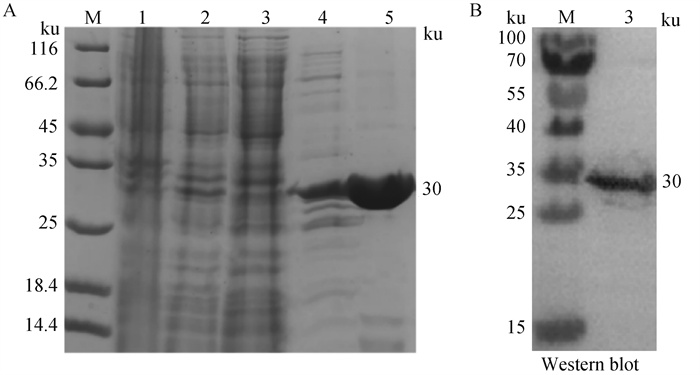

Fig. 3
Detection of humoral immune levels after immunization with rBtpA subunit vaccine A. Brucella specific antibody levels induced at different time points after rBtpA immunization in mice; B. Induction of Brucella specific antibody titers in mice immunized with rBtpA for 14 days"
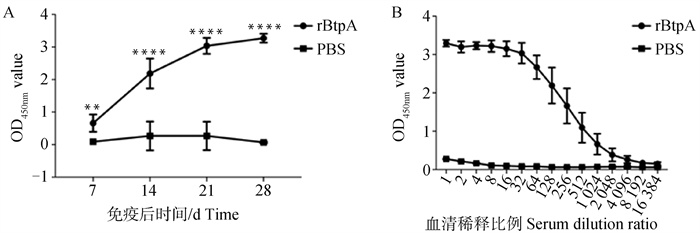
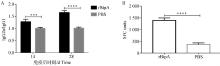
Fig. 4
Cell immune level detection after rBtpA subunit vaccine immunization A. IgG2a/IgG1 antibody levels induced at different time points after rBtpA immunization in mice; B. ELISpot detection of IFN-γ positive lymphocytes induced in rBtpA immunized mice"
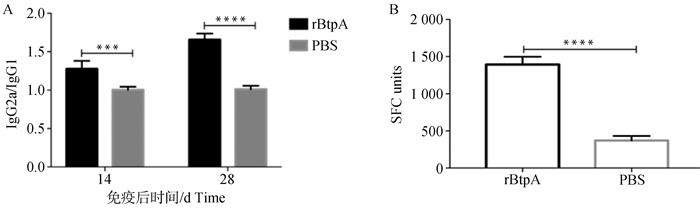
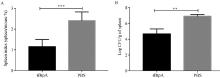
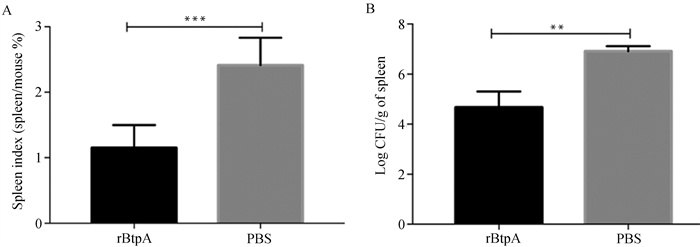
Fig. 5
Results of protective efficacy testing of rBtpA subunit vaccine in mice A.Spleen Index (SI) of each group of mice after challenge; B.The amount of bacteria in spleen of each group of mice after challenge"
| 1 |
HEIDARYM,DASHTBINS,GHANAVATIR,et al.Evaluation of Brucellosis vaccines: A comprehensive review[J].Front Vet Sci,2022,9,925773.
doi: 10.3389/fvets.2022.925773 |
| 2 | LAINEC G,JOHNSONV E,SCOTTH M,et al.Global estimate of human Brucellosis incidence[J].Emerg Infect Dis,2023,29(9):1789-1797. |
| 3 |
BALDIP C.Role of Btp proteins in the pathogenesis of Brucella infection acquired through the airways[J].Microb Pathog,2022,167,105567.
doi: 10.1016/j.micpath.2022.105567 |
| 4 |
SELEEMM N,BOYLES M,SRIRANGANATHANN.Brucella: A pathogen without classic virulence genes[J].Vet Microbiol,2008,129(1-2):1-14.
doi: 10.1016/j.vetmic.2007.11.023 |
| 5 |
YANGH X,FENGJ J,ZHANGQ X,et al.A case report of spontaneous abortion caused by Brucella melitensis biovar 3[J].Infect Dis Poverty,2018,7(1):31.
doi: 10.1186/s40249-018-0411-x |
| 6 | 景娟.羊布鲁氏菌病的流行病学、诊断与防控[J].中国动物保健,2022,24(11):5-6. |
| JINGJ.Epidemiology, diagnosis, and prevention and control of sheep Brucellosis[J].Chinese Journal of Animal Health,2022,24(11):5-6. | |
| 7 |
KUBOTAK.Innate IFN-gamma production by subsets of natural killer cells, natural killer T cells and gammadelta T cells in response to dying bacterial-infected macrophages[J].Scand J Immunol,2010,71(3):199-209.
doi: 10.1111/j.1365-3083.2009.02366.x |
| 8 | ZHENGR,XIES,ZHANGQ,et al.Circulating Th1, Th2, Th17, Treg, and PD-1 levels in patients with Brucellosis[J].J Immunol Res,2019,2019,3783209. |
| 9 |
ROMAGNANIS.Th1/Th2 cells[J].Inflamm Bowel Dis,1999,5(4):285-294.
doi: 10.1097/00054725-199911000-00009 |
| 10 | ZHANGY,ZHANGY,GUW,et al.TH1/TH2 cell differentiation and molecular signals[J].Adv Exp Med Biol,2014,841,15-44. |
| 11 |
MARTIROSYANA,GORVELJ P.Brucella evasion of adaptive immunity[J].Future Microbiol,2013,8(2):147-154.
doi: 10.2217/fmb.12.140 |
| 12 |
PELLEGRINIJ M,GORVELJ P,MÉMETS.Immunosuppressive mechanisms in Brucellosis in light of chronic bacterial diseases[J].Microorganisms,2022,10(7):1260.
doi: 10.3390/microorganisms10071260 |
| 13 | 何月月,朱玥洁,王泉,等.布鲁氏菌病患者外周血中Siglec-7+单核细胞与Th1/Th2细胞的相关性研究[J].中国免疫学杂志,2024,40(7):1474-1478. |
| HEY Y,ZHUY J,WANGQ,et al.Study on the correlation between Siglec-7+monocytes and Th1/Th2 cells in peripheral blood of patients with Brucellosis[J].Chinese Journal of Immunology,2024,40(7):1474-1478. | |
| 14 |
IWASAKIA,MEDZHITOVR.Control of adaptive immunity by the innate immune system[J].Nat Immunol,2015,16(4):343-353.
doi: 10.1038/ni.3123 |
| 15 | 田振中,乔军,孟庆玲,等.外周血中CD4+、CD8+T、CD4+CD25+Treg在绵羊接种布鲁氏菌M5-90弱毒疫苗后的动态变化[J].中国预防兽医学报,2013,35(6):504-506. |
| TIANZ Z,QIAOJ,MENGQ L,et al.Dynamic changes of CD4+, CD8+T, CD4+CD25+Treg in peripheral blood after vaccination with Brucella M5-90 attenuated vaccine in sheep[J].Chinese Journal of Preventive Veterinary Medicine,2013,35(6):504-506. | |
| 16 |
DE FIGUEIREDOP,FICHTT A,RICE-FICHTA,et al.Pathogenesis and immunobiology of brucellosis: review of Brucella-host interactions[J].Am J Pathol,2015,185(6):1505-1517.
doi: 10.1016/j.ajpath.2015.03.003 |
| 17 | 崔正云,李娜,姜成哲.浅谈布鲁氏菌减毒活疫苗的研究进程[J].黑龙江科技信息,2013(34):50-51. |
| CUIZ Y,LIN,JIANGC Z.A brief discussion on the research process of Brucella attenuated live vaccines[J].Heilongjiang Science and Technology Information,2013(34):50-51. | |
| 18 |
JAINS,AFLEYP,DOHRES K,et al.Evaluation of immunogenicity and protective efficacy of a plasmid DNA vaccine encoding ribosomal protein L9 of Brucella abortus in BALB/c mice[J].Vaccine,2014,32(35):4537-4542.
doi: 10.1016/j.vaccine.2014.06.012 |
| 19 |
YOUSEFIS,TAHMOORESPURM,SEKHAVATIM H.Cloning, expression and molecular analysis of Iranian Brucella melitensis Omp25 gene for designing a subunit vaccine[J].Res Pharm Sci,2016,11(5):412-418.
doi: 10.4103/1735-5362.192493 |
| 20 | JACQUESC,GOSSETM,BERENBAUMF,et al.The role of IL-1 and IL-1Ra in joint inflammation and cartilage degradation[J].Vitam Horm,2006,74,371-403. |
| 21 | 王真,HANGilsu,吴清民.动物布鲁氏菌病疫苗的来历及亚单位疫苗的研究概况[J].中国农业大学学报,2014,19(3):169-174. |
| WANGZ,HANG,WUQ M.The origin of animal Brucellosis vaccines and research overview of subunit vaccines[J].Journal of China Agricultural University,2014,19(3):169-174. | |
| 22 | 魏淑娟. 基于布鲁氏菌密度感应系统转录激活因子VjbR和BlxR新型亚单位疫苗株的构建及免疫效果的评价[D]. 新乡: 河南师范大学, 2023. |
| WEI S J. Construction and evaluation of immune efficacy of novel subunit vaccine strains based on Brucella density sensing system transcription activation factors VjbR and BlxR[D]. Xinxiang: Henan Normal University, 2023. (in Chinese) | |
| 23 | 朱琳. 布鲁氏菌真核及原核表达重组Omp10-Omp28-L7/L12亚基免疫效果的比较[D]. 泰安: 山东农业大学, 2019. |
| ZHU L. Comparison of the immune efficacy of recombinant Omp10-Omp28-L7/L12 subunits expressed in Brucella eukaryotes and prokaryotes[D]. Taian: Shandong Agricultural University, 2019. (in Chinese) | |
| 24 |
GŁOWACKAP,Z·AKOWSKAD,NAYLORK,et al.Brucella-virulence factors, pathogenesis and treatment[J].Pol J Microbiol,2018,67(2):151-161.
doi: 10.21307/pjm-2018-029 |
| 25 | 冯宇,丁家波.布鲁氏菌免疫应答研究进展[J].生命科学,2016,28(9):1067-1074. |
| FENGY,DINGJ B.Research progress on Brucella immune response[J].Life Sciences,2016,28(9):1067-1074. | |
| 26 | 王春芳,邱佳熠,姜秀云,等.母牛分枝杆菌感染引起小鼠细胞免疫应答的特征分析[J].中国预防兽医学报,2016,38(12):981-984. |
| WANGC F,QIUJ Y,JIANGX Y,et al.Characteristic analysis of cellular immune response in mice induced by Mycobacterium bovis infection[J].Chinese Journal of Preventive Veterinary Medicine,2016,38(12):981-984. | |
| 27 | 刘泽兵,朱平,杨林.PLA2R、IgG亚类和THSD7A在原发性膜性肾病中的临床应用[J].巴楚医学,2020,3(2):106-110, 124. |
| LIUZ B,ZHUP,YANGL.Clinical application of PLA2R, IgG subclasses, and THSD7A in primary membranous nephropathy[J].BACHU Medical,2020,3(2):106-110, 124. | |
| 28 |
HUANGL Y,REISE,SOUSAC,et al.IL-12 induction by a TH1-inducing adjuvant in vivo: dendritic cell subsets and regulation by IL-10[J].J Immunol,2001,167(3):1423-1430.
doi: 10.4049/jimmunol.167.3.1423 |
| 29 | 刘敏,邓兆群,刘君炎,等.T_(H1)类细胞因子对结核病患者产生单核细胞趋化蛋白1的调节作用[J].免疫学杂志,2003(3):218-220. |
| LIUM,DENGZ Q,LIUJ Y,et al.Regulation of T_(H1) cytokines on monocyte chemoattractant protein 1 production in tuberculosis patients[J].Journal of Immunology,2003(3):218-220. | |
| 30 |
DINGW,XUD,LIF,et al.Intrapulmonary IFN-γ instillation causes chronic lymphocytic inflammation in the spleen and lung through the CXCR3 pathway[J].Int Immunopharmacol,2023,122,110675.
doi: 10.1016/j.intimp.2023.110675 |
| 31 | 李文桂,陈雅棠.载体介导的布鲁氏菌L7/L12疫苗研制现状[J].中国病原生物学杂志,2019,14(7):864-866. |
| LIW G,CHENY T.Development status of carrier mediated Brucella L7/L12 vaccine[J].Chinese Journal of Pathogenic Biology,2019,14(7):864-866. | |
| 32 | 贾永利,杨新明,张培楠,等.基于活性氧/硫氧还蛋白结合蛋白通路探讨紫草素对布鲁氏菌感染小鼠的保护作用[J].中国医院用药评价与分析,2021,21(7):796-799, 803. |
| JIAY L,YANGX M,ZHANGP N,et al.Exploring the protective effect of purpurin on Brucella infected mice based on the reactive oxygen species/thioredoxin binding protein pathway[J].Chinese Hospital Drug Evaluation and Analysis,2021,21(7):796-799, 803. |
| [1] | LIU Yuxin, CHEN Si, GAO Yang, GU Deyuan, PENG Haitao, ZHANG Dong, ZHANG Ru, XU Huihui, LIU Yaqiao, YANG Yanling. Proteomic Analysis and Immunogenicity Evaluation of Outer Membrane Vesicles of Brucella melitensis [J]. Acta Veterinaria et Zootechnica Sinica, 2025, 56(7): 3378-3389. |
| [2] | ZHANG Xiaoling, HE Xinglin, ZHANG Mengdi, LI Pengfei, SUN Yumei, MA Hailong, ZHU Hongmei, ZHANG Mengjia, LI Wentao. Preparation of E2 Protein Nanoparticles from Classical Swine Fever Virus and the Immunogenicity Study in Rabbit [J]. Acta Veterinaria et Zootechnica Sinica, 2025, 56(5): 2301-2311. |
| [3] | LIU Aijun, HUANG Xiaobing, ZHANG Chuanliang, ZHANG Hongli. Progress on the Interactions of Brucella with Host Innate Immunity Signaling Pathways [J]. Acta Veterinaria et Zootechnica Sinica, 2025, 56(4): 1561-1574. |
| [4] | YOU Liuchao, YIN Hao, TAO Zhengyu, HUANG Rong, FU Lei, CHU Yuefeng. Research Progress in the Virulence Factors and Intracellular Survival Mechanism of Brucella [J]. Acta Veterinaria et Zootechnica Sinica, 2025, 56(4): 1575-1593. |
| [5] | GE Shengxin, LI Shuwen, NING Wenqing, DING Jiabo, YANG Xiaowen. Current Situation and Mechanism of Antibiotic Resistance of Brucella [J]. Acta Veterinaria et Zootechnica Sinica, 2025, 56(11): 5389-5401. |
| [6] | SHAN Yige, LIU Yongning, ZHOU Shuang, LIU Qianlin, LI Yilin, DUAN Sizhang, AN Jian, ZHANG Jianjun. Prokaryotic Expression and Immune Efficacy Evaluation of RON2L2ecto Protein from Eimeria tenella [J]. Acta Veterinaria et Zootechnica Sinica, 2025, 56(11): 5649-5659. |
| [7] | WANG Hengtai, JIANG Hui, LI Peng, DING Jiabo. Biosynthesis of Brucella Lipopolysaccharides and Their Biological Functions in Immune Evasion [J]. Acta Veterinaria et Zootechnica Sinica, 2025, 56(10): 4863-4876. |
| [8] | WU Tingting, GUAN Feihu, GUO Jia, ZHANG Lu, ZHU Dexin, SUN Zhihua, CAO Shuzhu, XU Yimei, ZHANG Hui, DENG Xingmei. Construction of Brucella Secretory Protein BPE005 Deletion Strain and Its Effect on GPR126/ADGRG6 Protein [J]. Acta Veterinaria et Zootechnica Sinica, 2025, 56(10): 5104-5114. |
| [9] | ZHANG Yunlong, WANG Jinglei, ZHU Yajie, ZHANG Mingjie, KANG Ao, ZHOU Xiang, WEI Kai, CAO Hongfang, LI Qiang, WANG Yong, SU Feng. Establishment and Application of a Nucleic Acid Detection Method for Brucella based on RAA-DETECTOR System [J]. Acta Veterinaria et Zootechnica Sinica, 2025, 56(10): 5115-5124. |
| [10] | XU Zhenyu, DENG Xiaoyu, WANG Yueli, SUN Can, WU Aodi, CAO Jian, YI Jihai, WANG Yong, WANG Zhen, CHEN Chuangfu. Biological Characteristics of Brucella abortus A19ΔBtpA Deletion Strain and Its Immunogenicity Study [J]. Acta Veterinaria et Zootechnica Sinica, 2024, 55(5): 2135-2145. |
| [11] | WU Shangjie, LUAN Yuanyuan, WANG Mingkun, ZHANG Hechun, YU Bo, MA Yuehui, JIANG Lin, HE Xiaohong. Advances of Disease-Resistant Breeding on Ovine Brucellosis [J]. Acta Veterinaria et Zootechnica Sinica, 2024, 55(3): 882-893. |
| [12] | ZHAI Yunyi, YUAN Ye, LI Junmei, TIAN Lulu, DIAO Ziyang, LI Bin, CHEN Jialu, ZHOU Dong, JIN Yaping, WANG Aihua. Preparation and Preliminary Application of Monoclonal Antibody to Brucella Outer Membrane Protein 16 [J]. Acta Veterinaria et Zootechnica Sinica, 2023, 54(5): 2083-2091. |
| [13] | XUAN Ting, YANG Kaiyi, CAI Jinshuang, GENG Yan, LI Yufeng. Analysis of the Immune Characteristics of the Six Recombinant Proteins of Glaesserella parasuis in Mice [J]. Acta Veterinaria et Zootechnica Sinica, 2023, 54(5): 2073-2082. |
| [14] | XIANG Caixia, WANG Xiangguo, LI Junmei, ZHI Feijie, FANG Jiaoyang, ZHENG Weifang, CHEN Jialu, JIN Yaping, WANG Aihua. The Influence of Brucella Type IV Secretes System Effector Protein VceC on Endoplasmic Reticulum Stress and Gonadal Hormone Secretory in Goat Trophoblast Cells [J]. Acta Veterinaria et Zootechnica Sinica, 2023, 54(3): 1210-1220. |
| [15] | CHI Lili, WANG Junna, ZHANG Yuming, LIU Jian, CHEN Zhiyuan, LI Shufan, YIN Yanbo, XU Shouzhen. Prokaryotic Expression and Immunogenicity Analysis of Truncated Fusion Protein of FAdV-4 Fiber2 and FAdV-8b Fiber [J]. Acta Veterinaria et Zootechnica Sinica, 2023, 54(12): 5162-5170. |
| Viewed | ||||||
|
Full text |
|
|||||
|
Abstract |
|
|||||
