


Acta Veterinaria et Zootechnica Sinica ›› 2026, Vol. 57 ›› Issue (1): 246-257.doi: 10.11843/j.issn.0366-6964.2026.01.021
• ANIMAL BIOTECHNOLOGY AND REPRODUCTION • Previous Articles Next Articles
LI Rongqing1( ), TE Rigele3, FU Shaoyin3, HE Xiaolong3, DA Lai3, WANG Liwei3, GAO Yuanshuai1, ZHANG Wenjia1, XIE Zhiqiang1, YANG Huiguo4, WANG Biao3(), LIU Yongbin2()
Received:2025-05-23
Online:2026-01-23
Published:2026-01-26
Contact:
WANG Biao, LIU Yongbin
E-mail:rong-qing.li@mail.imu.edu.cn;wangbnd@163.com;ybliu117@126.com
CLC Number:
LI Rongqing, TE Rigele, FU Shaoyin, HE Xiaolong, DA Lai, WANG Liwei, GAO Yuanshuai, ZHANG Wenjia, XIE Zhiqiang, YANG Huiguo, WANG Biao, LIU Yongbin. The Regulatory Role of Androgen Receptor in the Development of Ovarian Granulosa Cells in Sheep[J]. Acta Veterinaria et Zootechnica Sinica, 2026, 57(1): 246-257.
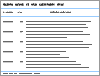
Table 1
siRNA interference sequences"
编号 Number | 序列(5′→3′) Sense | 互补序列(5′→3′) Antisense |
|---|---|---|
| siRNA-1 | GCUGCUCCACCGAUCUUAATT | UUAAGAUCGGUGGAGCAGCTT |
| siRNA-2 | GCGCCAAGGAGUUGUGUAATT | UUACACAACUCCUUGGCGCTT |
| siRNA-3 | GGAGCUCUCACUUGUGGAATT | UUCCACAAGUGAGAGCUCCTT |
Table 2
Quantitative primer sequences for real-time PCR"
基因名称 Gene name | 引物序列(5′→3′) Primer sequences | 退火温度/℃ Annealing temperature | |
|---|---|---|---|
| AR | Forward | TATGGGGACATGCGTTTGGA | 60 |
| Reverse | TGCTGGCACACAGGTACTTC | ||
| GAPDH | Forward | GTTTGTGATGGGCGTGAACC | 58 |
| Reverse | GCGTGGACAGTGGTCATAAGT | ||
| BCL2 | Forward | GGGGTCATGTGTGTGGAGAG | 60 |
| Reverse | TGCAGCTCCACAAAGGCGTC | ||
| BAX | Forward | TTCCGACGGCAACTTCAACT | 60 |
| Reverse | CTGATCAACTCGGGCACCTT | ||
| Caspase3 | Forward | TTCAGAGGGGACTGTTGCAG | 60 |
| Reverse | CAGTCCAGTTCTGTGCCTCG | ||
| ESR2 | Forward | AGAAGATTCCGGGCTTCGTG | 60 |
| Reverse | GAGCAAAGATGAGCTTGCCG | ||
| CYP19A1 | Forward | TCGTCCTGGTCACCCTTCTG | 60 |
| Reverse | CGGTCTCTGGTCTCGTCTGG | ||
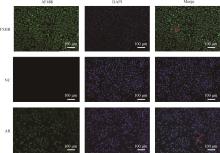
Fig.1
Identification of sheep ovarian granulosa cells and localization of AR in granulosa cells"

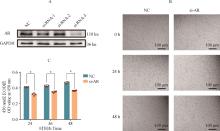
Fig.2
Effect of AR knockdown on the proliferative activity of granulosa cellsA. Validation of 3 siRNA sequences;B. State of granulosa cells following AR knockdown;C. Effect of AR knockdown on cell proliferation.*.P<0.05, the same as below"
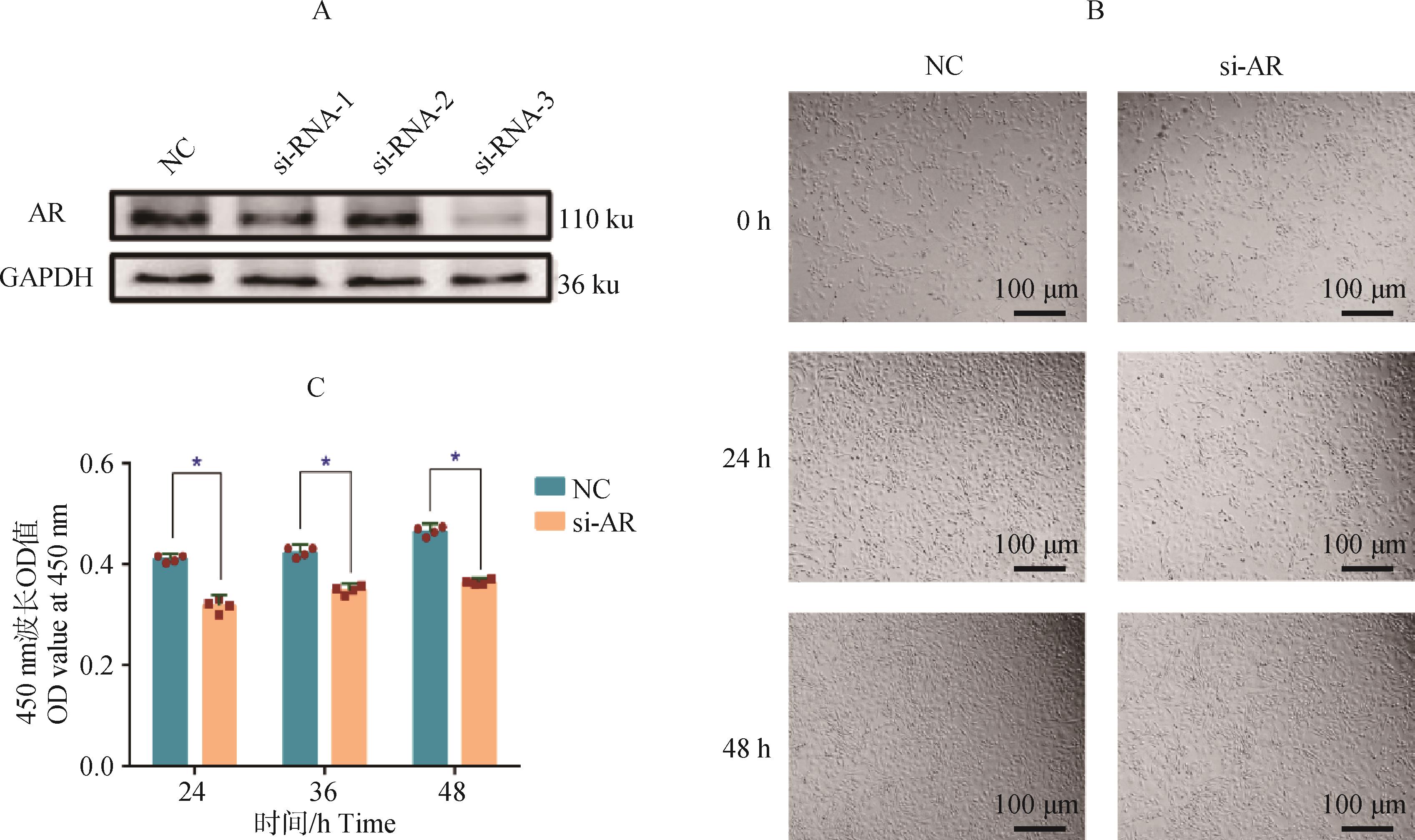
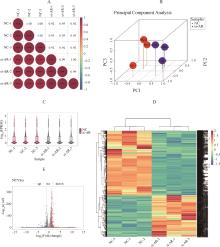
Fig.3
Transcriptome quality control and analysisA. Samples correlation analysis, ***.P<0.001; B. Principal component analysis (PCA); C. Violin diagram; D. Differential gene clustering heat map; E. Differential genes volcano map"

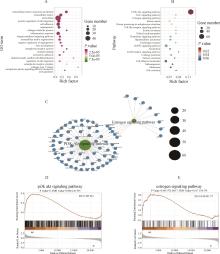
Fig.4
Transcriptome enrichment analysisA. Differential genes GO enrichment analysis; B. Differential genes KEGG enrichment analysis; C. KEGG enrichment pathways network diagram;D, E. GSEA enrichment analysis of KEGG pathways"

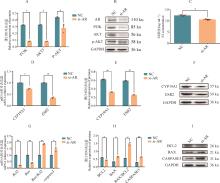
Fig.5
Transcriptome differential genes validationA, B. Changes in protein expression levels of PI3K, AKT, and p-AKT;C. Alterations in estrogen secretion by granulosa cells;D. Changes in mRNA expression levels of estrogen-related genes;E & F. Changes in proteins expression levels of estrogen-related genes;G. Changes in mRNA expression levels of apoptosis-related genes;H & I. Changes in proteins expression levels of apoptosis-related genes.*.P<0.05; **.P<0.01"

| [1] | YANG R,WANG Y,YUE S,et al.Identification of novel 58-5p and SREBF1 interaction and effects on apoptosis of ovine ovarian granulosa cell[J].Int J Mol Sci,2025,26(2):576. |
| [2] | SABRY R,GALLO F J,ROONEY C,et al.Genetic and epigenetic profiles of polycystic ovarian syndrome and in vitro bisphenol exposure in a human granulosa cell model[J].Biomedicines,2024,12(1):237. |
| [3] | SANTOS G C,CANDIDO K C,SILVAA D C F,et al.Granulosa cells and follicular development:a brief review[J].Rev Assoc Med Bras,2023,69(6):e20230175. |
| [4] | SPICER J L,MAYLEM S R E,SCHUTZ F L.Granulosa cell function in domestic animals:a review on the in vitro effects of FSH,insulin and insulin-like growth factor 1[J].Domest Anim Endocrinol,2025,91:106919. |
| [5] | SELENE C L D G,LOURDES M.Caspases and their role in inflammation and ischemic neuronal death.Focus on caspase-12[J].Apoptosis,2016,21(7):763-777. |
| [6] | YAN G,SHAN L,PING F,et al.Growth hormone activates PI3K/Akt signaling and inhibits ROS accumulation and apoptosis in granulosa cells of patients with polycystic ovary syndrome[J].Reprod Biol Endocrinol,2020,18(1):121. |
| [7] | JINBI Z,YINXUE X,HONGLIN L,et al.MicroRNAs in ovarian follicular atresia and granulosa cell apoptosis[J].Reprod Biol Endocrinol,2019,17(1):9. |
| [8] | DIDIER D,GEOFFROY R,MAELISS P,et al.Interactions between androgens,FSH,anti-Müllerian hormone and estradiol during folliculogenesis in the human normal and polycystic ovary[J].Hum Reprod Update,2016,22(6):709-724. |
| [9] | OLGA A,NMB M,RS H.Physiological and pathological androgen actions in the ovary[J].Endocrinology,2019,160(5):1166-1174. |
| [10] | BOSDOU K J,VENETIS C A,ANAGNOSTIS P,et al.Association of basal serum androgen concentration with follicles number on the day of triggering final oocyte maturation in low responders according to the bologna criteria:A prospective cohort study[J].Int J Mol Sci,2025,26(4):1656. |
| [11] | HONGWEI D,WENBO G,SHANSHAN Y,et al.Dihydrotestosterone regulates oestrogen secretion,oestrogen receptor expression,and apoptosis in granulosa cells during antral follicle development[J].J Steroid Biochem Mol Biol,2021,207:105819. |
| [12] | KALYANARAMAN H,CHINA P S,CASTEEL E D,et al.Crosstalk between androgen receptor and protein kinase G signaling in bone:implications for osteoporosis therapy[J].Trends Pharmacol Sci,2025,46(3):279-294. |
| [13] | CHENG B,WU J,CHEN K,et al.Association of 5α-reductase inhibitor prescription with immunotherapy efficacy in metastatic renal cell carcinoma:a multicenter retrospective analysis[J].J Immunother Cancer,2025,13(2):e011154. |
| [14] | NEDELJKOVIĆ M,VULETIĆ A,MARTINOVIĆ K.Divide and conquer-targeted therapy for triple-negative breast cancer[J].Int J Mol Sci,2025,26(4):1396. |
| [15] | WEIL S J,VENDOLA K,ZHOU J,et al.Androgen receptor gene expression in the primate ovary:cellular localization,regulation,and functional correlations[J].J Clin Endocrinol Metab,1998,83(7):2479-2485. |
| [16] | WALTERS K A,HANDELSMAN D J.Role of androgens in the ovary[J].Mol Cell Endocrinol,2017(4):36-47. |
| [17] | SONG Y,HAI E,ZHANG N,et al.Oocyte transcriptomes and follicular fluid proteomics of ovine atretic follicles reveal the underlying mechanisms of oocyte degeneration[J].BMC Genomics,2025,26(1):97. |
| [18] | CHEN D,YU Q,SHENG S,et al.Transcriptomic analysis of the effects exerted by curcumin on dihydrotestosterone-induced ovarian granulosa cells[J].Front Endocrinol,2025,16:1522269. |
| [19] | LU H,JIANG H,LI C,et al.Dissecting the impact of maternal androgen exposure on developmental programming through targeting the androgen receptor[J].Adv Sci (Weinh),2024,11(36):e2309429. |
| [20] | COSTERMANS N G J,KEIJER J,VAN SCHOTHORST E M,et al.In ovaries with high or low variation in follicle size,granulosa cells of antral follicles exhibit distinct size-related processes[J].Mol Hum Reprod,2019,25(10):614-624. |
| [21] | AZUMAH R,LIU M,HUMMITZSCH K,et al.Candidate genes for polycystic ovary syndrome are regulated by TGFβ in the bovine foetal ovary[J].Hum Reprod,2022,37(6):1244-1254. |
| [22] | DUAN H,GE W,YANG S,et al.Dihydrotestosterone regulates oestrogen secretion,oestrogen receptor expression,and apoptosis in granulosa cells during antral follicle development[J].J Steroid Biochem Mol Biol,2021,207(1):105819. |
| [23] | ZHENG M,ANDERSEN C Y,RASMUSSEN F R,et al.Expression of genes and enzymes involved in ovarian steroidogenesis in relation to human follicular development[J].Front Endocrinol (Lausanne),2023,14:1268248. |
| [24] | PALERMO R.Differential actions of FSH and LH during folliculogenesis[J].Reprod Biomed Online,2007,15(3):326-337. |
| [25] | SIMPSON E R,CLYNE C,RUBIN G,et al.Aromatase—a brief overview[J].Annu Rev Physiol,2002,64(1):93-127. |
| [26] | TETSUKA M,NANCARROW C D.The levels of 5α-dihydrotestosterone in follicular fluid in healthy and atretic ovine follicles[J].Domest Anim Endocrinol,2007,33(3):347-357. |
| [27] | COUSE J F,BUNCH D O,LINDZEY J,et al.Prevention of the polycystic ovarian phenotype and characterization of ovulatory capacity in the estrogen receptor-α knockout mouse[J].Endocrinology,1999,140(12):5855-5865. |
| [28] | CHENG J,HUANG Y,ZHANG X,et al.TRIM21 and PHLDA3 negatively regulate the crosstalk between the PI3K/AKT pathway and PPP metabolism[J].Nat Commun,2020,11(1):1880. |
| [29] | JOHN G B,SHIDLER M J,BESMER P,et al.Kit signaling via PI3K promotes ovarian follicle maturation but is dispensable for primordial follicle activation[J].Dev Biol,2009,331(2):292-299. |
| [30] | BARON S,MANIN M,BEAUDOIN C,et al.Androgen receptor mediates non-genomic activation of phosphatidylinositol 3-OH Kinase in androgen-sensitive epithelial cells[J].J Biol Chem,2004,279(15):14579-14586. |
| [31] | WANG C L,FAN Y C,TSENG C H,et al.Salmonella enteritidis infection slows steroidogenesis and impedes cell growth in hen granulosa cells[J].Avian Dis,2014,58(4):511-517. |
| [32] | ZHANG X,TANG N,HADDEN T J,et al.Akt,FoxO and regulation of apoptosis[J].Biochim Biophys Acta,2011,1813(11):1978-1986. |
| [33] | GONG Y,LUO S,FAN P,et al.Growth hormone activates PI3K/Akt signaling and inhibits ROS accumulation and apoptosis in granulosa cells of patients with polycystic ovary syndrome[J].Reprod Biol Endocrinol,2020,18(1):121. |
| [34] | YANG D,JIANG T,LIN P,et al.Knock-down of apoptosis inducing factor gene protects endoplasmic reticulum stress-mediated goat granulosa cell apoptosis[J].Theriogenology,2017,88:89-97. |
| [35] | TANG Z R,ZHANG R,LIAN Z X,et al.Estrogen-receptor expression and function in female reproductive disease[J].Cells,2019,8(10):1123. |
| [36] | CHENG H M,GONZÁLEZ R G.The effect of high glucose and oxidative stress on lens metabolism,aldose reductase,and senile cataractogenesis[J].Metabolism,1986,35(4):10-14. |
| [37] | SRIVASTAVA S,ANSARI N,BHATNAGAR A,et al.Activation of aldose reductase by nonenzymatic glycosylation[J].Prog Clin Biol Res,1989,304:171-184. |
| [38] | ROUILLIER P,MATTON P,DUFOUR M,et al.Steroid production,cell proliferation,and apoptosis in cultured bovine antral and mural granulosa cells:development of an in vitro model to study estradiol production[J].Mol Reprod Dev,1998,50(2):170-177. |
| [39] | WANG Z,LI X,LIU X,et al.Mechanistic insights into the anti-fibrotic effects of estrogen via the PI3K-Akt pathway in frozen shoulder[J].J Steroid Biochem Mol Biol,2025,249:106701. |
| [1] | XIE Beiyiting, SHEN Yangyang, AN Zhenjiang, MENG Chunhua, LIU Fenghui, ZHANG Jun, ZHANG Jianli, CAO Shaoxian, LI Yinxia, QIAN Yong. Mechanism Investigation of RHOU Gene Regulation on Goat Litter Size Based on the Goat 40K Liquid Chip [J]. Acta Veterinaria et Zootechnica Sinica, 2026, 57(1): 258-269. |
| [2] | QI Jiahui, FU Tingting, ZHENG Minxing, WANG Xuanjing, WU Haiyang, LU Jiayin, LUO Xiaomao, YU Xiuju, WANG Haidong, YAN Yi. Peroxisome Proliferator-activated Receptor α Promotes Skeletal Muscle Development in Mice by Regulating the AMPK/P38 MAPK Pathway [J]. Acta Veterinaria et Zootechnica Sinica, 2026, 57(1): 443-453. |
| [3] | ZHANG Zixuan, YU Wenjing, WANG Zhonghua, DONG Xusheng, HOU Qiuling. Advancements in Evaluation Techniques for Mammary Development and Its Application in Dairy Cattle [J]. Acta Veterinaria et Zootechnica Sinica, 2025, 56(9): 4176-4190. |
| [4] | XING Zhou, SONG Chenglei, CAO Fengfeng, LI Zhuoying, LI Qingyun, TAO Jinzhong*. Effects of Plasma Steroid Hormones on Superovulation Efficiency in Tan Sheep after Superovulation Treatment [J]. Acta Veterinaria et Zootechnica Sinica, 2025, 56(9): 4422-4431. |
| [5] | XIA Chunqiu, MIAO Shu, LI Zhiqing, LIU Lei, WAN Fachun, SHEN Weijun. Valine Regulates Bovine Myoblast Proliferation through the AMPK/mTOR Signaling Pathway [J]. Acta Veterinaria et Zootechnica Sinica, 2025, 56(9): 4491-4506. |
| [6] | HU Jinling, ZHONG Qiqi, HUANG Cheng, LEI Minggang. AKR1B1 Regulates Proliferation and Differentiation of Porcine Skeletal Muscle Satellite Cells via the AMPK/mTOR/S6 Signaling Pathway [J]. Acta Veterinaria et Zootechnica Sinica, 2025, 56(8): 3722-3733. |
| [7] | FAN Jing, LI Wei, ZHU Yan, Wudubala , SHI Jiahui, Husile , WU Jianghong. Study on Rumen Morphological Changes and Gene Expression Differences in Hu Sheep at Different Developmental Stages [J]. Acta Veterinaria et Zootechnica Sinica, 2025, 56(8): 3773-3786. |
| [8] | SHI Shanshan, WAN Qiongfei, XU Yingxin, WANG Qiushuo, ZHANG Linlin, GUO Yiwen, HU Debao, GUO Hong, DING Xiangbin, LI Xin. Sequencing and Bioinformatics Analysis of miRNAs at Different Developmental Stages of Bovine Skeletal Muscle [J]. Acta Veterinaria et Zootechnica Sinica, 2025, 56(6): 2701-2710. |
| [9] | HAN Xiaoman, SUN Shaoning, YANG Jie, SHEN Ning, BAO Zhiyuan, CAI Jiawei, ZHAO Bohao, CHEN Yang, WU Xinsheng. Cloning Expression and Bioinformatics Analysis of Rabbit MSX2 Gene [J]. Acta Veterinaria et Zootechnica Sinica, 2025, 56(6): 2724-2732. |
| [10] | ZHU Aiwen, WANG Jian, ZHU Gehui, LIU Haixia, PINGCUO Bandan, WANG Jun, DEQING Zhuoga, YAN Wei, HAN Dayong. Zearalenone Induced Proliferation, Apoptosis, Oxidative Stress and NAC Protective Mechanism of Sertoli Cells in Pengbo Semi-fine Wool Sheep [J]. Acta Veterinaria et Zootechnica Sinica, 2025, 56(6): 2752-2764. |
| [11] | CHEN Zhihua, WANG Qi, ZHANG Jin, YANG Liandi, YANG Tianqing, WANG Jing, LONG Dingbiao, HUANG Jinxiu, HUANG Wenming. Effects of Dietary Net Energy and Lysine Levels on Reproductive Performance, Serum Hormone, Lactation Performance and Fecal Flora Diversity of Rongchang Sows in Late Pregnancy [J]. Acta Veterinaria et Zootechnica Sinica, 2025, 56(6): 2801-2815. |
| [12] | ZHU Haiyan, ZHANG Jingyi, YAN Xueyong, LIANG Haiping, WEI Qing, CAO Ji, HUANG Jianzhen. Investigating the Molecular Mechanisms of Photoperiod 's Effect on Egg-Laying Performance of Taihe Black-Bone Silky Fowls Based on RNA-seq Analysis [J]. Acta Veterinaria et Zootechnica Sinica, 2025, 56(5): 2123-2135. |
| [13] | GAO Zhengjie, LUO Ping, LI Bocheng, WANG Shuilian. Effects of GnIH on Proliferation, Apoptosis and Estrogen Secretion of Mouse Ovarian Granulosa Cells [J]. Acta Veterinaria et Zootechnica Sinica, 2025, 56(5): 2230-2242. |
| [14] | GUO Yanyan, ZHANG Yuxin, LU Rui, LI Yupeng, CHEN Longbin, ZHANG Jinlong, YAO Dawei, RUAN Weibin, ZHANG Xiaosheng, GUO Xiaofei. Research Progress on the Proliferation and Differentiation of Granulosa Cells at Various Follicular Development Stages in Mammal [J]. Acta Veterinaria et Zootechnica Sinica, 2025, 56(4): 1484-1493. |
| [15] | GONG Yuxuan, HEI Wei, BAO Wu, CHEN Jiayi, LI Meng, GUO Xiaohong, LI Bugao. Study on the Regulation of Myogenic Differentiation of Porcine Skeletal Muscle Satellite Cells by Gene TMEM182 [J]. Acta Veterinaria et Zootechnica Sinica, 2025, 56(4): 1676-1688. |
| Viewed | ||||||
|
Full text |
|
|||||
|
Abstract |
|
|||||
