


畜牧兽医学报 ›› 2026, Vol. 57 ›› Issue (1): 155-166.doi: 10.11843/j.issn.0366-6964.2026.01.014
杨凯1,2( ), 李东锋2, 邵勇钢3, 翟曼君3, 白现广1, 张立凡2()
收稿日期:2025-06-09
出版日期:2026-01-23
发布日期:2026-01-26
通讯作者:
张立凡
E-mail:3202488467@qq.com;lifanzhang@njau.edu.cn
作者简介:杨凯,助教,硕士,主要从事动物基因组学与统计遗传学的研究,E-mail:3202488467@qq.com
基金资助:
YANG Kai1,2(), LI Dongfeng2, SHAO Yonggang3, ZHAI Manjun3, BAI Xianguang1, ZHANG Lifan2()
Received:2025-06-09
Online:2026-01-23
Published:2026-01-26
Contact:
ZHANG Lifan
E-mail:3202488467@qq.com;lifanzhang@njau.edu.cn
摘要:
旨在揭示拜城油鸡、和田鸡和吐鲁番鸡等3种新疆地方鸡相互之间的遗传关系和基因组差异,从而在基因组层面为新疆地方鸡遗传资源的保护与开发提供科学依据。本研究以65份鸡的全基因组重测序数据为对象,借助Rstudio、Plink、Pedstats等软件对数据实施过滤处理;通过状态同源(identical by state,IBS)多维标度分析不同鸡种的群体遗传结构,利用Treemix及Dsuite开展基因渗入(gene introgression)分析,采用群体间单倍体扩增纯合性检测(cross population extended haplotype homozygosity,XP-EHH)及跨群体的符合似然比检验(cross population composite likelihood radio test,XP-CLR)挖掘选择信号。数据质控后,10 228 705个常染色体的单核苷酸多态位点(single nucleotide polymorphism,SNP)用于基因渗入和选择信号的研究,4 657 217个最小等位基因频率(minor allele frequency,MAF)≥0.2的常染色体SNPs则被用来进行遗传关系分析。群体遗传关系分析显示,拜城油鸡和吐鲁番鸡的遗传距离最远,遗传分化系数达到(genetic differentiation coefficient,FST)0.077 7,和田鸡与拜城油鸡及吐鲁番鸡的遗传距离较近,FST分别为0.053 5和0.056 3。且和田鸡与吐鲁番鸡之间存在一次基因渗入,渗入信号最强的区域位于4号染色体,该区域包含ABLIM2等与耐热性能相关的基因。而在拜城油鸡与吐鲁番鸡的选择信号分析中,共筛选出70个参与关键生物学进程的候选基因。其中,CLCN6、ACTA2、CRIM1、IARS2等基因可能与耐热性能相关;BNIP2、DTNA、RAB3GAP2等基因可能涉及肌肉生长调控;AGMO、TSNARE1等基因则可能与斗鸡攻击性行为的形成有关。研究清晰地揭示了新疆3种地方鸡种之间存在的遗传关系,发现了和田鸡与吐鲁番鸡之间存在的基因组渗入区域及相关基因,鉴定了拜城油鸡和吐鲁番鸡之间的基因组选择区域及其中包括的与耐热性、肌肉生长、斗鸡攻击性行为等特色性状相关的候选基因,从而为新疆地方鸡种特色性状的保护和利用提供分子依据。
中图分类号:
杨凯, 李东锋, 邵勇钢, 翟曼君, 白现广, 张立凡. 新疆地方鸡遗传关系和基因组差异研究[J]. 畜牧兽医学报, 2026, 57(1): 155-166.
YANG Kai, LI Dongfeng, SHAO Yonggang, ZHAI Manjun, BAI Xianguang, ZHANG Lifan. Study on Genetic Relationships and Genomic Differences of Local Chicken Breeds in Xinjiang[J]. Acta Veterinaria et Zootechnica Sinica, 2026, 57(1): 155-166.
图1
质控后SNPs的染色体分布示意图"
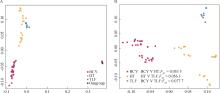
图2
新疆3种地方鸡群体遗传结构分析A.拜城油鸡、和田鸡、吐鲁番鸡和绿原鸡的IBS多维标度图;B.拜城油鸡、和田鸡、吐鲁番鸡的IBS多维标度图及成对FST值。BCY代表拜城油鸡,HT代表和田鸡,TLF代表吐鲁番鸡,Outgroup为绿原鸡"
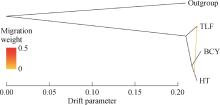
图3
新疆3种地方鸡群体间的基因渗入示意图"
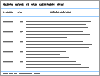
表1
和田鸡与吐鲁番鸡排名前20的渗入区域及基因"
区域排名 Region ranking | 区域位置 Region position | 染色体 Chromosome | 基因位置 Gene position | 基因 Gene | ||
|---|---|---|---|---|---|---|
| 1 | 80624337 | 81362351 | 4 | 80649049 | 80786524 | ABLIM2 |
| 1 | 80624337 | 81362351 | 4 | 80793977 | 80825261 | SH3TC1 |
| 1 | 80624337 | 81362351 | 4 | 80855311 | 80877258 | HTRA3 |
| 1 | 80624337 | 81362351 | 4 | 80933353 | 80968494 | ACOX3 |
| 1 | 80624337 | 81362351 | 4 | 80968536 | 80981295 | TRMT44 |
| 1 | 80624337 | 81362351 | 4 | 81142872 | 81147963 | GPR78 |
| 1 | 80624337 | 81362351 | 4 | 81163250 | 81197855 | CPZ |
| 2 | 80690000 | 81424671 | 4 | 81401297 | 81403526 | SOHO-1 |
| 2 | 80690000 | 81424671 | 4 | 81409978 | 81412649 | HMX1 |
| 3 | 80492569 | 81115546 | 4 | 79986601 | 80511445 | SORCS2 |
| 3 | 80492569 | 81115546 | 4 | 80530710 | 80589183 | AFAP1 |
| 6 | 115118700 | 115583816 | 2 | 115110507 | 115125929 | VXN |
| 6 | 115118700 | 115583816 | 2 | 115139370 | 115162145 | MYBL1 |
| 6 | 115118700 | 115583816 | 2 | 115177217 | 115191152 | VCPIP1 |
| 6 | 115118700 | 115583816 | 2 | 115207256 | 115264028 | SGK3 |
| 6 | 115118700 | 115583816 | 2 | 115277568 | 115277646 | SNORD87 |
| 6 | 115118700 | 115583816 | 2 | 115280942 | 115286441 | TCF24 |
| 6 | 115118700 | 115583816 | 2 | 115289879 | 115308471 | PPP1R42 |
| 6 | 115118700 | 115583816 | 2 | 115315596 | 115326952 | COPS5 |
| 6 | 115118700 | 115583816 | 2 | 115379044 | 115463018 | ARFGEF1 |
| 6 | 115118700 | 115583816 | 2 | 115482232 | 115569184 | CPA6 |
| 8 | 4797296 | 5576303 | 11 | 4645274 | 4873781 | FTO |
| 8 | 4797296 | 5576303 | 11 | 4878175 | 4936909 | RPGRIP1L |
| 8 | 4797296 | 5576303 | 11 | 4976046 | 4988616 | AKTIP |
| 8 | 4797296 | 5576303 | 11 | 4991886 | 5011381 | RBL2 |
| 8 | 4797296 | 5576303 | 11 | 5015742 | 5089734 | CHD9 |
| 8 | 4797296 | 5576303 | 11 | 5176684 | 5176790 | U6 |
| 8 | 4797296 | 5576303 | 11 | 5223979 | 5345307 | TOX3 |
| 10 | 65570685 | 66428389 | 1 | 65833774 | 66173568 | SOX5 |
| 11 | 115230557 | 115708914 | 2 | 115620395 | 115787873 | PREX2 |
| 13 | 80802442 | 81599620 | 4 | 81576968 | 81578308 | ADRA2C |
| 14 | 65645081 | 66496818 | 1 | 66453732 | 66480164 | ETNK1 |
| 17 | 115318072 | 115835589 | 2 | 115821712 | 115984273 | C8orf34 |
| 19 | 23676537 | 24481736 | 1 | 23662850 | 23926311 | KCND2 |
| 19 | 23676537 | 24481736 | 1 | 24435899 | 24484038 | ANKRD26 |
| 20 | 115041718 | 115539645 | 2 | 115081599 | 115082672 | RRS1 |
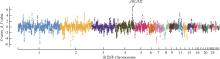
图4
和田鸡与吐鲁番鸡基因渗入区域的Z-score d_f分布图"
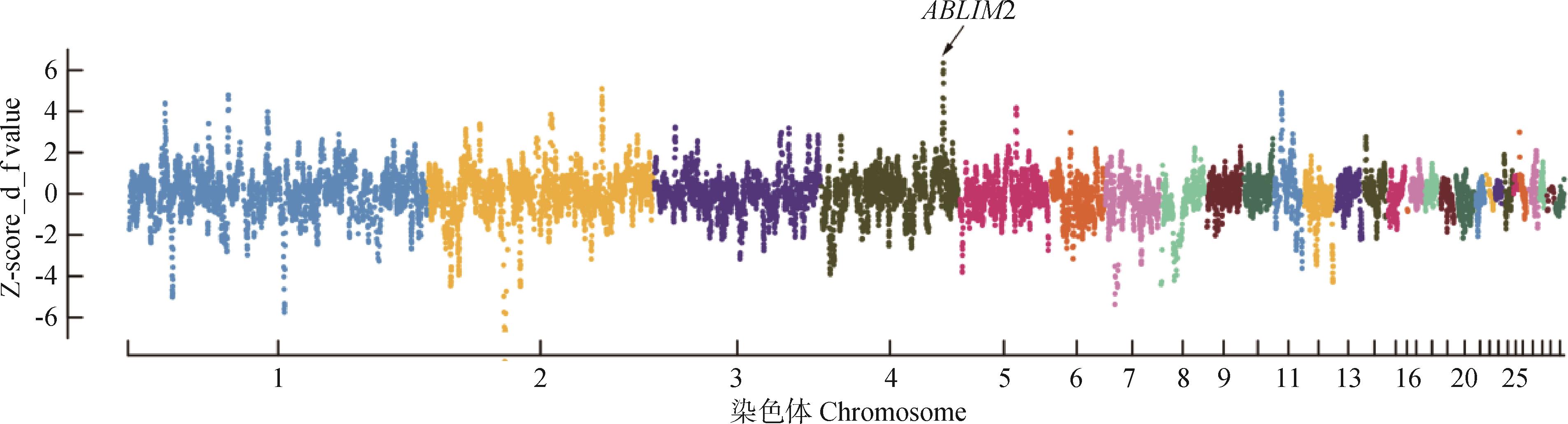
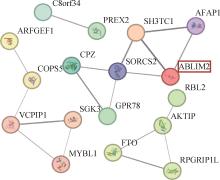
图5
和田鸡与吐鲁番鸡排名前20的渗入区域内候选基因的蛋白互作网络图本图仅保留有互作关系的蛋白,线条粗度表示相互作用的置信预测度"
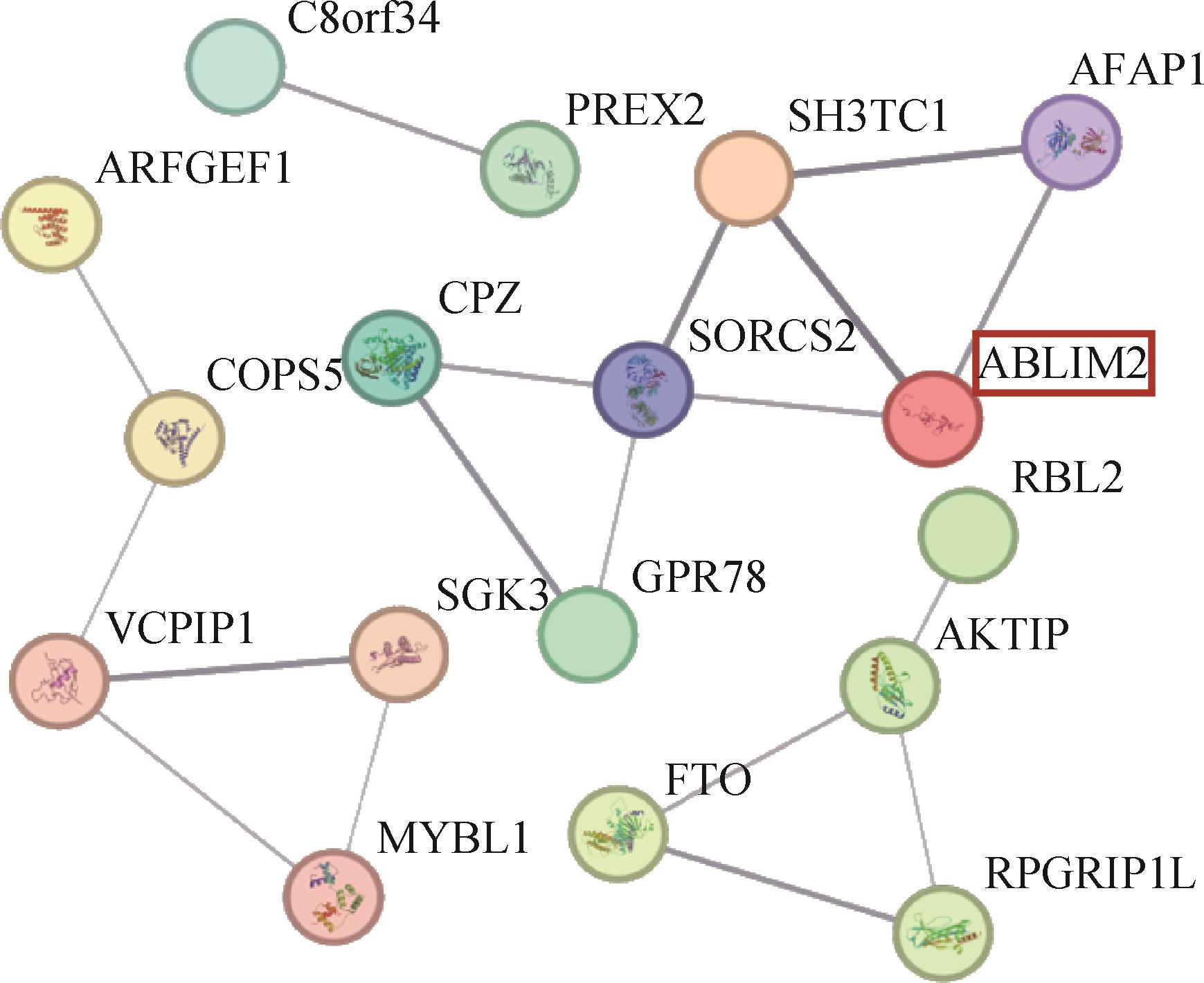
表2
拜城油鸡与吐鲁番鸡差异区域间部分与重要生物学过程相关的基因"
染色体 Chromosome | 基因位置 Gene position | 基因 Gene | 功能 Function | |
|---|---|---|---|---|
| 1 | 34535707 | 34549257 | HELB | 牛的环境适应性(Environmental adaptability of cattle)[ |
| 1 | 67188237 | 67209122 | KRAS | 牛骨骼肌生成(Bovine skeletal myogenesis)[ |
| 2 | 11439678 | 11481488 | PFKP | 参与鸡的体细胞重编程过程(Participate in the process of somatic reprogramming of chickens)[ |
| 2 | 27838091 | 28021352 | AGMO | 斗鸡攻击性行为(Aggressive behavior of gamecock chickens)[ |
| 2 | 107360212 | 107534708 | DTNA | 鸡肌肉发育(Muscle development in chickens)[ |
| 2 | 118477237 | 118542230 | CRISPLD1 | 人类心力衰竭(Human heart failure)[ |
| 2 | 146916969 | 147397126 | TSNARE1 | 斗鸡情绪调节和神经系统发育相关(Emotion regulation and nervous system development of gamecock chickens)[ |
| 3 | 18846742 | 18887139 | RAB3GAP2 | 调节人肌纤蛋白分泌(Regulate myocilin secretion of human)[ |
| 3 | 18886888 | 18911956 | IARS2 | 调节人血管生成(Regulates human angiogenesis)[ |
| 3 | 32394497 | 32555854 | CRIM1 | 人冠状血管内皮细胞发育(Coronary vascular endothelial cell development of human)[ |
| 6 | 19118047 | 19156066 | ARHGAP22 | 鼠上调节肌动蛋白细胞骨架(Regulates actin cytoskeleton of mice)[ |
| 6 | 20062668 | 20118932 | ACTA2 | 鸡羽毛更新循环(Cycle of chicken feather renewal)[ |
| 7 | 11545922 | 11578947 | ALS2 | 人肌萎缩侧索硬化(Amyotrophic lateral sclerosis of human)[ |
| 10 | 5823812 | 5839785 | BNIP2 | 调节人成肌细胞分化(Regulate the differentiation of human myoblast)[ |
| 10 | 7185220 | 7263560 | MYO1E | 抑制小鼠破骨细胞分化(Suppresses osteoclast differentiation of mice)[ |
| 13 | 4953827 | 5426056 | SLIT3 | 促进鸡细胞肌源性分化(Promote myogenic differentiation of chicken cells)[ |
| 21 | 5586241 | 5605153 | CLCN6 | 小鼠血管平滑肌收缩力(Vascular smooth muscle contractility of mice)[ |
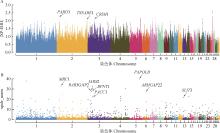
图6
拜城油鸡与吐鲁番鸡的选择信号分析A、B.拜城油鸡与吐鲁番鸡间的|XP-EHH|值(A)及XP-CLR得分(xpclr_norm)(B)的曼哈顿图。箭头标记的基因包含极高的|XP-EHH|位点,或该基因位于极高的XP-CLR得分区域内。|XP-EHH|和XP-CLR极高点的阈值分别设为2和20"

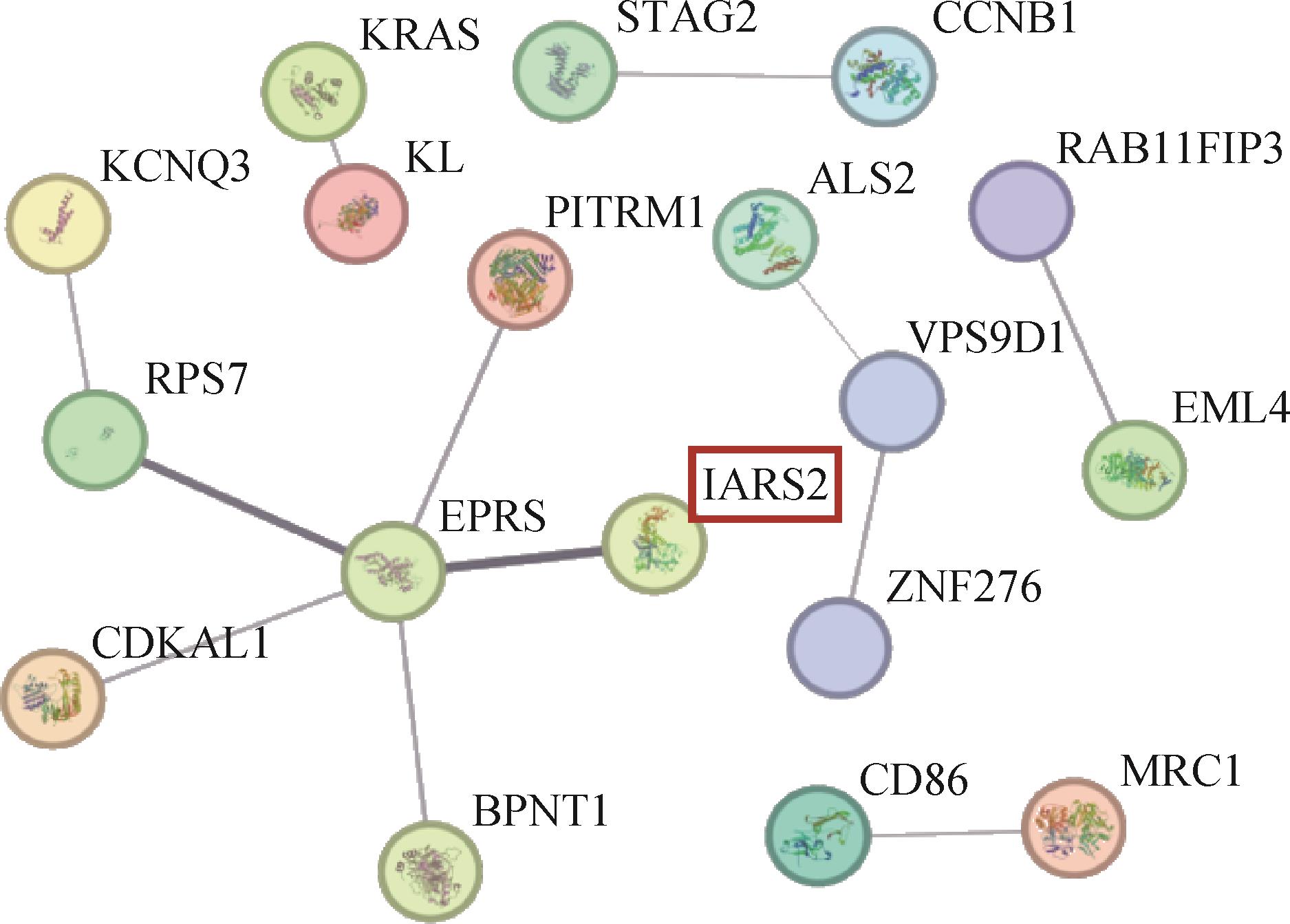
图7
拜城油鸡和吐鲁番鸡间70个候选基因的蛋白互作网络图本图仅保留有互作关系的蛋白,线条粗度表示相互作用的置信预测度"
| [1] | AZIMU W,MANATBAY B,LI Y,et al.Genetic diversity and population structure analysis of eight local chicken breeds of Southern Xinjiang[J].Bri Poult Sci,2018,59(6):629-635. |
| [2] | 国家畜禽遗传资源委员会.中国畜禽遗传资源志家禽志[M].北京:中国农业出版社,2011:16-19. |
| China National Commission of Animal Genetic Resources.Animal Genetic Resources In China Poultry[M].Beijing:China Agriculture Press,2011:16-19.(in Chinese) | |
| [3] | 李慧芳,陈宽维,章双杰,等.中国受威胁地方鸡品种的遗传多样性[J].南京农业大学学报,2005,28(3):68-70. |
| LI H F,CHEN K W,ZHANG S J,et al.Genetic diversity of indigeno threated chicken breeds in China[J].Journal of Nanjing Agricultural University,2005,28(3),68-70.(in Chinese) | |
| [4] | 汪家骏,陈若楠,孙楠桢,等.拜城油鸡不同时期脂肪代谢相关基因表达规律的研究[J].黑龙江畜牧兽医,2024(23):50-54. |
| WANG J J,CHEN R N,SUN N Z,et al.Study on the expression pattern of fat metabolism-related genes in differentperiods of Baicheng oil chickens[J].Heilongjiang Animal Science and Veterinary Medicine,2024(23):50-54.(in Chinese) | |
| [5] | 古丽娜·巴克,赵晨名.和田黑鸡、吐鲁番斗鸡A-FABP、H-FABP基因与IMF关联性分析[J].家禽科学,2025,47(3):63-68. |
| GULINA B K,ZHAO C M.Correlation analysis between A-FABP,H-FABP genes and IMF in Hetian black chickens and Turpan fighting chickens[J].China Poultry Science,2025,47(3):63-68.(in Chinese) | |
| [6] | WANG H E,ZHAO X R,WEN J H,et al.Comparative population genomics analysis uncovers genomic footprints and genes influencing body weight trait in Chinese indigenous chicken[J].Poult Sci,2023,102(11):103031. |
| [7] | ZHANG R Q,DENG J W,LI X Z,et al.Research Note:Comparison of the texture,structure,and composition of eggs from local Chinese chickens and a highly selected line of egg-type chickens and analysis of the effects of lipids on texture[J].Poult Sci,2022,101(8):101934. |
| [8] | BENTLEY D R.Whole-genome re-sequencing[J].Cur Opin Genet Dev,2006,16(6):545-552. |
| [9] | WENG Z X,XU Y J,LI W N,et al.Genomic variations and signatures of selection in Wuhua yellow chicken[J].PLoS One,2020,15(10):e0241137. |
| [10] | QANBARI S,RUBIN C J,MAQBOOL K,et al.Genetics of adaptation in modern chicken[J].PLoS Genet,2019,15(4):e1007989. |
| [11] | YANG K,ZHANG J,ZHAO Y L,et al.Whole genome resequencing revealed the genetic relationship and selected regions among baicheng-you,beijing-you,and european-origin broilers[J].Biology (Basel),2023,12(11):1397. |
| [12] | WANG M S,THAKUR M,PENG M S,et al.863 genomes reveal the origin and domestication of chicken[J].Cell Res,2020,30(8):693-701. |
| [13] | LI H,DURBIN R.Fast and accurate long-read alignment with Burrows-Wheeler transform[J].Bioinformatics,2010,26(5):589-595. |
| [14] | MCKENNA A,HANNA M,BANKS E,et al.The genome analysis toolkit:A mapreduce framework for analyzing next-generation DNA sequencing data[J].Genome Res,2010,20(9):1297-1303. |
| [15] | PURCELL S,NEALE B,TODD-BROWN K,et al.PLINK:a tool set for whole-genome association and population-based linkage analyses[J].Am J Hum Genet,2007,81(3):559-575. |
| [16] | WIGGINTON J E,ABECASIS G R.PEDSTATS:descriptive statistics,graphics and quality assessment for gene mapping data[J].Bioinformatics,2005,21(16):3445-3447. |
| [17] | JOMBART T.Adegenet:a R package for the multivariate analysis of genetic markers[J].Bioinformatics,2008,24(11):1403-1405. |
| [18] | DANECEK P,AUTON A,ABECASIS G,et al.The variant call format and VCFtools[J].Bioinformatics,2011,27(15):2156-2158. |
| [19] | MALINSKY M,MATSCHINER M,SVARDAL H.Dsuite-Fast D-statistics and related admixture evidence from VCF files[J].Mol Ecol Resources,2021,21(2):584-595. |
| [20] | PFEIFER B,KAPAN D D.Estimates of introgression as a function of pairwise distances[J].BMC Bioinformatics,2019,20(1):207. |
| [21] | WANG K J,ZHANG L G,DUAN D D,et al.Genomic analysis reveals human-mediated introgression from european commercial pigs to Henan indigenous pigs[J].Front Genet,2021,12:705803. |
| [22] | PICKRELL J K,PRITCHARD J K.Inference of population splits and mixtures from genome-wide allele frequency data[J].PLoS Genet,2012,8(11):e1002967. |
| [23] | SZPIECH Z A,HERNANDEZ R D.Selscan:an efficient multithreaded program to perform EHH-based scans for positive selection[J].Mol Biol Evo,2014,31(10):2824-2827. |
| [24] | BROWNING S R,BROWNING B L.Rapid and accurate haplotype phasing and missing-data inference for whole-genome association studies by use of localized haplotype clustering[J].Am J Hum Genet,2007,81(5):1084-1097. |
| [25] | MA H R,ZHANG S X,ZHANG K L,et al.Identifying selection signatures for backfat thickness in Yorkshire pigs highlights new regions affecting fat metabolism[J].Genes (Basel),2019,10(4):254. |
| [26] | SABETI P C,VARILLY P,FRY B,et al.Genome-wide detection and characterization of positive selection in human populations[J].Nature,2007,449(7164):913-918. |
| [27] | WANG Z,SUN H,CHEN Q,et al.A genome scan for selection signatures in Taihu pig breeds using next-generation sequencing[J].Animal,2019,13(4):683-693. |
| [28] | 田一妮.基于全基因组测序的中缅边境恶性疟原虫种群结构研究[D].上海:中国人民解放军海军军医大学,2018. |
| TIAN Y N.Genome-wide population genetics analysis of plasmodium falciparum isolates from China-Myanmar border[D].Shanghai:Naval Medical University,2018.(in Chinese) | |
| [29] | CHEN H,PATTERSON N,REICH D.Population differentiation as a test for selective sweeps[J].Genome Res,2010,20(3):393-402. |
| [30] | JEONG H,SONG K D,SEO M,et al.Exploring evidence of positive selection reveals genetic basis of meat quality traits in Berkshire pigs through whole genome sequencing[J].BMC Genet,2015,16(1):104. |
| [31] | NAVAL-SÁNCHEZ M,PORTO-NETO L R,CARDOSO D F,et al.Selection signatures in tropical cattle are enriched for promoter and coding regions and reveal missense mutations in the damage response gene HELB[J].Genet Select Evol,2020,52(1):27. |
| [32] | ZHANG X J,CHEN M M,LIU X F,et al.A novel lncRNA,lnc403,involved in bovine skeletal muscle myogenesis by mediating KRAS/Myf6[J].Gene,2020,751:144706. |
| [33] | DING Y,YUAN X,ZOU Y C,et al.OCT4,SOX2 and NANOG co-regulate glycolysis and participate in somatic induced reprogramming[J].Cytotechnology,2022,74(3):371-383. |
| [34] | LUO W,LUO C L,WANG M,et al.Genome diversity of Chinese indigenous chicken and the selective signatures in Chinese gamecock chicken[J].Sci Report,2020,10(1):14532. |
| [35] | GODOY T F,MOREIRA G C,BOSCHIERO C,et al.SNP and INDEL detection in a QTL region on chicken chromosome 2 associated with muscle deposition[J].Anim Genet,2015,46(2):158-163. |
| [36] | KHADJEH S,HINDMARSH V,WEBER F,et al.CRISPLD1:a novel conserved target in the transition to human heart failure[J].Basic Res Cardiol,2020,115(3):27. |
| [37] | REN X F,ZHAO X R,LI H Y,et al.The origin patterns,admixture,and selection signatures of the global gamecock populations[J].Poult Sci,2025,104(11):105738. |
| [38] | RASNITSYN A,DOUCETTE L,SEIFI M,et al.FOXC1 modulates MYOC secretion through regulation of the exocytic proteins RAB3GAP1,RAB3GAP2 and SNAP25[J].Plos One,2017,12(6):e0178518. |
| [39] | YU Y M,XU L,LI H R,et al.IARS2 regulates proliferation,migration,and angiogenesis of human umbilical vein endothelial cells[J].Revista da Associacao Medica Brasileira,2021,67(4):555-560. |
| [40] | IYER S,CHHABRA Y,HARVEY T J,et al.CRIM1 is necessary for coronary vascular endothelial cell development and homeostasis[J].J Mol Histol,2017,48(1):53-61. |
| [41] | MORI M,SAITO K,OHTA Y.ARHGAP22 localizes at endosomes and regulates actin cytoskeleton[J].PLoS One,2014,9(6):e100271. |
| [42] | CHEN C K,CHANG Y M,JIANG T X,et al.Conserved regulatory switches for the transition from natal down to juvenile feather in birds[J].Nat Commun,2024,15(1):4174. |
| [43] | ODA M,IZUMI Y,KAJI R.Gene mutations in familial amyotrophic lateral sclerosis[J].Brain Nerve,2011,63(2):165-170. |
| [44] | YI P,CHEW L L,ZHANG Z W,et al.KIF5B transports BNIP-2 to regulate p38 mitogen-activated protein kinase activation and myoblast differentiation[J].Mol Biol Cell,2015,26(1):29-42. |
| [45] | NAKAMURA S,MASUYAMA R,SAKAI K,et al.SH3P2 suppresses osteoclast differentiation through restricting membrane localization of myosin 1E[J].Genes to Cells,2020,25(11):707-717. |
| [46] | SHEN X X,ZHAO X Y,HE H R,et al.Evolutionary conserved circular MEF2A RNAs regulate myogenic differentiation and skeletal muscle development[J].PLoS Genet,2023,19(9):e1010923. |
| [47] | KLEMENS C A,CHULKOV E G,WU J,et al.Loss of chloride channel 6 (CLC-6) affects vascular smooth muscle contractility and arterial stiffness via alterations to Golgi calcium stores[J].Hypertension,2021,77(2):582-593. |
| [48] | 马 锦,李发源,庞国伟,等.古陆上丝绸之路复原及沿线基本地理特征分析[J].地理与地理信息科学,2017,33(4):123-129. |
| MA J,LI F Y,PANG G W,et al.The restoration of the ancient silk road on land and analysis of geographical features along the route[J].Geography and Geo-Information Science,2017,33(4):123-129.(in Chinese) | |
| [49] | 叶春华,吕建周,林之光.我国新极端最高气温的考察研究[J].气象,2008,34(11):3-6. |
| YE C H,LV J Z,LIN Z G.A study on new extreme maximum air temperature in China[J].Meteorological Monthly,2008,34(11):3-6.(in Chinese) | |
| [50] | WOLFENSON D,FREI Y F,SNAPIR N,et al.Heat stress effects on capillary blood flow and its redistribution in the laying hen[J].Pflugers Archiv (Eur J Physiol),1981,390(1):86-93. |
| [51] | HILLMAN P E,SCOTT N R,VAN TIENHOVEN A.Vasomotion in chicken foot:dual innervation of arteriovenous anastomoses[J].Am J Physiol,1982,242(5):582-590. |
| [52] | COLLIER R J,GEBREMEDHIN K G.Thermal biology of domestic animals[J].Ann Rev Anim Biosci,2015,3:513-532. |
| [53] | CORBETT R J,TE PAS M F W,VAN DEN BRAND H,et al.Genome-wide assessment of DNA methylation in chicken cardiac tissue exposed to different incubation temperatures and CO(2) levels[J].Front Genet,2020,11:558189. |
| [54] | LEKSRISOMPONG N,ROMERO-SANCHEZ H,PLUMSTEAD P W,et al.Broiler incubation.1.Effect of elevated temperature during late incubation on body weight and organs of chicks[J].Poult Sci,2007,86(12):2685-2691. |
| [55] | MAATJENS C M,REIJRINK I A,MOLENAAR R,et al.Temperature and CO2 during the hatching phase.I.Effects on chick quality and organ development[J].Poult Sci,2014,93(3):645-654. |
| [56] | YU B,PULIT S L,HWANG S J,et al.Rare exome sequence variants in CLCN6 reduce blood pressure levels and hypertension risk[J].Circ Cardiovasc Genet,2016,9(1):64-70. |
| [57] | IYER S,CHOU F Y,WANG R,et al.Crim1 has cell-autonomous and paracrine roles during embryonic heart development[J].Sci Rep,2016,6:19832. |
| [58] | WANG J,LI Y Y,DENG L J,et al.FTO suppresses cardiac fibrosis after myocardial infarction via m(6)A-mediated epigenetic modification of EPRS[J].Mol Med,2024,30(1):213. |
| [59] | 姜广礼.拜城油鸡屠宰性状及肉品质的研究[D].乌鲁木齐:新疆农业大学,2011. |
| JIANG G L.Studies on carcass traits and meat quality of Baicheng Fatty chicken[D].Urumqi:Xinjiang Agricultural University,2011.(in Chinese) | |
| [60] | 薛正芬,郭 立,张文举,等.吐鲁番斗鸡肉用性能研究[J].新疆畜牧业,2016(1):34-35. |
| XUE Z F,GUO L,ZHANG W J,et al.Study on meat performance of Turpan game chicken[J].Xinjiang Animal Husbandry,2016(1):34-35.(in Chinese) | |
| [61] | ZHANG Y H,LI S,WEN X,et al.MYOC promotes the differentiation of C2C12 cells by regulation of the TGF-β signaling pathways via CAV1[J].Biology (Basel),2021,10(7):686. |
| [62] | KANG J S,BAE G U,YI M J,et al.A Cdo-Bnip-2-Cdc42 signaling pathway regulates p38alpha/beta MAPK activity and myogenic differentiation[J].J Cell Biol,2008,182(3):497-507. |
| [63] | PAGEL M,DAWKINS M S.Peck orders and group size in laying hens:`futures contracts' for non-aggression[J].Behav Processes,1997,40(1):13-25. |
| [64] | LI Z H,ZHENG M,ABDALLA B A,et al.Genome-wide association study of aggressive behaviour in chicken[J].Sci Rep,2016,6:30981. |
| [65] | OKUR V,WATSCHINGER K,NIYAZOV D,et al.Biallelic variants in AGMO with diminished enzyme activity are associated with a neurodevelopmental disorder[J].Hum Genet,2019,138(11-12):1259-1266. |
| [1] | 王志敬, 刘英明, 高振华, 尹福泉. 粤西卷羽鸡与怀乡鸡杂交配套组合的正反交效应研究[J]. 畜牧兽医学报, 2026, 57(1): 167-180. |
| [2] | 田凯, 叶晓梦, 任聪, 王钰明, 解竞静, 赵峰. 不同消化速度的淀粉影响肉鸡对饲粮能量和蛋白质利用率的研究[J]. 畜牧兽医学报, 2026, 57(1): 282-293. |
| [3] | 李顺英, 邓仕伟, 廖秀冬, 黄靓, 李笑然, 王冲, 张丽阳, 吕林. 低蛋白饲粮钙、非植酸磷水平与电解质平衡值对肉仔鸡生长、血清指标及养分代谢率的影响[J]. 畜牧兽医学报, 2026, 57(1): 294-304. |
| [4] | 郭志廷, 孙焕焕, 刘淑宁, 李建喜, 张少博, 刘圆, 罗晓琴, 魏小成, 李成义. 常山散对感染不同发育阶段球虫雏鸡盲肠机械屏障的影响[J]. 畜牧兽医学报, 2026, 57(1): 526-539. |
| [5] | 王有栋, 曹志平, 李玉茂, 栾鹏, 李辉, 白雪. SNP芯片技术原理及其在鸡遗传育种中的应用[J]. 畜牧兽医学报, 2025, 56(9): 4165-4175. |
| [6] | 王超慧, 刘筱影, 杨小军, 刘艳利. 甜菜碱缓解油酸诱导鸡胚原代肝细胞脂代谢紊乱及氧化应激的作用机制[J]. 畜牧兽医学报, 2025, 56(9): 4741-4749. |
| [7] | 刘莎, 杨彩春, 张晓雨, 陈琼, 刘雄, 陈洪波, 周焕焕, 史良玉. 基于80K SNP芯片的梅花星猪群体遗传结构解析及全基因组连续纯合片段特征研究[J]. 畜牧兽医学报, 2025, 56(8): 3749-3760. |
| [8] | 付伟, 张冉, 丁虹, 臧素敏, 李祥龙, 褚素乔, 刘华格, 周荣艳. 太行鸡与坝上长尾鸡品种区分的分子标记筛选与鉴定[J]. 畜牧兽医学报, 2025, 56(8): 3761-3772. |
| [9] | 任千姿, 张佰忠, 王真勍, 王向林, 龚颖, 胡仁科, 浦亚斌, 苏鹏, 李业芳, 马月辉, 李昊帮, 蒋琳. 基于全基因组重测序对武雪山羊的遗传进化分析[J]. 畜牧兽医学报, 2025, 56(8): 3787-3801. |
| [10] | 薛晓晓, 孟令宅, 王素艳, 于蒙蒙, 陈运通, 祁小乐, 李留安, 于晓雪, 高玉龙. B亚型禽偏肺病毒病弱毒疫苗对商品蛋鸡的免疫效果[J]. 畜牧兽医学报, 2025, 56(8): 3958-3966. |
| [11] | 赵靖玉, 李丹, 张兵, 张乾义, 张锦华, 宋亚芬, 杨承槐. 鸡传染性支气管炎病毒M41株全基因组序列测定及致病性分析[J]. 畜牧兽医学报, 2025, 56(8): 3967-3975. |
| [12] | 袁橙, 袁月, 张清正, 宋小凯, 徐立新, 严若峰, 李祥瑞, 陆明敏. 巨型艾美耳球虫与产气荚膜梭菌共感染致鸡坏死性肠炎模型的评价[J]. 畜牧兽医学报, 2025, 56(8): 4120-4128. |
| [13] | 宗云鹤, 杨宇泽, 孙研研, 陈继兰, 李云雷. 赖氨酸乙酰化修饰在鸡精液冷冻中的保护作用及机制研究进展[J]. 畜牧兽医学报, 2025, 56(7): 3071-3079. |
| [14] | 张嘉良, 黄畅, 杨永林, 杨华, 白文林, 马月辉, 赵倩君. 基于50K液相芯片的中国绵羊群体遗传结构与羊毛性状选择信号分析[J]. 畜牧兽医学报, 2025, 56(7): 3164-3176. |
| [15] | 孙淑佳, 郑嘉祺, 卢姝婉, 刘金松, 姚春雷, 杨彩梅, 许英蕾, 张瑞强. 乳酸菌对黄羽肉鸡生长性能、消化功能和养分利用率的影响[J]. 畜牧兽医学报, 2025, 56(7): 3335-3343. |
| 阅读次数 | ||||||
|
全文 |
|
|||||
|
摘要 |
|
|||||
