


畜牧兽医学报 ›› 2025, Vol. 56 ›› Issue (11): 5743-5757.doi: 10.11843/j.issn.0366-6964.2025.11.032
张玉杰( ), 刘红祥, 宋姗姗, 薄智勇, 阮国宏, 赵成龙, 楚电峰, 杨雪, 杜元钊, 刘东*()
收稿日期:2025-02-06
出版日期:2025-11-23
发布日期:2025-11-27
通讯作者:
刘东
E-mail:ddzhang2008-2009@163.com;liudong@yebio.com
作者简介:张玉杰(1986-),男,山东青岛人,兽医师,主要从事畜禽新发疫病的病原学研究,Tel:0532-85631119,E-mail:ddzhang2008-2009@163.com
基金资助:
ZHANG Yujie(), LIU Hongxiang, SONG Shanshan, BO Zhiyong, RUAN Guohong, ZHAO Chenglong, CHU Dianfeng, YANG Xue, DU Yuanzhao, LIU Dong*()
Received:2025-02-06
Online:2025-11-23
Published:2025-11-27
Contact:
LIU Dong
E-mail:ddzhang2008-2009@163.com;liudong@yebio.com
摘要:
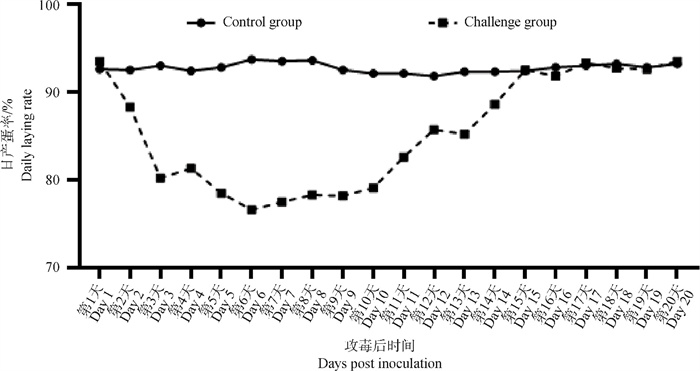
2018年秋冬季以来,我国蛋鸡养殖地区新发了一种以开产蛋鸡产蛋下降和腹泻为主要特征的传染病,为查明该病的病因,作者进行了本试验。采集发病鸡肠道组织,在SPF鸡胚上连续盲传10代分离病原物;对分离毒株进行理化特性和血凝特性测定;利用设计的疑似病毒特异性引物,对提取的病毒核酸进行PCR检测、基因测序以及核苷酸同源性比对,根据比对结果设计引物获得病毒的全基因组核苷酸序列;以新型禽冠状病毒AvCoV/CH/SD/24株对SPF鸡、AA+白羽肉鸡和海兰蛋鸡进行攻毒,对发病SPF鸡肠道进行病理切片并用酶联免疫吸附试验(ELISA)测定攻毒后不同鸡血清中传染性支气管炎病毒抗体滴度。结果显示:成功分离获得4株新型禽冠状病毒AvCoV/CH/BZ/24、AvCoV/CH/JS/24、AvCoV/CH/SD/24、AvCoV/CH/HB/24,病毒无血凝活性。核酸检测结果显示,有4份样品鸡传染性支气管炎病毒N和S1基因阳性,且N基因序列与数据库中鸡传染性支气管病毒相似性最高,S1基因序列与数据库中已有禽冠状病毒AvCoV/TZ/CA127/19株序列的相似性最高。全基因组扩增和测序结果显示,4株新型禽冠状病毒与2016年中国安徽省和2019年坦桑尼亚阿鲁沙发现并报道的两株禽冠状病毒全基因组核苷酸相似性高达97.1%~98.6%。系统发育分析表明,新型禽冠状病毒的S基因与类火鸡冠状病毒亲缘关系较近,处于同一进化分支的不同亚分支,而其它基因与GⅠ-19谱系传染性支气管炎病毒处于同一进化分支。动物实验表明,AvCoV/CH/SD/24株病毒能够引起SPF鸡腹泻,十二指肠绒毛脱落,绒毛顶端和黏膜固有层充血、出血,肾小管上皮细胞颗粒变性,间质充血,病毒主要通过泄殖腔排出体外,各脏器中以肠道和法氏囊的病毒载量最高,病毒不影响鸡的增重率;ELISA结果显示重组新型禽冠状病毒与鸡传染性支气管炎病毒具有血清学交叉反应;开产蛋鸡感染病毒后出现产蛋下降和腹泻,与临床发病一致。从蛋鸡产蛋下降和腹泻病例的肠道中分离获得的4株新型禽冠状病毒是类火鸡冠状病毒S基因与GⅠ-19谱系鸡传染性支气管炎病毒的重组病毒,能够引起鸡发生产蛋下降和腹泻。
中图分类号:
张玉杰, 刘红祥, 宋姗姗, 薄智勇, 阮国宏, 赵成龙, 楚电峰, 杨雪, 杜元钊, 刘东. 新发肠致病性重组新型禽冠状病毒的分离和鉴定[J]. 畜牧兽医学报, 2025, 56(11): 5743-5757.
ZHANG Yujie, LIU Hongxiang, SONG Shanshan, BO Zhiyong, RUAN Guohong, ZHAO Chenglong, CHU Dianfeng, YANG Xue, DU Yuanzhao, LIU Dong. Isolation and Identification of Novel Enteropathogenic Recombinant Avian Coronavirus[J]. Acta Veterinaria et Zootechnica Sinica, 2025, 56(11): 5743-5757.

表 1
不同病毒引物序列"
| 病毒 Virus | 引物(5′→3′) Primers | 大小/bp Size |
| 呼肠孤病毒 | F:GCTGCTAACATCCAAGAG | 620 |
| ARV | R:ATAAGATCGCGTACGTCG | |
| 鸡星状病毒 | F:AAAGCGAGGGTGTGGGCG | 1 260 |
| CAstV | R:GGTAAATTRAACCACCACCC | |
| 鸡细小病毒 | F:TGACTGCAGGGAGTTATG | 450 |
| ChPV | R:TACAAAAGGCTGTGTG | |
| 鸡传染性支气管炎病毒IBV | ||
| IBV-N | F:AACTAGGAGGGCCTAAACCA | 484 |
| R:GCTCTACTAGATGCTGCTGA | ||
| IBV-S1 | F:CAAGTTATTGATTAGAGATG | 1 630 |
| R:CCAATAGAACGTCTGAGMCG | ||
| 禽脑脊髓炎病毒 | F:ATGAGCAAACTATTTTCTACTGTA | 720 |
| AEV | R:CTGTGCGACCAAAGGGCTAAGTCC | |
| 禽腺病毒 | F:TCCAACAGTTCATTTCCGCC | 527 |
| FAdV | R:AGACTTGGCGAAGCGACCGA | |
| 禽肾炎病毒 | F:CTTGAACACTCTACTCTC | 624 |
| ANV | R:GGGAGATAAGAGTCCTTATG | |
| 新型禽冠状病毒 | F:GTATAATGTGCAGCCATGCG | 110 |
| nACoV | R:TGAAGCTAGACTACACGACA | |
| Probe:FAM-CAGTTTCTACGCAGGCTGTAGTTGTTA-BHQ |
表 2
禽冠状病毒基因组测序引物"
| 引物名称 Primer name | 引物序列(5′→3′) Primer sequence | 扩增片段位置 Segment position | 扩增片段长度/bp Segment length |
| P1-F/R | GATTAATATAAAGCTATTGC/AAAGCGATCACCACTCTTAA | 1/1 560 | 1 560 |
| P2-F/R | CATGCGAAATGACTTAACTC/GTTACTGGCTGGGTCTTGCA | 1 443/3 000 | 1 558 |
| P3-F/R | TGAGGAGTGTGATATAGATC/AATTTAGCCCATGCCTCTGC | 2 886/4 418 | 1 533 |
| P4-F/R | TGGCGTGACGGAAACTGCTG/ATACACTCTTGTAGCTAGGC | 4 321/5 758 | 1 438 |
| P5-F/R | ACTAGGGATTACTTTGAAGG/AAGACAACTATCAGACAGTT | 5 641/7 194 | 1 554 |
| P6-F/R | TTGATAAATTAACACCTCGT/AAGCTATCCACATAGGTACT | 7 061/8 485 | 1 425 |
| P7-F/R | CTTGTGACGAGTCGTAACAC/AGCTAGCACACATCTACTCC | 8 401/9 828 | 1 428 |
| P8-F/R | GATGAAATGACACCGGAATC/TATCAGTAACACGCGCTTCT | 9 721/11 152 | 1 432 |
| P9-F/R | GCCAATATTGCAAAGTCGGT/ACCGAGCACAGTTACGCTTC | 11 041/12 483 | 1 443 |
| P10-F/R | GCTAATGGTTGTGAACCTGA/GAAACTGTCTATTAGTCATA | 12 384/14 040 | 1 657 |
| P11-F/R | AGAAAAATGTTCTACCCACT/AGGGTTCAACAGTAGACCAG | 13 921/15 480 | 1 560 |
| P12-F/R | CAATACCGTTAGTATCTAAT/GCTTCAGCATCAAGCTCTGT | 15 361/16 912 | 1 552 |
| P13-F/R | TTAACAGATTTAATGTTGCG/ACAGCACCACCAATGTTGCA | 16 801/18 352 | 1 552 |
| P14-F/R | CTATGACTCATCGCCTTGCG/ACAAGGAGTGTTCCCTCAGG | 18 245/19 780 | 1 536 |
| P15-F/R | AACTACAATGTGTGTGCCGC/ACATATAACTCACTACCTAG | 19 661/21 332 | 1 672 |
| P16-F/R | CTTATAATTACACTTGTGTA/GACACACTCTTCAACCTTCT | 21 221/23 160 | 1 940 |
| P17-F/R | GACAGACTAATTACTGGTAG/ACAACTCTGGATCCAATACC | 23 041/24 840 | 1 800 |
| P18-F/R | AACATTGCAGTAGGTGTAAT/CCACGAGAACCATCCCTTGA | 24 721/26 520 | 1 800 |
| P19-F/R | CTGACAGTAATTTCCGTTGG/TTGTTTTCACTCTATACTAG | 26 406/27 696 | 1 291 |
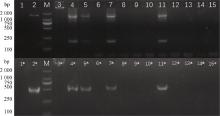
图 1
疑似病毒核酸的RT-PCR检测 M. DL2000 DNA相对分子质量标准;1、1*.阴性对照;2、2*.阳性对照;3~15、3*~15*.样品接种鸡胚的F10代肠组织;1-15.S1基因扩增产物;1*~15*.N基因扩增产物"
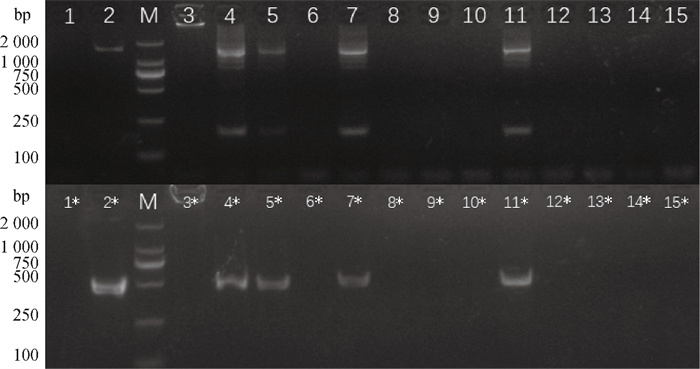
图 2
新型禽冠状病毒AvCoV/CH/SD/24株基因组序列的扩增 M.DL2000 DNA相对分子质量标准;1~19.F3代SPF鸡胚肠道研磨液用表 2引物扩增的产物"
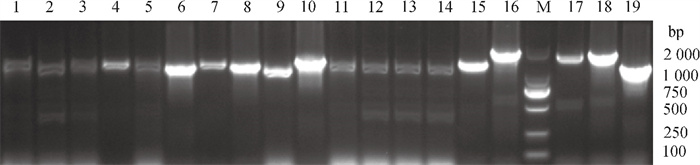
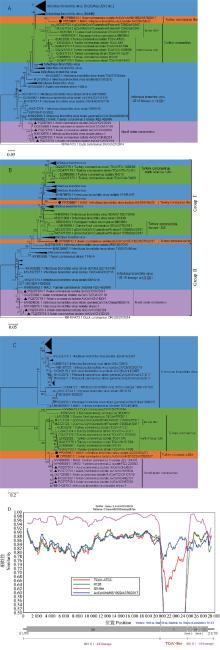
图 3
禽冠状病毒系统发育及重组事件分析 A.基因组核苷酸序列进化分析;B.其他基因核苷酸序列进化分析;C.S基因核苷酸序列进化分析;D.新型禽冠状病毒重组事件分析。●.类火鸡冠状病毒参考毒株;▲.本研究中鉴定的新型禽冠状病毒株"
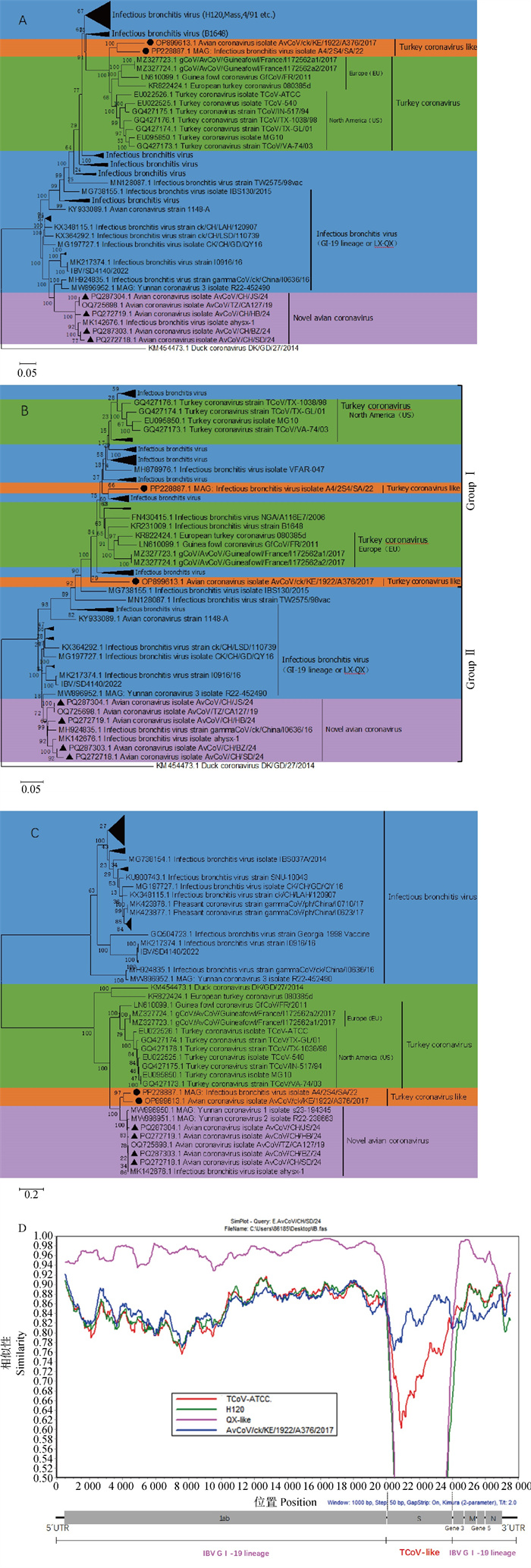

图 4
攻毒后第3天SPF鸡粪便情况 A.粪便成型呈棕褐色圆柱状,表面有少量白色尿酸盐覆盖;B.粪便不成型呈灰绿色松散,水分大,表面有黏液样物质覆盖"
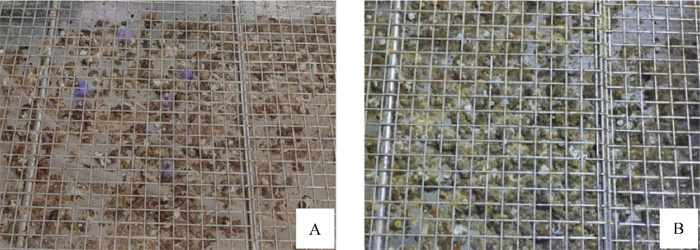
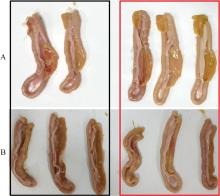
图 5
攻毒后不同时间SPF鸡的十二指肠剖检变化 A.攻毒后第3天;B.攻毒后第5天;黑框为对照组;红框为攻毒1组"
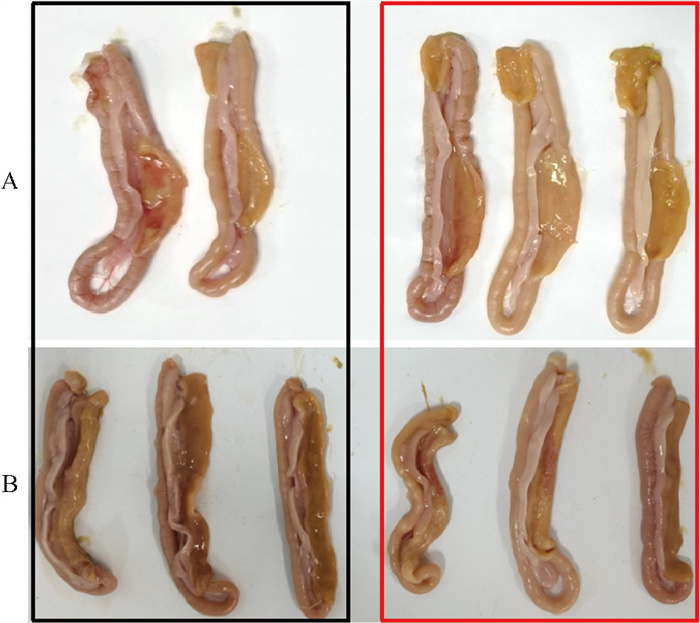
图 6
攻毒后第5天组织病理变化 A、B、C.对照组;D、E、F.攻毒1组"
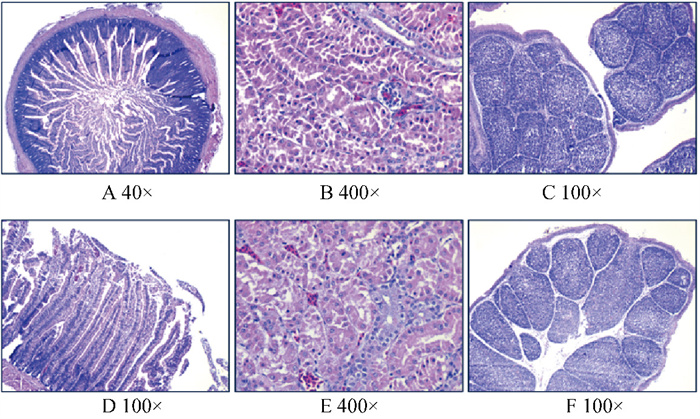
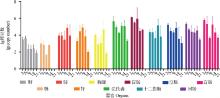
图 7
攻毒后不同脏器的病毒载量"
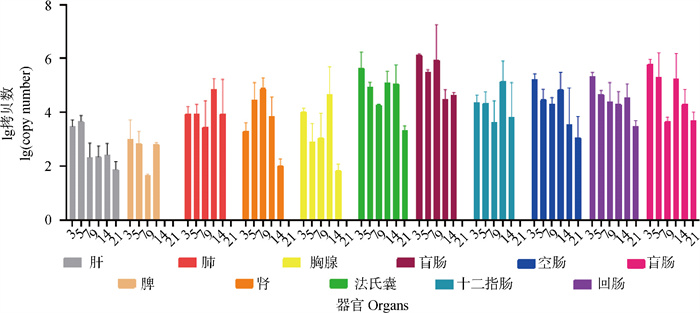
图 8
攻毒后不同时间的抗体滴度 A.攻毒1组SPF鸡;B.攻毒2组SPF鸡;C.攻毒组AA+白羽肉鸡;D.攻毒组海兰褐蛋鸡。红色虚线为血清抗体滴度阈值线,线上表示阳性,线下表示阴性"
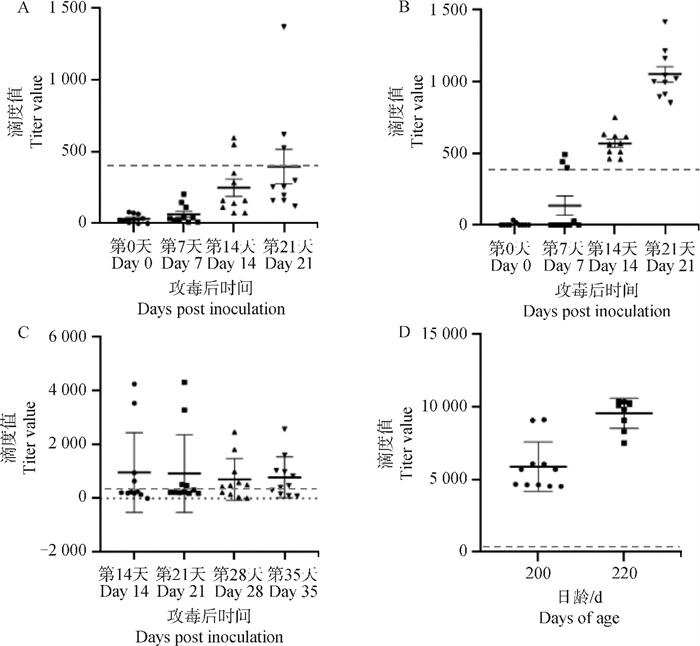
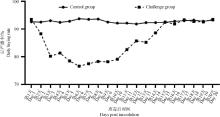
图 9
海兰褐蛋鸡攻毒后的产蛋情况"
| 1 |
ZHONGN S,ZHENGB J,LIY M,et al.Epidemiology and cause of severe acute respiratory syndrome (SARS) in Guangdong, People's Republic of China, in February, 2003[J].Lancet,2003,362(9393):1353-1358.
doi: 10.1016/S0140-6736(03)14630-2 |
| 2 |
ZAKIA M,VAN BOHEEMENS,BESTEBROERT M,et al.Isolation of a noval coronavirus from a man with pneumonia in Saudi Arabia[J].N Engl J Med,2012,367(19):1814-1820.
doi: 10.1056/NEJMoa1211721 |
| 3 |
ELIZABETHA K,AMALK M,AZADR B.Impact of COVID-19 on mental health in Adolescents: A systematic review[J].Int J Environ Res Public Health,2021,18(5):2470.
doi: 10.3390/ijerph18052470 |
| 4 |
ZHANGQ,YUY.Epidemiological features of the 2019 noval coronavirus outbreak in China[J].Curr Top Med Chem,2020,20(13):1137-1140.
doi: 10.2174/1568026620999200511094117 |
| 5 |
BANDEF,ARSHADS S,OMARA R,et al.Global distributions and strain diversity of avian infectious bronchitis virus: a review[J].Anim Health Res Rev,2017,18(1):70-83.
doi: 10.1017/S1466252317000044 |
| 6 |
RAJG D,JONESR C.Infectious bronchitis virus: Immunopathogenesis of infection in the chicken[J].Avian Pathol,1997,26(4):677-706.
doi: 10.1080/03079459708419246 |
| 7 | 董志华,范文胜,赵长润,等.2009-2017年广西地区鸡传染性支气管炎流行病学调查[J].中国兽医学报,2019,39(9):1691-1696. |
| DONGZ H,FANW S,ZHAOC R,et al.Epidemiological investigation of infectious bronchitis virus in Guangxi during 2009-2017[J].Chinese Journal of Veterinary Science,2019,39(9):1691-1696. | |
| 8 |
LINS Y,CHENH W.Infectious bronchitis virus Variants: Molecular analysis and pathogenicity investigation[J].Int J Mol Sci,2017,18(10):2030.
doi: 10.3390/ijms18102030 |
| 9 |
YUANS,CHENGQ,GUOJ Y,et al.Detection and genetic characterization of novel infectious bronchitis viruses from recent outbreaks in broiler and layer chicken flocks in southern China, 2021[J].Poult Sci,2022,101(10):102082.
doi: 10.1016/j.psj.2022.102082 |
| 10 |
ZHANGX Z,DENGT W,LUJ Z,et al.Molecular characterization of variant infectious bronchitis virus in China, 2019:Implications for control programmes[J].Transbound Emerg Dis,2020,67(3):1349-1355.
doi: 10.1111/tbed.13477 |
| 11 | 斯韦恩D E. 禽病学[M]. 刘胜旺, 李慧昕, 陈化兰, 译. 第14版. 沈阳: 辽宁科学技术出版社, 2022: 417. |
| SWAYNE D E. Diseases of poultry[M]. LIU S W, LI H X, CHEN H L, translation. 14th ed. Shenyang: Liaoning Science and Technology Press, 2022: 417. (in Chinese) | |
| 12 | FERUGSONA E.Bluecomb transmisible enteritis in turkeys[J].Can poult Rev,1961,85,74-76. |
| 13 |
LINT L,LOAC C,TSAIS C,et al.Characterization of turkey coronavirus from turkey poults with acute enteritis[J].Vet Microbiol,2002,84(1-2):179-186.
doi: 10.1016/S0378-1135(01)00447-3 |
| 14 |
PETERSONE H,HYMAST A.Antibiotics in the treatment of an unfamiliar turkey disease[J].Poult Sci,1951,30(3):466-468.
doi: 10.3382/ps.0300466 |
| 15 | Centers for Disease Control and Prevention (CDC).New laboratory assay for diagnostic testing of avian influenza A/H5 (Asian Lineage)[J].MMWR Morb Mortal Wkly Rep,2006,55(5):127. |
| 16 | 杨仉生. 火鸡冠状病毒的分离和初步鉴定[D]. 北京: 中国农业大学, 2005: 12-13. |
| YANG Z S. Isolation and preliminary of turkey coronaviruses[D]. Beijing: China Agricultural University, 2005: 12-13. (in Chinese) | |
| 17 |
YANK,WANGX L,LIUZ F,et al.QX-type infectious bronchitis virus infection in roosters can seriously injure the reproductive system and cause sex hormone secretion disorder[J].Virulence,2023,14(1):2185380.
doi: 10.1080/21505594.2023.2185380 |
| 18 |
JIANGL,ZHAOW J,HANZ X,et al.Genome characterization, antigenicity and pathogenicity of a novel infectious bronchitis virus type isolated from south China[J].Infect Genet Evol,2017,54,437-446.
doi: 10.1016/j.meegid.2017.08.006 |
| 19 |
熊挺,何献铭,赵希雅,等.三株鸡传染性支气管炎病毒优势流行毒株全基因组分析及其致病性[J].畜牧兽医学报,2024,55(5):2109-2122.
doi: 10.11843/j.issn.0366-6964.2024.05.029 |
|
XIONGT,HEX M,ZHAOX Y,et al.Whole genome analysis of three predominant epidemic strains of chicken infectious bronchitis virus and their pathogenicity[J].Acta Veterinaria et Zootechnica Sinica,2024,55(5):2109-2122.
doi: 10.11843/j.issn.0366-6964.2024.05.029 |
|
| 20 | ROBERTSONM D,WILCOXG E.Avian reovirus[J].Vet Bull,1986,56,155-174. |
| 21 |
DIASJ B L,PINHEIROM S,PETRUCCIM P,et al.Rotavirus A and D circulating in commercial chicken flocks in southeastern Brazil[J].Vet Res Commu,2024,48(2):743-748.
doi: 10.1007/s11259-023-10246-3 |
| 22 |
XIAJ Y,LIAOJ Y,LIUC X,et al.Identification and characterization of a novel avian nephritis variant in chickens with enteritis in Hunan province, China[J].Arch Virol,2023,168(2):46.
doi: 10.1007/s00705-022-05659-5 |
| 23 |
BIX Q,SONGZ R,MENGF R,et al.Molecular characteristics and pathogenicity of a novel chicken astrovirus variant[J].Vet Res,2023,54(1):117.
doi: 10.1186/s13567-023-01250-1 |
| 24 |
ZSAKL,CHAR M,DAYJ M.Chicken parvovirus-induced runting-stunting syndrome in young broilers[J].Avian Dis,2013,57(1):123-127.
doi: 10.1637/10371-091212-ResNote.1 |
| 25 |
DEAS,VERBEEKA,TIJSSENP.Transmissible enteritis of turkeys: experimental inoculation studies with tissue-culture-adapted turkey and bovine coronaviruses[J].Avian Dis,1991,35(4):767-777.
doi: 10.2307/1591609 |
| 26 |
POMEROYK A,PATELB L,LARSENC T,et al.Combined immunofluorescence and transmission electron microscopic studies of sequential intestinal samples from turkey embryos and poults infected with turkey enteritis coronavirus[J].Am J Vet Res,1978,39(8):1348-1354.
doi: 10.2460/ajvr.1978.39.08.1348 |
| 27 |
PANIGRAHYB,NAQIS A,HALLC F.Isolation and characterization of viruses associated with transmissible enteritis (bluecomb) of turkeys[J].Avian Dis,1973,17(2):430-438.
doi: 10.2307/1589228 |
| 28 |
DE WITJ J.Detection of infectious bronchitis virus[J].Avian Pathol,2000,29(2):71-93.
doi: 10.1080/03079450094108 |
| 29 | LOOMISL N,CUNNINGHAMC H,GRAYM L,et al.Pathology of the chicken embryo infected with infectious bronchitis virus[J].Am J Vet Res,1950,11(40):245-251. |
| 30 |
WANGY,CUIX J,CHENX,et al.A recombinant infectious bronchitis virus from a chicken with a spike gene closely related to that of a turkey coronavirus[J].Arch Virol,2020,165(3):703-707.
doi: 10.1007/s00705-019-04488-3 |
| 31 |
KARIITHIH M,VOLKENINGJ D,GORAICHUKI V,et al.Unique variants of avian coronaviruses from indigenous chickens in Kenya[J].Viruses,2023,15(2):264.
doi: 10.3390/v15020264 |
| 32 |
KARIITHIH M,VOLKENINGJ D,CHIWANGAG H,et al.Molecular characterization of complete genome sequence of an avian coronavirus identified in a backyard chicken from Tanzania[J].Genes (Basel),2023,14(10):1852.
doi: 10.3390/genes14101852 |
| 33 |
NWOKOROGUV C,PILLAIS,SANJ E,et al.A metagenomic investigation of the faecal RNA virome structure of asymptomatic chickens obtained from a commercial farm in Durban, KwaZulu-Natal province, South Africa[J].BMC Genomics,2024,25(1):629.
doi: 10.1186/s12864-024-10517-6 |
| 34 |
CHENY M,SADIQS,TIANJ H,et al.RNA viromes from terrestrial sites across China expand environmental viral diversity[J].Nat Microbiol,2022,7(8):1312-1323.
doi: 10.1038/s41564-022-01180-2 |
| 35 |
GOMAAM H,BARTAJ R,OJKICD,et al.Complete genomic sequence of turkey coronavirus[J].Virus Res,2008,135(2):237-246.
doi: 10.1016/j.virusres.2008.03.020 |
| 36 |
BROWNP A,TOUZAINF,BRIANDF X,et al.First complete genome sequence of European Turkey coronavirus suggests complex recombination history related with US Turkey and guinea fowl coronaviruses[J].J Gen Virol,2016,97(1):110-120.
doi: 10.1099/jgv.0.000338 |
| 37 |
DUCATEZM F,LIAISE,CROVILLEG,et al.Full genome sequence of guinea fowl coronavirus associated with fulminating disease[J].Virus Genes,2015,50(3):514-517.
doi: 10.1007/s11262-015-1183-z |
| 38 |
杨仉生,赵立红,乔健,等.火鸡冠状病毒的分离和初步鉴定[J].畜牧兽医学报,2006,37(11):1241-1244.
doi: 10.3321/j.issn:0366-6964.2006.11.027 |
|
YANGZ S,ZHAOL H,QIAOJ,et al.Isolation and priliminary identification of turkey coronavirus[J].Acta Veterinaria et Zootechnica Sinica,2006,37(11):1241-1244.
doi: 10.3321/j.issn:0366-6964.2006.11.027 |
|
| 39 |
XUL W,HANZ X,JIANGL,et al.Genetic diversity of avian infectious bronchitis virus in China in recent years[J].Infect Genet Evol,2018,66,82-94.
doi: 10.1016/j.meegid.2018.09.018 |
| 40 | DE WITJ J,DE WITM K,COOKJ K A.Infectious bronchitis virus types affecting European Countries-A review[J].Avian Dis,2021,65(4):643-648. |
| 41 |
KHATABYK,SOUIRIA,KASMIY,et al.Current situation, genetic relationship and control measures of infectious bronchitis virus variants circulating in African regions[J].J Basic Appl Zool,2016,76,20-30.
doi: 10.1016/j.jobaz.2016.08.002 |
| 42 |
GUYJ S,SMITHL G,RRESLINJ J,et al.Development of a competitive enzyme-linked immunosorbent assay for detection of turkey coronavirus antibodies[J].Avian Dis,2002,46(2):334-341.
doi: 10.1637/0005-2086(2002)046[0334:DOACEL]2.0.CO;2 |
| 43 |
LOAC C,LINT L,WUC C,et al.Detection of antibody to turkey coronavirus by antibody-capture enzyme-linked immunosorbent assay utilizing infectious bronchitis virus antigen[J].Avian Dis,2000,44(3):498-506.
doi: 10.2307/1593088 |
| [1] | 李慧敏, 雷铭楷, 阮胜男, 李盼盼, 李文涛, 何启盖. 猪流行性腹泻病毒荧光微球免疫层析抗原检测方法的建立[J]. 畜牧兽医学报, 2025, 56(9): 4572-4580. |
| [2] | 国桂海, 马茹梦, 尹方洁, 刘芯孜, 王梓, 孟伟静, 李佳璇, 崔文, 姜艳平, 唐丽杰, 赵海渊, 王晓娜. 表达猪流行性腹泻病毒S1基因重组罗伊氏黏液乳杆菌诱导仔猪特异性免疫应答的研究[J]. 畜牧兽医学报, 2025, 56(9): 4581-4592. |
| [3] | 田茹, 付星玮, 胡乐玉, 朱明君, 童德文. 一株GⅡa型猪流行性腹泻病毒的分离与致病性分析[J]. 畜牧兽医学报, 2025, 56(8): 4101-4111. |
| [4] | 孔祥鹤, 苏欣雨, 钟一铭, 卢赵梓暄, 廖献茂, 张哲, 张旭, 高萌萌, 周玉龙, 樊祜卿. 黑龙江省地区犊牛腹泻源致病性大肠杆菌流行情况调查、毒力基因及耐药性分析[J]. 畜牧兽医学报, 2025, 56(7): 3390-3398. |
| [5] | 李志强, 陈雪清, 张源淑. 猪流行性腹泻病毒临床感染仔猪肠道组织中血管紧张素转化酶2的检测及其与肠道病理变化的关系分析[J]. 畜牧兽医学报, 2025, 56(7): 3463-3473. |
| [6] | 王运珂, 王娜, 岳珂, 何坤淼, 张兴, 刘垚, 张改平. 体外对猪流行性腹泻病毒复制具有抑制效应的物质[J]. 畜牧兽医学报, 2025, 56(6): 2577-2589. |
| [7] | 吴超, 明文含, 卢姝婉, 杨彩梅, 刘金松, 马翔, 张瑞强. 猪流行性腹泻病毒的天然免疫逃避机制及其防控研究进展[J]. 畜牧兽医学报, 2025, 56(6): 2590-2599. |
| [8] | 周敏, 汤德元, 曾智勇, 王彬, 黄涛, 胡雯雯, 毛茵茗, 周飘, 何松. 猪流行性腹泻病毒蛋白与宿主蛋白相互作用的研究进展[J]. 畜牧兽医学报, 2025, 56(6): 2600-2612. |
| [9] | 李程程, 赵永祥, 曹秋霞, 宋旭, 李宇鹏, 范宝超, 郭容利, 徐业芬, 李彬. 紧密连接蛋白CLDN4促进猪流行性腹泻病毒感染[J]. 畜牧兽医学报, 2025, 56(6): 2826-2835. |
| [10] | 胡米, 沈瑶歆, 范宝超, 孙敏, 周金柱, 郭容利, 李彬. Eudragit L100修饰的铝锰双金属有机框架作为猪流行性腹泻灭活疫苗口服递送载体的初步评价[J]. 畜牧兽医学报, 2025, 56(5): 2292-2230. |
| [11] | 曹丽艳, 孔祥雨, 袁聪, 段月月, 马国祥, 施磊, 张宇, 万颖, 李想通, 王娅婷, 杜煜, 郑海学, 王琦. 猪急性腹泻综合征冠状病毒核衣壳蛋白新型线性B细胞表位的鉴定[J]. 畜牧兽医学报, 2025, 56(4): 1854-1864. |
| [12] | 张燕敏, 刘帅, 滕战伟, 谢红兵, 夏小静, 贺永惠, 常美楠. 功能性寡糖缓解犊牛腹泻的机理研究进展[J]. 畜牧兽医学报, 2025, 56(3): 979-994. |
| [13] | 邬沛伶, 李依璇, 王浩杰, 李亚菲, 刘绍蒙, 刘青芸, 王湘如. 猪流行性腹泻疫苗研究进展[J]. 畜牧兽医学报, 2025, 56(3): 1042-1058. |
| [14] | 赵婉玥, 徐肖文, 常舒舒, 项志杰, 郭爱珍, 陈颖钰. 牛呼吸道疾病综合征主要病毒的流行病学调查[J]. 畜牧兽医学报, 2025, 56(3): 1324-1335. |
| [15] | 余昕雅, 何海健, 王磊, 倪语晨, 杜静, 周莹珊, 董婉玉, 王晓杜. LncRNA 18850对猪流行性腹泻病毒复制的影响[J]. 畜牧兽医学报, 2025, 56(3): 1366-1375. |
| 阅读次数 | ||||||
|
全文 |
|
|||||
|
摘要 |
|
|||||
