


畜牧兽医学报 ›› 2025, Vol. 56 ›› Issue (11): 5414-5432.doi: 10.11843/j.issn.0366-6964.2025.11.007
李华丽1( ), 刘莹莹1, 崔清明1, 邓缘1, 赵小刚1, 胡雄贵1, 任慧波1, 朱吉1, 喻金娥2, 张四阳2, 曹丽华1, 喻晓丹2, 陈心怡2, 陈宇1, 彭英林1,*(), 陈晨1,*()
收稿日期:2025-04-07
出版日期:2025-11-23
发布日期:2025-11-27
通讯作者:
彭英林,陈晨
E-mail:233751146@qq.com;13907487646@126.com;2004chch@163.com
作者简介:李华丽(1979-),女,湖南资兴人,副研究员,博士,主要从事肉品质研究,E-mail: 233751146@qq.com
基金资助:
LI Huali1(), LIU Yingying1, CUI Qingming1, DENG Yuan1, ZHAO Xiaogang1, HU Xionggui1, REN Huibo1, ZHU Ji1, YU Jin'e2, ZHANG Siyang2, CAO Lihua1, YU Xiaodan2, CHEN Xinyi2, CHEN Yu1, PENG Yinglin1,*(), CHEN Chen1,*()
Received:2025-04-07
Online:2025-11-23
Published:2025-11-27
Contact:
PENG Yinglin, CHEN Chen
E-mail:233751146@qq.com;13907487646@126.com;2004chch@163.com
摘要:
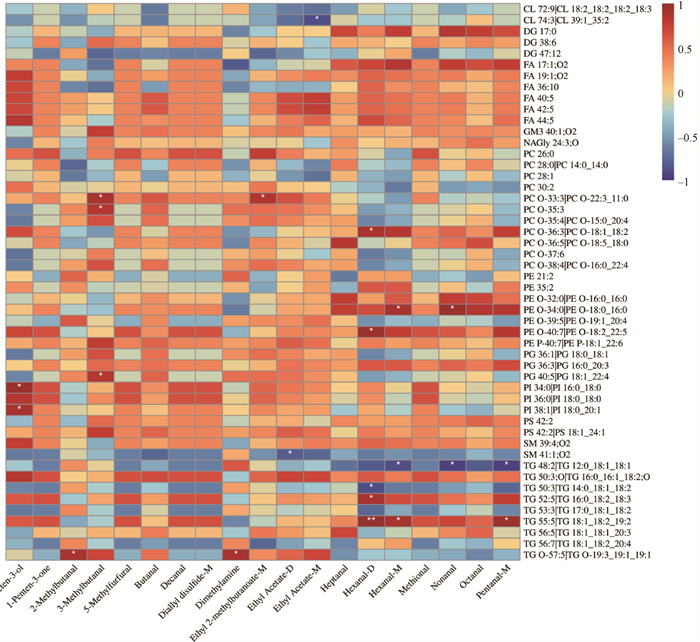
旨在研究不同日龄宁乡猪肌肉的脂质与挥发性有机化合物(volatile organic compound, VOC),比较不同日龄间的差异特性,并分析脂质与VOCs的相关性。本研究选取36头健康1日龄宁乡猪为试验对象,平均活重(0.98±0.09)kg,随机分成6组,每组6头,公母各半,各组分别饲养至60、120、180、240、300和360 d进行屠宰。屠宰后取左胴背最长肌样品,测定肌肉品质,运用高效液相色谱-质谱技术进行脂质组学分析,运用气相色谱-离子迁移谱联用(GC-IMS)技术进行风味组学分析。结果表明:宁乡猪60、120 d肌肉pH显著低于360 d(P < 0.05);宁乡猪肉色L*值从240 d后显著减小(P < 0.05),b*值从180 d后逐渐下降,60 d、120 d的a*值显著低于其它日龄(P < 0.05);60 d剪切力显著低于其它日龄组(P < 0.05),其它日龄组无显著差异(P>0.05);滴水损失在240 d显著降低(P < 0.05),随后日龄组无显著差异;肌内脂肪(IMF)含量随着日龄增长而增加,在240 d显著增加(P < 0.05),随后IMF含量无显著差异。脂质组学鉴定到55个脂质亚类,共1 841个脂质分子;主成分分析(PCA)和偏最小二乘判别分析(PLS-DA)显示不同日龄组脂质可明显区分;生长期间,主要差异脂质甘油三酯(TG)、醚联磷脂酰胆碱(EtherPC)、醚联磷脂酰乙醇胺(EtherPE)、磷脂酰胆碱(PC)、甘油二酯(DG)、酰基肉碱(CAR)和鞘磷脂(SM)的百分含量峰值或谷值均在240 d;确定了50个潜在标志脂质(VIP>1, P < 0.05),主要为PC、磷脂酰乙醇胺(PE)等磷脂,以及TG、脂肪酸(FA)、DG等亚类;富集到7条脂质代谢通路,其中甘油磷脂代谢通路最重要,其次为鞘脂代谢和醚脂代谢。60~360 d不同日龄组风味组学依次鉴定到24、31、34、57、37和36种已知VOCs,建立了不同日龄肌肉VOCs指纹图谱,不同日龄可明显区分,明确了癸醛、壬醛、己醛、1-戊烯-3-酮、1-辛烯-3-醇、乙酸乙酯和甲硫基丙醛等19种关键挥发性风味物质。脂质与VOCs相关性分析显示,磷脂、甘油酯与VOCs的相关性较强。宁乡猪随日龄增长,肉色越来越鲜红,从240 d开始肌肉持水性能更佳;TG、PC和PE可能是VOCs形成的关键脂质;确定240 d为肌肉风味品质的“窗口期”,本研究可为猪肉风味品质调控和优化屠宰日龄提供科学依据。
中图分类号:
李华丽, 刘莹莹, 崔清明, 邓缘, 赵小刚, 胡雄贵, 任慧波, 朱吉, 喻金娥, 张四阳, 曹丽华, 喻晓丹, 陈心怡, 陈宇, 彭英林, 陈晨. 不同日龄宁乡猪肌肉脂质与VOCs特性比较及相关性研究[J]. 畜牧兽医学报, 2025, 56(11): 5414-5432.
LI Huali, LIU Yingying, CUI Qingming, DENG Yuan, ZHAO Xiaogang, HU Xionggui, REN Huibo, ZHU Ji, YU Jin'e, ZHANG Siyang, CAO Lihua, YU Xiaodan, CHEN Xinyi, CHEN Yu, PENG Yinglin, CHEN Chen. Comparative Characteristics and Correlation Study of Lipid and VOCs in Muscle of Ningxiang Pigs at Different Ages[J]. Acta Veterinaria et Zootechnica Sinica, 2025, 56(11): 5414-5432.
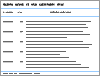
表 1
不同日龄宁乡猪肌肉品质"
| 项目Item | 60 d | 120 d | 180 d | 240 d | 300 d | 360 d |
| pH1 | 6.54±0.20bc | 6.50±0.28c | 6.76±0.12ab | 6.68±0.18abc | 6.64±0.07abc | 6.78±0.11a |
| pH24 | 5.73±0.13bc | 5.72±0.12bc | 5.66±0.08c | 5.83±0.13ab | 5.91±0.16a | 5.93±0.04a |
| L* | 46.42±0.98a | 46.59±1.59a | 44.33±2.49ab | 45.06±2.53a | 42.23±1.88bc | 41.27±1.31c |
| a* | 7.22±0.92b | 7.11±1.23b | 8.81±1.12a | 8.96±1.33a | 9.51±0.87a | 8.78±1.02a |
| b* | 6.65±0.61a | 5.11±0.77bc | 5.58±0.46b | 5.22±0.86b | 5.13±0.51bc | 4.43±0.31c |
| 嫩度/N Tenderness | 25.72±5.20b | 37.76±8.10a | 37.10±5.44a | 44.30±25.36a | 45.06±8.25a | 47.71±4.79a |
| 滴水损失/% Drip loss | 1.68±0.16b | 2.60±0.26a | 3.01±0.47a | 1.19±0.09bc | 1.15±0.33bc | 0.75±0.03c |
| 失水率/% Water loss rate | 11.74±1.83ab | 11.17±1.27ab | 12.23±2.68a | 10.6±0.79ab | 10.17±1.01ab | 10.02±1.35b |
| IMF/% | 0.75±0.21c | 2.53±0.93b | 2.60±0.76b | 5.43±1.23a | 5.23±0.44a | 5.70±0.53a |
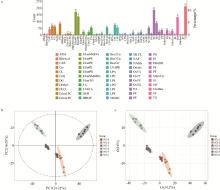
图 1
不同日龄宁乡猪肌肉脂质 a.不同脂质亚类分子数;b.不同日龄组PCA得分图;c.不同日龄组PLS-DA得分图"
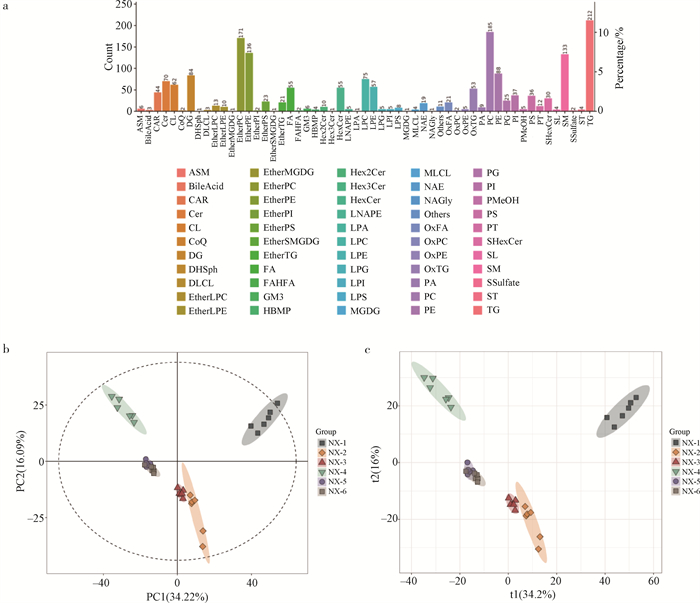
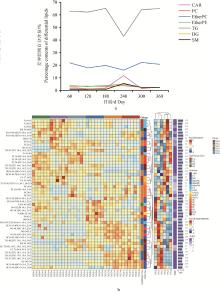
图 2
不同日龄宁乡猪肌肉显著差异脂质 a.差异脂质百分含量;b.VIP值前50脂质每组均值的层次聚类"

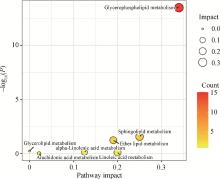
图 3
KEGG气泡图 图中每一个气泡表示一个KEGG通路;横轴表示通路中代谢物在通路中的相对重要性Impact value;纵轴表示代谢物参与通路的富集显著性-log10(P value);气泡大小代表Impact value,气泡越大通路重要性越大;Count表示注释到该通路中的差异代谢物数量,颜色越深,数量越多"
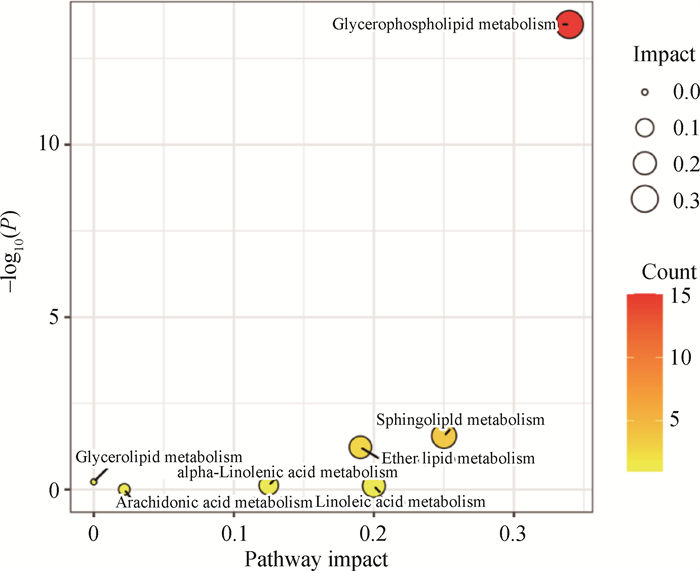
表 2
不同日龄宁乡猪肌肉显著差异脂质分子KEGG途径富集"
| 通路编号 Pathway ID | 通路名称 Pathway name | 二级分类 Secondary classification | 差异代谢物数量 Counts of differential metabolites | 通路重要性 Impact value | P 值 P-value |
| ssc00561 | 甘油酯代谢 Glycerolipid metabolism | 脂质代谢 lipid metabolism | 1 | 0 | 0.597 25 |
| ssc00564 | 甘油磷脂代谢 Glycerophospholipid metabolism | 脂质代谢 lipid metabolism | 15 | 0.339 6 | 3.27×10⁻¹⁴ |
| ssc00565 | 醚脂代谢 Ether lipid metabolism | 脂质代谢 lipid metabolism | 3 | 0.190 4 | 0.059 30 |
| ssc00590 | 花生四烯酸代谢 Arachidonic acid metabolism | 脂质代谢 lipid metabolism | 1 | 0.021 8 | 0.992 09 |
| ssc00591 | 亚油酸代谢 Linoleic acid metabolism | 脂质代谢 lipid metabolism | 1 | 0.200 0 | 0.783 66 |
| ssc00592 | α-亚麻酸代谢 α-Linolenic acid metabolism | 脂质代谢 lipid metabolism | 1 | 0.124 9 | 0.754 78 |
| ssc00600 | 鞘脂代谢 Sphingolipid metabolism | 脂质代谢 lipid metabolism | 4 | 0.250 1 | 0.027 77 |
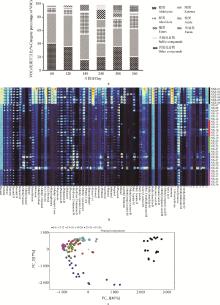
图 4
不同日龄宁乡猪肌肉VOCs a.VOCs类别百分比;b.VOCs指纹图谱;c.PCA得分图。图 4b中每一列代表一种VOC在所有样品中的信号峰,每一行代表一个样品的全部信号峰;图谱中亮点颜色越深,面积越大,表示VOC的峰体积越大;无亮点表示无信号峰。数字编号代表未知有机物"
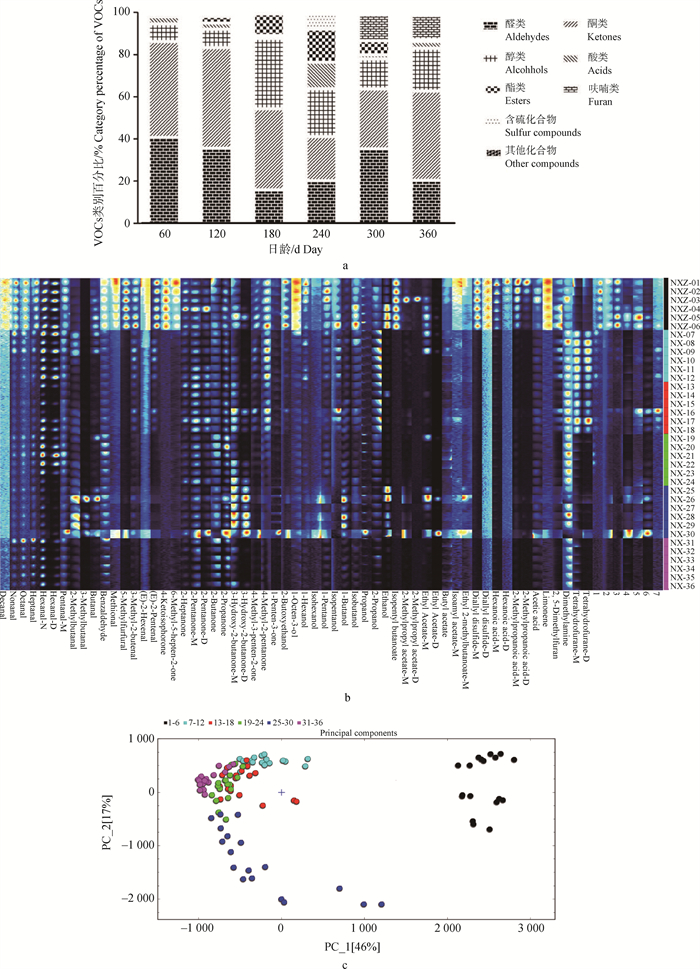
表 3
不同日龄宁乡猪肌肉VOCs相对含量与它们的ROAV"
| 序号 Number | VOCs | RI | 气味阈值 /ppb Odor threshold | 相对含量/% Relative content | ROAV | |||||||||||
| 60 d | 120 d | 180 d | 240 d | 300 d | 360 d | 60 d | 120 d | 180 d | 240 d | 300 d | 360 d | |||||
| 醛类Aldehyde | ||||||||||||||||
| 1 | 癸醛Decanal | 1 262.7 | 0.1 | — | — | — | 0.94±0.12 | — | — | — | — | — | 100.00 | — | — | |
| 2 | 壬醛Nonanal | 1 107.8 | 1.0 | 5.00± 0.72a | 3.73±0.24 bc | 1.88± 0.69d | 3.44±0.53 bc | 4.25± 0.91ab | 2.95±0.33 c | 100.00 | 100.00 | 48.45 | 36.60 | 100.00 | 100.00 | |
| 3 | 庚醛Heptanal | 898.1 | 3.0 | 1.53± 0.56a | 0.87±0.12 b | 0.47± 0.12c | 0.71±0.17 bc | 0.85± 0.09bc | 0.71±0.30 bc | 10.20 | 7.77 | 4.04 | 2.52 | 6.67 | 8.02 | |
| 4 | 辛醛Octanal | 1 003.7 | 0.7 | 2.15± 0.41a | 1.38±0.08 b | 0.68± 0.25d | 0.79±0.10 cd | 1.39± 0.11b | 1.06±0.22 c | 61.43 | 52.85 | 25.04 | 12.01 | 46.72 | 51.33 | |
| 5 | 5-甲基糠醛5-methylfurfural | 962.6 | 20.0 | — | — | — | 2.83±0.32 | — | — | — | — | — | 1.51 | — | — | |
| 6 | 己醛-M Hexanal-M | 788.3 | 5.0 | 8.93±1.39 a | 9.96± 3.20a | 2.02±1.04 c | 4.13± 0.95bc | 9.86±1.48 a | 5.64± 2.72b | 35.72 | 53.40 | 10.41 | 8.79 | 46.40 | 38.24 | |
| 7 | 己醛-D Hexanal-D | 787.3 | 5.0 | 2.63±0.97 bc | 4.70± 3.03ab | 0.50±0.34 c | 2.71± 1.13bc | 5.53±2.22 a | 2.08± 1.63c | 10.52 | 25.20 | 2.58 | 5.77 | 26.02 | 14.10 | |
| 8 | 3-甲基-2-丁烯醛 3-methyl-2-butenal | 767.1 | / | 0.66±0.08 bc | 0.54± 0.05c | 0.32±0.07 d | 0.84± 0.13ab | 0.97±0.20 a | 0.70± 0.21bc | / | / | / | / | / | / | |
| 9 | (E)-2-戊烯醛 (E)-2-pentenal | 739.0 | 1 500.0 | — | — | — | 1.34±0.23 a | 1.19± 0.39ab | 0.80±0.28 b | — | — | — | 0.01 | 0.02 | 0.02 | |
| 10 | 丁醛Butanal | 587.5 | 9.0 | 0.53± 0.04 | 0.68±0.63 | 0.89± 0.39 | 0.59±0.18 | 0.97± 0.73 | — | 1.18 | 2.03 | 2.55 | 0.70 | 2.54 | — | |
| 11 | 2-甲基丁醛 2-methylbutanal | 653.4 | 1.0 | 0.82±0.12 b | 1.10± 0.38b | 2.16±0.82 a | 0.16± 0.03c | 1.23±0.56 b | 0.76± 0.27b | 16.40 | 29.49 | 55.67 | 1.70 | 28.94 | 25.76 | |
| 12 | 3-甲基丁醛 3-methylbutanal | 644.2 | 1.1 | — | 0.54±0.14 b | 4.27± 2.29a | 0.17±0.02 b | — | — | — | 13.16 | 100.00 | 1.64 | — | — | |
| 13 | 戊醛-M Pentanal-M | 689.2 | 12.0 | 1.83±0.10 a | 1.76± 0.27a | 0.73±0.21 c | 0.81± 0.29c | 1.70±0.15 a | 1.29± 0.33b | 3.05 | 3.93 | 1.57 | 0.72 | 3.33 | 3.64 | |
| 14 | (E)-2-己烯醛 (E)-2-hexenal | 833.4 | 17.0 | — | — | — | 0.08±0.01 | — | — | — | — | — | 0.05 | — | — | |
| 15 | 苯甲醛Benzaldehyde | 955.7 | 750.9 | 0.51±0.09 a | 0.45± 0.09a | 0.21±0.07 b | 0.20± 0.03b | 0.26±0.02 b | 0.25± 0.03b | 0.01 | 0.02 | 0.01 | 0.00 | 0.01 | 0.01 | |
| 酮类Ketone | ||||||||||||||||
| 16 | 6-甲基-5-庚烯-2-酮 6-methyl-5-hepten-2-one | 988.6 | 50.0 | — | — | — | 0.24 ±0.05 | — | — | — | — | 0.00 | 0.05 | — | — | |
| 17 | 2-丁酮-M 2-butanone-M | 567.6 | 50 000.0 | 7.45±1.22 a | 6.67± 1.75a | 3.22±1.49 b | 2.88± 1.12b | 4.34±0.34 b | 3.93± 0.78b | 0.00 | 0.00 | 0.00 | 0.00 | 0.00 | 0.00 | |
| 18 | 4-酮异佛尔酮 4-ketoisophorone | 1 156.6 | 1 250.0 | — | — | — | 3.27±0.33 | — | — | — | — | — | 0.03 | — | — | |
| 19 | 2-庚酮2-heptanone | 889.6 | 140.0 | 0.95±0.12 c | 1.23± 0.28ab | 0.65±0.10 c | 0.84± 0.26c | 1.22±0.11 ab | 1.50± 0.44a | 0.14 | 0.24 | 0.12 | 0.06 | 0.21 | 0.36 | |
| 20 | 2-戊酮-M 2-pentanone-M | 675.4 | 70 000.0 | 3.63±0.87 bc | 4.40± 1.07ab | 2.62±0.77 cd | 1.74± 0.35d | 4.14±1.33 b | 5.50± 0.54a | 0.00 | 0.00 | 0.00 | 0.00 | 0.00 | 0.00 | |
| 21 | 2-戊酮-D 2-pentanone-D | 679.6 | 70 000.0 | — | 1.32±0.46 b | 1.04± 0.64b | 0.83±0.44 b | 1.54± 0.82b | 2.51±0.37 a | — | 0.00 | 0.00 | 0.00 | 0.00 | 0.00 | |
| 22 | 2-丙酮2-propanone | 492.2 | 500 000.0 | 8.33±2.77 ab | 9.67± 5.94a | 6.37±3.07 ab | 3.96± 0.71b | 5.97±1.08 ab | 7.14± 1.57ab | 0.00 | 0.00 | 0.00 | 0.00 | 0.00 | 0.00 | |
| 23 | 3-羟基-2-丁酮-M 3-hydroxy-2-butanone-M | 706.5 | 800.0 | 6.36±2.58 a | 6.36± 3.33a | 6.95±3.01 a | 3.08± 0.76b | 2.47±0.95 b | 6.50± 1.46a | 0.16 | 0.21 | 0.22 | 0.04 | 0.07 | 0.28 | |
| 24 | 3-羟基-2-丁酮-D 3-hydroxy-2-butanone-D | 707.2 | 800.0 | 0.99±0.59 b | 3.32± 3.73b | 11.73±3.6 a | 0.94± 1.05b | — | 2.41±1.54 b | 0.02 | 0.11 | 0.38 | 0.01 | — | 0.10 | |
| 25 | 4-甲基-3-戊烯-2-酮4-methyl-3-penten-2-one | 789.9 | / | — | 0.77±0.13 bc | 0.55± 0.50c | 0.88±0.20 abc | 1.52± 0.40a | 1.37±0.93 ab | — | / | / | / | / | / | |
| 26 | 1-戊烯-3-酮 1-penten-3-one | 692.3 | 1.0 | — | — | — | 0.35±0.10 | — | — | — | — | — | 3.72 | — | — | |
| 27 | 4-甲基-2-戊酮4-methyl-2-pentanone | 729.1 | 170.0 | — | 0.89±0.22 b | 0.24± 0.12b | 0.92±0.13 b | 2.16± 0.37a | 2.29±1.16 a | — | 0.14 | 0.04 | 0.06 | 0.30 | 0.46 | |
| 醇类Alcohol | ||||||||||||||||
| 28 | 乙醇Ethanol | 449.3 | 100 000.0 | — | — | 20.94± 7.40a | 15.39±10.33 ab | 2.59± 0.45c | 6.36±6.93 bc | — | — | 0.01 | 0.00 | 0.00 | 0.00 | |
| 29 | 丙醇Propanol | 535.0 | 9 000.0 | — | — | 0.95± 0.43 | 0.57±0.09 | — | — | — | — | 0.00 | 0.00 | — | — | |
| 30 | 异丙醇2-propanol | 495.3 | 9 787.9 | 0.75± 0.27bc | 1.18±0.33 b | 0.50± 0.20c | 0.66±0.13 c | 2.78± 0.44a | 2.61±0.62 a | 0.00 | 0.00 | 0.00 | 0.00 | 0.01 | 0.01 | |
| 31 | 1-丁醇1-butanol | 647.1 | 500.0 | 2.75± 0.41b | 3.31±0.93 b | 4.78± 1.80a | 0.74±0.08 c | 2.25± 0.53b | 3.17±0.85 b | 0.11 | 0.18 | 0.25 | 0.02 | 0.11 | 0.21 | |
| 32 | 异丁醇Isobutanol | 607.4 | 7 000.0 | 0.36± 0.09c | 0.47±0.17 bc | 0.30± 0.10c | 0.55±0.21 bc | 0.87± 0.35a | 0.73±0.15 ab | 0.00 | 0.00 | 0.00 | 0.00 | 0.00 | 0.00 | |
| 33 | 1-戊醇1-pentanol | 756.8 | 4 000.0 | 0.54± 0.05abc | 0.57±0.06 ab | 0.38± 0.04c | 0.67±0.26 a | 0.67± 0.12a | 0.43±0.05 bc | 0.00 | 0.00 | 0.00 | 0.00 | 0.00 | 0.00 | |
| 34 | 异戊醇Isopentanol | 726.2 | 250.0 | — | — | — | 0.43± 0.07 | 0.68±0.12 | 0.84± 0.52 | — | — | — | 0.02 | 0.06 | 0.11 | |
| 35 | 1-己醇1-hexanol | 867.1 | 2 500.0 | 0.76±0.04 | 0.63± 0.07 | 0.51±0.10 | 0.68± 0.38 | 0.88±0.32 | 1.11± 1.06 | 0.01 | 0.01 | 0.01 | 0.00 | 0.01 | 0.02 | |
| 36 | 异己醇Isohexanol | 827.3 | / | — | — | — | 0.12 ±0.03 | — | — | — | — | — | / | — | — | |
| 37 | 2-丁氧基乙醇2-butoxyethanol | 914.3 | / | — | — | — | 0.80±0.09 | 0.70± 0.09 | 0.68±0.21 | — | — | — | / | / | / | |
| 38 | 1-辛烯-3-醇1-octen-3-ol | 981.8 | 1.0 | — | 0.26±0.03 ab | 0.14± 0.04b | 0.22±0.03 ab | 0.30± 0.15ab | 0.34±0.27 a | — | 6.97 | 3.61 | 2.34 | 7.06 | 11.53 | |
| 酸类Acid | ||||||||||||||||
| 39 | 醋酸Acetic acid | 579.1 | 22 000.0 | 0.97±0.09 ab | 0.95± 0.17ab | 0.60±0.20 b | 0.83± 0.43ab | 0.87±0.17 ab | 1.63± 1.44a | 0.00 | 0.00 | 0.00 | 0.00 | 0.00 | 0.00 | |
| 40 | 2-甲基丙酸-M 2-methylpropanoic acid-M | 769.0 | 8 100.0 | 1.07±0.13 b | 1.05± 0.10b | 0.66±0.17 b | 4.94± 2.35a | 0.77±0.07 b | 0.75± 0.14b | 0.00 | 0.00 | 0.00 | 0.01 | 0.00 | 0.00 | |
| 41 | 2-甲基丙酸-D 2-methylpropanoic acid-D | 770.3 | 8 100.0 | — | — | — | 1.18±1.23 | — | — | — | — | — | 0.00 | — | — | |
| 42 | 己酸-M Hexanoic acid-M | 987.3 | 3 000.0 | — | — | — | 5.12±1.83 | — | — | — | — | — | 0.02 | — | — | |
| 43 | 己酸-D Hexanoic acid-D | 987.3 | 3 000.0 | — | — | — | 0.33±0.10 | — | — | — | — | — | 0.00 | — | — | |
| 酯类Ester | ||||||||||||||||
| 44 | 乙酸2-甲基丙酯-M 2-methylpropyl acetate-M | 744.6 | 66.0 | — | — | — | 0.88±1.00 | 0.46± 0.09 | — | — | — | — | 0.14 | 0.16 | — | |
| 45 | 乙酸2-甲基丙酯-D 2-methylpropyl acetate-D | 743.2 | 66.0 | — | — | — | 0.37±0.55 | — | — | — | — | — | 0.06 | — | — | |
| 46 | 丁酸异戊酯Isopentyl butanoate | 1 085.4 | / | — | — | — | 11.6±1.18 | — | — | — | — | — | / | — | — | |
| 47 | 乙酸乙酯-M Ethyl acetate-M | 595.8 | 5.0 | — | 1.35±1.85 | 2.01± 0.85 | 1.27±0.68 | 2.75± 2.46 | 0.73±0.27 | — | 7.24 | 10.36 | 2.70 | 12.94 | 4.95 | |
| 48 | 乙酸乙酯-D Ethyl acetate-D | 598.0 | 5.0 | — | 0.98±0.49 | 4.56± 7.02 | 0.89±0.32 | 1.69± 1.17 | — | — | 5.25 | 23.51 | 1.89 | 7.95 | — | |
| 49 | 2-甲基丁酸乙酯-M Ethyl 2-methylbutanoate-M | 838.2 | 0.1 | — | — | 0.17±0.05 | 0.09± 0.04 | — | — | — | — | 43.81 | 9.57 | — | — | |
| 50 | 乙酸异戊酯-M Isoamyl acetate-M | 870.5 | 2.0 | — | — | — | 0.07±0.01 | — | — | — | — | — | 0.37 | — | — | |
| 51 | 乙酸丁酯Butyl acetate | 801.8 | 66.0 | — | — | — | 0.10±0.04 | — | — | — | — | — | 0.02 | — | — | |
| 呋喃类Furan | ||||||||||||||||
| 52 | 2, 5-二甲基呋喃2, 5-dimethylfuran | 701.9 | / | — | — | — | 0.43±0.17 | 0.57± 0.26 | 0.91±1.11 | — | — | — | / | / | / | |
| 53 | 四氢呋喃-M Tetrahydrofurane-M | 620.3 | / | — | — | — | — | 7.01±1.19 | 6.21± 0.93 | — | — | — | — | / | / | |
| 54 | 四氢呋喃-D Tetrahydrofurane-D | 619.6 | / | — | — | — | — | 2.67±0.68 | 1.91± 0.50 | — | — | — | — | / | / | |
| 含硫化合物Sulfur compound | ||||||||||||||||
| 55 | 二烯丙基二硫-M Diallyl disulfide-M | 1 060.8 | 30.0 | — | — | — | 6.10±0.62 | — | — | — | — | — | 2.16 | — | — | |
| 56 | 二烯丙基二硫-D Diallyl disulfide-D | 1 061.2 | 30.0 | — | — | — | 0.55±0.05 | — | — | — | — | — | 0.20 | — | — | |
| 57 | 甲硫基丙醛Methional | 905.0 | 0.2 | — | — | — | 0.20±0.05 | — | — | — | — | — | 10.64 | — | — | |
| 其他化合物Other compound | ||||||||||||||||
| 58 | 柠檬烯Limonene | 1 028.5 | 10.0 | — | — | — | 0.13 ±0.02 | — | — | — | — | — | 0.14 | — | — | |
| 59 | 二甲胺Dimethylamine | 586.4 | 33.0 | 1.23±0.12 ab | 1.38± 0.13a | 0.78±0.35 c | 0.32± 0.11d | 0.98±0.25 bc | 1.08± 0.15b | 0.75 | 1.12 | 0.61 | 0.10 | 0.70 | 1.11 | |
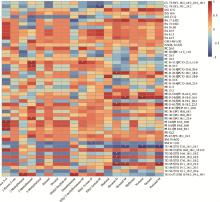
图 5
标志脂质与关键VOCs相关性 *.P < 0.05;**.P < 0.01"
| 1 |
NI Q , AMALFITANO N , BIASIOLI F , et al. Bibliometric review on the volatile organic compounds in meat[J]. Foods, 2022, 11 (22): 3574.
doi: 10.3390/foods11223574 |
| 2 |
RESCONI V C , BUENO M , ESCUDERO A , et al. Ageing and retail display time in raw beef odour according to the degree of lipid oxidation[J]. Food Chem, 2018, 242, 288- 300.
doi: 10.1016/j.foodchem.2017.09.036 |
| 3 | CHEN J , CHEN F , LIN X , et al. Effect of excessive or restrictive energy on growth performance, meat quality, and intramuscular fat deposition in finishing Ningxiang pigs[J]. Animals, 2021, 11, 27. |
| 4 | 段平男, 杨婷, 陈佳亿, 等. 白藜芦醇对生长肥育期宁乡猪肉品质的影响[J]. 动物营养学报, 2021, 33 (8): 4364- 4372. |
| DUAN P N , YANG T , CHEN J Y , et al. Effects of resveratrol on meat quality of growing and fattening ningxiang pigs[J]. Chinese Journal of Animal Nutrition, 2021, 33 (8): 4364- 4372. | |
| 5 | 朱吉, 罗璇, 陈晨, 等. 宁乡猪不同杂交组合的胴体性能和肉质性状分析[J]. 养猪, 2020 (5): 49- 51. |
| ZHU J , LUO X , CHEN C , et al. Analysis of carcass performance and meat quality traits of different hybrids of Ningxiang pigs[J]. Swine Production, 2020 (5): 49- 51. | |
| 6 |
XING Y , WU X , XIE C , et al. Meat quality and fatty acid profiles of Chinese Ningxiang pigs following supplementation with N-Carbamylglutamate[J]. Animals, 2020, 10 (1): 88.
doi: 10.3390/ani10010088 |
| 7 |
CLIFF M , STANICH K , TRUJILLO J M , et al. Determination and prediction of odor thresholds for odor active volatiles in a neutral apple juice matrix[J]. J Food Quality, 2011, 34 (3): 177- 186.
doi: 10.1111/j.1745-4557.2011.00383.x |
| 8 |
YANG P , SONG H , WANG L , et al. Characterization of key aroma-active compounds in black garlic by sensory-directed flavor analysis[J]. J Agric Food Chem, 2019, 67 (28): 7926- 7934.
doi: 10.1021/acs.jafc.9b03269 |
| 9 |
XIAO Y , HUANG Y , CHEN Y , et al. Discrimination and characterization of the volatile profiles of five Fu brick teas from different manufacturing regions by using HS-SPME/GC-MS and HS-GC-IMS[J]. Curr Res Food Sci, 2022, 5, 1788- 1807.
doi: 10.1016/j.crfs.2022.09.024 |
| 10 |
YAO L , HUANG C , DING J , et al. Application of yeast in plant-derived aroma formation from cigar filler leaves[J]. Front Bioeng Biotech, 2022, 10, 1093755.
doi: 10.3389/fbioe.2022.1093755 |
| 11 |
ZHU Y , CHEN J , CHEN X , et al. Use of relative odor activity value (ROAV) to link aroma profiles to volatile compounds: application to fresh and dried eel (Muraenesoxcinereus)[J]. Int J Food Prop, 2020, 23 (1): 2257- 2270.
doi: 10.1080/10942912.2020.1856133 |
| 12 |
胡颖, 周晓容, 黄金秀, 等. 荣昌猪和三元杂交猪胴体性状、肉品质及风味物质差异研究[J]. 畜牧兽医学报, 2023, 54 (5): 1877- 1892.
doi: 10.11843/j.issn.0366-6964.2023.05.011 |
|
HU Y , ZHOU X R , HUANG J X , et al. Research on the differences of carcass traits, meat quality and flavor substances between rongchang and duroc×landrace×yorkshire pigs[J]. Acta Veterinaria et Zootechnica Sinica, 2023, 54 (5): 1877- 1892.
doi: 10.11843/j.issn.0366-6964.2023.05.011 |
|
| 13 | 郭建凤. 冷藏条件下猪肉pH变化及采样时间对滴水损失影响[J]. 畜牧兽医杂志, 2024, 43 (3): 18- 21. |
| GUO J F . Effect of pH change and sampling time on drip loss of pork under refrigeration condition[J]. Journal of Animal Science and Veterinary Medicine, 2024, 43 (3): 18- 21. | |
| 14 |
HWANG Y H , LEE S J , LEE E Y , et al. Effects of carcass weight increase on meat quality and sensory properties of pork loin[J]. J Anim Sci Technol, 2020, 62 (5): 753- 760.
doi: 10.5187/jast.2020.62.5.753 |
| 15 |
ZHAN H , XIONG Y , WANG Z , et al. Integrative analysis of transcriptomic and metabolomic profiles reveal the complex molecular regulatory network of meat quality in Enshi black pigs[J]. Meat Sci, 2022, 183, 108642.
doi: 10.1016/j.meatsci.2021.108642 |
| 16 |
HE J , WU X L , ZENG Q , et al. Genomic mating as sustainable breeding for Chinese indigenous Ningxiang pigs[J]. PLoS One, 2020, 15 (8): e0236629.
doi: 10.1371/journal.pone.0236629 |
| 17 | JANKOWIAK H , BOCIAN M , BARCZAK J . The effect of intramuscular fat content on the meat quality of plw x pl pigs[J]. Ital J Food Sci, 2019, 31 (1): 87- 97. |
| 18 | 宋粤湘, 高虎, 张跃博, 等. 宁乡猪及杜宁二元杂种猪的胴体与肉质性状测定[J]. 中国畜牧杂志, 2021, 57 (4): 68- 72. |
| SONG Y X , GAO H , ZHNAG Y B , et al. Carrcass and meat quality traits determination and correlation analysis of ningxiang pig and its binary cross[J]. Chinese Journal of Animal Science, 2021, 57 (4): 68- 72. | |
| 19 | 刁小琴, 王莹, 贾瑞鑫, 等. 动物性脂肪对肉品风味影响机制研究进展[J]. 肉类研究, 2022, 36 (3): 45- 51. |
| DIAO X Q , WANG Y , JIA R X , et al. Progress in understanding the mechanism of the influence of animal fat on meat flavor[J]. Meat Research, 2022, 36 (3): 45- 51. | |
| 20 |
POLIDORI P , SANTINI G , KLIMANOVA Y , et al. Effects of ageing on donkey meat chemical composition, fatty acid profile and volatile compounds[J]. Foods, 2022, 11 (6): 821.
doi: 10.3390/foods11060821 |
| 21 |
WANG Y , MA C , SUN Y , et al. Dynamic transcriptome and DNA methylome analyses on longissimus dorsi to identify genes underlying intramuscular fat content in pigs[J]. BMC Genomics, 2017, 18 (1): 780.
doi: 10.1186/s12864-017-4201-9 |
| 22 |
GAO S Z , ZHAO S M . Physiology, affecting factors and strategies for control of pig meat intramuscular fat[J]. Recent Pat Food Nutr Agric, 2009, 1 (1): 59- 74.
doi: 10.2174/2212798410901010059 |
| 23 |
ZHOU J , ZHANG Y , WU J , et al. Proteomic and lipidomic analyses reveal saturated fatty acids, phosphatidylinositol, phosphatidylserine, and associated proteins contributing to intramuscular fat deposition[J]. J Proteomics, 2021, 241, 104235.
doi: 10.1016/j.jprot.2021.104235 |
| 24 | 张润, 刘海, 杨曼, 等. 北京黑猪肌内脂肪含量高、低组间脂质组差异分析[J]. 畜牧兽医学报, 2022, 53 (9): 3262- 3271. |
| ZHANG R , LIU H , YANG M , et al. Analysis of lipid group difference between high and low intramuscular fat content groups in beijing black pigs[J]. Acta Veterinaria et Zootechnica Sinica, 2022, 53 (9): 3262- 3271. | |
| 25 |
WU Z S , WANG Z G , WANG P , et al. Integrative analysis of proteomics and lipidomic profiles reveal the fat deposition and meat quality in Duroc×Guangdong small spotted pig[J]. Front Vet Sci, 2024, 11, 1361441.
doi: 10.3389/fvets.2024.1361441 |
| 26 |
DENG X X , ZHANG Y B , SONG G , et al. Integrative analysis of transcriptomic and lipidomic profiles reveals a differential subcutaneous adipose tissue mechanism among Ningxiang pig and Berkshires, and their offspring[J]. Animals, 2023, 13, 3321.
doi: 10.3390/ani13213321 |
| 27 |
BA H V , SEO H W , SEONG P N , et al. Live weights at slaughter significantly affect the meat quality and flavor components of pork meat[J]. Anim Sci J, 2019, 90 (5): 667- 679.
doi: 10.1111/asj.13187 |
| 28 | WANG Y , HE Y , LIU Y , et al. Analyzing volatile compounds of young and mature docynia delavayi fruit by HS-SPME-GC-MS and rOAV[J]. Foods, 2023, 12 (1): 59. |
| 29 |
HOA V B , SEONG P N , CHO S H , et al. Quality characteristics and flavor compounds of pork meat as a function of carcass quality grade[J]. Asian Austral J Anim, 2019, 32 (9): 1448- 1457.
doi: 10.5713/ajas.18.0965 |
| 30 |
ZHANG K , LI D , ZANG M , et al. Comparative characterization of fatty acids, reheating volatile compounds, and warmed-over flavor (WOF) of Chinese indigenous pork and hybrid pork[J]. LWT, 2022, 155, 112981.
doi: 10.1016/j.lwt.2021.112981 |
| 31 |
BAK K H , RICHARDS M P . Hexanal as a predictor of development of oxidation flavor in cured and uncured deli meat products as affected by natural antioxidants[J]. Foods, 2021, 10 (1): 152.
doi: 10.3390/foods10010152 |
| 32 |
CHENG L , LI X , TIAN Y , et al. Mechanisms of cooking methods on flavor formation of Tibetan pork[J]. Food Chem: X, 2023, 19, 100873.
doi: 10.1016/j.fochx.2023.100873 |
| 33 | HAN D , ZHANG C H , FAUCONNIER M L , et al. Characterization and differentiation of boiled pork from Tibetan, Sanmenxia and Duroc×(Landrac×Yorkshire) pigs by volatiles profiling and chemometrics analysis[J]. Food Res Int, 2020, 130 (4): 108910. |
| 34 |
LI P , ZHOU H , WANG Z , et al. Analysis of flavor formation during the production of Jinhua dry-cured ham using headspace-gas chromatography-ion mobility spectrometry (HS-GC-IMS)[J]. Meat Sci, 2022, 194, 108992.
doi: 10.1016/j.meatsci.2022.108992 |
| 35 |
WU W D , ZHAN J L , TANG X Y , et al. Characterization and identification of pork flavor compounds and their precursors in Chinese indigenous pig breeds by volatile profiling and multivariate analysis[J]. Food Chem, 2022, 385, 132543.
doi: 10.1016/j.foodchem.2022.132543 |
| 36 | 张杏艳, 蓝海恩, 谢炳坤, 等. 性别对杜陆猪肉品质及风味影响的代谢组学分析[J]. 中国畜牧兽医, 2021, 48 (10): 3585- 3594. |
| ZHANG X Y , LAN H E , XIE B K , et al. Metabonomics analysis of sex effects on meat quality and flavor in dulu pig[J]. China Animal Husbandry & Veterinary Medicine, 2021, 48 (10): 3585- 3594. | |
| 37 |
SHAHIDI F , HOSSAIN A . Role of lipids in food flavor generation[J]. Molecules, 2022, 27 (15): 5014.
doi: 10.3390/molecules27155014 |
| 38 |
LIU H , HUI T , ZHENG X , et al. Characterization of key lipids for binding and generating aroma compounds in roasted mutton by UPLC-ESI-MS/MS and Orbitrap Exploris GC[J]. Food Chem, 2022, 374, 131723.
doi: 10.1016/j.foodchem.2021.131723 |
| 39 |
WANG N , WANG J , ZHANG Y , et al. Comprehensive lipidomics and volatile compounds profiling reveals correlation of lipids and flavors in DHA-enriched egg yolk[J]. Oil Crop Sci, 2023, 8 (1): 27- 34.
doi: 10.1016/j.ocsci.2023.03.001 |
| 40 |
CAO J , ZOU X G , DEN L , et al. Analysis of nonpolar lipophilic aldehydes/ketones in oxidized edible oils using HPLC-QqQ-MS for the evaluation of their parent fatty acids[J]. Food Res Int, 2014, 64, 901- 907.
doi: 10.1016/j.foodres.2014.08.042 |
| [1] | 杨书博, 苑庆欣, 陈麒百, 王培, 高东阳, 李鹤, 宋军. 金黄色葡萄球菌噬菌体脂质体的制备及胞内抗菌活性[J]. 畜牧兽医学报, 2025, 56(9): 4638-4645. |
| [2] | 温雪, 许琬雪, 付壹彤, 杨洁, 付红玉, 樊瑞锋. 铁死亡与炎症相关性研究进展[J]. 畜牧兽医学报, 2025, 56(8): 3666-3677. |
| [3] | 周锐, 吴德, 车炼强, 林燕, 冯斌, 方正锋. N6-腺苷甲基化调控脂肪生成的研究进展[J]. 畜牧兽医学报, 2025, 56(5): 1995-2003. |
| [4] | 侯中一, 王宝维, 张名爱, 孔敏, 张晶, 王秉翰, 岳斌, 鲁秀, 凡文磊. 基于蛋白质组学解析鹅肥肝形成的脂质代谢调控机制[J]. 畜牧兽医学报, 2025, 56(5): 2182-2193. |
| [5] | 张文娟, 盛清, 彭永佳, 张瑾. “金乌猪”背部皮下脂肪脂质组成分析[J]. 畜牧兽医学报, 2025, 56(11): 5449-5463. |
| [6] | 周心仪, 杨利丹, 高晨, 魏新华, 霍浩楠, 邹惠影, 余大为, 杜卫华. X染色体定点整合GFP元件的野猪诱导多能性干细胞系的建立[J]. 畜牧兽医学报, 2025, 56(10): 5007-5017. |
| [7] | 周瑾, 庄玉洁, 张雅琳, 谢小雨, 孙明珠, 张雪梅, 王小龙, 张志平, 张君涛. 利用牛子宫内膜上皮细胞和小鼠子宫内膜炎模型评价胎盘组织源脂质体载药复合物的效果[J]. 畜牧兽医学报, 2025, 56(10): 5239-5250. |
| [8] | 付红玉, 李玥, 崔晗, 李玖芝, 许琬雪, 王曦, 樊瑞锋. 长链酯酰辅酶A合成酶4介导铁死亡的发生机制[J]. 畜牧兽医学报, 2024, 55(9): 3792-3801. |
| [9] | 张诣, 徐婕, 宋晓愿, 周世伟, 滕雨萌, 刘晓丽, 程国富, 谷长勤, 张万坡, 胡薛英. 武汉地区犬乳腺肿瘤的临床病理特征与良恶性的相关性分析[J]. 畜牧兽医学报, 2024, 55(9): 4121-4130. |
| [10] | 李跃, 张长春, 刘光裕, 高梦源, 符超俊, 邢家宝, 徐思佳, 邝麒元, 刘静, 高校鹏, 王衡, 龚浪, 张桂红, 孙彦阔. 宏转录组测序技术在一起仔猪病毒性腹泻疾病诊断中的运用及分析[J]. 畜牧兽医学报, 2024, 55(8): 3579-3589. |
| [11] | 崔恒洁, 覃金珑, 朱志豪, 鲍雪, 栗绍文, 孟宪荣. 金黄色葡萄球菌对苯扎溴铵敏感性与生物被膜形成能力相关性分析[J]. 畜牧兽医学报, 2024, 55(8): 3669-3677. |
| [12] | 鲜婷婷, 刘彦, 曹忻, 冯涛. 母猪子宫内膜炎阴道菌群与血清促炎细胞因子的变化及其相关性分析[J]. 畜牧兽医学报, 2024, 55(8): 3688-3698. |
| [13] | 王一诺, 徐丹, 杨建华, 刘洋, 田尧夫, 赵小玲. 基于超声波测量胸肌厚预测肉鸡产肉性能的选育方法研究[J]. 畜牧兽医学报, 2024, 55(7): 2901-2912. |
| [14] | 金雨锡, 吴媛媛, 董杰, 姚琪, 赵博达, 尹柏慧, 代宜霖, 秦佳慧, 李禹涛, 顾甜甜, 范晶晶, 肖发沂. 鸡肉风味物质1-辛烯-3-醇含量与脂质过氧化的相关性研究[J]. 畜牧兽医学报, 2024, 55(12): 5489-5497. |
| [15] | 任钰为, 王峰, 孙瑞萍, 张艳, 刘海隆, 林燕宁, 洪玲玲, 黄潇仙, 晁哲. 五指山猪MYH基因家族结构变异对背最长肌肌纤维性状的影响[J]. 畜牧兽医学报, 2024, 55(11): 4912-4924. |
| 阅读次数 | ||||||
|
全文 |
|
|||||
|
摘要 |
|
|||||
