


畜牧兽医学报 ›› 2025, Vol. 56 ›› Issue (11): 5801-5816.doi: 10.11843/j.issn.0366-6964.2025.11.037
吴含玉( ), 夏欣悦(), 徐义刚, 宋厚辉, 王静*(), 杨永春*()
收稿日期:2025-01-15
出版日期:2025-11-23
发布日期:2025-11-27
通讯作者:
王静,杨永春
E-mail:502268789@qq.com;359027475@qq.com;jingwang@zafu.edu.cn;yyc@zafu.edu.cn
作者简介:吴含玉(2004-),女,浙江金华人,本科生,主要从事病毒的分子流行病学及宿主免疫逃逸机制研究,E-mail: 502268789@qq.com吴含玉和夏欣悦是同等贡献作者
基金资助:
WU Hanyu(), XIA Xinyue(), XU Yigang, SONG Houhui, WANG Jing*(), YANG Yongchun*()
Received:2025-01-15
Online:2025-11-23
Published:2025-11-27
Contact:
WANG Jing, YANG Yongchun
E-mail:502268789@qq.com;359027475@qq.com;jingwang@zafu.edu.cn;yyc@zafu.edu.cn
摘要:
本研究旨在系统评价和分析猪繁殖与呼吸综合征病毒(PRRSV)在我国长三角地区的感染状况,为有效防控PRRSV感染提供科学依据。通过检索中国知网(CNKI)、万方数据知识服务平台、维普中文科技期刊数据库、PubMed和Science Direct等5个主要数据库,收集自1995年PRRSV在中国爆发以来关于长三角区域猪群PRRSV流行情况的文献,并进行系统评价和Meta分析。经过筛选,共纳入36篇文献,样本总数为28 767头猪,其中8 277头为PRRSV阳性。Meta分析结果显示,长三角地区猪群中PRRSV的整体流行率为35.8%(95% CI:0.266, 0.456)。安徽省流行率最高,为51.5%(95%CI:0.321, 0.706),其次为江苏省45.0%(95%CI:0.315, 0.589)和上海市41.2%(95%CI:0.211, 0.629),而浙江省的流行率最低,为31.0%(95%CI:0.213, 0.416)。哺乳仔猪的流行率最高,为34.1%(95%CI: 0.181, 0.521),保育猪为30.4% (95%CI: 0.077, 0.598),育肥猪则最低,为21.5%(95%CI: 0.115, 0.333)。亚组分析和Meta回归分析表明,文献的异质性来源不包括采样地点、采样时间、诊断方法、临床症状、猪的发育阶段和文献质量(P>0.05),而样本类型、饲养模式和健康状况等因素均为影响PRRSV流行率的因素(P < 0.05)。我国长三角地区猪群中PRRSV流行率较高,需持续监测其感染情况,特别是对散养猪群和哺乳仔猪的管理和监测,同时制定针对性的防控措施,降低病毒传播风险。
中图分类号:
吴含玉, 夏欣悦, 徐义刚, 宋厚辉, 王静, 杨永春. 中国长三角地区猪繁殖与呼吸综合征病毒流行性Meta分析[J]. 畜牧兽医学报, 2025, 56(11): 5801-5816.
WU Hanyu, XIA Xinyue, XU Yigang, SONG Houhui, WANG Jing, YANG Yongchun. Meta-analysis of Porcine Reproductive and Respiratory Syndrome Virus Prevalence in China's Yangtze River Delta Region[J]. Acta Veterinaria et Zootechnica Sinica, 2025, 56(11): 5801-5816.
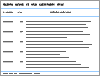
表 1
文献质量评价表"
| 序号 No. | 文献质量评估工具 Tools for assessing the quality of literature |
| 1 | 样本框架是否适合解决目标猪群的问题? Was the sample frame appropriate to address the target pig? |
| 2 | 研究是否采用了合适的抽样方法? Were study participants sampled in an appropriate way? |
| 3 | 样本量是否足够? Was the sample size adequate? |
| 4 | 数据分析是否覆盖了目标样本? Was the data analysis conducted with sufficient coverage of the identified sample? |
| 5 | 是否采用了有效的方法计算发病率? Were valid methods used for the identification of the condition? |
| 6 | 是否以标准、可靠的方式评估所有样本? Was the condition measured in a standard, reliable way for all participants? |
| 7 | 是否进行了适当的统计分析? Was there appropriate statistical analysis? |
| 8 | 研究对象和研究环境是否详细描述? Were the study subjects and the setting described in detail? |
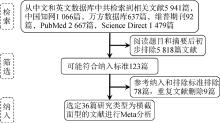
图 1
文献纳入流程图"
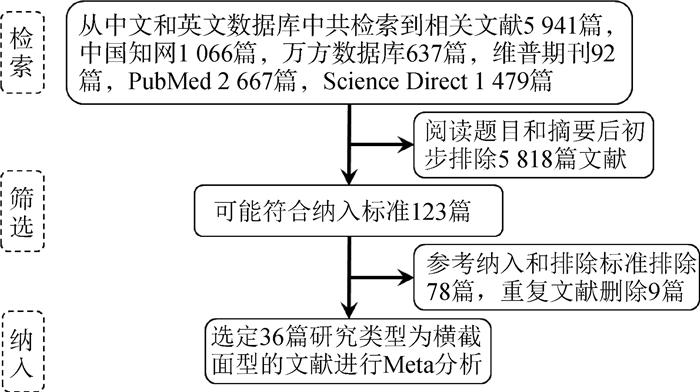
表 2
纳入文献基本情况及质量评分"
| 研究文献 Study ID | 采样时间 Sampling time | 采样地(省/市) Region (Province/City) | PRRSV抗原和核酸检测 Detection of PRRSV-Ag and RNA | 质量评分 Quality score | 文献质量 Study quality | ||
| 诊断方法 Diagnose method | 阳性样本/总样本 Positive/total samples | 检出率/% (95% CI) Detection rate (95% CI) | |||||
| Han et al, 2019[ | 2016—2017 | 浙江、江苏 Zhejiang, Jiangsu | ELISA | 85/88 | 0.97 (0.90, 0.99) | 4 | 中等 |
| Jiang et al, 2010[ | 2006—2007 | 浙江 Zhejiang | RT-PCR | 22/76 | 0.29 (0.20.0.40) | 6 | 中等 |
| Li et al, 2024[ | 2021—2022 | 浙江、江苏 Zhejiang, Jiangsu | RT-qPCR | 147/511 | 0.29 (0.25, 0.33) | 7 | 高 |
| Peng et al, 2017[ | 2012—2015 | 长三角地区 Yangtze River Delta | RT-PCR | 1 543/2 424 | 0.64 (0.62.0.66) | 6 | 中等 |
| Rao et al, 2014[ | 2009—2012 | 浙江 Zhejiang | RT-qPCR | 10/60 | 0.17 (0.09, 0.28) | 6 | 中等 |
| Wang et al, 2022[ | 2020 | 安徽、江苏 Anhui, Jiangsu | RT-PCR | 2/13 | 0.15 (0.04.0.42) | 2 | 低 |
| Wang et al, 2017[ | 2004—2012 | 上海 Shanghai | RT-PCR | 518/1 499 | 0.35 (0.32, 0.37) | 6 | 中等 |
| Wang et al, 2015[ | 2011—2012 | 上海、江苏 Shanghai, Jiangsu | RT-PCR | 5/52 | 0.10 (0.04, 0.21) | 6 | 中等 |
| Zhou et al, 2022[ | 2017—2022 | 浙江、安徽、江苏 Zhejiang, Anhui, Jiangsu | RT-PCR | 52/215 | 0.24 (0.19, 0.30) | 8 | 高 |
| Zhou et al, 2024[ | 2021—2022 | 浙江 Zhejiang | MLPA | 78/88 | 0.89 (0.80, 0.94) | 4 | 中等 |
| 柏坤桃等, 2008[ Bo et al, 2008[ | 2003—2008 | 江苏 Jiangsu | RT-PCR | 120/372 | 0.32 (0.28, 0.37) | 6 | 中等 |
| 杜庆川, 2024[ Du et al, 2024[ | 2020—2022 | 江苏 Jiangsu | RT-PCR | 1 850/5 620 | 0.33 (0.32.0.34) | 6 | 中等 |
| 顾秋成, 2017[ Gu et al, 2017[ | 2014—2015 | 安徽 Anhui | RT-PCR | 44/211 | 0.21 (0.16, 0.27) | 4 | 中等 |
| 顾小根等, 2002[ Gu et al, 2002[ | 1998—2001 | 浙江 Zhejiang | ELISA、病毒分离 | 82/654 | 0.13 (0.10.0.15) | 5 | 中等 |
| 金一春等, 2021[ Jin et al, 2021[ | 2016—2020 | 上海 Shanghai | RT-PCR | 3/5 728 | 0.00 (0.00.0.00) | 6 | 中等 |
| 鞠厚斌等, 2009[ Ju et al, 2009[ | 2006—2009 | 上海 Shanghai | RT-qPCR | 444/1 050 | 0.25 (0.23, 0.27) | 6 | 中等 |
| 李凌光等, 2022[ Li et al, 2022[ | 2019—2022 | 长三角区域 Yangtze River Delta | RT-PCR | 95/277 | 0.34 (0.29.0.40) | 9 | 高 |
| 李玉峰等, 2003[ Li et al, 2003[ | 2001 | 上海 Shanghai | RT-PCR | 18/18 | 1.00 (0.82, 1.00) | 3 | 低 |
| 刘爱军等, 2019[ Liu et al, 2019[ | 2018 | 浙江 Zhejiang | RT-PCR | 8/137 | 0.06 (0.03, 0.11) | 6 | 中等 |
| 刘茂军等, 2009[ Liu et al, 2009[ | 2009 | 江苏 Jiangsu | RT-PCR | 9/21 | 0.43 (0.24.0.63) | 4 | 中等 |
| 刘瑞琳, 2024[ Liu et al, 2024[ | 2021—2023 | 江苏、上海、浙江 Jiangsu, Shanghai, Zhejiang | RT-PCR | 81/285 | 0.28 (0.23, 0.34) | 7 | 高 |
| 刘晓东等, 2014[ Liu et al, 2014[ | 2012 | 浙江 Zhejiang | RT-PCR | 121/247 | 0.49 (0.43, 0.55) | 5 | 中等 |
| 钱琨等, 2011[ Qian et al, 2011[ | 2007—2010 | 江苏 Jiangsu | RT-PCR | 18/45 | 0.40 (0.27.0.55) | 4 | 中等 |
| 沈艳等, 2021[ Shen et al, 2021[ | 2016—2020 | 安徽 Anhui, | RT-qPCR | 200/1 189 | 0.17 (0.15, 0.19) | 9 | 高 |
| 童武等, 2011[ Tong et al, 2011[ | 2010 | 江苏、上海、浙江 Jiangsu, Shanghai, Zhejiang | RT-PCR | 24/65 | 0.37 (0.26.0.49) | 4 | 中等 |
| 王建等, 2015[ Wang et al, 2015[ | 2004—2012 | 上海 Shanghai | RT-PCR | 641/1 629 | 0.39(0.37.0.42) | 9 | 高 |
| 王倩等, 2019[ Wang et al, 2019[ | 2015—2019 | 安徽 Anhui, | RT-qPCR | 375/1 391 | 0.27 (0.25, 0.29) | 5 | 中等 |
| 王强等, 2010[ Wang et al, 2010[ | 2001—2004 | 安徽 Anhui, | RT-PCR | 326/625 | 0.52 (0.48, 0.56) | 8 | 高 |
| 吴瑕等, 2021[ Wu et al, 2021[ | 2017—2020 | 江苏、上海、浙江 Jiangsu, Shanghai, Zhejiang | RT-PCR | 179/357 | 0.50 (0.45, 0.55) | 5 | 中等 |
| 徐丽华等, 2022[ Xu et al, 2022[ | 2017—2020 | 浙江 Zhejiang | RT-PCR | 450/1 963 | 0.23 (0.21, 0.25) | 6 | 中等 |
| 徐丽华等, 2013[ Xu et al, 2013[ | 2004—2009 | 浙江 Zhejiang | RT-PCR | 61/109 | 0.56 (0.47.0.65) | 7 | 高 |
| 叶俊平等, 2007[ Ye et al, 2007[ | 2005—2006 | 江苏 Jiangsu | RT-PCR | 108/211 | 0.51 (0.44, 0.58) | 7 | 高 |
| 叶向阳等, 1999[ Ye et al, 1999[ | 1999 | 浙江、上海 Zhejiang, Shanghai | ELISA | 67/240 | 0.28 (0.23.0.34) | 3 | 低 |
| 张维谊等, 2008[ Zhang et al, 2008[ | 2005—2007 | 上海 Shanghai | RT-qPCR | 240/695 | 0.35 (0.15, 0.31) | 6 | 中等 |
| 赵永旺等, 2010[ Zhao et al, 2010[ | 未知 | 江苏 Jiangsu | ELISA | 18/186 | 0.10 (0.31, 0.38) | 6 | 中等 |
| 祝闰琦等, 2020[ Zhu et al, 2020[ | 2017—2018 | 安徽 Anhui | RT-qPCR | 223/416 | 0.56 (0.51, 0.61) | 8 | 高 |
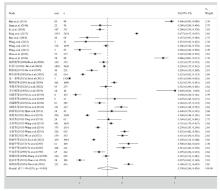
图 2
长三角地区猪群中PRRSV流行率森林图 点表示流行率,横线表示95%置信区间,对应于效应大小(ES),底下菱形表示合并效应"
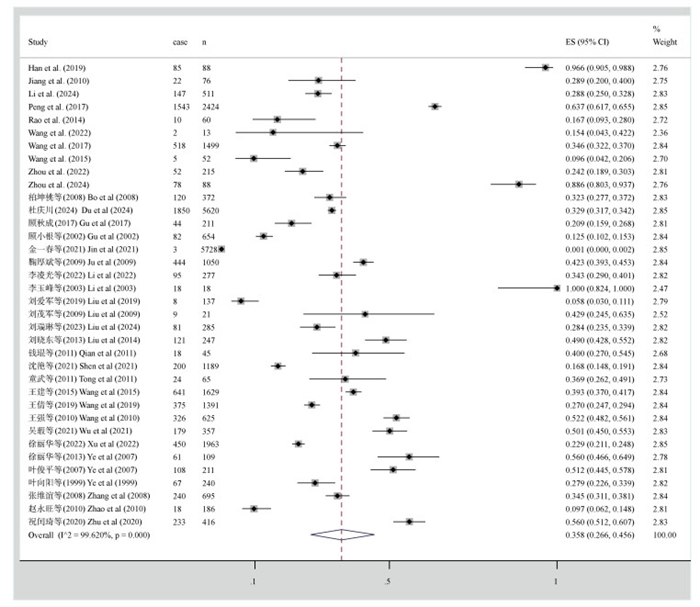
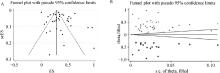
图 3
纳入文献的发表偏倚检验 A. 漏斗图;B. 剪补法校正;每一个点代表一篇文献"
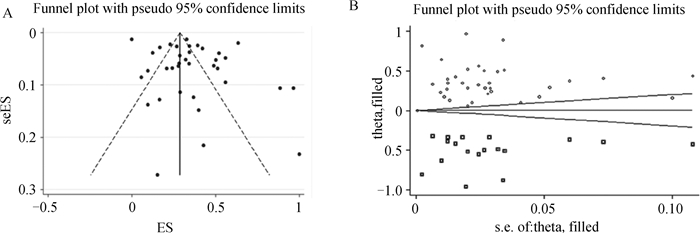
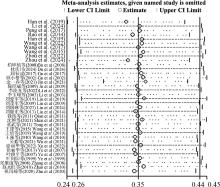
图 4
纳入文献的敏感性分析"
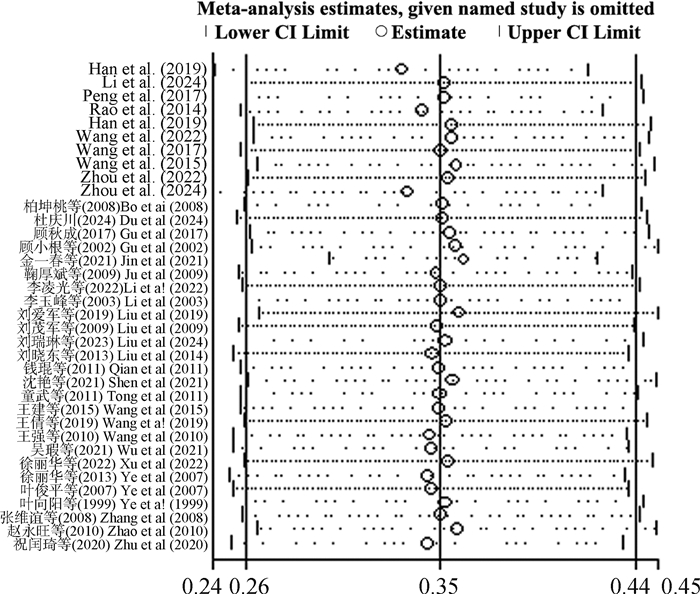
表 3
长三角地区中的PRRSV流行风险因子相关性分析"
| 风险因子 Risk factors | 文献数量 No.studies | 样本总数 No.tested | 阳性数目 Positive | 流行率/% (CI 95%) | 异质性 Heterogeneity | Meta回归分析 Meta-regression | ||||||
| χ2 | P-value | I2 | P-value | Cofficient(95% CI) | R2/% | T2 | ||||||
| 采样地点 Region | 0.117 | -0.051(-0.116, 0.013) | 3.56% | 0.041 | ||||||||
| 安徽 Anhui | 8 | 3 473 | 1 517 | 51.5(0.321, 0.706) | 755.35 | 0.000 | 99.07% | |||||
| 江苏 Jiangsu | 14 | 2 262 | 1 029 | 45.0(0.315, 0.589) | 483.56 | 0.000 | 97.31% | |||||
| 上海 Shanghai | 14 | 13 795 | 3 515 | 41.2(0.211, 0.629) | 6 782.46 | 0.000 | 99.81% | |||||
| 浙江 Zhejiang | 14 | 3 520 | 967 | 31.0(0.213, 0.416) | 363.43 | 0.000 | 96.42% | |||||
| 方法 Method | 0.502 | 0.042(-0.083, 0.166) | -1.94% | 0.039 | ||||||||
| ELISA | 4 | 1 168 | 252 | 36.6(0.092, 0.699) | 342.05 | 0.000 | 99.12% | |||||
| RT-PCR | 26 | 23 310 | 6 771 | 35.6(0.239, 0.483) | 8 460.11 | 0.000 | 99.70% | |||||
| RT-qPCR | 5 | 4 201 | 1 176 | 26.2(0.170, 0.360) | 185.86 | 0.000 | 97.84% | |||||
| MLPA | 1 | 88 | 78 | 88.6(0.80, 0.94) | NA | NA | NA | |||||
| 样本类型 Sample type | 0.045* | 0.155(-0.004, 0.306) | 19.82% | 0.019 | ||||||||
| 血清 Serum | 8 | 7 420 | 469 | 21.9(0.054, 0.451) | 1 472.20 | 0.000 | 99.53% | |||||
| 组织 Tissue | 15 | 7 070 | 2 143 | 37.9(0.304, 0.456) | 564.68 | 0.000 | 97.52% | |||||
| 采样时间 Sampling time | 0.596 | -0.031(-0.147, 0.086) | -3.41% | 0.040 | ||||||||
| 1995—2004 | 4 | 1 537 | 493 | 48.6(0.217, 0.759) | 309.24 | 0.000 | 99.03% | |||||
| 2005—2014 | 15 | 8 394 | 3 808 | 37.5(0.23, 0.47) | 603.65 | 0.000 | 97.68% | |||||
| 2015—2024 | 15 | 18 278 | 3 838 | 33.5(0.193, 0.495) | 5 709.35 | 0.000 | 99.76% | |||||
| 养殖模式 Breeding mode | 0.033* | 0.203(0.018, 0.388) | 18.57% | 0.021 | ||||||||
| 规模化 Scale farming | 23 | 20 217 | 4 214 | 25.5(0.194, 0.404) | 5 478.19 | 0.000 | 99.60% | |||||
| 散养 Free-range farming | 4 | 755 | 346 | 44.6(0.336, 0.559) | 24.025 | 0.000 | 87.51% | |||||
| 发育阶段 Development stage | 0.516 | -0.038(-0.156, 0.081) | -5.10% | 0.043 | ||||||||
| 哺乳仔猪 Lactating piglets | 7 | 2 192 | 357 | 34.1(0.181, 0.521) | 197.00 | 0.000 | 96.95% | |||||
| 保育猪 Nursery pig | 5 | 2 241 | 410 | 30.4(0.077, 0.598) | 463.11 | 0.000 | 99.14% | |||||
| 育肥猪 Fattening pigs | 12 | 6 070 | 959 | 21.5(0.115, 0.333) | 999.36 | 0.000 | 98.90% | |||||
| 健康状况 Health status | 0.005* | -0.240(-0.403, -0.078) | 22.40% | 0.031 | ||||||||
| 无症状 Asymptomatic | 7 | 9 133 | 722 | 11.4(0.013, 0.292) | 1 863.27 | 0.000 | 99.68% | |||||
| 有症状 Symptomatic | 26 | 51 055 | 31 943 | 38.1(0.233, 0.541) | 19 994.23 | 0.000 | 99.88% | |||||
| 临床症状 Clinical symptoms | 0.346 | 0.214(-0.274, 0.703) | 0.32% | 0.091 | ||||||||
| 繁殖障碍 Reproductive disorders | 7 | 2 369 | 296 | 31.3(0.110, 0.562) | 545.87 | 0.000 | 98.90% | |||||
| 呼吸道疾病 Respiratory diseases | 4 | 369 | 214 | 56.2(0.165, 0.919) | 106.86 | 0.000 | 97.19% | |||||
| 文献质量 Literature quality | 0.419 | 0.051(-0.075, 0.177) | -1.80% | 0.039 | ||||||||
| 高 High | 10 | 5 467 | 1 944 | 38.1(0.29, 0.48) | 443.09 | 0.000 | 97.97% | |||||
| 中 Medium | 23 | 24 005 | 6 315 | 32.2(0.21, 0.45) | 8 117.41 | 0.000 | 99.73% | |||||
| 低 Low | 3 | 271 | 87 | 35.3(0.04, 0.98) | NA | NA | ||||||
| 1 |
AN T Q , LI J N , SU C M , et al. Molecular and cellular mechanisms for PRRSV pathogenesis and host response to infection[J]. Virus Res, 2020, 286, 197980.
doi: 10.1016/j.virusres.2020.197980 |
| 2 | 蔡雪辉, 安同庆. 猪蓝耳病的前世今生[J]. 中国科学: 生命科学, 2023, 53 (12): 1745- 1753. |
| CAI X H , AN T Q . Porcine reproductive and respiratory syndrome: past and present[J]. Scientia Sinica(Vitae), 2023, 53 (12): 1745- 1753. | |
| 3 | 赵世伟. 高致病性猪蓝耳病的临床诊断与防治措施[J]. 中国畜牧业, 2022 (11): 96- 97. |
| ZHAO S W . Clinical diagnosis and preventive measures of highly pathogenic porcine blue ear disease[J]. China Animal Industry, 2022 (11): 96- 97. | |
| 4 |
刘爱军, 张传亮, 黄晓兵, 等. 猪繁殖与呼吸综合征病毒生命周期的研究进展[J]. 畜牧兽医学报, 2025, 56 (3): 1027- 1041.
doi: 10.11843/j.issn.0366-6964.2025.03.006 |
|
LIU A J , ZHANG C L , HUANG X B , et al. Research progress on the life cycle of porcine reproductive and respiratory syndrome virus[J]. Acta Veterinaria et Zootechnica Sinica, 2025, 56 (3): 1027- 1041.
doi: 10.11843/j.issn.0366-6964.2025.03.006 |
|
| 5 |
DU T , NAN Y , XIAO S , et al. Antiviral strategies against PRRSV infection[J]. Trends Microbiol, 2017, 25 (12): 968- 979.
doi: 10.1016/j.tim.2017.06.001 |
| 6 | 郭宝清, 陈章水, 刘文兴, 等. 从疑似PRRS流产胎儿分离PRRSV的研究[J]. 中国畜禽传染病, 1996 (2): 3- 7. |
| GUO B Q , CHEN Z S , LIU W X , et al. Isolation of PRRSV from aborted foetuses suspected of PRRS[J]. Chinese Journal of Preventive Veterinary Medicine, 1996 (2): 3- 7. | |
| 7 | 郑杰, 宁宜宝, 赵启祖, 等. 高致病性变异株引起的猪繁殖与呼吸综合征在我国的发生与流行[J]. 中国兽医杂志, 2007 (6): 48- 50. |
| ZHENG J , NING Y B , ZHAO Q Z , et al. Occurrence and prevalence of porcine reproductive and respiratory syndrome caused by highly pathogenic mutant strains in China[J]. Chinese Journal of Veterinary Medicine, 2007 (6): 48- 50. | |
| 8 |
SUN Q , XU H , AN T , et al. Recent progress in studies of porcine reproductive and respiratory syndrome virus 1 in China[J]. Viruses, 2023, 15 (7): 1528.
doi: 10.3390/v15071528 |
| 9 | 王丽丽. 浅谈猪蓝耳病的防治措施[J]. 现代畜牧科技, 2021 (1): 80- 82. |
| WANG L L . Control measures for blue ear disease in pig[J]. Modern Animal Husbandry Science & Technology, 2021 (1): 80- 82. | |
| 10 | 何克文. 基层养猪常见猪病的预防与治疗[J]. 国外畜牧学(猪与禽), 2021, 41 (4): 36- 37. |
| HE K W . Prevention and treatment of common pig diseases in grassroots pig farming[J]. Animal Science Abroad (Pigs and Poultry), 2021, 41 (4): 36- 37. | |
| 11 |
MATHEW J L . Systematic reviews and Meta-analysis: a guide for beginners[J]. Indian Pediatr, 2022, 59 (4): 320- 330.
doi: 10.1007/s13312-022-2500-y |
| 12 |
高辉, 方敏, 姜玲玲, 等. 中国2012-2022年羊群中蓝舌病毒流行的Meta分析[J]. 畜牧兽医学报, 2024, 55 (2): 706- 717.
doi: 10.11843/j.issn.0366-6964.2024.02.028 |
|
GAO H , FANG M , JIANG L L , et al. Meta-analysis of bluetongue virus prevalence in sheep flocks in China from 2012-2022[J]. Acta Veterinaria et Zootechnica Sinica, 2024, 55 (2): 706- 717.
doi: 10.11843/j.issn.0366-6964.2024.02.028 |
|
| 13 |
申远航, 黄晓灵, 高利伟, 等. 中草药对断奶仔猪生长性能影响的Meta分析[J]. 畜牧兽医学报, 2020, 51 (4): 861- 872.
doi: 10.11843/j.issn.0366-6964.2020.04.023 |
|
SHEN W H , HUANG X L , GAO L W , et al. Effect of Chinese herbal medicine on the growth performance of weaned piglets by meta-analysis[J]. Acta Veterinaria et Zootechnica Sinica, 2020, 51 (4): 861- 872.
doi: 10.11843/j.issn.0366-6964.2020.04.023 |
|
| 14 |
沈鹏, 王艺, 任炜杰, 等. 牛结节性皮肤病免疫抗体监测的Meta分析[J]. 畜牧兽医学报, 2024, 55 (8): 3649- 3658.
doi: 10.11843/j.issn.0366-6964.2024.08.036 |
|
SHEN P , WANG Y , REN W J , et al. Meta analysis of immune antibody monitoring for lumpy skin disease[J]. Acta Veterinaria et Zootechnica Sinica, 2024, 55 (8): 3649- 3658.
doi: 10.11843/j.issn.0366-6964.2024.08.036 |
|
| 15 |
HAN G , XU H , WANG K , et al. Emergence of two different recombinant PRRSV strains with low neutralizing antibody susceptibility in China[J]. Sci Rep, 2019, 9 (1): 2490.
doi: 10.1038/s41598-019-39059-8 |
| 16 |
JIANG Y , SHANG H , XU H , et al. Simultaneous detection of porcine circovirus type 2, classical swine fever virus, porcine parvovirus and porcine reproductive and respiratory syndrome virus in pigs by multiplex polymerase chain reaction[J]. Vet J, 2010, 183 (2): 172- 175.
doi: 10.1016/j.tvjl.2008.11.016 |
| 17 |
LI C , FAN A , LIU Z , et al. Prevalence, time of infection, and diversity of porcine reproductive and respiratory syndrome virus in china[J]. Viruses, 2024, 16 (5): 774.
doi: 10.3390/v16050774 |
| 18 |
PENG Z , ZHAO T , LIANG W , et al. RT-PCR detection of porcine reproductive and respiratory syndrome virus based on the ORF5 gene in Chinese mainland, 2012-2015[J]. Acta Virol, 2017, 61 (3): 336- 340.
doi: 10.4149/av_2017_312 |
| 19 |
RAO P , WU H , JIANG Y , et al. Development of an EvaGreen-based multiplex real-time PCR assay with melting curve analysis for simultaneous detection and differentiation of six viral pathogens of porcine reproductive and respiratory disorder[J]. J Virol Methods, 2014, 208, 56- 62.
doi: 10.1016/j.jviromet.2014.06.027 |
| 20 |
WANG J , ZHU X , CAI C , et al. Risk analysis of viral diseases in infected pig farms during the lockdown period in China, January to May 2020[J]. Int J Environ Res Public Health, 2022, 19 (6): 3215.
doi: 10.3390/ijerph19063215 |
| 21 |
WANG L J , XIE W , CHEN X X , et al. Molecular epidemiology of porcine reproductive and respiratory syndrome virus in central China since 2014: The prevalence of NADC30-like PRRSVs[J]. Microb Pathog, 2017, 109, 20- 28.
doi: 10.1016/j.micpath.2017.05.021 |
| 22 |
WANG S , ZHANG M , LIU X C , et al. Investigation on the co-infections of Toxoplasma gondii with PRRSV, CSFV or PCV-2 in swine in part of China[J]. J Integr Agric, 2015, 14 (9): 1838- 1844.
doi: 10.1016/S2095-3119(15)61044-9 |
| 23 |
ZHOU L , YANG Y , XIA Q , et al. Genetic characterization of porcine reproductive and respiratory syndrome virus from Eastern China during 2017-2022[J]. Front Microbiol, 2022, 13, 971817.
doi: 10.3389/fmicb.2022.971817 |
| 24 |
ZHOU Y , YU H , ZHAO X , et al. Detection and differentiation of seven porcine respiratory pathogens using a multiplex ligation-dependent probe amplification assay[J]. Vet J, 2024, 305, 106124.
doi: 10.1016/j.tvjl.2024.106124 |
| 25 | 柏坤桃, 柏玉升, 陈闻, 等. 江苏省高邮市猪圆环病毒病和猪繁殖与呼吸综合征流行病学调查[J]. 畜牧与兽医, 2008, 40 (12): 75- 77. |
| BO K T , BO Y S , CHEN W , et al. Epidemiological survey on porcine circovirus disease and porcine reproductive and respiratory syndrome in Gaoyou City, Jiangsu province[J]. Animal Husbandry & Veterinary Medicine, 2008, 40 (12): 75- 77. | |
| 26 | 杜庆川. 江苏省规模猪场主要病毒性疾病的流行病学调查[D]. 呼和浩特: 内蒙古农业大学, 2023. |
| DU Q C. Epidemiological investigation of major viral diseases in large-scale pig farms in Jiangsu province[D]. Hohhot: Inner Mongolia Agricultural University, 2023. (in Chinese) | |
| 27 | 顾秋成. 安徽地区猪繁殖与呼吸综合征血清学和分子流行病学调查[D]. 合肥: 安徽农业大学, 2016. |
| GU Q C. Serological and molecular epidemiology of porcine reproductive and respiratory syndrome in Anhui[D]. Hefei: Anhui Agricultural University, 2016. | |
| 28 | 顾小根, 俞国乔, 陆国林. 浙江省养猪场母猪繁殖障碍症主要病因调查[J]. 中国预防兽医学报, 2002, 24 (1): 64- 65. |
| GU X G , YU G Q , LU G L . Investigation on the main etiological factors of reproductive disorders in sows in pig farms in Zhejiang province[J]. Chinese Journal of Preventive Veterinary Medicine, 2002, 24 (1): 64- 65. | |
| 29 | 金一春, 许柯, 朱骏, 等. 2016~2020年上海市松江区猪蓝耳病的监测与分析[J]. 四川畜牧兽医, 2021, 48 (10): 25- 27. |
| JIN Y C , XU K , ZHU J , et al. Surveillance and analysis of porcine blue ear disease in Songjiang District, Shanghai from 2016 to 2020[J]. Sichuan Animal & Veterinary Sciences, 2021, 48 (10): 25- 27. | |
| 30 | 鞠厚斌, 曹火仁, 张维谊, 等. 近年来上海地区病死猪主要病毒病感染状况调查[J]. 中国动物传染病学报, 2010, 18 (1): 40- 44. |
| JU H B , CAO H R , ZHANG W Y , et al. Survey on the status of major viral disease infections in sick and dead pigs in Shanghai in recent years[J]. Chinese Journal of Animal Infectious Diseases, 2010, 18 (1): 40- 44. | |
| 31 | 李凌光. 2019-2022年长三角区域猪繁殖与呼吸综合征病毒的重组特征及致病性分析[D]. 北京: 中国农业科学院, 2022. |
| LI L G. The recombination characteristics and pathogenicity analysis of Porcine reproductive and respiratory syndrome virus in Yangtze River Delta between2019-2022[D]. Beijing: Chinese Academy of Agricultural Sciences, 2022. (in Chinese) | |
| 32 | 李玉峰, 王先炜, 姜平. 上海地区出现猪繁殖与呼吸综合征和2型猪圆环病毒混合感染[J]. 中国兽医学报, 2003 (5): 442- 444. |
| LI Y F , WANG X W , JIANG P . Occurrence of porcine circovirus type 2 and porcine reproductive and respiratory syndrome virus in Shanghai Area[J]. Chinese Journal of Veterinary Science, 2003 (5): 442- 444. | |
| 33 | 刘爱军, 周彩琴, 孙冰冰, 等. 浙江省高致病性猪蓝耳病和猪瘟强制免疫需求调查[J]. 浙江畜牧兽医, 2019, 44 (4): 16- 18. |
| LIU A J , ZHOU C Q , SUN B B , et al. The compulsory immunization requirements of PRRS and swine fever in province Zhejiang[J]. Zhejiang Journal Animal Science and Veterinary Medicine, 2019, 44 (4): 16- 18. | |
| 34 | 刘茂军, 甘源, 唐红慧, 等. 江苏部分地区猪高热病中猪瘟病毒和猪蓝耳病病毒的检测[J]. 金陵科技学院学报, 2009, 25 (4): 84- 88. |
| LIU M J , GAN Y , TANG H H , et al. Detection of classical swine fever virus and porcine reproductive and respiratory syndrome virus in cases of high fever swine in Jiangsu[J]. Journal of Jinling Institute of Technology, 2009, 25 (4): 84- 88. | |
| 35 | 刘瑞琳, 黄世静, 于家荣, 等. 猪繁殖与呼吸综合征病毒SH1/2022株的分离鉴定及基因组特征分析[J/OL]. 中国动物传染病学报, 2023. (2023-06-28)[2025-09-02]. https://link.cnki.net/doi/10.19958/j.cnki.cn31-2031/s.20230628.002. |
| LIU R L, HUANG S J, YU J R, et al. Isolation and genomic characterization of sh1/2022 strain of porcine reproductive and respiratory syndrome virus[J/OL]. Chinese Journal of Animal Infectious Diseases, 2023. (2023-06-28)[2025-09-02]. https://link.cnki.net/doi/10.19958/j.cnki.cn31-2031/s.20230628.002. (in Chinese) | |
| 36 | 刘晓东, 何海健, 姜正前, 等. 浙江部分地区猪场猪繁殖与呼吸综合征与副猪嗜血杆菌病流行现状[J]. 中国兽医杂志, 2014, 50 (5): 53- 54. |
| LIU X D , HE H J , JIANG Z Q , et al. Prevalence of porcine reproductive and respiratory syndrome and haemophiles parvovirus in pig farms in some areas of Zhejiang province[J]. Chinese Journal of Veterinary Medicine, 2014, 50 (5): 53- 54. | |
| 37 | 钱琨, 顾丙泉, 王明珍, 等. 2007~2010年江苏地区猪繁殖与呼吸综合征病毒RT-PCR检测及部分Nsp2基因序列分析[J]. 中国动物传染病学报, 2011, 19 (4): 1- 6. |
| QIAN K , GU B Q , WANG M Z , et al. RT-PCR detection and partial nsp2 gene analysis of porcine reproductive and respiratory syndrome virus in Jiangsu province from 2007 to 2010[J]. Chinese Journal of Animal Infectious Diseases, 2011, 19 (4): 1- 6. | |
| 38 | 沈艳, 何长生, 占松鹤, 等. 2016-2020年安徽省高致病性猪繁殖与呼吸综合征定点监测[J]. 中国动物检疫, 2021, 38 (6): 21- 25. |
| SHEN Y , HE Z S , ZHAN S H , et al. Fixed-point surveillance for HP-PRRS in Anhui Province from 2016 to 2020[J]. China Animal Health Inspection, 2021, 38 (6): 21- 25. | |
| 39 | 童武, 周艳君, 肖少波, 等. 2010年国内部分省份猪场常见病毒性疾病的病原学调查[J]. 中国动物传染病学报, 2011, 19 (5): 1- 7. |
| TONG W , ZHOU Y J , XIAO S B , et al. Epidemiological analysis of swine viral diseases in some of provinces in 2010[J]. Chinese Journal of Animal Infectious Diseases, 2011, 19 (5): 1- 7. | |
| 40 | 王建, 张维谊, 鞠厚斌, 等. 2004年~2012年上海地区猪繁殖与呼吸综合征流行情况调查[J]. 中国预防兽医学报, 2015, 37 (3): 190- 193. |
| WANG J , ZHANG W Y , JU H B , et al. Investigation on the prevalence of porcine reproductive and respiratory syndrome in Shanghai area from 2004 to 2012[J]. Chinese Journal of Preventive Veterinary Medicine, 2015, 37 (3): 190- 193. | |
| 41 | 王倩, 何长生, 周迎春, 等. 2015-2018年安徽省定点猪场主要疫病病原和血清抗体监测[J]. 中国动物检疫, 2019, 36 (3): 29- 34. |
| WANG Q , HE Z S , ZHOU Y C , et al. Surveillance for pathogens and serum antibodies against major diseases in fixed-point swine farms in Anhui province from 2015 to 2018[J]. China Animal Health Inspection, 2019, 36 (3): 29- 34. | |
| 42 | 王强, 王荣祥, 庞训胜, 等. 皖北地区猪繁殖和呼吸综合征病毒的调查[J]. 安徽农业科学, 2005, 33 (7): 1239. |
| WANG Q , WANG R X , PANG X S , et al. A survey of porcine reproductive and respiratory syndrome virus in northern Anhui province, China[J]. Journal of Anhui Agricultural Sciences, 2005, 33 (7): 1239. | |
| 43 | 吴瑕, 劳梦琴, 谭祥梅, 等. 2017-2020年我国部分地区PRRSV流行毒株变异情况分析[J]. 中国动物传染病学报, 2021, 29 (5): 64- 74. |
| WU X , LAO M Q , TAN X M , et al. Analysis on variation of PRRSV epidemic strains in some areas of China[J]. Chinese Journal of Animal Infectious Diseases, 2021, 29 (5): 64- 74. | |
| 44 | 徐丽华, 袁秀芳, 李军星, 等. 浙江省猪繁殖与呼吸综合征病毒ORF5基因的遗传变异分析[J]. 中国兽医学报, 2013, 33 (2): 187- 194. |
| XU L H , YUAN X F , LI J X , et al. Genetic analysis of porcine reproductive and respiratory syndrome virus ORF5 gene from Zhejiang province[J]. Chinese Journal of Veterinary Science, 2013, 33 (2): 187- 194. | |
| 45 | 叶俊平, 盛瑜, 朱丽娜, 等. 江苏省猪高热病病例主要继发感染病毒的多重PCR检测[J]. 中国兽医科学, 2007 (12): 1029- 1034. |
| YE J P , SHENG Y , ZHU L N , et al. Multiplex PCR detection of main subsequent viruses in cases of high swine fever in Jiangsu province from 2005 to 2006[J]. Chinese Veterinary Science, 2007 (12): 1029- 1034. | |
| 46 | 叶向阳, 张婉华, 祈贤, 等. 上海地区猪繁殖-呼吸综合征血清学检测及病毒分离与鉴定[J]. 上海畜牧兽医通讯, 1999 (6): 7- 8. |
| YE X Y , ZHANG W H , QI X , et al. Serological detection, virus isolation and identification of porcine reproductive-respiratory syndrome in the Shanghai area[J]. Shanghai Journal of Animal Husbandry and Veterinary Medicine, 1999 (6): 7- 8. | |
| 47 | 张维谊, 鞠厚斌, 周锦萍, 等. 上海及周边地区散养猪主要病毒病的流行状况调查[J]. 动物医学进展, 2008 (7): 36- 38. |
| ZHANG W Y , JU H B , ZHOU J P , et al. Epidemic investigation on main swine virus disease in small-scale pig farms in Shanghai and peripheral areas[J]. Progress in Veterinary Medicine, 2008 (7): 36- 38. | |
| 48 | 赵永旺, 王子轼, 朱达文, 等. 猪繁殖与呼吸综合征病毒和猪瘟病毒混合感染的调查[J]. 江苏农业科学, 2010 (3): 292- 293. |
| ZHAO Y W , WANG Z S , ZHU D W , et al. Investigation of mixed infections of porcine reproductive and respiratory syndrome virus and swine fever virus[J]. Jiangsu Agricultural Sciences, 2010 (3): 292- 293. | |
| 49 | 祝闰琦, 崔雪娇, 何长生, 等. 安徽地区猪繁殖与呼吸综合征病毒临床感染与流行毒株的监测与分析[J]. 畜牧与兽医, 2020, 52 (6): 128- 132. |
| ZHU R Q , XUE J C , HE C S , et al. Epidemiological investigation of PRRSV in Anhui Province[J]. Animal Husbandry & Veterinary Medicine, 2020, 52 (6): 128- 132. | |
| 50 | 李文忠, 荣新利, 刘野, 等. 天津地区猪繁殖与呼吸综合征病毒流行毒株ORF5基因的克隆及遗传变异分析[J]. 中国动物传染病学报, 2025, 33 (2): 156- 164. |
| LI W Z , RONG X L , LIU Y , et al. Cloning and genetic variation analysis of ORF5 gene of porcine reproductive and respiratory syndrome epidemic strains in Tianjin[J]. Chinese Journal of Animal Infectious Diseases, 2025, 33 (2): 156- 164. | |
| 51 | 袁志乔. 河南地区猪繁殖与呼吸综合征病毒遗传变异分析[D]. 南阳: 南阳师范学院, 2022. |
| YUAN Z Q. Genetic variation analysis of porcine Reproductive and respiratory syndrome virus in Henan province[D]. Nanyang: Nanyang Normal University, 2022. (in Chinese) | |
| 52 |
王志远, 刘博奇, 许志颖, 等. 2021—2022年我国部分地区猪繁殖与呼吸综合征病毒ORF5基因变异分析[J]. 畜牧兽医学报, 2023, 54 (9): 3812- 3823.
doi: 10.11843/j.issn.0366-6964.2023.09.021 |
|
WANG A Y , LIU B Q , XU Z Y , et al. Analysis of orf5 gene variation of porcine reproductive and respiratory syndrome virus in local regions of China from 2021 to 2022[J]. Acta Veterinaria et Zootechnica Sinica, 2023, 54 (9): 3812- 3823.
doi: 10.11843/j.issn.0366-6964.2023.09.021 |
|
| 53 | 钟佳欢, 李德龙, 张诗琦, 等. 猪繁殖与呼吸综合征研究进展[J]. 养猪, 2024 (4): 43- 46. |
| ZHONG J H , LI D L , ZHANG S Q , et al. Advances in research on porcine reproductive and respiratory syndrome[J]. Swine Production, 2024 (4): 43- 46. | |
| 54 | 张力超. 高致病性猪蓝耳病RT-PCR检测[J]. 吉林畜牧兽医, 2024, 45 (2): 34- 36. |
| ZHANG L C . Detection of highly pathogenic porcine blue ear disease by RT-PCR[J]. Jilin Animal Husbandry and Veterinary Medicine, 2024, 45 (2): 34- 36. | |
| 55 | 刘英杰, 齐六卫, 董彦龙, 等. 吉林某规模化猪场的猪蓝耳病抗原抗体分析及防控建议[J]. 猪业科学, 2022, 39 (11): 77- 79. |
| LIU Y J , QI L W , DONG Y L , et al. Analysis of antigenic antibodies to porcine blue ear disease in a large-scale pig farm in Jilin, China, and recommendations for prevention and control of the disease[J]. Swine Industry Science, 2022, 39 (11): 77- 79. | |
| 56 | 张慧勤. 猪蓝耳病在我国的防控现状[J]. 畜牧兽医科技信息, 2020 (12): 162. |
| ZHANG H Q . The current situation of pig blue ear disease prevention and control in China[J]. Chinese Journal of Animal Husbandry and Veterinary Medicine, 2020 (12): 162. | |
| 57 | 高延娜, 宋丽霞, 包小萌, 等. 高致病性猪蓝耳病研究进展[J]. 山东畜牧兽医, 2016, 37 (12): 85- 86. |
| GAO Y N , SONG L X , BAO X M , et al. Research progress on highly pathogenic porcine reproductive and respiratory syndrome[J]. Shandong Journal of Animal Science and Veterinary Medicine, 2016, 37 (12): 85- 86. |
| [1] | 李慧敏, 雷铭楷, 阮胜男, 李盼盼, 李文涛, 何启盖. 猪流行性腹泻病毒荧光微球免疫层析抗原检测方法的建立[J]. 畜牧兽医学报, 2025, 56(9): 4572-4580. |
| [2] | 国桂海, 马茹梦, 尹方洁, 刘芯孜, 王梓, 孟伟静, 李佳璇, 崔文, 姜艳平, 唐丽杰, 赵海渊, 王晓娜. 表达猪流行性腹泻病毒S1基因重组罗伊氏黏液乳杆菌诱导仔猪特异性免疫应答的研究[J]. 畜牧兽医学报, 2025, 56(9): 4581-4592. |
| [3] | 王琳玮, 王靖, 韩赛波, 李涵川, 王盼盼, 郭刚, 蒋林树. 植物精油对哺乳期犊牛血清免疫及生化指标影响的Meta分析[J]. 畜牧兽医学报, 2025, 56(8): 3872-3892. |
| [4] | 田茹, 付星玮, 胡乐玉, 朱明君, 童德文. 一株GⅡa型猪流行性腹泻病毒的分离与致病性分析[J]. 畜牧兽医学报, 2025, 56(8): 4101-4111. |
| [5] | 李志强, 陈雪清, 张源淑. 猪流行性腹泻病毒临床感染仔猪肠道组织中血管紧张素转化酶2的检测及其与肠道病理变化的关系分析[J]. 畜牧兽医学报, 2025, 56(7): 3463-3473. |
| [6] | 王运珂, 王娜, 岳珂, 何坤淼, 张兴, 刘垚, 张改平. 体外对猪流行性腹泻病毒复制具有抑制效应的物质[J]. 畜牧兽医学报, 2025, 56(6): 2577-2589. |
| [7] | 吴超, 明文含, 卢姝婉, 杨彩梅, 刘金松, 马翔, 张瑞强. 猪流行性腹泻病毒的天然免疫逃避机制及其防控研究进展[J]. 畜牧兽医学报, 2025, 56(6): 2590-2599. |
| [8] | 周敏, 汤德元, 曾智勇, 王彬, 黄涛, 胡雯雯, 毛茵茗, 周飘, 何松. 猪流行性腹泻病毒蛋白与宿主蛋白相互作用的研究进展[J]. 畜牧兽医学报, 2025, 56(6): 2600-2612. |
| [9] | 李程程, 赵永祥, 曹秋霞, 宋旭, 李宇鹏, 范宝超, 郭容利, 徐业芬, 李彬. 紧密连接蛋白CLDN4促进猪流行性腹泻病毒感染[J]. 畜牧兽医学报, 2025, 56(6): 2826-2835. |
| [10] | 吴非凡, 常伟辰, 孔亮, 张素梅, 黎露露, 徐曾浩, 张红英, 袁淑萍, 杨明凡. 黄芩苷对猪繁殖与呼吸综合征病毒的体外抑制作用[J]. 畜牧兽医学报, 2025, 56(5): 2270-2278. |
| [11] | 胡米, 沈瑶歆, 范宝超, 孙敏, 周金柱, 郭容利, 李彬. Eudragit L100修饰的铝锰双金属有机框架作为猪流行性腹泻灭活疫苗口服递送载体的初步评价[J]. 畜牧兽医学报, 2025, 56(5): 2292-2230. |
| [12] | 刘爱军, 张传亮, 黄晓兵, 周彩琴. 猪繁殖与呼吸综合征病毒生命周期的研究进展[J]. 畜牧兽医学报, 2025, 56(3): 1027-1041. |
| [13] | 邬沛伶, 李依璇, 王浩杰, 李亚菲, 刘绍蒙, 刘青芸, 王湘如. 猪流行性腹泻疫苗研究进展[J]. 畜牧兽医学报, 2025, 56(3): 1042-1058. |
| [14] | 余昕雅, 何海健, 王磊, 倪语晨, 杜静, 周莹珊, 董婉玉, 王晓杜. LncRNA 18850对猪流行性腹泻病毒复制的影响[J]. 畜牧兽医学报, 2025, 56(3): 1366-1375. |
| [15] | 张冬萱, 王智豪, 乔岩, 赵肖肖, 范松杰, 张超. 猪流行性腹泻病毒S1蛋白的原核表达及其核酸适配体的筛选[J]. 畜牧兽医学报, 2025, 56(2): 839-850. |
| 阅读次数 | ||||||
|
全文 |
|
|||||
|
摘要 |
|
|||||
