


Acta Veterinaria et Zootechnica Sinica ›› 2026, Vol. 57 ›› Issue (1): 270-281.doi: 10.11843/j.issn.0366-6964.2026.01.023
• ANIMAL BIOTECHNOLOGY AND REPRODUCTION • Previous Articles Next Articles
ZHU Chunhong1( ), TAO Zhiyun1, GENG Mingyang3, WANG Zhicheng1, SONG Weitao1, GU Haotian1, LIU Hongxiang1, ZHANG Shuangjie1, CHEN Li2, XU Wenjuan1, WANG Yifei1, LI Huifang1()
Received:2025-06-04
Online:2026-01-23
Published:2026-01-26
Contact:
LI Huifang
E-mail:zhuch_1304428@126.com;lhfxf_002@aliyun.com
CLC Number:
ZHU Chunhong, TAO Zhiyun, GENG Mingyang, WANG Zhicheng, SONG Weitao, GU Haotian, LIU Hongxiang, ZHANG Shuangjie, CHEN Li, XU Wenjuan, WANG Yifei, LI Huifang. Differential Analysis of Testicular Metabolites Associated with Semen Quality in Ducks[J]. Acta Veterinaria et Zootechnica Sinica, 2026, 57(1): 270-281.
Table 1
Comparison of body weight and sperm motility parameters in drakes"
分组 Group | 体重/g Body weight | 活动精子数/个 Motile sperm count | 精子活力/% Sperm motility | 精子活率/% Sperm viability | 精子死亡率/% Sperm mortality rate |
|---|---|---|---|---|---|
精液质量低组G_L组 Low semen quality group (G_L Group) | 1 397.125±141.50 | 490.88±134.32 | 71.23±7.79 | 81.60±5.27 | 18.40±5.27 |
精液质量高组G_H组 High semen quality group (G_H Group) | 1 343.00±109.75 | 892.69±131.53 | 98.21±0.33 | 99.64±0.07 | 0.37±0.07 |
| P值 P-value | 0.408 00 | 0.000 03 | 0.000 02 | 0.000 03 | 0.000 03 |
Table 2
Comparison of sperm kinematic parameters in drakes"
分组 Group | 直线速率/(µm·s-1) Straight-linevelocity | 曲线速率/(µm·s-1) Curvilinearvelocity | 路径速度/(µm·s-1) Pathvelocity | 侧摆幅值/µm Amplitude of lateral head displacement | 摆动性 Wobble | 线性度 Linearity | 移动角度 Movement angle | 前向性 Straightness |
|---|---|---|---|---|---|---|---|---|
精液质量低组G_L组 Low semen qualitygroup (G_L Group) | 21.35± 3.34 | 44.23± 4.96 | 31.27±3.51 | 12.95± 1.45 | 0.85±0.05 | 0.49±0.05 | 389.00±6.28 | 0.69±0.06 |
精液质量高组G_H组 High semen qualitygroup (G_H Group) | 28.51± 6.58 | 66.07± 6.92 | 46.72±4.90 | 19.35± 2.03 | 0.96±0.03 | 0.42±0.04 | 909.14±137.89 | 0.60±0.05 |
P值 P-value | 0.020 10 | 0.000 01 | 0.000 01 | 0.000 01 | 0.000 33 | 0.007 41 | 0.000 00 | 0.006 63 |
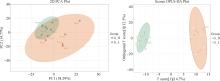
Fig.1
PCA and OPLS-DA analyses of differential metabolites in testicular tissues with varying semen quality"
Table 3
Top 30 significantly differential metabolites"
物质一级分类 Primary classificationof substances | 物质 Substance | 化合物 Compound | 化学式 Formula | VIP | P-value | log2FC |
|---|---|---|---|---|---|---|
脂肪酰类 Fatty acyl classes | 二十二碳七烯酸 | FFA(22:7) | C22H30O2 | 2.332 6 | 0.000 1 | -0.382 8 |
| 肉碱 C20:3 | Carnitine C20:3 | C27H47NO4 | 2.302 8 | 0.000 8 | -0.830 4 | |
| 十六烷酸 | FFA(16:0) | C16H32O2 | 2.240 7 | 0.003 6 | 0.849 6 | |
| 肉碱 C24:5 | Carnitine C24:5 | C31H51NO4 | 2.102 2 | 0.004 9 | -0.755 5 | |
| 肉碱 C18:0 | Carnitine C18:0 | C25H49NO4 | 2.088 7 | 0.003 3 | -0.684 9 | |
| 肉碱 C22:4 | Carnitine C22:4 | C29H49NO4 | 2.067 7 | 0.001 2 | -0.814 3 | |
| 肉碱 C20:2 | Carnitine C202 | C27H49NO4 | 2.058 5 | 0.010 9 | -0.831 1 | |
| 肉碱 C20:1-OH | Carnitine C20:1-OH | C27H51NO5 | 2.027 8 | 0.029 1 | -1.113 0 | |
| 肉碱 C20:1 | Carnitine C20:1 | C27H51NO4 | 2.026 5 | 0.003 5 | -0.737 8 | |
| 肉碱 C18-OH | Carnitine C18-OH | C25H49NO5 | 2.022 0 | 0.023 7 | -0.946 0 | |
| 肉碱 C17:0 | Carnitine C17:0 | C24H47NO4 | 2.009 5 | 0.008 3 | -0.807 7 | |
| 肉碱 C18:2 | Carnitine C18:2 | C25H45NO4 | 2.000 4 | 0.021 3 | -0.760 5 | |
氨基酸及其代谢物 Amino acids andmetabolites | L-赖氨酸-L-苏氨酸 | Lys-Thr | C10H21N3O4 | 2.572 6 | 0.000 1 | -2.908 2 |
| 脯氨酸-亮氨酸 | Pro-Leu | C11H20N2O3 | 2.019 9 | 0.004 2 | -0.574 9 | |
苯及其衍生物 Benzene and derivatives | 4-甲氧基肉桂酸乙酯 | Ethyl-4-Methoxycinnamate | C12H14O3 | 2.276 6 | 0.000 3 | -0.273 4 |
| 2,6-二叔丁基-1,4-苯醌 | 2,6-di-tert-butyl-1,4-benzoquinone | C14H20O2 | 2.071 8 | 0.001 6 | -1.189 6 | |
醇、胺类 Alcohols and amines classes | 十六碳酰胺 | Hexadecanamide | C16H33NO | 2.376 8 | 0.000 3 | -1.847 5 |
胆汁酸 Bile acids | 猪去氧胆酸 | Hyodeoxycholic acid | C24H40O4 | 2.294 3 | 0.000 5 | -1.051 6 |
辅酶和维生素 Coenzymes and vitamins | 反式-13,14-二羟视黄醇 (Z)-古尔司酮 | All-Trans-13,14-Dihydroretinol (Z)-Guggulsterone | C20H32O | 2.470 5 | 0.015 7 | -3.156 6 |
| C21H28O2 | 2.186 4 | 0.000 5 | -0.464 7 | |||
甘油磷脂类 Glycerophospholipid classes | 溶血磷脂酰丝氨酸_ LPS(20:1) | LPS(20:1) | C26H50NO9P | 2.566 4 | 0.000 2 | -2.930 1 |
| LPE(O-18:2) | LPE(O-18:2) | C23H46NO6P | 2.227 2 | 0.000 3 | -0.543 6 | |
| LPC(O-16:1) | LPC(O-16:1) | C24H50NO6P | 2.193 5 | 0.001 3 | -0.758 7 | |
核苷酸及其代谢物 Nucleotides and metabolites | 5'-腺苷酸硫酸(APS) | 5'-Adenylyl sulfate (APS) | C10H14N5O10PS | 2.074 2 | 0.004 1 | -0.465 5 |
激素及激素相关物质 Hormones and hormone-related substances | 7-酮胆固醇 | 7-Ketocholesterol | C27H44O2 | 2.462 3 | 0.000 0 | -1.295 0 |
| 20,26-二羟基蜕皮激素 | 20,26-dihydroxyecdysone | C27H44O8 | 2.134 8 | 0.004 0 | -0.587 9 | |
鞘脂类 Sphingolipid classes | 鞘氨醇_SPH (d18:0) | SPH(d18:0) | C18H39NO2 | 2.043 7 | 0.008 7 | 0.510 7 |
醛、酮、酯类 Aldehydes, ketones and esters classes | 2-戊基-3-苯基-2-丙烯醛 | 2-Pentyl-3-phenyl-2-propenal | C14H18O | 2.496 8 | 0.000 0 | -0.870 9 |
碳水化合物及代谢物 Carbohydrates and metabolites | 麦芽糖醇 | Maltitol | C12H24O11 | 2.573 8 | 0.000 2 | 2.863 4 |
有机酸及其衍生物 Organic acids and derivatives | 2-羟基己二酸 | 2-Hydroxyadipic acid | C6H10O5 | 2.315 0 | 0.000 3 | 0.306 4 |
Fig.2
Volcano plot of differential metabolites (A) and VIP plot of differential metabolites (B)"
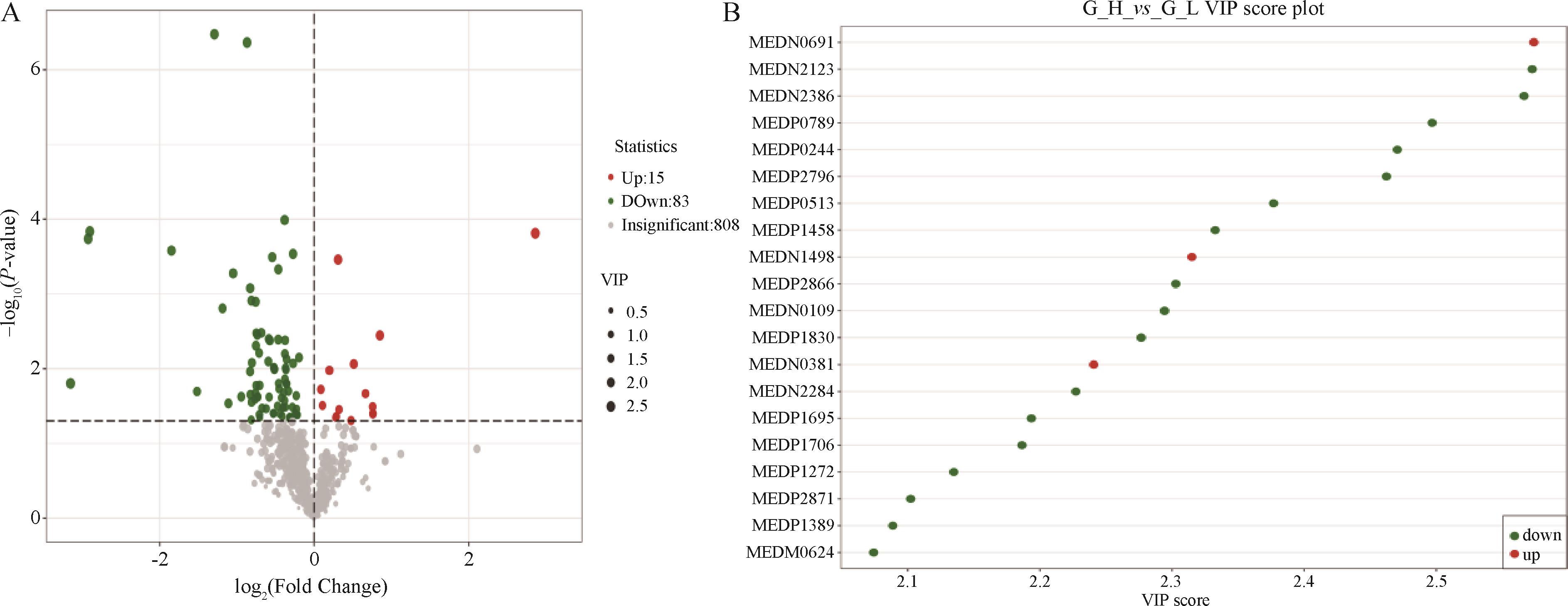
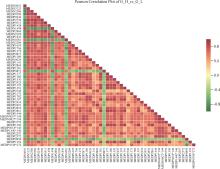
Fig.3
Correlation analysis heatmap of the top 50 differential metabolitesRed indicates strong positive correlations, green indicates strong negative correlations, and darker colors represent larger absolute values of correlation coefficients between samples"

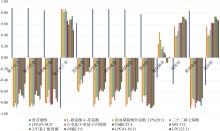
Fig.4
Correlation analysis of differential metabolites with semen quality parameters"

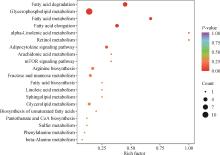
Fig.5
Enrichment plot of the top 20 metabolic pathways"
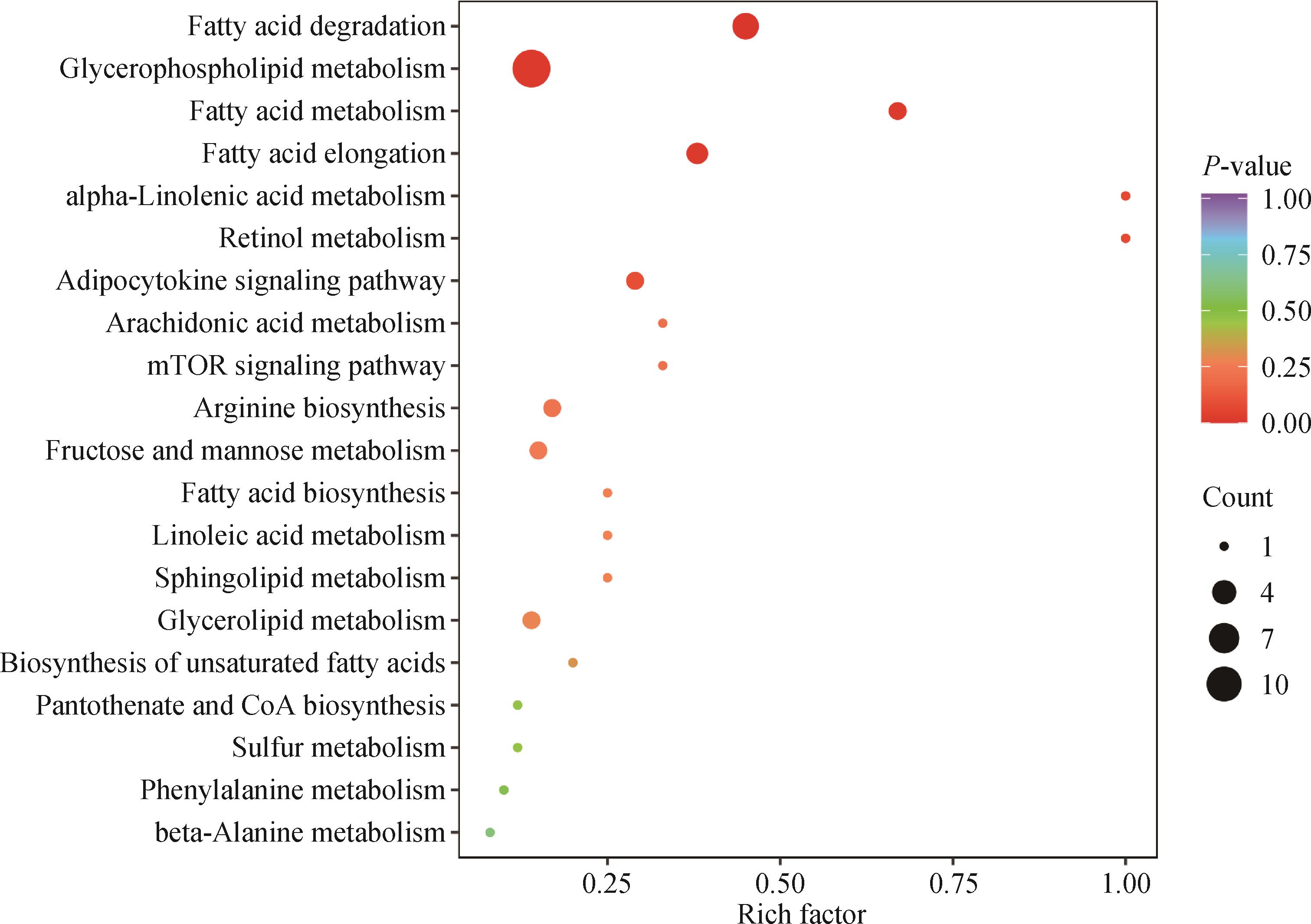
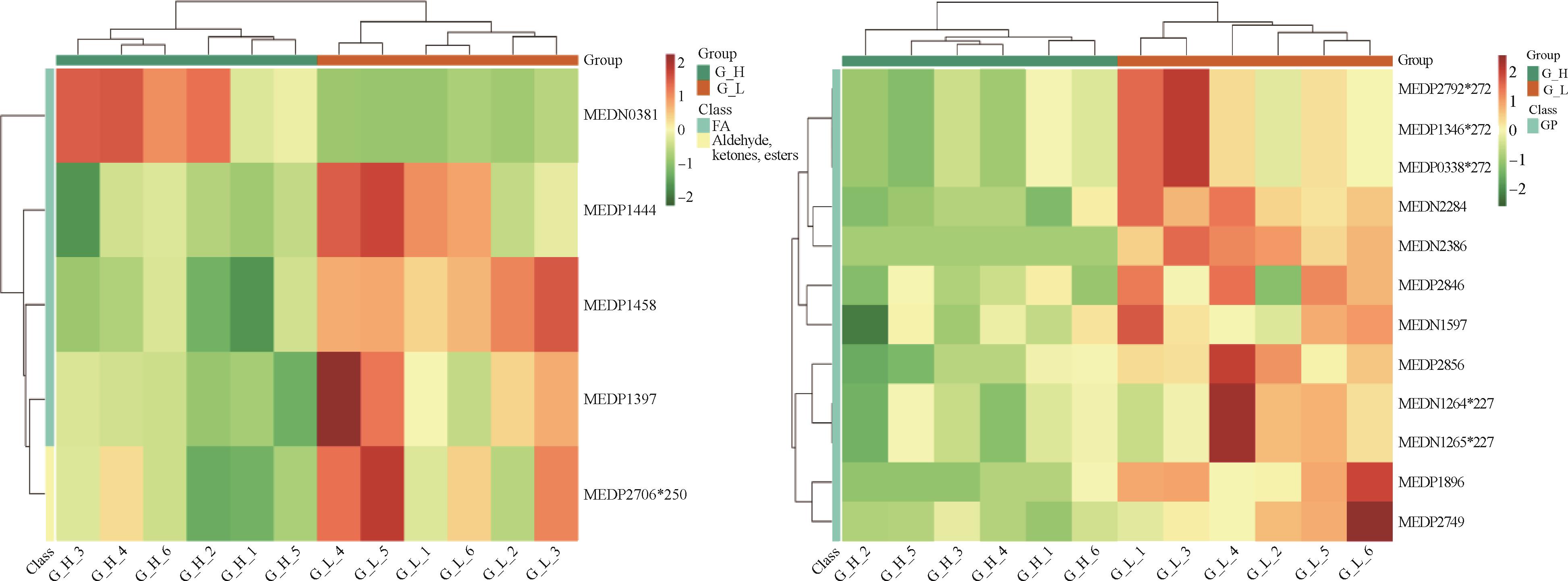
Fig.6
Clustering heatmap of differential metabolites in the fatty acid degradation (ko00071) and glycerophospholipid metabolism (ko00564) pathwaysThe x-axis represents sample names, the y-axis represents differential metabolites, and colors correspond to normalized relative abundance values (red indicate high abundance, green indicate low abundance). The annotation bar above the heatmap indicates sample grouping (Group)"
| [1] | 张 博,唐 静,赵 睿,等.种母鸭核黄素缺乏对子代雏鸭初生重、器官指数、体尺指标及血浆生化指标的影响[J].动物营养学报,2020,32(5):2185-2191. |
| ZHANG B,TANG J,ZHAO R,et al.Effects of riboflavin deficiency in breeder ducks on birth weight,organ index,body size indexes and plasma biochemical indexes of offspring ducklings[J].Chinese Journal of Animal Nutrition,2020,32(5):2185-2191.(in Chinese) | |
| [2] | 解广娟.公鸭精液品质及精浆蛋白组学的研究[D].雅安:四川农业大学,2022. |
| XIE G J.Study on semen quality and seminal plasma proteomics of male ducks[D].Ya'an:Sichuan Agricultural University,2022.(in Chinese) | |
| [3] | GRISWOLD M D.The central role of Sertoli cells in spermatogenesis[J].Semin Cell Dev Biol,1998,9(4):411-416. |
| [4] | 李金梅.雄激素通过间接调控PLZF介导的精原干细胞分化机制研究[D].南京:南京农业大学,2016. |
| LI J M.Study on the mechanism of androgens indirectly regulating PLZF-mediated spermatogonial stem cell differentiation[D].Nanjing:Nanjing Agricultural University,2016.(in Chinese) | |
| [5] | 彭红波,刘 晃,宋小燕,等.代谢组学技术对非梗阻性无精子症的诊断价值[J].检验医学与临床,2023,20(5):625-629. |
| PENG H B,LIU H,SONG X Y,et al.Diagnostic value of metabolomics technology in non-obstructive azoospermia[J].Laboratory Medicine and Clinic,2023,20(5):625-629.(in Chinese) | |
| [6] | ZHU Z,LI R,FENG C,et al.Exogenous oleic acid and palmitic acid improve boar sperm motility via enhancing mitochondrial beta-oxidation for ATP generation[J].Animals (Basel),2020,10(4):591. |
| [7] | KARAHALIL B.Overview of systems biology and omics technologies[J].Curr Med Chem,2016,23(37):4221-4230. |
| [8] | ZHAO Q,HUANG J F,CHENG Y,et al.Polyamine metabolism links gut microbiota and testicular dysfunction[J].Microbiome,2021,9(1):224. |
| [9] | SETIAWAN R,PRIYADARSHANA C,MIYAZAKI H,et al.Functional difference of ATP-generating pathways in rooster sperm (Gallus gallus domesticus)[J].Anim Reprod Sci,2021,233:106843. |
| [10] | 赵延辉,陈 余,王 梁,等.基于RNA-seq数据筛选鸡睾丸附睾间差异表达基因及其功能分析[J].中国畜牧杂志,2022,58(1):117-122. |
| ZHAO Y H,CHEN Y,WANG L,et al.Screening of differentially expressed genes between testis and epididymis of chickens based on RNA-seq data and their functional analysis[J].Chinese Journal of Animal Science,2022,58(1):117-122.(in Chinese) | |
| [11] | KUANG W,ZHANG J,LAN Z,et al.SLC22A14 is a mitochondrial riboflavin transporter required for sperm oxidative phosphorylation and male fertility[J].Cell Rep,2021,35(3):109025. |
| [12] | 赵志显,常雪蕊,郭 勇,等.种公鸡精液品质营养调控的研究进展[J].畜牧兽医学报,2022,53(8):2435-2443. |
| ZHAO Z X,CHANG X R,GUO Y,et al.Research progress on nutritional regulation of breeder rooster semen quality[J].Acta Veterinaria et Zootechnica Sinica,2022,53(8):2435-2443.(in Chinese) | |
| [13] | JERYSZ A,LUKASZEWICZ E.Effect of dietary selenium and vitamin E on ganders' response to semen collection and ejaculate characteristics[J].Biol Trace Elem Res,2013,153(1-3):196-204. |
| [14] | WANG Y,FU X,LI H.Mechanisms of oxidative stress-induced sperm dysfunction[J].Front Endocrinol (Lausanne),2025,16:1520835. |
| [15] | NICHOLSON J K,LINDON J C,HOLMES E.'Metabonomics':understanding the metabolic responses of living systems to pathophysiological stimuli via multivariate statistical analysis of biological NMR spectroscopic data[J].Xenobiotica,1999,29(11):1181-1189. |
| [16] | HAN G,HONG S H,LEE S J,et al.Transcriptome analysis of testicular aging in mice[J].Cells,2021,10(11):2895. |
| [17] | PATTI G J,YANES O,SIUZDAK G.Innovation:Metabolomics:the apogee of the omics trilogy[J].Nat Rev Mol Cell Biol,2012,13(4):263-269. |
| [18] | YANG K,XIA B,WANG W,et al.A comprehensive analysis of metabolomics and transcriptomics in cervical cancer[J].Sci Rep,2017,7:43353. |
| [19] | WANG Y T,YANG Y,SUN X L,et al.Development of a widely-targeted metabolomics method based on gas chromatography-mass spectrometry[J].Se Pu,2023,41(6):520-526. |
| [20] | STOCKL J B,SCHMID N,FLENKENTHALER F,et al.Proteomic insights into senescence of testicular peritubular cells from a nonhuman primate model[J].Cells,2020,9(11):2498. |
| [21] | ALPAUGH W F,VOIGT A L,DARDARI R,et al.Loss of ubiquitin carboxy-terminal hydrolase L1 impairs long-term differentiation competence and metabolic regulation in murine spermatogonial stem cells[J].Cells,2021,10(9):2265. |
| [22] | CAI X,WU S,MIPAM T,et al.Testis transcriptome profiling identified lncRNAs involved in spermatogenic arrest of cattleyak[J].Funct Integr Genomics,2021,21(5-6):665-678. |
| [23] | O'DONNELL L,REBOURCET D,DAGLEY L F,et al.Sperm proteins and cancer-testis antigens are released by the seminiferous tubules in mice and men[J].FASEB J,2021,35(3):e21397. |
| [24] | WENK M R.Lipidomics:new tools and applications[J].Cell,2010,143(6):888-895. |
| [25] | IUCHI K,TAKAI T,HISATOMI H.Cell Death via lipid peroxidation and protein aggregation diseases[J].Biology (Basel),2021,10(5):399. |
| [26] | LEE W K,LAM T K Y,TANG H C,et al.PFOS-elicited metabolic perturbation in liver and fatty acid metabolites in testis of adult mice[J].Front Endocrinol (Lausanne),2023,14:1302965. |
| [27] | 覃佐剑.基于LC-MS/MS氧化脂肪酸数据库的构建和应用[D].北京:中国农业科学院,2020. |
| QIN Z J.Construction and application of oxidized fatty acid database based on LC-MS/MS[D].Beijing:Chinese Academy of Agricultural Sciences,2020.(in Chinese) | |
| [28] | 陈嘉康,吕春荣,苗永旺,等.脂质组学技术在家畜精液质量评价和体外保存研究中的应用研究进展[J].中国畜牧兽医,2022,49(12):4697-4706. |
| CHEN J K,LV C R,MIAO Y W,et al.Research progress on the application of lipidomics technology in livestock semen quality evaluation and in vitro preservation[J].China Animal Husbandry & Veterinary Medicine,2022,49(12):4697-4706.(in Chinese) | |
| [29] | FLESCH F M,GADELLA B M.Dynamics of the mammalian sperm plasma membrane in the process of fertilization[J].Biochim Biophys Acta,2000,1469(3):197-235. |
| [30] | 胡学春.脂肪酸对小鼠睾丸支持细胞存活率的影响及机制研究[D].南京:南京大学,2018. |
| HU X C.Study on the effect and mechanism of fatty acids on the survival rate of mouse testicular Sertoli cells[D].Nanjing:Nanjing University,2018.(in Chinese) | |
| [31] | ILICETO M,STENSEN M H,ANDERSEN J M,et al.Levels of L-carnitine in human seminal plasma are associated with sperm fatty acid composition[J].Asian J Androl,2022,24(5):451-457. |
| [32] | ARSLAN E,KOYUNCU I,TEMIZ E,et al.Comparison of sperm carnitine profiles of normospermic,oligospermic and azospermic individuals[J].Eur Rev Med Pharmacol Sci,2023,27(17):8154-8162. |
| [33] | MATEUS F G,MOREIRA S,MARTINS A D,et al.L-carnitine and male fertility:Is supplementation beneficial?[J].J Clin Med,2023,12(18):5796. |
| [34] | VAN MEER G,VOELKER D R,FEIGENSON G W.Membrane lipids:where they are and how they behave[J].Nat Rev Mol Cell Biol,2008,9(2):112-124. |
| [35] | 张宇霆.猪精子差异耐冻性机制与耐冻性生物标志物筛选[D].哈尔滨:东北农业大学,2021. |
| ZHANG Y T.Mechanism of differential freezing tolerance of boar sperm and screening of freezing tolerance biomarkers[D].Harbin:Northeast Agricultural University,2021.(in Chinese) | |
| [36] | ENGEL K M,BAUMANN S,ROLLE-KAMPCZYK U,et al.Metabolomic profiling reveals correlations between spermiogram parameters and the metabolites present in human spermatozoa and seminal plasma[J].PLoS One,2019,14(2):e0211679. |
| [37] | LI Y,HU Y,WANG Z,et al.IKBA phosphorylation governs human sperm motility through ACC-mediated fatty acid beta-oxidation[J].Commun Biol,2023,6(1):323. |
| [38] | 何慧慧,刘卫红,贾 瑞,等.当归芍药散对PM2.5致雄性生殖损伤大鼠睾丸组织代谢组学的影响[J].郑州大学学报(医学版),2022,57(1):38-44. |
| HE H H,LIU W H,JIA R,et al.Effect of Danggui Shaoyao Powder on metabolomics of testicular tissue in rats with male reproductive injury induced by PM2.5[J].Journal of Zhengzhou University (Medical Sciences),2022,57(1):38-44.(in Chinese) | |
| [39] | AM-IN N,KIRKWOOD R N,TECHAKUMPHU M,et al.Lipid profiles of sperm and seminal plasma from boars having normal or low sperm motility[J].Theriogenology,2011,75(5):897-903. |
| [40] | 陈佳颖,马博闻,赵青余,等.公猪精液质量与精子脂质成分相关性研究[J].中国畜牧兽医,2024,51(4):1537-1548. |
| CHEN J Y,MA B W,ZHAO Q Y,et al.Study on the correlation between boar semen quality and sperm lipid components[J].China Animal Husbandry & Veterinary Medicine,2024,51(4):1537-1548.(in Chinese) |
| [1] | WANG Yajun, LIU Qi, WANG Yangyang, HE Lei, WEI Ying, CHEN Songbiao, YU Zuhua, DING Ke, CHEN Jian. Study on the Effect of EAV-HP Integration in the 5’ Non-Coding Region of the SLCO1B3 Gene on the Liver Metabolomics of Luhua Chicken [J]. Acta Veterinaria et Zootechnica Sinica, 2026, 57(1): 476-485. |
| [2] | TU Minhang, CAI Gentan, SONG Yanze, AN Guihua, WU Jiangheng, MA Longfei, SHI Zhendan, HAN Guofeng, CHEN Zhe, WANG Tian, WANG Chao. Dietary Lycium barbarum Flavonoids Improve Muscle Quality of Meat Ducks by Regulating Nrf/HO-1 Signaling Pathway [J]. Acta Veterinaria et Zootechnica Sinica, 2025, 56(8): 3922-3932. |
| [3] | CHEN Liu, XIANG Shengrui, YUN Tao, NI Zheng, HUA Jionggang, ZHU Yinchu, ZHANG Cun, YE Weicheng. Construction and Evaluation of Immune Protection Capacity of a Recombinant Duck Enteritis Virus Deleting UL35 Gene [J]. Acta Veterinaria et Zootechnica Sinica, 2025, 56(8): 3933-3941. |
| [4] | ZHENG Hao, LUO Fang, SONG Chenglei, TAO Jinzhong. Screening Potential Plasma Biomarkers of Non-pregnant Dairy Cows after Artificial Insemination Based on Metabolomics Technology [J]. Acta Veterinaria et Zootechnica Sinica, 2025, 56(7): 3252-3264. |
| [5] | HUO Zhen, ZHUANG Lei, ZHOU Wei, WANG Shuaiqin, XIE Ming, HOU Shuisheng, HOU Shuisheng. Effects of Dietary Folic Acid Levels on Production Performance, Plasma Biochemical Indicators and Antioxidant Capacity of Pekin Ducks from 1 to 21 Days of Age [J]. Acta Veterinaria et Zootechnica Sinica, 2025, 56(7): 3327-3334. |
| [6] | LI Ting, ZHANG Chengcheng, WANG Xiuling, ZHANG Xiaorong, WU Yantao. Isolation and Identification of a Novel Duck Reovirus Strain and the Sequence Analysis of Its σC Gene [J]. Acta Veterinaria et Zootechnica Sinica, 2025, 56(5): 2520-2524. |
| [7] | MENG Xiangxu, LI Jia, REN Deming, CHEN Kuirong, HE Yiyun, WANG Lixian, SHENG Xihui, WANG Ligang. Study on Serum Metabolomics of High and Low Resilience Group of Min Pigs with Porcine Reproductive and Respiratory Syndrome [J]. Acta Veterinaria et Zootechnica Sinica, 2025, 56(4): 1689-1699. |
| [8] | YE Rungen, LIU Yuanbo, LU Lili, Collins Amponsah Asiamah, SU Ying*. Expression of miR-215-5p in Leizhou Black Duck Tissues and Its Effect on Follicular Granulosa Cells Proliferation and Apoptosis [J]. Acta Veterinaria et Zootechnica Sinica, 2025, 56(4): 1722-1730. |
| [9] | WANG Xinxin, LIU Xiaoying, WANG Yi, WANG Fang, ZHAO Han, DU Zhiqiang, YANG Caixia. Acute Heat Stress Affects the Functions of Porcine Sertoli Cells via Decreasing Taurine Level [J]. Acta Veterinaria et Zootechnica Sinica, 2025, 56(4): 1779-1790. |
| [10] | YU Jiangwei, CHENG Huimin, LIN Jian, YANG Baolin, HUANG Cheng, YANG Zhiyuan, HU Ge. Establishment and Application of TaqMan Fluorescent Quantitative PCR Detection Method for Duck Plague Virus [J]. Acta Veterinaria et Zootechnica Sinica, 2025, 56(2): 765-773. |
| [11] | WU Jiahui, SHEN Shiyan, DENG Jinbo, WU Haiyang, REN Zhixin, WU Yangbo, HUANG Juan, HUANG Haobin, PAN Weixiong, ZHAO Zengjue, HE Rongxiao, SUN Chongjun, ZHANG Linghua. Construction of Recombinant Lactococcus lactis Inducible Expressing HA Protein of H5N1 Subtype Avian Influenza Virus and Analysis of Its Immunogenicity in Ducks [J]. Acta Veterinaria et Zootechnica Sinica, 2025, 56(2): 774-787. |
| [12] | GU Yayi, XIA Sugan, LIU Pengli, ZOU Hui, GU Jianhong, YUAN Yan, LIU Xuezhong, LIU Zongping, BIAN Jianchun. Damaging Effect of Polystyrene Nanoplastics on the Testicles of Male Ducks [J]. Acta Veterinaria et Zootechnica Sinica, 2025, 56(2): 925-933. |
| [13] | GAO Zhimiao, NI Haihua, WANG Yanping, ZHAO Xueyan, LI Jingxuan, WANG Jiying, ZHANG Qin. Application of Metabolomics in Genetic Analysis of Important Economic Traits in Pigs [J]. Acta Veterinaria et Zootechnica Sinica, 2025, 56(10): 4787-4795. |
| [14] | WENG Ziyuan, CEN Ting, MA Ye, ZHENG Enpei, WU Xuan, LENG Jun, WANG Zuzhong, WANG Yuanyuan, YE Ziying, LI Minhong, HU Changmin. Evaluation of Efficacy and Urine Metabolomics of a Prescription Cans for Feline Urinary Tract [J]. Acta Veterinaria et Zootechnica Sinica, 2025, 56(10): 5289-5301. |
| [15] | Yudian SUN, Ziyue SONG, Hongliang ZHANG, Zhihua QIN, Hu SHAN, Ruimei YANG. Isolation and ldentification of Duckling Short Beak and Dwarfism Syndrome Virus [J]. Acta Veterinaria et Zootechnica Sinica, 2024, 55(8): 3623-3630. |
| Viewed | ||||||
|
Full text |
|
|||||
|
Abstract |
|
|||||
