


Acta Veterinaria et Zootechnica Sinica ›› 2026, Vol. 57 ›› Issue (1): 553-563.doi: 10.11843/j.issn.0366-6964.2026.01.048
• CLINICAL VETERINARY MEDICINE • Previous Articles Next Articles
WANG Fang1,2( ), GANG Huasheng1,2, ZHANG Rong1,2, DUAN Hongwei1,2, HU Junjie1,2()
Received:2024-12-11
Online:2026-01-23
Published:2026-01-26
Contact:
HU Junjie
E-mail:18719806885@163.com;hujj@gsau.edu.cn
CLC Number:
WANG Fang, GANG Huasheng, ZHANG Rong, DUAN Hongwei, HU Junjie. A Preliminary Study on the Early Warning Model of Postpartum Metritis in Dairy Cows based on Electronic Nose Detection[J]. Acta Veterinaria et Zootechnica Sinica, 2026, 57(1): 553-563.
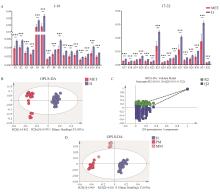
Fig.1
Statistical analysis of VOCs data from blood samplesMET. Metritis; H. Health; PM: Primiparous metritis; MM. Multiparous metritis. ns. P>0.05, *. P<0.05, **. P<0.01, ***. P<0.001, the same as belowA. Differential analysis of electronic nose sensor; B. 2D result diagram of OPLS-DA model; C. Results of the 200 permutation test for the OPLS-DA model; D. OPLS-DA model 2-dimensional result plots for classification of uteritis samples"

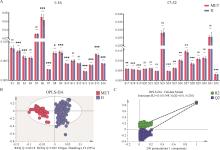
Fig.2
Statistical analysis of VOCs data from fecal samplesA. Difference analysis of electronic nose sensor; B. 2D result diagram of OPLS-DA model; C. Results of the 200 permutation test for the OPLS-DA model"

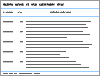
Table 1
SelectKBest function for fecal sample electronic nose sensor feature selection score table"
排名 Rank | 特征名称 Sensor | 评分 Score | 排名 Rank | 特征名称 Sensor | 评分 Score |
|---|---|---|---|---|---|
| 1 | S6 | 0.030 995 | 17 | S25 | 0.000 110 |
| 2 | S3 | 0.001 080 | 18 | S1 | 0.000 097 |
| 3 | S28 | 0.000 940 | 19 | S14 | 0.000 082 |
| 4 | S27 | 0.000 692 | 20 | S29 | 0.000 075 |
| 5 | S9 | 0.000 424 | 21 | S8 | 0.000 073 |
| 6 | S2 | 0.000 417 | 22 | S16 | 0.000 071 |
| 7 | S19 | 0.000 367 | 23 | S11 | 0.000 062 |
| 8 | S18 | 0.000 356 | 24 | S17 | 0.000 059 |
| 9 | S26 | 0.000 341 | 25 | S7 | 0.000 055 |
| 10 | S15 | 0.000 276 | 26 | S5 | 0.000 039 |
| 11 | S23 | 0.000 227 | 27 | S21 | 0.000 033 |
| 12 | S32 | 0.000 214 | 28 | S4 | 0.000 024 |
| 13 | S24 | 0.000 203 | 29 | S31 | 0.000 014 |
| 14 | S10 | 0.000 165 | 30 | S20 | 0.000 009 |
| 15 | S30 | 0.000 148 | 31 | S12 | 0.000 002 |
| 16 | S13 | 0.000 115 | 32 | S22 | 0.000 000 |
Table 2
Model evaluation metrics for fecal sample train and test sets"
| 数据集Dataset | 评价指标 Evaluation metrics | DT | RF | KNN | XGBoost | LDA |
|---|---|---|---|---|---|---|
| Train | ACC | 0.84 | 0.94 | 0.77 | 0.91 | 0.98 |
| TPR | 0.86 | 0.94 | 0.89 | 0.89 | 0.99 | |
| TNR | 0.86 | 0.94 | 0.89 | 0.89 | 0.99 | |
| PPV | 0.85 | 0.98 | 0.85 | 0.90 | 0.97 | |
| Test | ACC | 0.88 | 0.96 | 0.88 | 0.91 | 0.98 |
| TPR | 0.86 | 0.94 | 0.89 | 0.89 | 0.99 | |
| TNR | 0.86 | 0.94 | 0.89 | 0.89 | 0.99 | |
| PPV | 0.85 | 0.98 | 0.85 | 0.90 | 0.97 | |
| Precision | 0.92 | 0.95 | 0.97 | 0.92 | 1.00 | |
| Recall | 0.89 | 1.00 | 0.84 | 0.95 | 0.97 | |
| F1 Score | 0.91 | 0.97 | 0.90 | 0.94 | 0.99 |
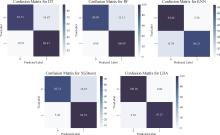
Fig.3
Confusion matrix results for fecal sample test setA. Confusion matrix for DT model; B. Confusion matrix for RF model; C. Confusion matrix for KNN model; D. Confusion matrix for XGBoost model; E. Confusion matrix for LR model; F. Confusion matrix for DA model. 0 is the MET sample label and 1 is the H sample label"
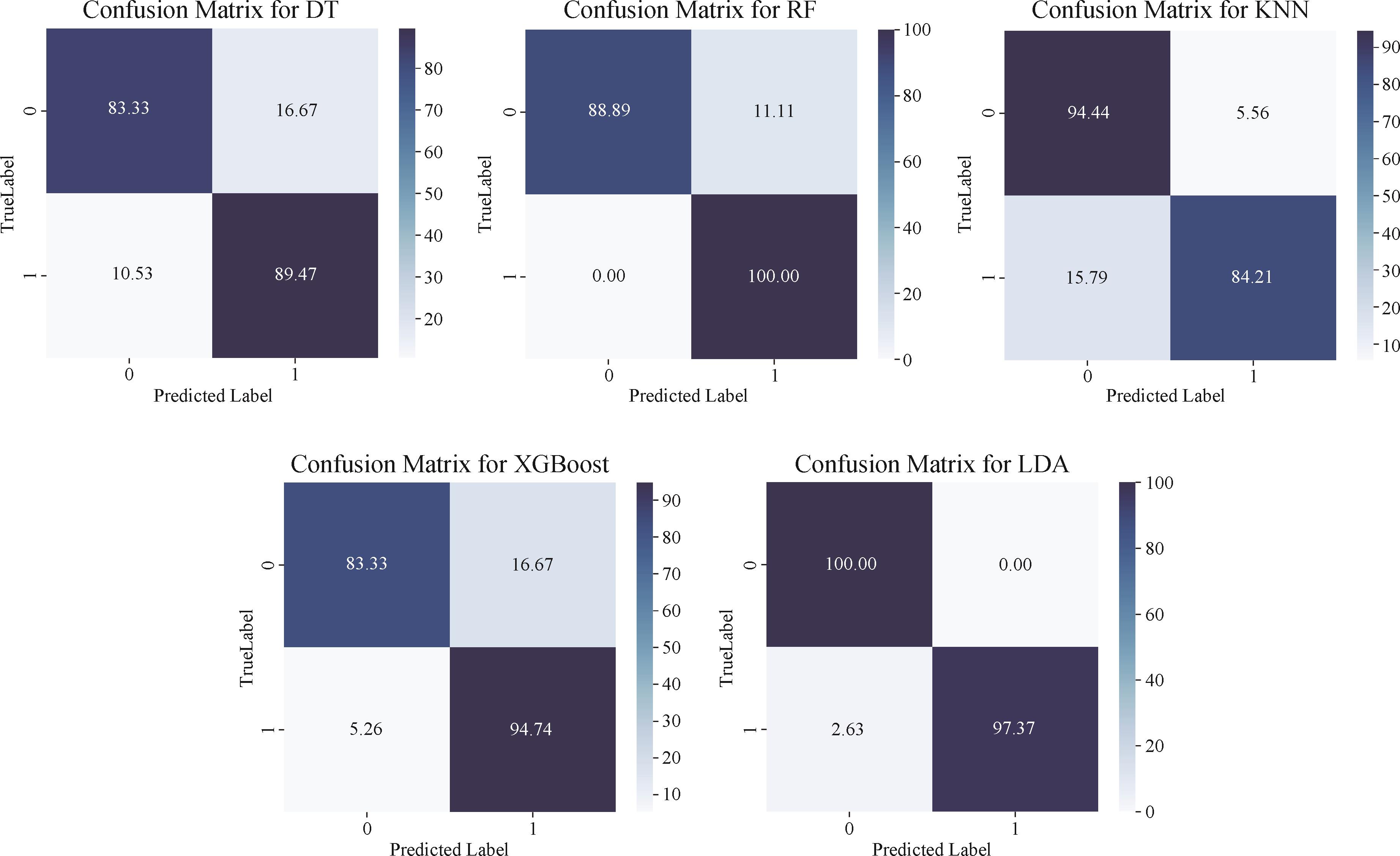
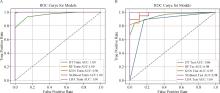
Fig.4
ROC curves for train and test sets of fecal sampleA. Feces sample train set ROC curve;B. Feces sample test set ROC curve. The solid line represents the ROC; diagonal dotted line of different models, and the performance of the model is expressed in AUC"

| [1] | PINEDO P,SANTOS J E P,CHEBEL R C,et al.Early-lactation diseases and fertility in 2 seasons of calving across US dairy herds[J].J Dairy Sci,2020,103(11):10560-10576. |
| [2] | DAETZ R,CUNHA F,BITTAR J H,et al.Clinical response after chitosan microparticle administration and preliminary assessment of efficacy in preventing metritis in lactating dairy cows[J].J Dairy Sci,2016,99(11):8946-8955. |
| [3] | SILVA T V,D E OLIVEIRA E B,PÉREZ-BÁEZ J,et al.Economic comparison between ceftiofur-treated and nontreated dairy cows with metritis[J].J Dairy Sci,2021,104(8):8918-8930. |
| [4] | DUBUC J,DUFFIELD T F,LESLIE K E,et al.Risk factors for postpartum uterine diseases in dairy cows[J].J Dairy Sci,2010,93(12):5764-5771. |
| [5] | SHELDON I M,CRONIN J G,BROMFIELD J J.Tolerance and innate immunity shape the development of postpartum uterine disease and the impact of endometritis in dairy cattle [J].Annu Rev Anim Biosci,2019,7:361-384. |
| [6] | CASARO S,PRIM J G,GONZALEZ T D,et al.Unraveling the immune and metabolic changes associated with metritis in dairy cows[J].J Dairy Sci,2023,106(12):9244-9259. |
| [7] | JUODŽENTIS V,ŠIUGŽDAITĖ J,PALUBINSKAS G,et al.Influence of puerperal metritis on the first ovulation after calving in dairy cows[J].Pol J Vet Sci,2020,23(4):619-626. |
| [8] | PÉREZ-BÁEZ J,SILVA T V,RISCO CA,et al.The economic cost of metritis in dairy herds[J].J Dairy Sci,2021,104(3):3158-3168. |
| [9] | PAIANO R B,BIRGEL D B,BONILLA J,et al.Alterations in biochemical profiles and reproduction performance in postpartum dairy cows with metritis[J].Reprod Domest Anim,2020,55(11):1599-1606. |
| [10] | GIULIODORI M J,MAGNASCO R P,BECU-VILLALOBOS D,et al.Metritis in dairy cows:risk factors and reproductive performance[J].J Dairy Sci,2013,96(6):3621-3631. |
| [11] | GARZON A,HABING G,LIMA F,et al.Defining clinical diagnosis and treatment of puerperal metritis in dairy cows:A scoping review[J].J Dairy Sci,2022,105(4):3440-3452. |
| [12] | FIGUEIREDO C C,MERENDA V R,DE OLIVEIRA E B,et al.Failure of clinical cure in dairy cows treated for metritis is associated with reduced productive and reproductive performance[J].J Dairy Sci,2021,104(6):7056-7070. |
| [13] | MENTA P R,FERNANDES L,PRIM J,et al.A randomized controlled trial evaluating the efficacy of systemic ceftiofur administration for metritis therapy in dairy cows and the effect of metritis cure on economically important outcomes[J].J Dairy Sci,2024,107(9):7092-7105. |
| [14] | MENTA P R,MACHADO V S,PIÑEIRO J M,et al.Heat stress during the transition period is associated with impaired production,reproduction,and survival in dairy cows[J].J Dairy Sci,2022,105(5):4474-4489. |
| [15] | GOSHEN T,SHPIGEL N Y.Evaluation of intrauterine antibiotic treatment of clinical metritis and retained fetal membranes in dairy cows[J].Theriogenology,2006,66(9):2210-2218. |
| [16] | BORCHARDT S,BURNETT T A,DRILLICH M,et al.Association of uterine health in the first lactation with transition cow health and reproductive performance in the second lactation of Holstein dairy cows[J].J Dairy Sci,2024,107(11):9706-9718. |
| [17] | JANOVICK N A,DRACKLEY J K.Prepartum dietary management of energy intake affects postpartum intake and lactation performance by primiparous and multiparous Holstein cows[J].J Dairy Sci,2010,93(7):3086-3102. |
| [18] | BARRACLOUGH R A C,SHAW D J,BOYCE R,et al.The behavior of dairy cattle in late gestation:Effects of parity and dystocia[J].J Dairy Sci,2020,103(1):714-722. |
| [19] | STANGAFERRO M L,WIJMA R,CAIXETA L S,et al.Use of rumination and activity monitoring for the identification of dairy cows with health disorders:Part III.Metritis[J].J Dairy Sci,2016,99(9):7422-7433. |
| [20] | BARRAGAN A A,LAKRITZ J,CARMAN M K,et al.Short communication:Assessment of biomarkers of inflammation in the vaginal discharge of postpartum dairy cows diagnosed with clinical metritis[J].J Dairy Sci,2019,102(8):7469-7475. |
| [21] | POMEROY B,SIPKA A,HUSSEN J,et al.Counts of bovine monocyte subsets prior to calving are predictive for postpartum occurrence of mastitis and metritis[J].Vet Res,2017,48(1):13. |
| [22] | MCNEEL A K,REITER B C,WEIGEL D,et al.Validation of genomic predictions for wellness traits in US Holstein cows[J].J Dairy Sci,2017,100(11):9115-9124. |
| [23] | DERVISHI E,ZHANG G,HAILEMARIAM D,et al.Urine metabolic fingerprinting can be used to predict the risk of metritis and highlight the pathobiology of the disease in dairy cows[J].Metabolomics,2018,14(6):83. |
| [24] | ALI A S,JACINTO J G P,MΫNCHEMYER W,et al.Estrus detection in a dairy herd using an electronic nose by direct sampling on the perineal region[J].Vet Sci,2022,9(12):688. |
| [25] | CHO Y S,JUNG S C,OH S.Diagnosis of bovine tuberculosis using a metal oxide-based electronic nose[J].Lett Appl Microbiol,2015,60(6):513-516. |
| [26] | MAURER D L,ELLIS C K,THACKER T C,et al.Screening of microbial volatile organic compounds for detection of disease in cattle:development of lab-scale method[J].Sci Rep,2019,9(1):12103. |
| [27] | LOUTFI A,CORADESCHI S,MANI G K,et al.Electronic noses for food quality:A review[J].J Food Eng,2015,144:103-111. |
| [28] | TAECHACHOKEVIVAT N,KOU B,ZHANG T,et al.Evaluating the performance of herd-specific Long Short-Term Memory models to identify automated health alerts associated with a ketosis diagnosis in early lactation cows[J].J Dairy Sci,2024,107(12):11489-11501. |
| [29] | FERRAZ P A,POIT D A S,FERREIRA PINTO L M,et al.Accuracy of early pregnancy diagnosis and determining pregnancy loss using different biomarkers and machine learning applications in dairy cattle[J].Theriogenology,2024,224:82-93. |
| [30] | SADEGHI H,BRAUN H S,PANTI B,et al.Validation of a deep learning-based image analysis system to diagnose subclinical endometritis in dairy cows[J].PLoS One,2022,17(1):e0263409. |
| [31] | RISVANLI A,TANYERI B,YILDIRIM G,et al.Metrisor:A novel diagnostic method for metritis detection in cattle based on machine learning and sensors[J].Theriogenology,2024,223:115-121. |
| [32] | ZHANG E,WANG F,YIN C,et al.Application of an electronic nose for the diagnosis of ketosis in dairy cows[J].Food Biosci,2024,60:104355. |
| [33] | DRAGONIERI S,QUARANTA V N,PORTACCI A,et al.Effect of food intake on exhaled volatile organic compounds profile analyzed by an electronic nose[J].Molecules,2023,28(15):5755. |
| [34] | LIMA F S,VIEIRA-NETO A,SNODGRASS J A,et al.Economic comparison of systemic antimicrobial therapies for metritis in dairy cows[J].J Dairy Sci,2019,102(8):7345-7358. |
| [35] | GRANTZ J M,MUKHOPADHYAY A,JANNASCH A H,et al.Plasma oxylipin profile of postpartum dairy cows categorized into different systemic inflammatory grades in the first week after parturition[J].JDS Commun,2023,5(2):155-160. |
| [36] | MENTA P R,NEVES R C,MACHADO V S.Association of time to metritis diagnosis with circulating concentration of metabolites,minerals,and haptoglobin in Jersey cows[J].J Dairy Sci,2023,106(7):5029-5042. |
| [37] | BRUINJÉ T C,MORRISON E I,RIBEIRO E S,et al.Progesterone profiles in postpartum dairy cows with inflammatory disorders[J].J Dairy Sci,2024,107(9):7153-7164. |
| [38] | BRUINS M,BOS A,PETIT P L,et al.Device-independent,real-time identification of bacterial pathogens with a metal oxide-based olfactory sensor[J].Eur J Clin Microbiol Infect Dis,2009,28(7):775-780. |
| [39] | XIAO Q,XIA Y.Insights into dendritic cell maturation during infection with application of advanced imaging techniques[J].Front Cell Infect Microbiol,2023,13:1140765. |
| [40] | SAEZ A,HERRERO-FERNANDEZ B,GOMEZ-BRIS R,et al.Pathophysiology of inflammatory bowel disease:Innate immune system[J].Int J Mol Sci,2023,24(2):1526. |
| [41] | 周佳丽,丁宝隆,马子明,等.奶牛子宫内膜炎与胃肠微生物相关性及益生菌作用的研究进展[J].畜牧兽医学报,2024,55(8):3321-3330. |
| ZHOU J L,DING B L,MA Z M,et al.Research progress on the correlation between endometritis and gastrointestinal microorganisms and the role of probiotics in dairy cows[J].Acta Veterinaria et Zootechnica Sinica,2024,55(8):3321-3330.(in Chinese) | |
| [42] | JEON S J,CUNHA F,VIEIRA-NETO A,et al.Blood as a route of transmission of uterine pathogens from the gut to the uterus in cows[J].Microbiome,2017,5(1):109. |
| [43] | JONES K,CUNHA F,JEON S J,et al.Tracing the source and route of uterine colonization by exploring the genetic relationship of Escherichia coli isolated from the reproductive and gastrointestinal tract of dairy cows[J].Vet Microbiol,2022,266:109355. |
| [44] | GRIMARD B,HUMBLOT P,et al.Influence of postpartum energy restriction on energy status,plasma LH and oestradiol secretion and follicular development in suckled beef cows[J].J Reprod Fertil,1995,104(1):173-179. |
| [45] | CLARAMUNT M,MEIKLE A,SOCA P.Metabolic hormones,grazing behaviour,offspring physical distance and productive response of beef cow grazing at two herbage allowances[J].Animal,2020,14(7):1520-1528. |
| [46] | INGVARTSEN K L,ANDERSEN J B.Integration of metabolism and intake regulation:A review focusing on periparturient animals[J].J Dairy Sci,2000,83(7):1573-1597. |
| [47] | MANN S,URH C,SAUERWEIN H,et al.Short communication:The association of adiponectin and leptin concentrations with prepartum dietary energy supply,parity,body condition,and postpartum hyperketonemia in transition dairy cows[J].J Dairy Sci,2018,101(1):806-811. |
| [48] | BRIANO C,MEIKLE A,VELAZCO J I,et al.Metabolic and hormonal profiles and productive performance in primiparous and multiparous cows grazing different forage allowance in late gestation[J].Theriogenology,2024,227:68-76. |
| [49] | GONZÁLEZ L A,TOLKAMP B J,COFFEY M P,et al.Changes in feeding behavior as possible indicators for the automatic monitoring of health disorders in dairy cows[J].J Dairy Sci,2008,91(3):1017-1028. |
| [50] | NEAVE H W,LOMB J,WEARY D M,et al.Behavioral changes before metritis diagnosis in dairy cows[J].J Dairy Sci,2018,101(5):4388-4399. |
| [51] | PAUDYAL S,MAUNSELL F P,RICHESON J T,et al.Rumination time and monitoring of health disorders during early lactation[J].Animal,2018,12(7):1484-1492. |
| [52] | BURFEIND O,BRUINS M,BOS A,et al.Diagnosis of acute puerperal metritis by electronic nose device analysis of vaginal discharge in dairy cows[J].Theriogenology,2014,82(1):64-70. |
| [53] | VIDAL G,SHARPNACK J,PINEDO P,et al.Impact of sensor data pre-processing strategies and selection of machine learning algorithm on the prediction of metritis events in dairy cattle[J].Prev Vet Med,2023,215:105903. |
| [54] | LEGGIERI M C,MAZZONI M,FODIL S,et al.An electronic nose supported by an artificial neural network for the rapid detection of aflatoxin B1 and fumonisins in maize[J].Food Control,2021,123:107722. |
| [55] | KAMPHUIS C,MOLLENHORST H,HEESTERBEEK J A,et al.Detection of clinical mastitis with sensor data from automatic milking systems is improved by using decision-tree induction[J].J Dairy Sci,2010,93(8):3616-3627. |
| [56] | MOAWED S A,MAHROUS E,ELASWAD A,et al.Milk yield prediction in Friesian cows using linear and flexible discriminant analysis under assumptions violations[J].BMC Vet Res,2024,20(1):392. |
| [57] | WANG J,BELL M,LIU X,et al.Machine-learning techniques can enhance dairy cow estrus detection using location and acceleration data[J].Animals (Basel),2020,10(7):1160. |
| [58] | FAUVEL K,MASSON V,FROMONT E,et al.Towards sustainable dairy management-a machine learning enhanced method for estrus detection[C].Proceedings of the 25th ACM SIGKDD International Conference on Knowledge Discovery & Data Mining.2019:3051-3059. |
| [1] | CAO Fengfeng, LI Qingyun, XING Zhou, LI Zhuoying, TAO Jinzhong. Research Progress on the Variation Pattern of Uterine Tissue Nutrients during the Estrous Cycle of Cows and Their Effects on Early Embryo Development [J]. Acta Veterinaria et Zootechnica Sinica, 2026, 57(1): 13-21. |
| [2] | ZHOU Jin, ZHUANG Yujie, ZHANG Yalin, XIE Xiaoyu, SUN Mingzhu, ZHANG Xuemei, WANG Xiaolong, ZHANG Zhiping, ZHANG Juntao. Antibacterial Test of Placental Tissue-derived Liposome Drug Complex in Endometritis Model [J]. Acta Veterinaria et Zootechnica Sinica, 2025, 56(10): 5239-5250. |
| [3] | Tingting XIAN, Yan LIU, Xin CAO, Tao FENG. Analysis of the Changes of Vaginal Microflora and Serum Pro-inflammatory Cytokines and Their Correlation in Sows with Endometritis [J]. Acta Veterinaria et Zootechnica Sinica, 2024, 55(8): 3688-3698. |
| [4] | Jiali ZHOU, Baolong DING, Ziming MA, Xingang DAN, Hongxi ZHAO. Research Progress on the Correlation between Endometritis and Gastrointestinal Microorganisms and the Role of Probiotics in Dairy Cows [J]. Acta Veterinaria et Zootechnica Sinica, 2024, 55(8): 3321-3330. |
| [5] | WANG Ruiling, WANG Xueyan, WANG Feifei, KONG Weiyi, MAO Yongxia, LIU Xin, DING Hui, XU Lihua, GUO Yansheng. Study on the Changes of Blood Oxidized Lipid Group in Postpartum Dairy Cows with Acute Endometritis [J]. Acta Veterinaria et Zootechnica Sinica, 2024, 55(1): 373-387. |
| [6] | GAO Kangkang, YI Yanyan, ZHAO Yiteng, LIN Pengfei, CHEN Huatao, JIN Yaping. Protective Effect of Endoplasmic Reticulum Stress Preadaptation on LPS-Induced Inflammatory Response in Goat Endometrial Epithelial Cells [J]. Acta Veterinaria et Zootechnica Sinica, 2023, 54(8): 3546-3556. |
| [7] | SHAN Qiang, WANG Xue, ZHU Yaohong, WANG Jiufeng. Application Prospect of Anti-inflammatory Mechanism of Lactobacillus rhamnosus and Its Prevention and Treatment in Livestock Diseases [J]. Acta Veterinaria et Zootechnica Sinica, 2023, 54(11): 4537-4550. |
| [8] | WANG Jingxuan, XU Yao, WANG Haoran, LIU Zhiyuan, ZHAO Qida, LIU Ruifang, WANG Xinyu, LIU Tao, SONG Xudong, XIAO Jianhua. A New Classification of Canine Endometritis: An Anatomical and Histopathological Perspective [J]. Acta Veterinaria et Zootechnica Sinica, 2022, 53(4): 1259-1269. |
| [9] | LIU Tong, YANG Youyou, LIU Dapeng, YU Simeng, GUO Zhanbao, HU Jian, ZHAO Jinshan, ZHOU Zhengkui, HOU Shuisheng. Identification of Specific Volatile Flavor Compounds in Breast Muscle of Meat Duck [J]. Acta Veterinaria et Zootechnica Sinica, 2022, 53(2): 402-413. |
| [10] | DONG Shu-wei,ZHANG Shi-dong,WANG Dong-sheng,WANG Hui,MIAO Xiao-lou,YAN Zuo-ting,YANG Zhi-qiang. Efficacy of Chinese Medicine on Endometritis in Cow:a Systematic Review and Meta-analysis [J]. ACTA VETERINARIA ET ZOOTECHNICA SINICA, 2015, 46(11): 2085-2096. |
| [11] | WANG Guoqing;WANG Honghai;ZHANG Naisheng. The Relationship between MMP2, MMP9 mRNA of Bovine Endometrium and Endometritis [J]. ACTA VETERINARIA ET ZOOTECHNICA SINICA, 2012, 43(5): 810-815. |
| [12] | WANG Guo-qing;WANG Hong-hai;ZHANG Nai-sheng;WANG Hai-xia. The Study on Concentration of Endometrial Histamine and MastCell Graininess in Endometritis Cow [J]. ACTA VETERINARIA ET ZOOTECHNICA SINICA, 2010, 41(8): 1046-1048. |
| [13] | LI De-jun;Liu Yun-feng;PEI Xiao-ying;GUO Ding-zong. Research on Change of Acute Phase Protein and IL-6 in Cows with Endometritis [J]. ACTA VETERINARIA ET ZOOTECHNICA SINICA, 2010, 41(10): 1333-1336. |
| [14] | ZHAO Hong-xia;LI Pei-feng;WU Cong-ming;FAN Hong-liang;SHEN Jian-zhong. Research of Drugresistance of Escherichia coli Isolated from Bovine with Endometritis and the Relationship betweenAntibiotic Resistance and Integron [J]. ACTA VETERINARIA ET ZOOTECHNICA SINICA, 2009, 40(1): 142-144. |
| [15] | KONG Xiang-feng;HU Yuan-liang;HUANG Xiao-yan;GUO Zhen-huan;RUI Rong;HE Zi-shuang;SUN Jun-ling;YANG Liu-qing. Studies on New Fertilitypromoting Intrauterine Infusion Liquid and Its Additive Prescriptions in Treatment of Experimental Endometritis [J]. ACTA VETERINARIA ET ZOOTECHNICA SINICA, 2006, 37(4): 379-383. |
| Viewed | ||||||
|
Full text |
|
|||||
|
Abstract |
|
|||||
