


畜牧兽医学报 ›› 2026, Vol. 57 ›› Issue (1): 206-220.doi: 10.11843/j.issn.0366-6964.2026.01.018
谢泽婷, 侯晓韵( ), 詹胤锴, 林随源, 朱溥睿, 郭诗琦, 秦双, 罗阳冰, 李秀金, 黄运茂, 伍仲平(), 张续勐()
收稿日期:2025-06-17
出版日期:2026-01-23
发布日期:2026-01-26
通讯作者:
伍仲平,张续勐
E-mail:hxy_2005129@qq.com;wuzhongping@zhku.edu.cn;zhangxumeng@zhku.edu.cn
作者简介:谢泽婷与侯晓韵为同等贡献作者基金资助:
XIE Zeting, HOU Xiaoyun(), ZHAN Yinkai, LIN Suiyuan, ZHU Purui, GUO Shiqi, QIN Shuang, LUO Yangbing, LI Xiujin, HUANG Yunmao, WU Zhongping(), ZHANG Xumeng()
Received:2025-06-17
Online:2026-01-23
Published:2026-01-26
Contact:
WU Zhongping, ZHANG Xumeng
E-mail:hxy_2005129@qq.com;wuzhongping@zhku.edu.cn;zhangxumeng@zhku.edu.cn
摘要:
旨在对比狮头鹅和乌鬃鹅在40和90日龄时,其胸肌肌纤维形态和转录组的差异,挖掘导致不同日龄、不同鹅种胸肌生长差异的候选基因。本研究随机选取同批次健康的40、90日龄的狮头鹅和乌鬃鹅公鹅各3只,采集胸肌组织,利用H&E染色分析肌纤维形态差异,结合转录组测序筛选出与肌肉生长相关的差异表达基因(DEGs),并采用实时荧光定量PCR(RT-qPCR)验证关键候选基因。H&E染色结果发现,40日龄时,狮头鹅的胸肌肌纤维密度极显著高于乌鬃鹅(P<0.001),胸肌肌纤维直径极显著低于乌鬃鹅(P<0.001),而90日龄时,狮头鹅的胸肌肌纤维密度显著低于乌鬃鹅(P<0.05),胸肌纤维直径无显著差异(P>0.05)。胸肌转录组测序共筛选出DEGs 5 719个,不同日龄同一鹅种间的DEGs 3 907个,同一日龄不同鹅种间的DEGs 1 812个。对胸肌DEGs进行KEGG通路富集分析发现,ECM-受体相互作用、细胞黏附分子和黏着斑等6个通路在不同日龄同一鹅种间胸肌生长中发挥关键调控作用,细胞因子-细胞因子受体相互作用和细胞黏附分子通路在同一日龄不同鹅种间胸肌生长中发挥关键调控作用,并从中筛选出8个与胸肌生长发育密切相关的候选基因,分别是COL4A2、ITGB3、CAV1、CCND2、MYLK2、PDGFRA、ACTN2和TNNC2。通过对上述基因进行RT-qPCR验证,发现其结果与转录组测序结果相关系数均在0.90以上,说明测序结果可靠。综上,本研究发现,不同日龄及品种间的肌纤维形态差异显著,黏着斑通路、ECM-受体相互作用和细胞黏附分子等通路可通过调控COL4A2、ITGB3和CAV1等8个候选基因表达介导两品种胸肌肌纤维的肥大过程。本研究将为肉鹅分子标记辅助育种提供数据基础,进而推动肉鹅遗传改良和新品种培育。
中图分类号:
谢泽婷, 侯晓韵, 詹胤锴, 林随源, 朱溥睿, 郭诗琦, 秦双, 罗阳冰, 李秀金, 黄运茂, 伍仲平, 张续勐. 狮头鹅和乌鬃鹅胸肌组织形态学及转录组比较分析[J]. 畜牧兽医学报, 2026, 57(1): 206-220.
XIE Zeting, HOU Xiaoyun, ZHAN Yinkai, LIN Suiyuan, ZHU Purui, GUO Shiqi, QIN Shuang, LUO Yangbing, LI Xiujin, HUANG Yunmao, WU Zhongping, ZHANG Xumeng. Comparative Analysis of Histomorphology and Transcriptome in Pectoral Muscle Tissues between Shitou and Wuzong Geese[J]. Acta Veterinaria et Zootechnica Sinica, 2026, 57(1): 206-220.
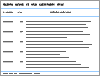
表1
试验相关的基因以及内参基因的引物序列"
基因名称 Gene name | 正向(5′→3′) Forward | 反向(3′→5′) Reverse | GenBank序列号 Accession number |
|---|---|---|---|
| β-actin | ATGTCGCCCTGGATTTCG | CACAGGACTCCATACCCAAGAA | XM_066977989.1 |
| COL4A2 | GGTTTGGTTTGTCAGGATCTGG | AAACACTGGCATCCTCCACT | XM_048080798.2 |
| ITGB3 | AGGGATGAATCTGGCAATCTACA | CAAACTCAGCTTCACCCTGC | XM_066994002.1 |
| CAV1 | GATCCTCCTGCCTCCGTTAT | GTACAGAAAGCCCTCCGAGT | XM_066991389.1 |
| CCND2 | ACAAGCACAGATGTGGACTG | AAGGATTGCTTTGCTGTTGC | XM_066977338.1 |
| MYLK2 | TCATCAAAGAGAAAGGCGGC | ATTTCTTGAGCAGCACCTGG | XM_066978075.1 |
| PDGFRA | TCAAATGAGGCAGTTGTCGG | GGAACAATAGTCGGCAGAGG | XM_013172769.3 |
| ACTN2 | AAGCCTGCCTCATCAGTCTA | CAAACTCAGCTTCACCCTGC | XM_066994002.1 |
| TNNC2 | CTTCCGCATCTTCGACAAGAAC | GTCTTCTATGTCCTCCTCGGT | XM_048050648.2 |
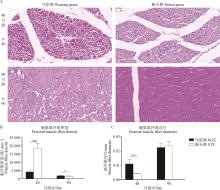
图1
40、90日龄乌鬃鹅(WZE)和狮头鹅(STE)的胸肌H&E染色切片及肌纤维密度和直径统计A.从左到右从上到下依次为40日龄乌鬃鹅、40日龄狮头鹅、90 日龄乌鬃鹅、90日龄狮头鹅的H&E染色切片图,比例尺为20 μm;B.肌纤维密度统计图;C.肌纤维直径统计图。*.P<0.05;***.P<0.001"

表 2
40、90日龄狮头鹅与乌鬃鹅胸肌转录组测序数据的质量评估"
样品 Sample | 质控数据 Quality control data | GC含量/% GC content | ≥Q30/% | 比对上的片段数 Aligned Reads |
|---|---|---|---|---|
| S40X-1 | 25 993 686 | 52.89 | 92.65 | 39 532 520(76.04%) |
| S40X-2 | 29 258 927 | 51.99 | 93.01 | 44 956 487(76.83%) |
| S40X-3 | 26 641 012 | 51.64 | 92.47 | 41 752 034(78.36%) |
| S90X-1 | 28 035 903 | 52.88 | 93.13 | 43 059 724(76.79%) |
| S90X-2 | 28 889 935 | 52.62 | 92.97 | 44 994 751(77.87%) |
| S90X-3 | 26 895 653 | 51.37 | 92.95 | 42 246 027(78.54%) |
| W40X-1 | 38 520 719 | 52.64 | 92.99 | 59 236 364(76.89%) |
| W40X-2 | 29 841 669 | 51.23 | 92.48 | 47 271 191(79.20%) |
| W40X-3 | 21 850 224 | 52.10 | 92.83 | 34 262 682(78.40%) |
| W90X-1 | 31 078 128 | 51.01 | 92.74 | 49 449 086(79.56%) |
| W90X-2 | 42 480 650 | 51.22 | 92.32 | 66 544 240(78.32%) |
| W90X-3 | 33 421 269 | 51.34 | 92.50 | 53 187 288(79.57%) |
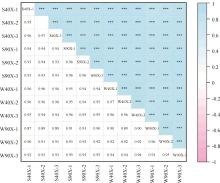
图 2
40、90日龄狮头鹅与乌鬃鹅胸肌转录组测序数据Spearman相关系数分析***. P<0.001"
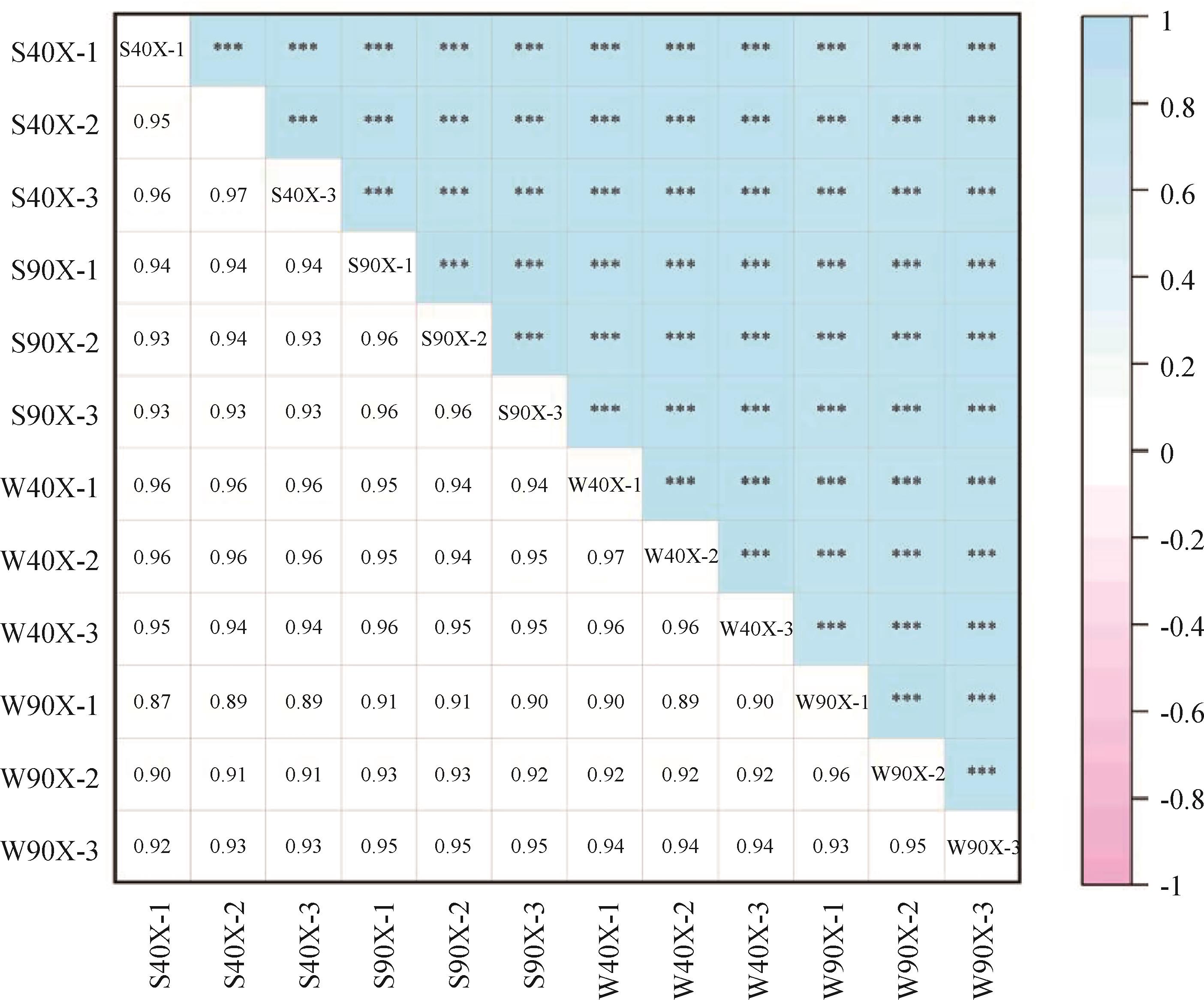
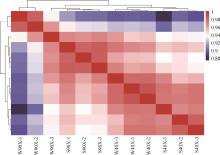
图3
40、90日龄狮头鹅与乌鬃鹅胸肌转录组测序数据聚类分析"
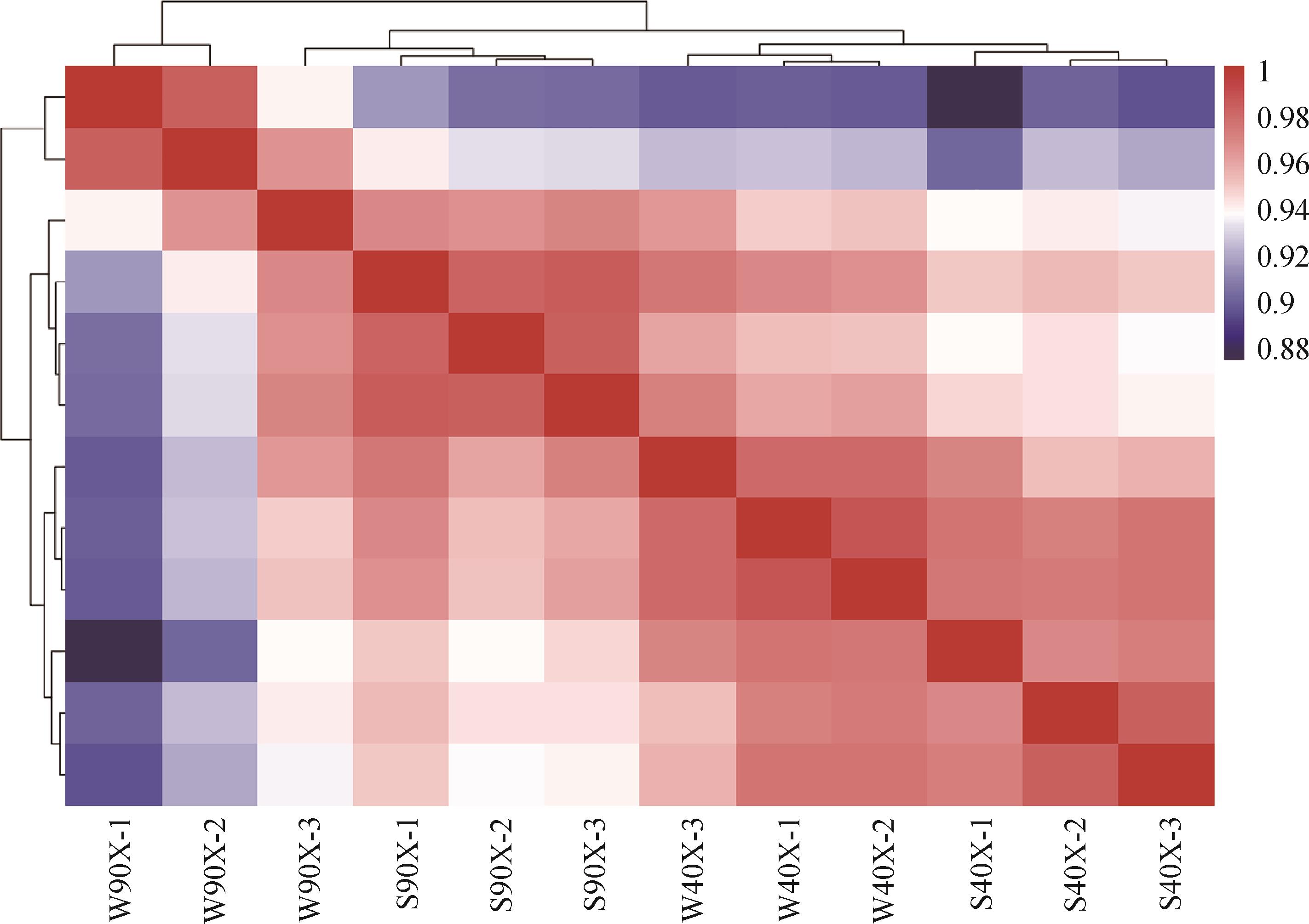
表3
40、90日龄狮头鹅与乌鬃鹅胸肌差异表达基因数目统计表"
差异表达基因集 DEGs set | 差异表达基因数目 Number of DEGs | 上调基因数目 Number of up-regulated genes | 下调基因数目 Number of down-regulated genes |
|---|---|---|---|
| 不同日龄同一鹅种 Same goose breed with different ages | |||
| S40X vs S90X | 1 912 | 836 | 1 076 |
| W40X vs W90X | 1 995 | 923 | 1 072 |
| 同一日龄不同鹅种 Different goose breeds with the same age | |||
| S40X vs W40X | 319 | 187 | 132 |
| S90X vs W90X | 1 493 | 858 | 635 |
表 4
GO显著富集的与成肌相关条目中的DEGs"
分组 Group | 生物过程 Biological process | q值 q-value | 基因名称 Gene name |
|---|---|---|---|
| S40X vsS90X | 胶原纤维组织 | 0.02 | DDR2、MKX、LOC106044084、LOX、P3H1、COL2A1、ANXA2、COL5A2、LUM |
| S40X vsW40X | 钙离子稳态 | 0.05 | LOC106031155、LOC106031415、CSRP3 |
| 骨骼肌卫星细胞增殖的调节 | 0.05 | ANGPT1 | |
| 肌丝滑动 | 0.05 | TNNT2 | |
| Rho蛋白信号转导的调节 | 0.05 | Anser_cygnoides_newGene_5510、PLEKHG5、ARHGEF9 | |
| 肌肉组织发育的正向调控 | 0.05 | PPARGC1A | |
| 血管发生的正向调控 | 0.05 | ASB4 | |
| 肌肉器官发育 | 0.05 | MYF5、ETV1 | |
| 对肌肉活动的响应 | 0.05 | PPARGC1A | |
| 细胞黏附的调节 | 0.05 | S1PR1、LAMA5 | |
| 细胞呼吸的正向调控 | 0.05 | PPARGC1A | |
| ATP生物合成过程的正向调控 | 0.05 | PPARGC1A | |
| W40X vs W90X | 炎症反应 | 0.01 | Anser_cygnoides_newGene_9361、IL18、LOC106029986、LOC106041040、NCF1、BMPR1B、LOC106041921、LOC106041918、NOS2、PTAFR、C3、ITGB6、KIT |
| W90X vsS90X | 炎症反应 | 0.01 | Anser_cygnoides_newGene_9361、IL18、LOC106029986、LOC106041040、NCF1、LOC106041921、LOC106041918、NOS2、PTAFR、C3、KIT |
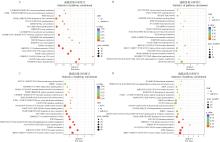
图4
40、90日龄狮头鹅与乌鬃鹅胸肌DEGs的KEGG通路富集散点图纵坐标表示通路名称,横坐标为富集因子。圆圈颜色代表通路富集的q 值,q 值越小颜色越红,圆圈的大小表示该通路中富集到的基因数目,点越大富集到的基因数目越多"

表5
KEGG显著富集的与成肌相关通路中的DEGs"
分组 Group | 通路名称 Pathway | q值 q-value | 基因名称 Gene name |
|---|---|---|---|
| A组 A group(S40X vs S90X) | ECM-受体相互作用 | <0.01 | COL4A5、COL4A6、COL1A2、SDC4、CD44、COL4A2、THBS2、SDC1、VWF、ITGA9、ITGB3、COL6A6、COMP、THBS3、COL2A1、LOC106049842、TNXB、ITGB8、HMMR、CHAD、ITGB4、CD36、ITGA1、ITGA2、COL4A3、SV2B |
| A组 A group(S40X vsS90X) | 细胞黏附分子 | <0.01 | NCAM1、CADM1、ESAM、JAM3、SDC4、VCAN、NEGR1、LRRC4C、CD276、NEO1、SDC1、SDC3、ITGA9、CNTN1、NRCAM、OCLN、CLDN19、CLDN10、LOC106029335、ITGB8、CLDN5、CDH5、PTPRF、PECAM1、PTPRM、CD99、CD58、JAM2、CDH2、COLEC10 |
| A组 A group(S40X vsS90X) | 黏着斑 | <0.01 | LOC106038554、COL4A5、COL4A6、COL1A2、FLT1、CAV2、CAV1、PIK3R1、COL4A2、THBS2、VWF、ITGA9、ITGB3、CCND2、COL6A6、MYLK2、COMP、THBS3、MYLK4、SHC2、VEGFA、COL2A1、LOC106049842、TNXB、ITGB8、PDGFRA、KDR、MYL2、CRKL、PDGFC、FLT4、PIK3R3、SHC4、CHAD、ITGB4、ITGA1、ITGA2、COL4A3、CAV3、FIGF、FLNB、PARVG |
| C组 C group(W40X vsW90X) | ECM-受体相互作用 | <0.01 | COL4A5、COL4A6、COL1A2、LAMA5、SPP1、LAMB1、LAMB4、ITGA11、CD44、LAMC3、AGRN、THBS2、VWF、ITGA9、GP1BA、COL6A6、THBS3、LOC106049058、COL2A1、COL6A2、LOC106049839、LOC106049842、TNXB、ITGB5、ITGB6、GP1BB、LAMA2、LAMA4、COL6A3、CHAD、TNC、LOC106037602、COLEC10 |
| C组 C group(W40X vsW90X) | 细胞因子-细胞因子受体相互作用 | <0.01 | Anser_cygnoides_newGene_1760、IL2RA、IL18、TNFRSF1B、TNFRSF8、TNFRSF6B、BMPR1B、LOC106041570、IL18R1、IL1R2、LOC106041918、LOC106041919、CXCL12、IFNAR1、IL10RB、TNFRSF18、TNFSF13B、AMH、LOC106045913、IL4R、CD40、IL1RAP、CSF1、CNTFR、LOC106048595、LOC106048600、NGFR、VEGFA、CCR7、IL1B、PDGFRA、KIT、IL17RA、TGFB2、BMPR1A、CXCL14、CX3CL1、PDGFA、LOC106035752、LOC106035885、IL2RB、IL7R、TNFSF15、IL13RA1、IL2RG、TNFRSF21、LOC106038377、LOC106038356、LOC106038357 |
| C组 C group(W40X vsW90X) | 黏着斑 | <0.01 | COL4A5、COL4A6、COL1A2、PIK3CB、LAMA5、SPP1、VAV3、PIK3CG、LAMB1、LAMB4、ITGA11、LAMC3、VAV2、PIK3CD、CCND1、THBS2、LOC106044678、VWF、ITGA9、CCND3、LOC106045852、COL6A6、PIK3R5、ZYX、ACTN2、THBS3、RASGRF1、LOC106049058、SHC2、VEGFA、COL2A1、COL6A2、LOC106049839、LOC106049842、TNXB、ITGB5、ITGB6、PDGFRA、MYL2、LAMA2、LAMA4、PDGFA、BIRC2、COL6A3、PRKCA、CHAD、IGF1、RAC2、PAK7、CAV3、TNC、LOC106037602 |
| C组 C group(W40X vsW90X) | 细胞黏附分子 | <0.01 | Anser_cygnoides_newGene_6728、CD2、CD80、VCAM1、NCAM1、CADM1、NLGN4X、JAM3、CD34、LOC106041540、LOC106041602、NTNG1、PTPRC、NRXN1、NEGR1、LRRC4C、PDCD1、ITGA9、LOC106046390、CD40、CNTN1、CD4、CD86、LOC106049813、LOC106029726、CD28、ITGB2、CD8A、PTPRF、COLEC10 |
| C组 C group(W40X vsW90X) | 钙信号通路 | <0.01 | Anser_cygnoides_newGene_6800 、Anser_cygnoides_newGene_6806 、CAMK2D、ADCY7、HTR7、HRH1、PHKG1、P2RX1、CAMK4、ADRB2、NOS2、LOC106044837、TBXA2R、ADORA2B、CACNA1S、PTAFR、AVPR1A、PLCB2、TNNC2、PLN、PTK2B、LOC106049872、PDE1A、TACR2、PDGFRA、SLC8A3、CACNA1H、ERBB4、PRKCA、SPHK1、AGTR1、ADCY2、HTR2C、GRPR、PHKA2 |
| C组 C group(W40X vs W90X) | 肌动蛋白细胞骨架的调控 | <0.01 | FGFR2、ARHGEF4、PIK3CB、ELN、VAV3、PIK3CG、IQGAP2、ITGA11、VAV2、EZR、PIK3CD、FGFR1、LOC106044678、ITGA9、LOC106045852、FGF6、PIK3R5、ACTN2、LOC106049058、FGFR4、LOC106049839、LOC106029514、ITGB5、ITGB6、ABI2、ITGB2、PDGFRA、MYL2、ENAH、CFL2、ARPC1B、FGF1、PDGFA、GNA13、RAC2、PAK7、SCIN |
| D组 D group(S90X vsW90X) | 细胞因子-细胞因子受体相互作用 | <0.01 | Anser_cygnoides_newGene_1760、TNFRSF11B、IL2RA、IL18、TNFRSF1B、TNFRSF19、LOC106041570、IL18R1、IL1R2、LOC106041918、LOC106041919、IFNAR1、IL10RB、TNFRSF18、TNFSF13B、AMH、LOC106045913、IL1RAP、CSF1、CNTFR、CCR7、IL1B、PDGFRA、KIT、TGFB2、CXCL14、FLT4、PDGFA、LOC106035752、LOC106035885、IL7R、TNFSF15、IL2RG、LOC106038356、LOC106038357 |
| D组 D group(S90X vsW90X) | 细胞黏附分子 | 0.01 | CD80、VCAM1、ESAM、CD34、LOC106041540、LOC106041602、PTPRC、VCAN、PDCD1、LOC106046592、CNTN1、CD4、OCLN、CD86、LOC106049813、LOC106029504、CD28、ITGB2、CDH5、JAM2、CDH2、ALCAM |
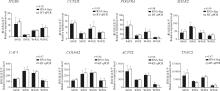
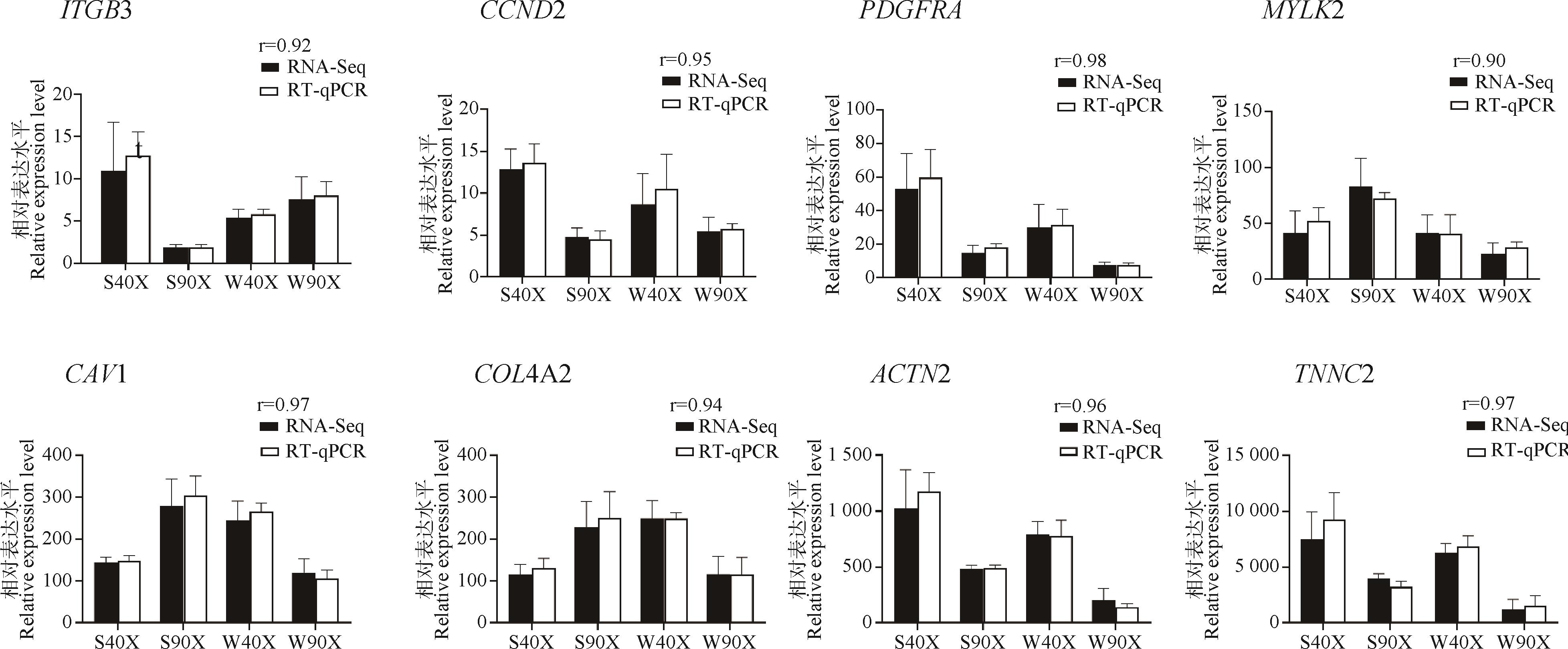
图5
转录组测序数据与实时荧光定量PCR数据相关性分析"
| [1] | 侯水生,刘灵芝.2024年水禽产业与技术发展报告[J].中国畜牧杂志,2025,61(3):383-387. |
| HOU S S,LIU L Z.2024 report on the waterfowl industry and technological development[J].Chinese Journal of Animal Science,2025,61(3):383-387.(in Chinese) | |
| [2] | GU S,HUANG Q,Jie Y,et al.Transcriptomic and epigenomic landscapes of muscle growth during the postnatal period of broilers[J].J Anim Sci Biotechnol,2024,15(5):1851-1865. |
| [3] | 刘雅丽.三个品种鹅肌纤维发育和肌内脂肪沉积的调控机制研究[D].温江:四川农业大学,2023. |
| LIU Y L.The regulation mechanism of muscle fiber development and intramuscular fat depositionin three goose breeds[D].Wenjiang :Sichuan Agricultural University,2023.(in Chinese) | |
| [4] | YANG Y,WANG C,CHEN S F,et al.Identifying candidate genes and biological pathways in muscle development through multi-tissue transcriptome comparisons between male and female geese[J].Sci Rep,2024,14(1):16474. |
| [5] | ZHAO X,CAO Y,LI H,et al.Development of myofibers and muscle transcriptomic analysis in growing Yili geese[J].Poult Sci,2024,103(2):103328. |
| [6] | HU X,LIU Y,TANG B,et al.Comparative transcriptomic analysis revealed potential mechanisms regulating the hypertrophy of goose pectoral muscles[J].Poult Sci,2024,103(12):104498. |
| [7] | 张 鑫,江 幸,张 康,等.能量和蛋白水平对生长育肥阶段皖西白鹅生长性能、肠道酶活性及血液指标的影响[J].饲料研究,2024,47(10):48-54. |
| ZHANG X,JIANG X,ZHANG K,et al.Effects of energy and protein levels on growth performance,intestinal enzyme activity,and blood indicators of Wanxi white geese during growth and fattening stages[J].Feed Research,2024,47(10):48-54.(in Chinese) | |
| [8] | 黄松波.肉用狮头鹅的饲养管理[J].中国家禽,2009,31(22):65-66. |
| HUANG S B.Breeding management of meat-type Shitou Geese [J].The Chinese Livestock and Poultry Breeding,2009,31(22):65-66.(in Chinese) | |
| [9] | 何 莉.提高养鹅经济效益的关键措施[J].现代农业科技,2008(5):198. |
| HE L.Key measures to improve the economic benefits of goose farming[J].Modern Agricultural Science and Technology,2008(5):198.(in Chinese) | |
| [10] | 夏成兴,许坤杰,陈梓远,等.乌鬃鹅的遗传资源保护与开发利用现状研究[J].中国畜禽种业,2024,20(7):40-47. |
| XIA C X,XU K J,CHEN Z Y,et al.Research status of conservation and development of genetic resources of Wuzong Goose[J].The Chinese Livestock and Poultry Breeding,2024,20(7):40-47.(in Chinese) | |
| [11] | 罗永全,韩远豪,黎颂超,等.狮头鹅种质资源概述及保护与开发利用建议[J].中国畜禽种业,2024,20(7):32-39. |
| LUO Y Q,HAN Y H,LI S C,et al.Overview of germplasm resources of Shitou Goose and suggestions for protection,development and utilization[J].The Chinese Livestock and Poultry Breeding,2024,20(7):32-39.(in Chinese) | |
| [12] | TANG J,OUYANG H,CHEN X,et al.Comparative transcriptome analyses of leg muscle during early growth between geese (Anser cygnoides) breeds differing in body size characteristics[J].Genes,2023,14(5):1048. |
| [13] | ZHANG X,WANG J,LI X,et al.Transcriptomic investigation of embryonic pectoral muscle reveals increased myogenic processes in Shitou geese compared to Wuzong geese[J].Br Poult Sci,2021,62(5):650-657. |
| [14] | CORDERO A I H,GONZALES N M,PARKER C C,et al.Genome-wide associations reveal human-mouse genetic convergence and modifiers of myogenesis,CPNE1 and STC2[J].Am J Hum Genet,2019,105(6):1222-1236. |
| [15] | 贺 喜,宋泽和,常 凌.肉鸡肌纤维性状形成机制及调控的研究进展[J].动物营养学报,2022,34(10):6298-6305. |
| HE X,SONG Z H,CHANG L.Research progress on mechanism and regulation of chicken muscle fiber development[J].Chinese Journal of Animal Nutrition,2022,34(10):6298-6305(in Chinese) | |
| [16] | LUDOLPH D C,KONIECZNY S F.Transcription factor families:muscling in on the myogenic program[J].FASEB J,1995,15(9):1595-1604. |
| [17] | 欧秀琼,李 睿,张晓春,等.肌纤维类型组成对猪肌肉品质与能量代谢的影响研究进展[J].浙江农业学报,2022,34(1):196-203. |
| OU X Q,LI R,ZHANG X C,et al.Research progress of effects of muscle fiber type composition on muscle quality and energy metabolism in pigs[J].Acta Agriculturae Zhejiangensis,2022,34(1):196-203.(in Chinese) | |
| [18] | 武 敏,徐俊杰,李欣欣,等.基于转录组测序筛选调控黄羽肉鸡肌肉发育的关键基因[J].中国畜牧兽医,2025,52(3):990-1000. |
| WU M,XU J J,LI X X,et al.Screening of key genes regulating muscle development in Yellow-feathered chickens based on RNA-Seq[J].China Animal Husbandry & Veterinary Medicine,2025,52(3):990-1000.(in Chinese) | |
| [19] | ZHANG X,LI Y,ZHU C,et al.DNA demethylation of myogenic genes may contribute to embryonic leg muscle development differences between Wuzong and Shitou Geese [J].Int J Mol Sci,2023,24(8):7188. |
| [20] | 王金辉,黎颂超,唐黄益,等.胚胎期狮头鹅和乌鬃鹅肌纤维及肌内脂肪的发育比较[J].仲恺农业工程学院学报,2020,33(2):32-37. |
| WANG J H,LI S C,TANG H Y,et al.Comparison of embryomc myofiber and intramuscular fat development between Shitou and Wuzong goose[J].Journal of Zhongkai University of Agriculture and Engineering,2020,33(2):32-37.(in Chinese) | |
| [21] | 杨朝永,陈若楠,张若彤,等.鸡胚胎期肌纤维形成相关miRNAs的筛选与分析[J].中国家禽,2024,46(5):1-11. |
| YANG C Y,CHEN R N,ZHANG R T,et al.Screening and analysis of miRNAs related to chicken embryonic muscle fiber formation[J].China Poultry,2024,46(5):1-11.(in Chinese) | |
| [22] | 王金辉,黄雪菲,杨 晨,等.狮头鹅和乌鬃鹅不同生长阶段肌纤维发育规律的研究[J].仲恺农业工程学院学报,2019,32(2):31-35. |
| WANG J H,HUANG X F,YANG C,et al.Development of muscle fibers at different growth stages of Shitou and Wuzong geese[J].Journal of Zhongkai University of Agriculture and Engineering,2019,32(2):31-35.(in Chinese) | |
| [23] | 刘海婷,王国文,彭 巍,等.犏牛、牦牛及黄牛骨骼肌转录特征的差异研究[J].青海大学学报,2024,42(2):18-27. |
| LIU H T,WANG G W,PENG W,et al.Differences research on the transcriptional characteristics of skeletal muscles among cattle-yak,yak and cattle[J].Journal of Qinghai University,2024,42(2):18-27.(in Chinese) | |
| [24] | DENG Y,HU S,LUO C,et al.Integrative analysis of histomorphology,transcriptome and whole genome resequencing identified DIO2 gene as a crucial gene for the protuberant knob located on forehead in geese[J].BMC Genomics,2021,22(1):487. |
| [25] | WOHLGEMUTH R P,SRIRAM S,HENRICSIN K E,et al.Strain-dependent dynamic re-alignment of collagen fibers in skeletal muscle extracellular matrix[J].Acta Biomater,2024,187:227-241. |
| [26] | 郭 豪,任小青.子宫内膜异位症导致免疫性不孕的病因研究进展[J].医学理论与实践,2011,24(15):1789-1790. |
| GUO H,REN X Q.Research progress on the etiology of immune infertility caused by endometriosis[J].The Journal of Medical Theory and Practice,2011,24(15):1789-1790.(in Chinese) | |
| [27] | SHAO M,SHI K,ZHAO Q,et al.Transcriptome analysis reveals the differentially expressed genes associated with growth in Guangxi Partridge Chickens[J].Genes,2022,13(5):798. |
| [28] | 张莹莹.BMPR-1B基因在藏羊卵巢颗粒细胞凋亡过程的作用及其多态性与产羔性状关联性分析[D].西宁:青海大学,2023. |
| ZHANG Y Y.Role of BMPR-1B gene in apoptosis of ovarian granulosa cells in Tibetan sheep and analysis of its polymorphism in association with lambing traits[D].Xining:Qinghai University,2023.(in Chinese) | |
| [29] | 魏婧雅.日粮不同锌源对大肠杆菌感染犊牛肠道上皮屏障及空肠黏膜蛋白质组学的影响[D].北京:中国农业科学院,2019. |
| WEI J Y.Effects of Different zinc sources on the intestinal epithelial barrier and jejunal mucosal proteomics of newborn calves challenged with Escherichia Coli K88[D].Beijing:Chinese Academy of Agricultural Sciences,2019.(in Chinese) | |
| [30] | 赵 迪,康慧敏,谭晓冬,等.利用加权基因共表达网络分析筛选天农麻鸡胴体性状候选基因[J].畜牧兽医学报,2022,53(7):2130-2140. |
| ZHAO D,KANG H M,TAN X D,et al.Screening of candidate genes for carcass traits of Tiangong Partridge Chicken using weighted gene co-expression network analysis[J].Acta Veterinaria et Zootechnica Sinica,2022,53(7):2130-2140.(in Chinese) | |
| [31] | 杨 峥,郭占林,王宇飞.整合素αvβ3与肿瘤关系的研究进展[J].内蒙古医科大学学报,2022,44(6):660-663. |
| YANG Z,GUO Z L,WANG Y F.INTEGRIN αv β research progress in the relationship between tumor[J].Journal of Inner Mongolia Medical University,2022,44(6):660-663.(in Chinese) | |
| [32] | MENG Z,TANG D,CHENG Z,et al.GPR41 regulates the proliferation of BRECs via the PIK3-AKT-mTOR pathway[J].Int J Mol Sci,2023,24(4):4203. |
| [33] | 高 一,吕 阳,刘理想,等.牛PDGFRA基因克隆及过表达载体构建的研究[J].黑龙江畜牧兽医,2019(3):11-14. |
| GAO Y,LV Y,LIU L X,et al.Cloning and construction of over-expression vector of bovine PDGFRA gene[J].Heilongjiang Animal Science and Veterinary Medicine,2019(3):11-14.(in Chinese) | |
| [34] | HUANG R,CHENG J,DONG X et al.Transcriptome data revealed the circRNA-miRNA-mRNA regulatory network during the proliferation and differentiation of myoblasts in Shitou Goose[J].Animals,2024,4(14):576. |
| [35] | 张 军,卢立志,吕 佳,等.鸡CACNA1S基因SNPs及其与部分屠体性状的关联性研究[J].黑龙江畜牧兽医,2012(1):49-51. |
| ZHANG J,LU L Z,LV J,et al.Association between SNPs in the Chicken CACNA1S gene and part of carcass traits[J].Heilongjiang Animal Science and Veterinary Medicine,2012(1):49-51.(in Chinese) | |
| [36] | 施 安,孙文阳,陈志龙,等.不同品种肉牛肌内脂肪沉积相关基因比较研究[J].动物营养学报,2023,35(9):6013-6025. |
| SHI A,SUN W Y,CHEN Z L,et al.Comparative study on genes related to intramuscular fat deposition in different breeds of beef cattle[J].Chinese Journal of Animal Nutrition,2023,35(9):6013-6025 (in Chinese) | |
| [37] | 徐秋良,崔 锦,朱宽佑,等.不同TNNC2基因型滩羊骨骼肌中TNNC2的表达量分析[J].黑龙江畜牧兽医,2015(2):28-29. |
| XU Q L,CUI J,ZHU K Y,et al.Analysis of TNNC2expression in skeletal muscle of Tan sheep with different TNNC2 genotypes[J].Heilongjiang Animal Science and Veterinary Medicine,2015(2):28-29.(in Chinese) | |
| [38] | 中华医学会核医学分会,中国生物物理学会分子影像学分会.整合素RGD受体显像临床应用专家共识(2022版)[J].协和医学杂志,2022,13(2):227-234. |
| Chinese Society of Nuclear Medicine,Chinese Society of Molecular Imaging in Chinese Biophysical Society.Expert consensus on clinical application of integrin RGD receptor imaging[J].Medical Journal of Peking Union Medical College Hospital,2022,13(2):227-234.(in Chinese) | |
| [39] | 余书娟,冷梅钦.汕头市澄海狮头鹅产业高质量发展的路径研究[J].现代商业,2024(22):159-163. |
| YU S J,LENG M Q.Research on pathways for the high-quality development of the Chenghai Shitou Goose industry in Shantou City[J].Modern Business,2024(22):159-163.(in Chinese) | |
| [40] | 朱辰语,梁雅妍,陈益填,等.肉鸽骨骼肌生长发育调控机制的研究进展及展望[J].中国畜禽种业,2023,19(12):97-107. |
| ZHU C Y,LIANG Y Y,CHEN Y T,et al.Research progress and prospects on the regulatory mechanism of skeletal muscle growth and development in meat pigeons[J].The Chinese Livestock and Poultry Breeding,2023,19(12):97-107.(in Chinese) | |
| [41] | 秦小伟.Neddylation对绵羊卵泡颗粒细胞功能调控的作用机制[D].太谷:山西农业大学,2022. |
| QIN X W.Mechanism of Neddylation on the function regulation of follicular granulosa cells in sheep[D].Taigu:Shanxi Agricultural University,2022.(in Chinese) | |
| [42] | 李莉娟,宋少华,方晓琳,等.基于生物信息学检测PRKCD在肝细胞癌中的表达及意义[J].国际检验医学杂志,2021,42(16):1982-1986. |
| LI L J,SONG S S,FANG X L,et al.Expression and significance of PRKCD inhepatocellular carcinoma based on bioinformatics[J].International Journal of Laboratory Medicine,2021,42(16):1982-1986.(in Chinese) | |
| [43] | 马明杰,陈丽丽,马 毅.转录组测序技术在牦牛特性研究中的应用[J].中国畜禽种业,2024,20(11):51-58. |
| MA M J,CHEN L L,MA Y.Application of transcriptome sequencing technology inthe study of yak characteristics[J].The Chinese Livestock and Poultry Breeding,2024,20(11):51-58.(in Chinese) |
| [1] | 林晓, 李瑞杰, 刘龙, 耿拓宇, 龚道清. 动物的性别决定基因及其甲基化调控的研究进展[J]. 畜牧兽医学报, 2025, 56(9): 4129-4142. |
| [2] | 陈艳茹, 马小春, 王明慧, 唐瑶瑶, 白露, 赵桂苹, 文杰, 刘冉冉. 白羽肉鸡胸肌意大利面肉和木质肉发生率及其对肉品质影响研究[J]. 畜牧兽医学报, 2025, 56(6): 2672-2684. |
| [3] | 苏蒙, 刘莎, 宋丹丽, 高倩梅, 郑麦青, 文杰, 赵桂苹, 李庆贺. 基于转录组测序筛选肉鸡腹水综合征相关候选基因[J]. 畜牧兽医学报, 2025, 56(2): 559-570. |
| [4] | 陈尚琛, 董宁宁, 谈晓梅, 李娜, 张琦, 罗茂青, 邓应坤, 庞帅赛, 高嘉溪, 刘光清, 孟春春. 表达猫杯状病毒NS2质粒转染猫肾传代细胞的转录组学分析[J]. 畜牧兽医学报, 2025, 56(12): 6339-6350. |
| [5] | 朱功全, 张越宏, 王军, 李晓鸣, 葛晶, 穆晓惠, 赵洪昌, 赵敏孟, 刘龙, 龚道清, 王健, 耿拓宇. 鹅豁眼与深浅黄羽性状的遗传标记筛选及分子基础初探[J]. 畜牧兽医学报, 2025, 56(11): 5512-5530. |
| [6] | 张怡然, 毛楠楠, 王韵龙, 周荣艳, 臧素敏, 谢辉, 王文君, 张维娅. 基于全基因组选择信号和转录组鉴定28日龄乳鸽胸肌率相关关键基因[J]. 畜牧兽医学报, 2025, 56(11): 5531-5544. |
| [7] | 黄红艳, 张力允, 黄智荣, 伍仲平, 张续勐, 欧阳宏佳, 陈俊鹏, 林桢平, 田允波, 李秀金, 黄运茂. 狮头鹅群体遗传多样性和体重体尺全基因组关联分析[J]. 畜牧兽医学报, 2024, 55(9): 3914-3924. |
| [8] | 王一诺, 徐丹, 杨建华, 刘洋, 田尧夫, 赵小玲. 基于超声波测量胸肌厚预测肉鸡产肉性能的选育方法研究[J]. 畜牧兽医学报, 2024, 55(7): 2901-2912. |
| [9] | 高娅薇, 彭弟, 孙朝阳, 晏子越, 崔凯, 马泽芳. 基于转录组数据挖掘外源褪黑激素影响水貂卵巢发育的分子机制[J]. 畜牧兽医学报, 2024, 55(2): 607-618. |
| [10] | 王雅婷, 曾雅婷, 张幸哲, 吴琼, 吴旭. 基于脂质组学和风味组学分析日龄、品种对鸭胸肌风味的影响[J]. 畜牧兽医学报, 2024, 55(10): 4403-4416. |
| [11] | 张寅梁, 张冉, 王文君, 王德贺, 李兰会, 周荣艳. 基于转录组数据挖掘蛋鸡产蛋前后骨代谢差异的关键候选基因[J]. 畜牧兽医学报, 2024, 55(10): 4455-4465. |
| [12] | 王子渲, 王巧, 张锦, Astrid Lissette Barreto Sánchez, 郑麦青, 李庆贺, 崔焕先, 安炳星, 赵桂苹, 文杰, 李和刚. 基于脾脏转录组筛选北京油鸡和广明白鸡抗热应激相关功能基因[J]. 畜牧兽医学报, 2023, 54(5): 1905-1914. |
| [13] | 欧正淼, 周家文, 刘莉莉, 吴芸, 陈粉粉. 基于RNA-Seq的无量山乌骨鸡肝脏组织脂代谢相关基因筛选及其表达分析[J]. 畜牧兽医学报, 2023, 54(3): 976-988. |
| [14] | 韩浩园, 李世凯, 杨瑞巧, 李曼曼, 李君, 哈斯, 赵金艳, 魏红芳, 权凯. 基于转录组测序挖掘槐山羊高繁关键候选基因[J]. 畜牧兽医学报, 2023, 54(12): 5077-5090. |
| [15] | 马帅, 王燕, 庄新娟, 王文正, 赵茹茜. 母鹅日粮添加甜菜碱通过IGFs信号通路促进子代胸肌肌纤维肥大[J]. 畜牧兽医学报, 2023, 54(12): 5112-5124. |
| 阅读次数 | ||||||
|
全文 |
|
|||||
|
摘要 |
|
|||||
