


Acta Veterinaria et Zootechnica Sinica ›› 2025, Vol. 56 ›› Issue (11): 5789-5800.doi: 10.11843/j.issn.0366-6964.2025.11.036
• Preventive Veterinary Medicine • Previous Articles Next Articles
WANG Xinyu1( ), LI Jiani1, BO Huiwen2, MA Chenchen1, WU Wenjuan1, YU Yongle1, YANG Haiyan1, MA Qingxia1,*(), ZHANG Chuanmei1,*()
Received:2025-02-17
Online:2025-11-23
Published:2025-11-27
Contact:
MA Qingxia, ZHANG Chuanmei
E-mail:2280065461@qq.com;maqingxia2006@163.com;zhangchuanmei100@163.com
CLC Number:
WANG Xinyu, LI Jiani, BO Huiwen, MA Chenchen, WU Wenjuan, YU Yongle, YANG Haiyan, MA Qingxia, ZHANG Chuanmei. Establishment of a Triple Fluorescence Quantitative PCR Method for Porcine Circovirus Types 2, 3 and 4 and Analysis of Genetic Evolution of the Cap Gene[J]. Acta Veterinaria et Zootechnica Sinica, 2025, 56(11): 5789-5800.
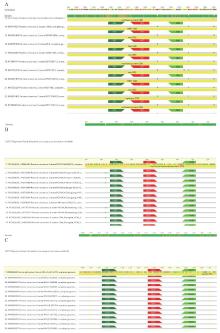
Fig. 1
Sequence alignment of conserved regions in the Cap and Rep genes of PCV A. Sequence alignment results of the conserved region of the PCV2 Rep gene (. PCV2 upstream primer; . PCV2 downstream primer; . PCV2 probe); B. Sequence alignment results of the conserved region of the PCV3 Rep gene (. PCV3 upstream primer; . PCV2 downstream primer; . PCV3 probe); C. Sequence alignment results of the conserved region of the PCV4 Cap gene (. PCV4 upstream primer; . PCV4 downstream primer; . PCV4 probe)"


Table 1
Primers and probes designed for real-time PCR"
| 病原 Pathogen | 基因 Gene | 引物及探针序列(5′→3′) Primer and probe | 片段长度/bp Length |
| PCV2 | Rep | F: CCCGCAGTATTCTGATTACC | 87 |
| R: TCCGATAGAGAGCTTCTACA | |||
| P: GCAATCAGACCCCGTTGGAATGG | |||
| PCV3 | Rep | F: AATCTGACTGAAGTTGCG | 133 |
| R: TCAGTTTTAAAATCACGC | |||
| P: CTATGGGCGGGGTTTGCG | |||
| PCV4 | Cap | F: TCCACACCTGCACAAAGTT | 119 |
| R: CCTCCACTTCCAGCCTAA | |||
| P: GTCCTGGTCCGCCATGCT |
Table 2
Summary of primers used for detecting and amplification the genome of PCV"
| 病原 Pathogen | 引物(5′→3′) Primer | 片段长度/bp Length | 基因 Gene | 引物用途 Primer usage |
| PCV2 | F: CAGACCCCGTTGGAATGG | 949 | Cap | 检测 |
| R: AATACTTACAGCGCACTTCTTTCG | ||||
| PCV3 | F: CTTGTGTACAATTATTGCGTTGG | 883 | Cap | 检测 |
| R: AATACTAGCCCGGCACCA | ||||
| PCV4 | F: CGCACTTGCAAGGGTTTGTG | 428 | Rep | 检测 |
| R: GCCACGTGGTTTCCAGAAGAGGT |
Table 3
PCV2 Reference strains"
| 登录号 Accession No. | 毒株来源 Source of virus Strain | 宿主 Host | 提交年份 Year | 长度/nt Length/nt | 亚基因型 Sub-genotype |
| OP113847.1 | 中国山东 | 猪 | 2022 | 1 768 | PCV2a |
| OR533473.1 | 中国江苏 | 猪 | 2023 | 1 768 | PCV2a |
| MZ615677.1 | 中国吉林 | 猪 | 2019 | 1 768 | PCV2a |
| HQ202970.1 | 中国台湾 | 猪 | 2012 | 1 767 | PCV2b |
| FJ870969.1 | 中国江西 | 猪 | 2021 | 1 770 | PCV2b |
| HQ831525.1 | 葡萄牙 | 猪 | 2007 | 1 767 | PCV2b |
| EU148505.1 | 丹麦 | 猪 | 2008 | 1 767 | PCV2b |
| EU148203.1 | 丹麦 | 猪 | 2008 | 1 767 | PCV2c |
| EU148504.1 | 丹麦 | 猪 | 2008 | 1 767 | PCV2c |
| OR533470.1 | 中国 | 猪 | 2015 | 1 767 | PCV2d |
| KC515022.1 | 中国河南 | 猪 | 2021 | 1 767 | PCV2d |
| MK504417.1 | 美国 | 猪 | 2018 | 1 767 | PCV2d |
| MK347372.1 | 中国 | 猪 | 2015 | 1 767 | PCV2d |
| MK405699.1 | 中国 | 猪 | 2018 | 1 767 | PCV2d |
| KF742551.1 | 中国 | 猪 | 2012 | 1 767 | PCV2d |
| KT795290.1 | 美国 | 猪 | 2015 | 1 767 | PCV2e |
| KT795287.1 | 墨西哥 | 猪 | 2014 | 1 777 | PCV2e |
Table 4
PCV3 Reference strains"
| 登录号 Accession No. | 毒株来源 Source of virus Strain | 宿主 Host | 提交年份 Year | 长度/nt Length/nt | 亚基因型 Sub-genotype |
| OP948026.1 | 中国重庆 | 猪 | 2023 | 2 000 | PCV3a |
| MW715784.1 | 中国山东 | 猪 | 2021 | 2 000 | PCV3a |
| MT075524.1 | 巴西 | 猪 | 2021 | 2 000 | PCV3a |
| MK746104.1 | 中国新疆 | 猪 | 2019 | 1 999 | PCV3a |
| OL422143.1 | 中国山东 | 猪 | 2021 | 2 000 | PCV3a |
| ON376262.1 | 波兰 | 猪 | 2023 | 2 000 | PCV3a |
| MK058529.1 | 美国 | 猪 | 2018 | 2 000 | PCV3a |
| MN848609.1 | 中国甘肃 | 猪 | 2019 | 2 000 | PCV3a |
| MN848598.1 | 中国甘肃 | 猪 | 2019 | 2 000 | PCV3b |
| MZ449245.1 | 中国新疆 | 猪 | 2020 | 2 000 | PCV3b |
| MZ449242.1 | 中国内蒙古 | 猪 | 2020 | 2 000 | PCV3b |
| OQ117227.1 | 中国四川 | 猪 | 2023 | 2 000 | PCV3b |
| KY753912.1 | 中国福建 | 猪 | 2018 | 2 000 | PCV3b |
| MT461294.1 | 哥伦比亚 | 猪 | 2020 | 2 000 | PCV3c |
| MG778698.1 | 中国北京 | 猪 | 2018 | 2 000 | PCV3c |
| OP616730.1 | 加勒比地区 | 猪 | 2023 | 2 000 | PCV3c |
| MG870097.1 | 中国吉林 | 猪 | 2018 | 2 000 | PCV3c |
| MG253679.1 | 中国广东 | 猪 | 2017 | 2 000 | PCV3c |
Table 5
PCV4 reference sequence information"
| 登录号 Accession No. | 毒株来源 Source of virus Strain | 宿主 Host | 提交年份 Year | 长度/nt Length/nt |
| MN162710.1 | 中国湖南 | 猪 | 2019 | 1 770 |
| NC_055580.1 | 中国湖南 | 猪 | 2019 | 1 770 |
| ON470196.1 | 中国河南 | 猪 | 2019 | 1 770 |
| MT015686.1 | 中国河南 | 猪 | 2019 | 1 770 |
| MT193105.1 | 中国河南 | 猪 | 2019 | 1 770 |
| MW759027.1 | 中国河南 | 猪 | 2019 | 1 770 |
| ON419542.1 | 中国河南 | 猪 | 2019 | 1 770 |
| MW439192.1 | 中国河北 | 猪 | 2019 | 1 770 |
| MT995847.1 | 中国河北 | 猪 | 2019 | 1 770 |
| MT193106.1 | 中国河南 | 猪 | 2020 | 1 770 |
| MW538943.1 | 中国河南 | 猪 | 2020 | 1 770 |
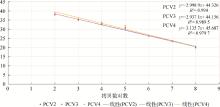
Fig. 2
PCV triple fluorescence quantitative PCR standard curve"
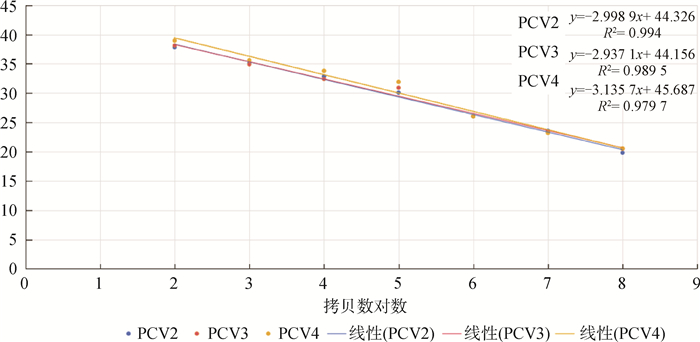
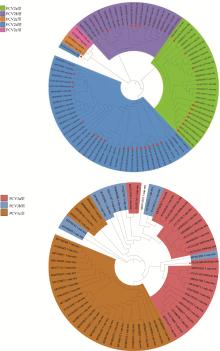
Fig. 3
Phylogenetic anlysis based on the Cap sequence of PCV2 and PCV3 . Verified sequence"

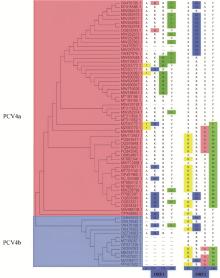
Fig. 4
Phylogenetic analysis of PCV4 whole gene sequence"

| 1 | 邓盈盈. 猪圆环病毒2型Cap蛋白抗独特型纳米抗体免疫保护性及其机制研究[D]. 杨凌: 西北农林科技大学, 2023. |
| DENG Y Y. Study on the immunoprotective effect and mechanism of anti-idiotypic nanobodies against porcine circovirus type 2 Cap protein[D]. Yangling: Northwest A&F University, 2023. (in Chinese) | |
| 2 |
SAPORITI V , HUERTA E , CORREA F , et al. Detection and genotyping of porcine circovirus 2 (PCV-2) and detection of porcine circovirus 3 (PCV-3) in sera from fattening pigs of different European countries[J]. Transbound Emerg Dis, 2020, 67 (6): 2521- 2531.
doi: 10.1111/tbed.13596 |
| 3 | 范杰, 邰易润, 朱艳丽, 等. 近年湖南省猪圆环病毒2型感染状况的调查及遗传演化分析[J]. 畜牧兽医学报, 2024, 55 (12): 1- 14. |
| FAN J , TAI Y R , ZHU Y L , et al. Investigation and genetic evolution analysis of porcine circovirus type 2 infection in Hunan Province in recent years[J]. Acta Veterinaria et Zootechnica Sinica, 2024, 55 (12): 1- 14. | |
| 4 | 方正. 猪圆环病毒4型病毒样颗粒的制备及应用[D]. 北京: 中国农业科学院, 2024. |
| FANG Z. Preparation and application of virus-like particles of porcine circovirus type 4[D]. Beijing: Chinese Academy of Agricultural Sciences, 2024. (in Chinese) | |
| 5 |
库旭钢, 于学祥, 孙琪, 等. 猪圆环病毒3型的分离及致病性分析[J]. 畜牧兽医学报, 2023, 54 (4): 1568- 1578.
doi: 10.11843/j.issn.0366-6964.2023.04.020 |
|
KU X G , YU X X , SUN Q , et al. Isolation and pathogenicity analysis of porcine circovirus type 3[J]. Acta Veterinaria et Zootechnica Sinica, 2023, 54 (4): 1568- 1578.
doi: 10.11843/j.issn.0366-6964.2023.04.020 |
|
| 6 | 邓文芳, 宋文博, 胡星星, 等. 2017~2018年华中地区猪圆环病毒2型分子流行病学分析[J]. 中国动物传染病学报, 2020, 28 (2): 32- 38. |
| DENG W F , SONG W B , HU X X , et al. Molecular epidemiological analysis of porcine circovirus type 2 in Central China from 2017 to 2018[J]. Chinese Journal of Animal Infectious Diseases, 2020, 28 (2): 32- 38. | |
| 7 | 周文锋, 张英婕, 白一涵, 等. 猪圆环病毒2型全基因组序列分析及Cap蛋白CTL表位预测[J]. 中国畜牧兽医, 2023, 50 (2): 656- 665. |
| ZHOU W F , ZHANG Y J , BAI Y H , et al. Whole genome sequence analysis of porcine circovirus type 2 and prediction of CTL epitopes in Cap protein[J]. China Animal Husbandry & Veterinary Medicine, 2023, 50 (2): 656- 665. | |
| 8 |
SAVBIC B , MILICEVIC V , RADANOVIC O , et al. Identification and genetic characterization of porcine circovirus 3 on pig farms in Serbia[J]. Arch Virol, 2020, 165 (1): 193- 199.
doi: 10.1007/s00705-019-04455-y |
| 9 | 李博天, 李春琪, 刘国平, 等. 2020-2022年华中地区部分猪场猪圆环病毒3型的分子流行特征与遗传变异分析[J]. 中国农业科学, 2024, 57 (3): 613- 626. |
| LI B T , LI C Q , LIU G P , et al. Molecular epidemiological characteristics and genetic variation analysis of porcine circovirus type 3 in some pig farms in Central China from 2020 to 2022[J]. Scientia Agricultura Sinica, 2024, 57 (3): 613- 626. | |
| 10 |
HOLGADO-MARTÍN R , ARNAL J L , SIBILA M , et al. First detection of porcine circovirus 4 (PCV-4) in Europe[J]. Virol J, 2023, 20 (1): 230.
doi: 10.1186/s12985-023-02181-1 |
| 11 | SHUAI J , CHEN K , WANG Z , et al. A multiplex digital PCR assay for detection and quantitation of porcine circovirus type 2 and type 3[J]. Arch Virol, 2024 (5): 119. |
| 12 | ZOU J , LIU H , CHEN J , et al. Development of a TaqMan-probe-based multiplex real-Time PCR for the simultaneous detection of porcine circovirus 2, 3 and 4 in East China from 2020 to 2022[J]. Vet Sci, 2022 (11): 29. |
| 13 | MOLINNI U , COETZEE L , CHRISTIANS V , et al. High detection frequency and genetic diversity of porcine circovirus 3 (PCV-3) in Namibian backyard farms and warthogs[J]. Acta Trop, 2024 (1): 107085. |
| 14 | FRANZO G , USTULIN M , ZANARDELLI P , et al. First detection of porcine circovirus type 2e in Europe[J]. Vet J, 2022 (1): 279. |
| 15 |
PENG Q , SHI J , LANG Y , et al. Phylogenetic analysis and serological investigation of porcine circovirus indicates frequent infection with various subtypes[J]. Int J Mol Sci, 2023, 24 (21): 15850.
doi: 10.3390/ijms242115850 |
| 16 | 于成东. 内蒙古PCV4分子流行病学调查及间接ELISA检测方法的初步建立[D]. 延吉: 延边大学, 2021. |
| YU C D. Molecular epidemiological investigation of PCV4 in Inner Mongolia and preliminary establishment of an indirect ELISA detection method[D]. Yanji: Yanbian University, 2021. (in Chinese) | |
| 17 |
KLAUMANN F , DIAS A , CABEZON O , et al. Porcine circovirus 3 is highly prevalent in serum and tissues and may persistently infect wild boar (Sus scrofa scrofa)[J]. Transbound Emerg Dis, 2019, 66 (1): 91- 101.
doi: 10.1111/tbed.12988 |
| 18 | 吴佳鑫. 猪圆环病毒2型TaqMan探针实时荧光定量PCR检测方法的建立以及PCV2疫苗对BALB/c小鼠的攻毒保护性研究[D]. 南京: 南京农业大学, 2020. |
| WU J X. Establishment of a TaqMan-based real-time PCR assay for porcine circovirus type 2 and evaluation of PCV2 vaccine efficacy in BALB/c mice challenge trial[D]. Nanjing Agricultural University, 2020. | |
| 19 | 吕素芳, 李峰, 郭广君, 等. 猪圆环病毒3型SYBR greenⅠ荧光定量PCR方法建立及初步应用[J]. 中国兽医学报, 2019, 39 (7): 1250- 1255. |
| LÜ S F , LI F , GUO G J , et al. Establishment and preliminary application of SYBR greenⅠ fluorescent quantitative PCR method for porcine circovirus type 3[J]. Chinese Journal of Veterinary Science, 2019, 39 (7): 1250- 1255. | |
| 20 |
CAO M , WEI Y , SHI W , et al. Investigation of porcine circovirus type 2 and porcine circovirus type 3 infections based on dual TaqMan fluorescent quantitative PCR method and genetic evolutionary analysis of these two viruses[J]. Front Microbiol, 2024, 15, 1385137.
doi: 10.3389/fmicb.2024.1385137 |
| 21 | 韩勇, 刘玉洁, 吕桂霞, 等. TaqMan-MGB多重荧光定量PCR检测PCV2、PCV3和PCV4方法的建立和应用[J]. 中国兽医杂志, 2023, 59 (8): 29- 34. |
| HAN Y , LIU Y J , LÜ G X , et al. Development and application of TaqMan-MGB multiplex real-time PCR for detection of PCV2, PCV3, and PCV4[J]. Chinese Journal of Veterinary Medicine, 2023, 59 (8): 29- 34. | |
| 22 | NAWAGITGUL P , MOROZOV I , BOLIN S R , et al. Open reading frame 2 of porcine circovirus type 2 encodes a major capsid protein[J]. J Gen Virol, 2000, 81 (Pt 9): 2281- 2287. |
| 23 | 付朋飞, 高冬生, 刘倩雯, 等. 猪圆环病毒4型分子流行病学及其检测技术研究进展[J]. 病毒学报, 2024, 40 (4): 934- 942. |
| FU P F , GAO D S , LIU Q W , et al. Research progress on molecular epidemiology and detection technologies of porcine circovirus type 4[J]. Chinese Journal of Virology, 2024, 40 (4): 934- 942. |
| [1] | WANG Yan, HUANG Xinyu, WU Guiying, WU Wanping, Lü Qizhuang. Genetic Variation Analysis of Porcine Circovirus Type 3 in China from 2017 to 2023 [J]. Acta Veterinaria et Zootechnica Sinica, 2025, 56(6): 2857-2867. |
| [2] | CHEN Yunlong, FAN Gang, FAN Xinyi, GUO Yongchao, ZHANG Xinmiao, WANG Yan, ZHANG Shiqiang. Isolation and Identification of a Novel Porcine Circovirus Type 2d Strain with Multiple Nucleotide Substitutions [J]. Acta Veterinaria et Zootechnica Sinica, 2025, 56(6): 3032-3040. |
| [3] | KUANG Yinzhi, XU Fengpei, ZHOU Pei. Whole Genome Sequence Analysis of Canine Circovirus in an Otter (Lutra lutra) [J]. Acta Veterinaria et Zootechnica Sinica, 2025, 56(4): 1989-1994. |
| [4] | FAN Jie, TAI Yirun, ZHU Yanli, CHEN Zhixiong, HU Qiaoyun, CHEN Zhi, LIU Tiantian, LI Xin, FAN Zhongxin, GE Meng. Investigation of Porcine Circovirus 2 Infection Status and Analysis of Genetic Evolution in Hunan Province in Recent Years [J]. Acta Veterinaria et Zootechnica Sinica, 2025, 56(3): 1376-1385. |
| [5] | YU Jiangwei, CHENG Huimin, LIN Jian, YANG Baolin, HUANG Cheng, YANG Zhiyuan, HU Ge. Establishment and Application of TaqMan Fluorescent Quantitative PCR Detection Method for Duck Plague Virus [J]. Acta Veterinaria et Zootechnica Sinica, 2025, 56(2): 765-773. |
| [6] | SONG Ruoqi, TAN Shanshan, MA Ruiyi, CHEN Xinxin, YI Yue, MA Mengyao, WANG Ying, NIU Sheng, YAN Fang, ZHAO Yujun, TIAN Wenxia, REN Jianle. Construction and Immune Effect in Mice of Recombinant Pseudorabies Virus Expressing Porcine Circovirus Type 3 Cap Protein [J]. Acta Veterinaria et Zootechnica Sinica, 2025, 56(11): 5778-5788. |
| [7] | CAI Yunfeng, LI Hong, HUANG Xiaoming, HE Qing, DING Zhenyu, YU Wanting, LUO Shile, CHEN Fangzhi, WANG Naidong, YANG Yi, ZHAN Yang. Study on the Presentation Strategy and Immunogenicity of Porcine Parvovirus Epitope Inserted by 3-fold Axes Region on the Surface of Porcine Circovirus Type 2 Virus-like Particles [J]. Acta Veterinaria et Zootechnica Sinica, 2025, 56(1): 307-318. |
| [8] | WANG Xingyue, YANG Zhiyuan, LIN Jian, ZHANG Zixuan, ZHOU Yuting, CHENG Huimin, LIU Yuehuan, HU Ge. Development and Application of a Real-time Fluorescence Quantitative PCR Detection Method for Pigeon Circovirus [J]. Acta Veterinaria et Zootechnica Sinica, 2025, 56(1): 335-342. |
| [9] | Jitong LI, Tong ZHU, Junfeng LÜ, Yuehua GAO, Feng HU, Kexiang YU, Minxun SONG, Jianlin WANG, Yufeng LI. Isolation and Identification of Novel Picornavirus from Ducks and Whole Genome Sequence Analysis [J]. Acta Veterinaria et Zootechnica Sinica, 2024, 55(7): 3075-3084. |
| [10] | HAN Yang, GUAN Shuaiyin, LI Zhen, ZHOU Saisai, YUAN Honggen, SONG Yunfeng. Prokaryotic Expression and Protein Activity of Porcine Circovirus Type 3 Rep [J]. Acta Veterinaria et Zootechnica Sinica, 2024, 55(5): 2061-2071. |
| [11] | MA Chunling, REN Shanhui, YANG Xue, LIN Yugang, LI Jiyun, WANG Xiangwei, YIN Xiangping, SUN Yuefeng, WAN Xuerui, CHEN Haotai. Establishment and Application of Fluorescence Quantitative PCR Detection Method based on Lumpy Skin Disease Virus ORF61 Gene [J]. Acta Veterinaria et Zootechnica Sinica, 2024, 55(4): 1800-1809. |
| [12] | ZHANG Baoge, HUANG Yaqin, CAI Jinshuang, ZHU Chenguang, LI Yufeng. Preparation of Monoclonal Antibodies to Porcine Circovirus Type 3 Cap Protein and the Establishment of a Blocking ELISA Assay [J]. Acta Veterinaria et Zootechnica Sinica, 2024, 55(3): 1170-1178. |
| [13] | WANG Kang, LIU Geyan, WANG Yu, YANG Zhen, TANG Xinwei, CAO Sanjie, HUANG Xiaobo, YAN Qigui, WU Rui, ZHAO Qin, DU Senyan, WEN Xintian, WEN Yiping. Preparation of Glaesserella parasuis Ghosts Vaccine Delivering Porcine Circovirus Type 2 DNA Vaccine and Evaluation of Its Immunoprotective Effect in Mice [J]. Acta Veterinaria et Zootechnica Sinica, 2024, 55(3): 1179-1191. |
| [14] | Hongqiang ZHANG, Shanhui REN, Wei YAO, Zhenli GONG, Xue YANG, Chunling MA, Ting YOU, Yuzhe ZHANG, Minyi LIU, Wenjie QIAN, Liuyang LI, Zhipeng YU, Yuefeng SUN, Haotai CHEN, Jiangfeng FAN. The Establishment of a SYBR Green Fluorescence Quantitative PCR Detection Method by Targeting the G-protein Coupled Chemokine Receptor Gene of Goat Poxvirus [J]. Acta Veterinaria et Zootechnica Sinica, 2024, 55(10): 4779-4784. |
| [15] | KU Xugang, YU Xuexiang, SUN Qi, LI Panpan, ZHANG Mengjia, LUO Rui, QIAN Ping, HE Qigai. Isolation and Pathogenicity Analysis of Porcine Circovirus Type 3 [J]. Acta Veterinaria et Zootechnica Sinica, 2023, 54(4): 1568-1578. |
| Viewed | ||||||
|
Full text |
|
|||||
|
Abstract |
|
|||||
