


Acta Veterinaria et Zootechnica Sinica ›› 2024, Vol. 55 ›› Issue (11): 4968-4979.doi: 10.11843/j.issn.0366-6964.2024.11.016
• Animal Genetics and Breeding • Previous Articles Next Articles
Huili LIANG1( ), Yujing XIE1, Bowen SI1, Guiying WANG1, Yunliang JIANG2, Guiling CAO1,2,*()
Received:2024-03-26
Online:2024-11-23
Published:2024-11-30
Contact:
Guiling CAO
E-mail:2210190109@stu.lcu.edu.cn;cglling@126.com
CLC Number:
Huili LIANG, Yujing XIE, Bowen SI, Guiying WANG, Yunliang JIANG, Guiling CAO. Analysis on Genomic Variation and Population Structure of Large-tailed Han Sheep Based on Whole Genome Resequencing[J]. Acta Veterinaria et Zootechnica Sinica, 2024, 55(11): 4968-4979.

Fig. 1
The result of agarose gel electrophoresis of genomic DNA"
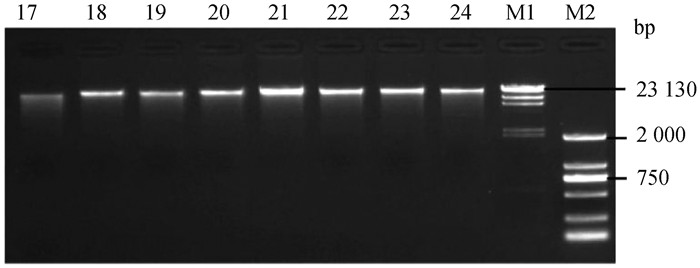
Table 1
The genotypes of Large-tailed Han sheep"
| 变异类型Variation type | 基因型位点总数Total sites number | 位点缺失数量Miss sites number | 非缺失位点总数No miss sites number | 纯合型数量Homozygote number | 杂合型数量Heterozygote number | 纯合型比例/% Homozygote rate | 杂合型比例/% Heterozygote rate |
| SNP | 49 530 191 | 6 950 441 | 42 679 749 | 36 554 780 | 6 124 969 | 85.649 | 14.351 |
| InDel | 6 010 541 | 998 272 | 5 012 268 | 4 143 729 | 868 539 | 82.672 | 17.328 |

Fig. 2
Variation types of SNP and the length of SV and CNV a. The variation type of SNPs; b. The statistics of SV length; c. The statistics of CNV length"

Table 2
Statistics of SNP and InDel annotation"
| 位置Location | 基因型数量Genotype number | 比例/% Percentage | InDel数量InDel number | 比例/% Percentage |
| 内含子Intronic | 16 978 650 | 33.771 | 2 524 292 | 34.863 |
| 基因间Intergenic | 31 878 775 | 63.407 | 4 433 588 | 61.233 |
| 基因上游Upstream | 340 540 | 0.677 | 96 459 | 1.332 |
| 基因下游Downstream | 295 506 | 0.588 | 53 434 | 0.738 |
| 一个基因下游同时另一个基因上游Upstream/downstream | 10 598 | 0.021 | 3 173 | 0.044 |
| 形成终止密码子Stop gain | 2 487 | 0.005 | 365 | 0.005 |
| 引起终止密码子消失Stop loss | 337 | 0.001 | 36 | < 0.001 |
| 可变剪切位点Splicing | 4 669 | 0.009 | 3 124 | 0.043 |
| 基因5′-UTR区域UTR5 | 198 349 | 0.395 | 38 908 | 0.537 |
| 基因3′-UTR区域UTR3 | 248 668 | 0.495 | 51 835 | 0.716 |
| 同义突变Synonymous | 157 590 | 0.313 | - | - |
| 非同义突变Non-synonymous | 159 910 | 0.318 | - | - |
| 导致移码突变的缺失位点Frameshift deletion | - | - | 13 014 | 0.180 |
| 导致移码突变的插入位点Frameshift insertion | - | - | 17 228 | 0.238 |
| 非移码突变的缺失位点Non-frameshift deletion | - | - | 2 511 | 0.035 |
| 非移码突变的插入位点Non-frameshift insertion | - | - | 2 573 | 0.036 |
| 总计Total | 50 276 079 | 100.000 | 7 240 540 | 100.000 |

Fig. 3
PCA analysis of LTH sheep"

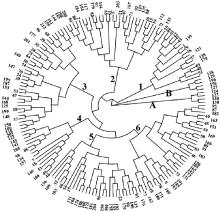
Fig. 4
Phylogenetic tree analysis of LTH sheep The out numbers represent the individual number, numbers located in the inner circle represent rams and numbers located in the outer ring represent ewes; the letters and numbers in the center of figure represent families"

Table 3
The body size measurements of families of LTH sheep"
| 家系(数量) Family | 体高/cm Body height | 体斜长/cm Body length | 胸围/cm Chest circumference | 管围/cm Shank circumference | 臀高/cm Hip height | 腰高/cm Waist height | 尾长/cm Tail length | 尾宽/cm Tail width |
| 家系1(17) Family 1 | 70.59±6.53 | 66.79±5.27 | 94.53±10.15 | 8.47±0.80 | 69.03±5.20 | 60.09±5.18 | 48.97±0.56 | 35.09±4.99 |
| 家系2(31) Family 2 | 69.90±5.98 | 66.58± 5.18 | 93.02±10.10 | 8.32±0.64 | 70.00±5.23 | 59.79±4.84 | 49.33±9.22 | 35.08±5.51 |
| 家系3(36) Family 3 | 69.36±5.25 | 66.99±6.03 | 95.68±9.17 | 8.21±0.63 | 68.76±4.24 | 59.56±3.73 | 51.99±9.41 | 38.43±8.11 |
| 家系4(15) Family 4 | 70.70±4.86 | 67.07±4.50 | 94.10±8.23 | 7.90±0.71 | 70.67±4.40 | 60.07±5.82 | 45.48±10.80 | 33.70±6.88 |
| 家系5(28) Family 5 | 66.43±3.34 | 62.71±4.05 | 92.80 ±9.32 | 7.93±0.50 | 65.75±2.82 | 55.88±4.15 | 48.82±6.68 | 35.18±5.34 |
| 家系6(35) Family 6 | 66.80±4.39 | 63.39±4.38 | 92.53±8.74 | 8.13±0.62 | 66.13±3.48 | 56.86±4.10 | 48.17±7.64 | 35.74±5.72 |
| A组(4) A group | 72.63±1.44 | 69.00±4.24 | 108.13±5.01 | 8.38±0.63 | 73.75±1.89 | 60.38±2.14 | 52.63±7.32 | 33.38±3.64 |
| B组(4) B group | 72.75±0.65 | 70.75±2.63 | 103.50±4.88 | 8.13±0.25 | 70.25±0.96 | 56.13±2.72 | 49.63±5.02 | 36.00±4.24 |

Fig. 5
Distribution of cross-validation error values with different K values"
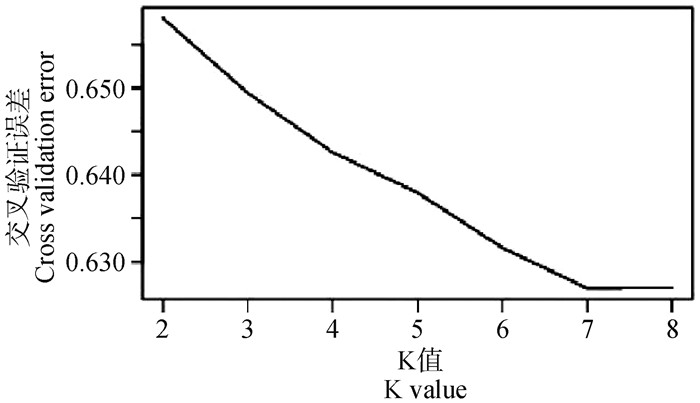

Fig. 6
The phylogenetic tree and genetic structure of LTH sheep The numbers and letters of left side represent families, and the color bars and numbers of right side represent the potential ancestors"


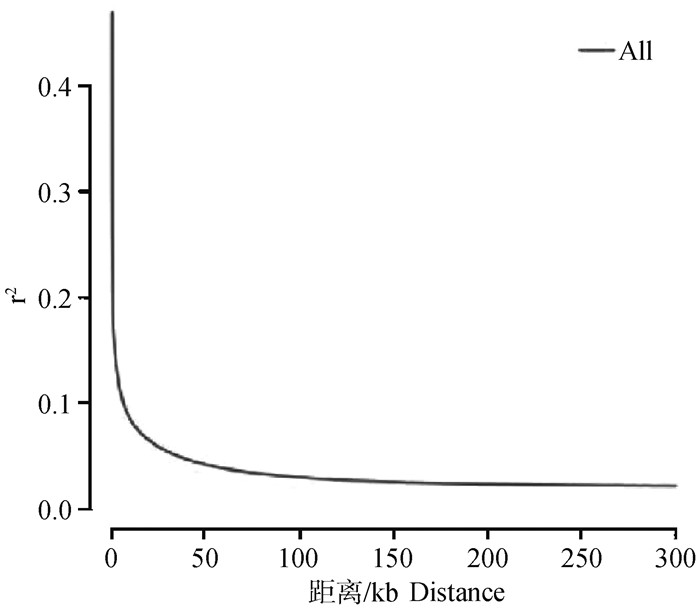
Fig. 7
LD attenuation analysis"
| 1 | 国家畜禽遗传资源委员会. 中国畜禽遗传资源志(羊志)[M]. 北京: 中国农业出版社, 2011. |
| China National Commission of Animal Genetic Resources . Animal genetic resources in China: sheep and goats[M]. Beijing: China Agriculture Press, 2011. | |
| 2 |
KALDS P , LUO Q , SUN K , et al. Trends towards revealing the genetic architecture of sheep tail patterning: promising genes and investigatory pathways[J]. Anim Genet, 2021, 52 (6): 799- 812.
doi: 10.1111/age.13133 |
| 3 | FARHADI S , HASANPUR K , GHIAS J S , et al. Comprehensive gene expression profiling analysis of adipose tissue in male individuals from fat-and thin-tailed sheep breeds[J]. Animals (Basel), 2023, 13 (22): 3475. |
| 4 |
BAKHTIARIZADEH M R . Deciphering the role of alternative splicing as a potential regulator in fat-tail development of sheep: a comprehensive RNA-seq based study[J]. Sci Rep, 2024, 14 (1): 2361.
doi: 10.1038/s41598-024-52855-1 |
| 5 |
XU Y X , WANG B , JING J N , et al. Whole-body adipose tissue multi-omic analyses in sheep reveal molecular mechanisms underlying local adaptation to extreme environments[J]. Commun Biol, 2023, 6 (1): 159.
doi: 10.1038/s42003-023-04523-9 |
| 6 |
HOU M , YE M J , MA X L , et al. Colon microbiota and metabolite potential impact on tail fat deposition of Altay sheep[J]. Microbiol Spectr, 2024, 12 (6): e0310323.
doi: 10.1128/spectrum.03103-23 |
| 7 |
CAIYE Z , SONG S Z , LI M N , et al. Genome-wide DNA methylation analysis reveals different methylation patterns in Chinese indigenous sheep with different type of tail[J]. Front Vet Sci, 2023, 10, 1125262.
doi: 10.3389/fvets.2023.1125262 |
| 8 | LI T T , JIN M L , WANG H H , et al. Whole-genome scanning for selection signatures reveals candidate genes associated with growth and tail length in sheep[J]. Animals (Basel), 2024, 14 (5): 687. |
| 9 |
DENG J , XIE X L , WANG D F , et al. Paternal origins and migratory episodes of domestic sheep[J]. Curr Biol, 2020, 30 (20): 4085- 4095.e6.
doi: 10.1016/j.cub.2020.07.077 |
| 10 |
ZHU C Y , LI N , CHENG H P , et al. Genome wide association study for the identification of genes associated with tail fat deposition in Chinese sheep breeds[J]. Biol Open, 2021, 10 (5): bio054932.
doi: 10.1242/bio.054932 |
| 11 |
YUAN Z , LIU E , LIU Z , et al. Selection signature analysis reveals genes associated with tail type in Chinese indigenous sheep[J]. Anim Genet, 2017, 48 (1): 55- 66.
doi: 10.1111/age.12477 |
| 12 | 章焕, 张成, 邸腾刚, 等. 大尾寒羊和小尾寒羊尾部脂肪lncRNA差异表达分析[J]. 河南农业大学学报, 2023, 57 (2): 298- 306. |
| ZHANG H , ZHANG C , DI T G , et al. Differential expression analysis of tail fat LncRNA in Large-tailed Han sheep and Small-tailed Han sheep breeds[J]. Journal of Henan Agricultural University, 2023, 57 (2): 298- 306. | |
| 13 | 杨广礼, 刘凯迪, 付欢欢, 等. 大尾寒羊和小尾寒羊尾脂、心脂和肾脂脂肪细胞比较研究[J]. 黑龙江畜牧兽医, 2019, (19): 60-64, 179. |
| YANG G L , LIU K D , FU H H , et al. Comparative study on adipocytes of tail fat, pericardiac fat and perirenal adipose tissue of Large-tailed Han sheep and Small-tailed Han sheep breeds[J]. Heilongjiang Animal Science and Veterinary Medicine, 2019, (19): 60-64, 179. | |
| 14 | 张果平, 蔡中峰. 山东省绵羊、山羊种业发展现状、问题与建议[J]. 山东畜牧兽医, 2022, 43 (4): 72- 76. |
| ZHANG G P , CAI Z F . The development status, problem and suggestion on sheep and goat breeding industry in Shandong Province[J]. Shandong Journal of Animal Science and Veterinary Medicine, 2022, 43 (4): 72- 76. | |
| 15 |
IANNUCCI A , BENAZZO A , NATALI C , et al. Population structure, genomic diversity and demographic history of Komodo dragons inferred from whole-genome sequencing[J]. Mol Ecol, 2021, 30 (23): 6309- 6324.
doi: 10.1111/mec.16121 |
| 16 |
LI H , DURBIN R . Fast and accurate short read alignment with Burrows-Wheeler transform[J]. Bioinformatics, 2009, 25 (14): 1754- 1760.
doi: 10.1093/bioinformatics/btp324 |
| 17 |
MCKENNA A , HANNA M , BANKS E , et al. The genome analysis toolkit: a MapReduce framework for analyzing next-generation DNA sequencing data[J]. Genome Res, 2010, 20 (9): 1297- 1303.
doi: 10.1101/gr.107524.110 |
| 18 |
WANG K , LI M Y , HAKONARSON H . ANNOVAR: functional annotation of genetic variants from high-throughput sequencing data[J]. Nucleic Acids Res, 2010, 38 (16): e164.
doi: 10.1093/nar/gkq603 |
| 19 |
CHEN X Y , SCHULZ-TRIEGLAFF O , SHAW R , et al. Manta: rapid detection of structural variants and indels for germline and cancer sequencing applications[J]. Bioinformatics, 2016, 32 (8): 1220- 1222.
doi: 10.1093/bioinformatics/btv710 |
| 20 |
BOEVA V , POPOVA T , BLEAKLEY K , et al. Control-FREEC: a tool for assessing copy number and allelic content using next-generation sequencing data[J]. Bioinformatics, 2012, 28 (3): 423- 425.
doi: 10.1093/bioinformatics/btr670 |
| 21 |
PURCELL S , NEALE B , TODD-BROWN K , et al. PLINK: a tool set for whole-genome association and population-based linkage analyses[J]. Am J Hum Genet, 2007, 81 (3): 559- 575.
doi: 10.1086/519795 |
| 22 |
PRICE M N , DEHAL P S , ARKIN A P . FastTree 2-approximately maximum-likelihood trees for large alignments[J]. PLoS One, 2010, 5 (3): e9490.
doi: 10.1371/journal.pone.0009490 |
| 23 |
ALEXANDER D H , NOVEMBRE J , LANGE K . Fast model-based estimation of ancestry in unrelated individuals[J]. Genome Res, 2009, 19 (9): 1655- 1664.
doi: 10.1101/gr.094052.109 |
| 24 |
ZHANG C , DONG S S , XU J Y , et al. PopLDdecay: a fast and effective tool for linkage disequilibrium decay analysis based on variant call format files[J]. Bioinformatics, 2019, 35 (10): 1786- 1788.
doi: 10.1093/bioinformatics/bty875 |
| 25 |
DANECEK P , AUTON A , ABECASIS G , et al. The variant call format and VCFtools[J]. Bioinformatics, 2011, 27 (15): 2156- 2158.
doi: 10.1093/bioinformatics/btr330 |
| 26 | 陈宏福, 韦体, 张俊松, 等. 国家级畜禽遗传资源兰州大尾羊保护现状与对策[J]. 甘肃畜牧兽医, 2023, 53 (1): 15- 18. |
| CHEN H F , WEI T , ZHANG J S , et al. The conservational status and recommendation of the national livesrock and poultry genetic resource-Lanzhou Large-tailed sheep[J]. Gansu Animal Husbandry and Veterinary Medicine, 2023, 53 (1): 15- 18. | |
| 27 | 高毅, 巩薇娜, 张明娟, 等. 浅析广灵大尾羊资源保护[J]. 中国畜牧业, 2023, (10): 53- 54. |
| GAO Y , GONG W N , ZHANG M J , et al. General views on the conservation of Guangling Large-tailed sheep[J]. China Animal Industry, 2023, (10): 53- 54. | |
| 28 | 赵真坚, 王书杰, 陈栋, 等. 基于低深度全基因组测序分析内江猪群体结构和遗传多样性[J]. 畜牧兽医学报, 2023, 54 (6): 2297- 2307. |
| ZHAO Z J , WANG S J , CHEN D , et al. Population structure and genetic diversity analysis of Neijiang pigs based on low-coverage whole genome sequencing[J]. Acta Veterinaria et Zootechnica Sinaica, 2023, 54 (6): 2297- 2307. | |
| 29 | 石兰, 马梅兰, 木合塔帕·买买提江, 等. 基于全基因组重测序解析皮山红羊群体遗传结构及产羔数候选基因研究[J]. 中国畜牧兽医, 2024, 51 (2): 624- 638. |
| SHI L , MA M L , MUHETAPA M M T J , et al. Study on the genetic structure and litter size candidate genes of Pishan Red sheep population based on whole genome resequencing[J]. China Animal Husbandry & Veterinary Medicine, 2024, 51 (2): 624- 638. | |
| 30 | 马克岩, 韩金涛, 白雅琴, 等. 基于简化基因组测序的永登七山羊遗传多样性分析[J]. 畜牧兽医学报, 2023, 54 (5): 1939- 1950. |
| MA K Y , HAN J T , BAI Y Q , et al. Genetic diversity analysis of Yongdeng Qishan sheep based on specific-locus amplified fragment sequencing[J]. Acta Veterinaria et Zootechnica Sinica, 2023, 54 (5): 1939- 1950. | |
| 31 | 陈开旭, 郭翠洁, 杨帆, 等. 基于全基因组重测序分析新疆细毛羊遗传多样性[J]. 新疆农业科学, 2023, 60 (5): 1292- 1300. |
| CHEN K X , GUO C J , YANG F , et al. Genetic diversity analysis of Xinjiang sheep with fine wool based on whole-genome re-sequencing[J]. Xinjiang Agricultural Sciences, 2023, 60 (5): 1292- 1300. | |
| 32 | 余道宁, 王佟, 铁中华, 等. 基于全基因组重测序对祁连白藏羊类群的群体结构分析[J]. 中国草食动物科学, 2023, 43 (6): 12- 16. |
| YU D N , WANG T , TIE Z H , et al. Population structure analysis of Qilian White Tibetan sheep group based on whole genome resequencing[J]. China Herbivore Science, 2023, 43 (6): 12- 16. | |
| 33 | 常晨城, 白音巴图, 周乐, 等. 内蒙古地方绵羊遗传多样性及尾椎数性状相关选择信号研究[J]. 中国畜牧杂志, 2023, 59 (12): 109- 115. |
| CHANG C C , BAIYINBATU , ZHOU L , et al. Analysis on the genetic diversity and selection signatures for the caudal vertebrae number of local sheep species of Inner Mongolia, China[J]. Chinese Journal of Animal Science, 2023, 59 (12): 109- 115. | |
| 34 | LI J , XU H , LIU X F , et al. Insight into the possible formation mechanism of the intersex phenotype of Lanzhou Fat-tailed Sheep using whole-genome resequencing[J]. Animals (Basel), 2020, 10 (6): 944. |
| 35 | YI W F , HU M Y , SHI L L , et al. Whole genome sequencing identified genomic diversity and candidated genes associated with economic traits in Northeasern Merino in China[J]. Front Genet, 2024, 15, 1302222. |
| 36 | SUN X L , GUO J Z , LI R , et al. Whole-genome resequencing reveals genetic diversity and wool trait-related genes in Liangshan semi-fine-wool sheep[J]. Animals (Basel), 2024, 14 (3): 444. |
| 37 | LI R N , ZHAO Y H T , LIANG B M , et al. Genome-wide signal selection analysis revealing genes potentially related to sheep-milk-production traits[J]. Animals (Basel), 2023, 13 (10): 1654. |
| 38 | QIAO G Y , XU P , GUO T T , et al. Genome-wide detection of structural variation in some sheep breeds using whole-genome long-read sequencing data[J]. J Anim Breed Genet, 2024, 141 (4): 403- 414. |
| 39 | 刘泽民, 王岩超, 张淑二, 等. 利用微卫星和线粒体D-loop区联合分析大尾寒羊的遗传多样性[J]. 山东畜牧兽医, 2019, 40 (7): 1- 5. |
| LIU Z M , WANG Y C , ZHANG S E , et al. Analysis on the genetic diversity of Large-tailed Han sheep using mtDNA D-loop and microsatellite loci[J]. Shandong Journal of Animal Science and Veterinary Medicine, 2019, 40 (7): 1- 5. | |
| 40 | BAKHTIARIZADEH M R , SALEHI A , ALAMOUTI A A , et al. Deep transcriptome analysis using RNA-Seq suggests novel insights into molecular aspects of fat-tail metabolism in sheep[J]. Sci Rep, 2019, 9 (1): 9203. |
| 41 | HE X G , WU R H , YUN Y Y , et al. MicroRNA and circular RNA profiling in the deposited fat tissue of Sunite sheep[J]. Front Vet Sci, 2022, 9, 954882. |
| 42 | LIU T Y , FENG H , YOUSUF S , et al. Genome-wide analysis of microRNAs identifies the lipid metabolism pathway to be a defining factor in adipose tissue from different sheep[J]. Front Vet Sci, 2022, 9, 938311. |
| [1] | Siyu LIU, Man ZHANG, Yan ZHANG, Zhitong WEI, Xinglei QI, Tengyun GAO, Xian LIU, Dong LIANG, Tong FU. Evaluation of the Conservation Effect in Nanyang Cattle Based on Resequencing Data [J]. Acta Veterinaria et Zootechnica Sinica, 2024, 55(9): 3876-3886. |
| [2] | Tao ZHANG, Jiaqi LI, Lei XU, Dan WANG, Menghua ZHANG, Tao ZHANG, Mengjie YAN, Weitao WANG, Shoumin FAN, Xixia HUANG. Detection and Population Structure Analysis of Genomic Structural Variation in Xinjiang Brown Cattle Based on Whole Genome Resequencing Data [J]. Acta Veterinaria et Zootechnica Sinica, 2024, 55(8): 3427-3435. |
| [3] | REN Yuwei, CHEN Xing, LIN Yanning, HUANG Xiaoxian, HONG Lingling, WANG Feng, SUN Ruiping, ZHANG Yan, LIU Hailong, ZHENG Xinli, CHAO Zhe. Investigating the Influencing Factors of Egg Laying Performance in Wenchang Chickens Based on Whole Genome Resequencing [J]. Acta Veterinaria et Zootechnica Sinica, 2024, 55(2): 502-514. |
| [4] | LIU Zhenni, LI Jianjun, LIAN Hai, LEI Xiaowen, TAN Donghai, ZENG Qingyuan, CHENG Di, TIAN Yuling, KONG Zhiwei, XIE Hualiang, ZHONG Yunping. Population Evolution Analysis of Ganzhou Muscovy Duck Based on Whole Genome Resequencing [J]. Acta Veterinaria et Zootechnica Sinica, 2024, 55(11): 4992-5002. |
| [5] | Xiangzhen GOU, Junxiang YANG, Zihui ZHAO, Lingxia FENG, Wanhui CHEN, Yujie LI, Zhongyu ZHANG, Keyan MA, Dongping JIANG, Rong CHANG, Yazhou WEN, Ke WANG, Youji MA. Evaluation of the Population Structure of the Ziwuling Black Goat Based on Super-GBS [J]. Acta Veterinaria et Zootechnica Sinica, 2024, 55(10): 4334-4345. |
| [6] | LIN Yan, HUANG Min, LI Xiujin, ZHANG Xumeng, HUANG Yunmao, TIAN Yunbo, WU Zhongping. Uncovering Genome-wide Copy Number Variations in 8 Duck Breeds Using Whole Genome Resequencing Data [J]. Acta Veterinaria et Zootechnica Sinica, 2023, 54(9): 3700-3709. |
| [7] | LU Chang, DONG Lei, ZHANG Wanfeng, GAO Pengfei, GUO Xiaohong, CAI Chunbo, CAO Guoqing, LI Bugao. Identification and Screening of Single Nucleotide Polymorphism Loci in Jinfen White Pigs Based on Whole Genome Resequencing [J]. Acta Veterinaria et Zootechnica Sinica, 2023, 54(7): 2761-2771. |
| [8] | ZHAO Zhenjian, WANG Shujie, CHEN Dong, JI Xiang, SHEN Qi, YU Yang, CUI Shengdi, WANG Junge, CHEN Ziyang, TANG Guoqing. Population Structure and Genetic Diversity Analysis of Neijiang Pigs Based on Low-coverage Whole Genome Sequencing [J]. Acta Veterinaria et Zootechnica Sinica, 2023, 54(6): 2297-2307. |
| [9] | MA Keyan, HAN Jintao, BAI Yaqin, LI Taotao, MA Youji. Genetic Diversity Analysis of Yongdeng Qishan Sheep Based on Specific-Locus Amplified Fragment Sequencing [J]. Acta Veterinaria et Zootechnica Sinica, 2023, 54(5): 1939-1950. |
| [10] | GAO Chaoqun, CAO Ranran, DU Wenping, HU Xiaoyu, LEI Yanru, LI Wenting, KANG Xiangtao. Genetic Diversity and Population Structure Analysis of Chinese Native Chicken Breeds using Genome-wide SNPs [J]. Acta Veterinaria et Zootechnica Sinica, 2023, 54(2): 554-562. |
| [11] | HU Ziping, WANG Ligang, ZONG Wencheng, HOU Renda, SU Yanfang, NIU Naiqi, WANG Lixian, WANG Yuan, ZHNAG Longchao. Genetic Structure Analysis of Jianbai Xiang Pig Population Based on Genomic SNP and ROH [J]. Acta Veterinaria et Zootechnica Sinica, 2023, 54(10): 4117-4125. |
| [12] | YUAN Jiao, XU Guoqiang, ZHOU Xiang, XU Sanping, LI Sheng, LI Wangming, LIU Bang. SNP Chip-Based Monitoring of Population Conservation Effect of Tongcheng Pigs [J]. Acta Veterinaria et Zootechnica Sinica, 2022, 53(8): 2514-2523. |
| [13] | LIU Hongxiang, SHEN Yongjie, ZHANG Lihua, ZHANG Shuangjie, WANG Jing, ZHU Jie, CHEN Yuzhe, ZHU Chunhong, SONG Weitao, ZHANG Dan, TAO Zhiyun, XU Wenjuan, LIU Honglin, LI Huifang. Genetic Diversity Evaluation of Loumen Duck Based on Reduced-Representation Genome Sequencing [J]. Acta Veterinaria et Zootechnica Sinica, 2022, 53(6): 1735-1748. |
| [14] | LI Jing, CHENG Luguang, WAN Jiusheng, CHEN Chao, DENG Weidong, ZHANG Zhenghong, ZHANG Zhi, LI Liguang. A Study of Genetic Population Structure Analysis and Selection Signatures in Kunming Dog [J]. Acta Veterinaria et Zootechnica Sinica, 2022, 53(5): 1455-1464. |
| [15] | LIU Xiaojing, LIU Lu, WANG Jie, CUI Huanxian, ZHAO Guiping, WEN Jie. Genome-wide Association Study of Chicken Blood Glucose Traits Using Whole Genome Resequencing [J]. Acta Veterinaria et Zootechnica Sinica, 2020, 51(6): 1187-1195. |
| Viewed | ||||||
|
Full text |
|
|||||
|
Abstract |
|
|||||
