


畜牧兽医学报 ›› 2025, Vol. 56 ›› Issue (12): 6080-6093.doi: 10.11843/j.issn.0366-6964.2025.12.013
缪丰诚1,2( ), 龙晓倩2, 李志宇2, 沈瑶2, 吕凯凯5, 简华锋2, 李军星4, 李双茂4, 杨华2,3, 马剑钢2,*(), 代兵1,*()
收稿日期:2025-03-28
出版日期:2025-12-23
发布日期:2025-12-24
通讯作者:
马剑钢,代兵
E-mail:13777368638@163.com;vetmajg@163.com;daibing2008@126.com
作者简介:缪丰诚(1999-),男,浙江杭州人,硕士生,主要从事畜产品质量安全研究, E-mail: 13777368638@163.com
基金资助:
MIAO Fengcheng1,2(), LONG Xiaoqian2, LI Zhiyu2, SHEN Yao2, LÜ Kaikai5, JIAN Huafeng2, LI Junxing4, LI Shuangmao4, YANG Hua2,3, MA Jiangang2,*(), DAI Bing1,*()
Received:2025-03-28
Online:2025-12-23
Published:2025-12-24
Contact:
MA Jiangang, DAI Bing
E-mail:13777368638@163.com;vetmajg@163.com;daibing2008@126.com
摘要:
禽源多杀性巴氏杆菌是一种广泛分布的革兰阴性短杆菌,能够引起禽霍乱,给全球家禽养殖业带来巨大经济损失。目前禽霍乱防控长期依赖抗生素治疗,导致家禽中对抗生素耐药的细菌不断增加。本文统计了近二十年国内外17个地区的禽源多杀性巴氏杆菌流行情况和耐药性。统计结果表明,禽源多杀性巴氏杆菌广泛分布于全球各大洲,尤其在禽类养殖和消费较为普遍的地区,流行率大于43.50%。国内禽源多杀性巴氏杆菌在江苏省(53.73%)和广东省(48.97%)的流行率较高,流行率大于48%。对数据库中禽源多杀性巴氏杆菌基因组分析显示,共检测到31个ST型,其中ST159(115/733,15.69%)和ST128(82/733,11.19%)分别对鸡和鸭具有宿主偏好性。耐药性方面,国内外均发现对多种常用抗生素耐药的菌株,对卡那霉素(99/165,60%)、氯霉素(124/230,53.91%)和四环素(258/556,46.40%)等抗生素耐药率较高。对数据库中基因组进行分析,共检测到29种耐药基因,涵盖了八大类抗生素,其中sul2(13.64%)和tet(B)(10.64%)携带率最高。综上所述,禽源多杀性巴氏杆菌国内外流行率存在差异且对多种常用抗生素耐药率较高。可根据地区流行特点针对性使用疫苗、噬菌体等防治手段,减少耐药率高的抗生素使用,以实现高效的治疗效果,建立绿色、可持续的养殖模式。
中图分类号:
缪丰诚, 龙晓倩, 李志宇, 沈瑶, 吕凯凯, 简华锋, 李军星, 李双茂, 杨华, 马剑钢, 代兵. 禽源多杀性巴氏杆菌流行趋势及耐药性研究进展[J]. 畜牧兽医学报, 2025, 56(12): 6080-6093.
MIAO Fengcheng, LONG Xiaoqian, LI Zhiyu, SHEN Yao, LÜ Kaikai, JIAN Huafeng, LI Junxing, LI Shuangmao, YANG Hua, MA Jiangang, DAI Bing. Research Progress on the Epidemic Trend and Antimicrobial Resistance of Avian Pasteurella multocida[J]. Acta Veterinaria et Zootechnica Sinica, 2025, 56(12): 6080-6093.
表 1
国内禽源多杀性巴氏杆菌流行率"
| 省份 Province | 宿主Host | 总流行率 Overall prevalence | |||||
| 鸡Chicken | 鸭Duck | 鹅Goose | 鹦鹉Parrot | 火鸡Turkey | 鸽Pigeon | ||
| 江苏[ Jiangsu | 52.08(25/48) | 50(6/12) | 66.67(4/6) | 100(1/1) | / | / | 53.73(36/67) |
| 广东[ Guangdong | 100(6/6) | 85.71(18/21) | 46.34(190/410) | / | / | / | 48.97(214/437) |
| 安徽[ Anhui | 27.27(3/11) | 21.43(3/14) | / | / | / | / | 24(6/25) |
| 浙江[ | / | / | 33.33(1/3) | / | / | / | 33.33(1/3) |
| 湖南[ | 16.67(1/6) | / | / | / | / | / | 16.67(1/6) |
| 福建[ | / | 100(3/3) | / | / | / | / | 100(3/3) |
| 吉林[ | / | / | 33.33(1/3) | / | 20(1/5) | / | 25(2/8) |
| 贵州[ | / | 10(1/10) | / | / | / | / | 10(1/10) |
| 青海[ | / | / | / | 100(1/1) | / | / | 100(1/1) |
| 湖北[ | / | / | / | / | / | 0.53(1/189) | 0.53(1/189) |
| 合计Total | 49.29(35/71) | 51.67(31/60) | 46.45(196/422) | 100(2/2) | 20(1/5) | 0.53(1/189) | 35.51(266/749) |
表 2
国外禽源多杀性巴氏杆菌流行率"
| 国家 Country | 宿主Host | 总流行率 Overall prevalence | |||||
| 鸡 Chicken | 鸭 Duck | 鹅 Goose | 火鸡 Turkey | 鹌鹑 Quail | 未明确分类 Unspecified | ||
| 澳大利亚[ Australia[ | 96.20(152/158) | 37.5(3/8) | 50(1/2) | 100(96/96) | / | 0(0/60) | 77.78(252/324) |
| 埃及[ Egypt[ | 10.63(37/348) | 9.78(22/225) | / | 10.53(4/38) | 13.89(5/36) | 10.51(68/647) | |
| 肯尼亚[ Kenya[ | 6.17(10/162) | 25.93(14/54) | / | / | / | 11.11(24/216) | |
| 坦桑尼亚[ Tanzania[ | 1.52(5/330) | 7.24(11/152) | / | / | / | 3.32(16/482) | |
| 莫桑比克[ Mozambique[ | 71.5(284/398) | / | / | / | / | 71.5(284/398) | |
| 匈牙利[ Hungary[ | / | 100(3/3) | 100(66/66) | / | / | 100(69/69) | |
| 波兰[ Poland[ | 100(1/1) | 100(2/2) | 100(28/28) | 100(12/12) | / | 100(43/43) | |
| 伊朗[ Iran[ | 100(15/15) | 100(15/15) | |||||
| 印度[ India[ | 100(106/106) | 100(23/23) | 100(1/1) | 100(2/2) | 100(4/4) | 100(136/136) | |
| 越南[ Vietnam[ | 100(22/22) | / | / | / | / | 100(22/22) | |
| 孟加拉国[ Bangladesh[ | 38.6(22/57) | / | / | / | / | 38.6(22/57) | |
| 美国[ United States[ | 62.84(208/331) | / | / | / | / | 62.84(208/331) | |
| 巴西[ Brazil[ | 100(56/56) | / | / | / | / | 100(56/56) | |
| 合计Total | 45.86 (903/1 969) | 16.70 (78/467) | 98.97 (96/97) | 77.03 (114/148) | 22.5 (9/40) | 20 (15/75) | 43.45 (1 215/2 796) |
表 3
全球禽源多杀性巴氏杆菌药敏数据地区分布"
| 国内Domestic | 国外Overseas | |||||
| 省份 Province | 菌株数量 Strain No. | 宿主来源 Host | 国家 Country | 菌株数量 Strain No. | 宿主来源 Host | |
| 安徽[ | 32 | 鸡、鸭、鹅 | 埃及[ Egypt | 106 | 鸡、鸭、火鸡、鹌鹑 | |
| 福建[ | 3 | 鸭 | 巴西[ Brazil | 158 | 鸡、火鸡、鹌鹑 | |
| 广东[ | 148 | 鸡、鸭、鹅 | 印度[ India | 132 | 鸡、鸭、鹅、火鸡、鹌鹑 | |
| 江苏[ | 13 | 鸡 | 美国[ United states | 207 | 鸡 | |
| 江西[ | 14 | 鸡、鸭、鹅 | 孟加拉国[ Bangladesh | 22 | 鸡 | |
| 江苏、安徽[ | 4 | 鸡 | 匈牙利[ Hungary | 27 | 鸭、鹅 | |
| 福建、广东、江西[ | 89 | 鸭 | ||||
| 广东、福建、江苏、浙江和湖北[ Guangdong, Fujian, Jiangsu, Zhejiang and Hubei | 18 | 鸭 | ||||
| 浙江、福建、广东、江苏、四川、重庆、湖南和贵州[ Zhejiang, Fujian, Guangdong, Jiangsu, Sichuan, Chongqing, Hunan and Anhui | 17 | 鸭、鸡 | ||||
| 福建、广东、江西、海南、浙江、广西和安徽[ Fujian, Guangdong, Jiangxi, Hainan, Zhejiang, Guangxi and Anhui | 113 | 鸡、鸭、鹅 | ||||
| 合计Total | 451 | 合计Total | 652 | |||
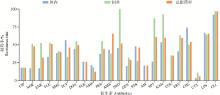
图 1
不同抗生素在国内外的耐药率情况 CIP. 环丙沙星;NOR. 诺氟沙星;ENR. 恩诺沙星;FLE. 左氧氟沙星;SMZ.复方新诺明;TCY.四环素;DOX. 多西环素;FLR. 氟苯尼考;AMP.氨苄西林;PEN. 青霉素;AMX.阿莫西林;NEO.新霉素;GEN.庆大霉素;STR.链霉素;AM.丁胺卡那霉素;SPT.大观霉素;KAN.卡那霉素;COL.黏菌素;ERY.红霉素;CHL.氯霉素;CTX.头孢噻肟;LIN.林可霉素;CLI.克林霉素"
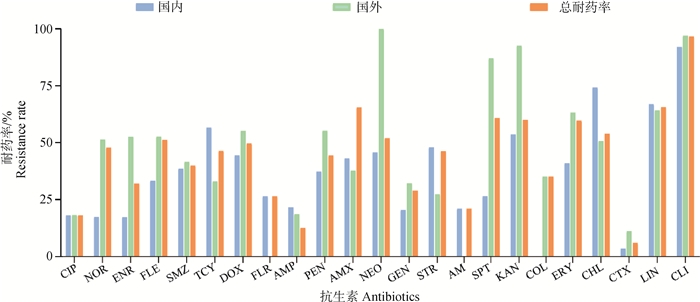
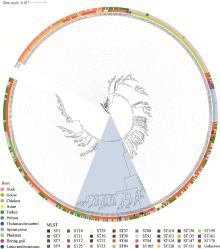
图 2
禽源多杀性巴氏杆菌全基因组分析"
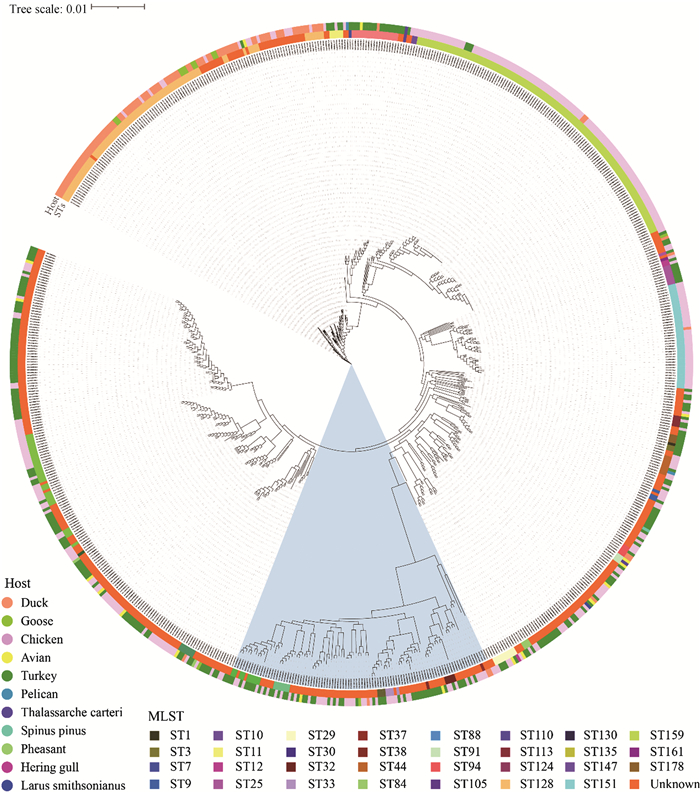
表 4
733株禽源多杀性巴氏杆菌耐药基因"
| 抗生素种类 Types of antibiotics | 耐药基因 Antibiotic resistance genes | 耐药基因比率/% Resistance gene ratio |
| 磺胺类Sulfonamides | sul2 | 13.64 |
| sul3 | 0.95 | |
| 四环素类Tetracycline | tet(A) | 0.95 |
| tet(B) | 10.64 | |
| tet(H) | 0.68 | |
| tet(Y) | 0.27 | |
| β-内酰胺类β-lactams | blaVEB-1 | 0.41 |
| blaOXA-1 | 1.36 | |
| blaTEM-1B | 0.95 | |
| blaROB-1 | 0.68 | |
| blaOXA-10 | 0.14 | |
| 氨基糖苷类Aminoglycosides | aph(3′)-Ia | 4.50 |
| aph(3″)-Ib | 7.64 | |
| aph(6)-Id | 5.46 | |
| ant(2″)-Ia | 0.41 | |
| aadA17 | 0.55 | |
| aac(6′)-aph(2″) | 0.14 | |
| aac(6′)-IIa | 0.27 | |
| 大环内酯类Macrolides | mef(B) | 0.95 |
| erm(T) | 0.55 | |
| 酰胺类Amides | catP | 2.05 |
| catA3 | 3.00 | |
| floR | 4.09 | |
| 甲氧苄胺嘧啶类Trimethoprim | dfrA32 | 0.68 |
| dfrA17 | 1.77 | |
| dfrA27 | 0.14 | |
| dfrA1 | 0.14 | |
| dfrA20 | 0.27 | |
| 利福平类Rifampicin | arr-3 | 0.41 |
| 1 |
WILSON B A , HO M . Pasteurella multocida: from zoonosis to cellular microbiology[J]. Clin Microbiol Rev, 2013, 26 (3): 631- 655.
doi: 10.1128/CMR.00024-13 |
| 2 | WILKIE I W , HARPER M , BOYCE J D , et al. Pasteurella multocida: diseases and pathogenesis[J]. Curr Top Microbiol, 2012, 361, 1- 22. |
| 3 | PENG Z , WANG X , ZHOU R , et al. Pasteurella multocida: Genotypes and Genomics[J]. Microbiol Mol Biol R, 2019, 83 (4) |
| 4 |
SCHOELLKOPF J , MUELLER T , HIPPCHEN L , et al. Genome wide CRISPR screen for Pasteurella multocida toxin (PMT) binding proteins reveals LDL Receptor Related Protein 1 (LRP1) as crucial cellular receptor[J]. Plos Pathog, 2022, 18 (12): e1010781.
doi: 10.1371/journal.ppat.1010781 |
| 5 | CARTER G R . Studies on Pasteurella multocida.I.A hemagglutination test for the identification of serological types[J]. Am J Vet Res, 1955, 16 (60): 481- 484. |
| 6 | 四郎曲珍. 多杀性巴氏杆菌相关毒力因子的研究进展[J]. 中国畜牧兽医文摘, 2015 (9): 2. |
| SI L Q Z . Research progress on virulence factors associated with Pasteurella multocida[J]. Zhongguo Xumu Shouyi Wenzhai, 2015 (9): 2. | |
| 7 | 孙翠平, 王金良, 李书光, 等. 雏鸭源多杀性巴氏杆菌的分离鉴定和荚膜PCR分型[J]. 中国预防兽医学报, 2011, 33 (7): 5. |
| SUN C P , WANG J L , LI S G , et al. Isolation, identification and capsular pcr typing of Pasteurella multocida from ducklings[J]. Chinese Journal of Preventive Veterinary Medicine, 2011, 33 (7): 5. | |
| 8 |
SUBAAHARAN S , BLACKALL L L , BLACKALL P J . Development of a multi-locus sequence typing scheme for avian isolates of Pasteurella multocida[J]. Vet Microbiol, 2010, 141 (3-4): 354- 361.
doi: 10.1016/j.vetmic.2010.01.017 |
| 9 | 王凤杰, 任砚, 刘万, 等. 多杀性巴氏杆菌研究概述[J]. 畜牧与兽医, 2024, 56 (7): 134- 139. |
| WANG F J , REN Y , LIU W , et al. Overview of research on Pasteurella multocida[J]. Animal Husbandry & Veterinary Medicine, 2024, 56 (7): 134- 139. | |
| 10 | 陈静, 许梦怡, 刘慧谋, 等. 引起一鸡场多次爆发禽霍乱的多杀性巴氏杆菌的分离试验[J]. 黑龙江畜牧兽医, 2015 (11): 177- 179. |
| CHEN J , XU M Y , LIU H M , et al. Isolation experiment of Pasteurella multocida causing multiple outbreaks of fowl cholera in a chicken farm[J]. Heilongjiang Animal Science and Veterinary Medicine, 2015 (11): 177- 179. | |
| 11 | 刘小龙, 卢荣辉, 程龙飞, 等. 麻鸭源多杀性巴氏杆菌的生物学特性分析[J]. 中国家禽, 2016, 38 (22): 56- 58. |
| LIU X L , LU R H , CHENG L F , et al. Analysis of biological characteristics of Pasteurella multocida ssolated from shelducks[J]. China Poultry, 2016, 38 (22): 56- 58. | |
| 12 | 郭伟娜, 路振香, 刘利晓, 等. 鸭多杀性巴氏杆菌的分离及药敏试验[J]. 畜牧兽医科技信息, 2017 (3): 26- 28. |
| GUO W N , LU Z X , LIU L X , et al. Isolation and drug sensitivity test of Pasteurella multocida from ducks[J]. Chinese Journal of Animal Husbandry and Veterinary Medicine, 2017 (3): 26- 28. | |
| 13 | 郭伟娜, 路振香, 刘利晓, 等. 鸡源多杀性巴氏杆菌的分离鉴定及其毒力基因的检测[J]. 中国兽医科学, 2017, 47 (7): 890- 896. |
| GUO W N , LU Z X , LIU L X , et al. Isolation and identification of Pasteurella multocida from chickens and detection of its virulence genes[J]. Chinese Journal of Veterinary Medicine, 2017, 47 (7): 890- 896. | |
| 14 | 郭伟娜, 路振香, 刘利晓, 等. 一株番鸭源多杀性巴氏杆菌的分离鉴定[J]. 黑龙江畜牧兽医, 2017 (22): 133-135, 298. |
| GUO W N , LU Z X , LIU L X , et al. Isolation and identification of a strain of Pasteurella multocida from muscovy ducks[J]. Heilongjiang Animal Science and Veterinary Medicine, 2017 (22): 133-135, 298. | |
| 15 | 陶娅, 王铉皓, 李军朝, 等. 禽源多杀性巴氏杆菌的分离及生物学鉴定[J]. 中国兽医杂志, 2019, 55 (4): 92- 94. |
| TAO Y , WANG X H , LI J C , et al. Isolation and biological identification of Pasteurella multocida from poultry[J]. Chinese Journal of Veterinary Medicine, 2019, 55 (4): 92- 94. | |
| 16 | 郑小兰, 程龙飞, 黄瑜. 三株鸭源荚膜A型多杀性巴氏杆菌的分离与鉴定[J]. 福建畜牧兽医, 2020, 42 (4): 7- 10. |
| ZHENG X L , CHENG L F , HUANG Y . Isolation and identification of three strains of capsular type A Pasteurella multocida from ducks[J]. Journal of Animal Husbandry and Veterinary Medicine Fujian, 2020, 42 (4): 7- 10. | |
| 17 | 仇桂玲, 钟嘉诚, 谭结敏, 等. 20株禽多杀性巴氏杆菌的分离及荚膜与脂多糖的分型鉴定[J]. 广东畜牧兽医科技, 2021, 46 (1): 43-49, 52. |
| QIU G L , ZHONG J C , TAN J M , et al. Isolation of 20 strains of avian Pasteurella multocida and typing identification of their capsules and lipopolysaccharides[J]. Guangdong Journal of Animal and Veterinary Science, 2021, 46 (1): 43-49, 52. | |
| 18 | 郭伟娜, 张瑞, 王雨欣, 等. 鸡源多杀性巴氏杆菌的分离及毒力基因检测[J]. 安徽科技学院学报, 2021, 35 (5): 12- 16. |
| GUO W N , ZHANG R , WANG Y X , et al. Isolation of Pasteurella multocida from chickens and detection of its virulence genes[J]. Journal of Anhui Science and Technology University, 2021, 35 (5): 12- 16. | |
| 19 | 刘丹. 鸭多杀性巴氏杆菌的分离鉴定及致病性研究[D]. 合肥: 安徽农业大学, 2023. |
| LIU D. Isolation, identification and pathogenicity study of Pasteurella multocida from ducks[D]. Hefei: Anhui Agricultural University, 2023. (in Chinese) | |
| 20 | 郭伟娜, 王紫苇, 马佰贺, 等. 鸭源多杀性巴氏杆菌的分离鉴定及药敏试验[J]. 安徽科技学院学报, 2024, 38 (1): 1- 6. |
| GUO W N , WANG Z W , MA B H , et al. Isolation, identification and drug sensitivity test of Pasteurella multocida from ducks[J]. Journal of Anhui Science and Technology University, 2024, 38 (1): 1- 6. | |
| 21 | 苏文楠, 杨智灿, 张美琳, 等. 广东鹅源多杀性巴氏杆菌的分离鉴定、耐药表型和耐药基因的检测及相关性分析[J]. 中国预防兽医学报, 2024, 46 (2): 121- 127. |
| SU W N , YANG Z C , ZHANG M L , et al. Isolation and identification of Pasteurella multocida from Guangdong geese, detection of its drug-resistant phenotypes and drug-resistant genes, and correlation analysis[J]. Chinese Journal of Preventive Veterinary Medicine, 2024, 46 (2): 121- 127. | |
| 22 | 苏文楠. 鹅源多杀性巴氏杆菌的分离鉴定及荚膜亚单位疫苗的研制[D]. 佛山: 佛山科学技术学院, 2024. |
| SU W N. Isolation and identification of goose-derived Pasteurella multocida and development of capsular subunit vaccine[D]. Foshan: Foshan University, 2024. (in Chinese) | |
| 23 | 龚丽娜, 李夏诚. 6株多杀性巴氏杆菌的分离与鉴定[J]. 新农民, 2024 (24): 73- 75. |
| GONG L N , LI X C . Isolation and identification of six strains of Pasteurella multocida[J]. New Farmers, 2024 (24): 73- 75. | |
| 24 | 许明, 张笛, 沈海玉, 等. 江苏省肉种鸡场禽多杀性巴氏杆菌流行病学调查[J]. 中国家禽, 2024, 46 (10): 121- 125. |
| XU M , ZHANG D , SHEN H Y , et al. Epidemiological investigation of avian Pasteurella multocida in broiler breeding farms in Jiangsu province[J]. China Poultry, 2024, 46 (10): 121- 125. | |
| 25 | 贺青梅, 张红见, 文英. 金刚鹦鹉多杀性巴氏杆菌的分离鉴定[J]. 中国兽医杂志, 2012, 48 (1): 73- 74. |
| HE Q M , ZHANG H J , WEN Y . Isolation and identification of Pasteurella multocida from macaws[J]. Chinese Journal of Veterinary Medicine, 2012, 48 (1): 73- 74. | |
| 26 | 李军朝, 邸涛, 陈静, 等. 1株鹦鹉源多杀性巴氏杆菌的鉴定[J]. 中国兽医杂志, 2016, 52 (7): 33- 34. |
| LI J C , DI T , CHEN J , et al. Identification of one strain of Pasteurella multocida isolated from parrots[J]. Chinese Journal of Veterinary Medicine, 2016, 52 (07): 33- 34. | |
| 27 | 江涛, 魏云舫, 何会时. 鸽源多杀性巴氏杆菌的分离与鉴定[J]. 吉林畜牧兽医, 2007 (9): 22- 23. |
| JIANG T , WEI Y F , HE H S . Isolation and identification of Pasteurella multocida from pigeons[J]. Jilin Animal Husbandry and Veterinary Medicine, 2007 (9): 22- 23. | |
| 28 | 么乃全, 李斯齐, 邸海洋, 等. 火鸡多杀性巴氏杆菌的分离鉴定及致病性研究[J]. 中国兽医科学, 2016, 46 (2): 242- 246. |
| ME N Q , LI S Q , DI H Y , et al. Isolation, identification and pathogenicity study of Pasteurella multocida from turkeys[J]. Chinese Journal of Veterinary Medicine, 2016, 46 (2): 242- 246. | |
| 29 | 胡杰, 赵国明, 陆文俊, 等. 鸡多杀性巴氏杆菌的分离与鉴定[J]. 中国家禽, 2006 (17): 22- 23. |
| HU J , ZHAO G M , LU W J , et al. Isolation and identification of Pasteurella multocida from chickens[J]. China Poultry, 2006 (17): 22- 23. | |
| 30 | 邵璐璐, 廖永洪, 罗玲, 等. 湖北麻鸡多杀性巴氏杆菌的分离和PCR鉴定[J]. 湖北农业科学, 2010, 49 (11): 2663-2664, 2668. |
| SHAO L L , LIAO Y H , LUO L , et al. Isolation and pcr identification of Pasteurella multocida from Hubei partridge chickens[J]. Hubei Agricultural Sciences, 2010, 49 (11): 2663-2664, 2668. | |
| 31 | 宋阳, 王兆淼, 鲁娜. 鹅霍乱多杀性巴氏杆菌分离鉴定及疫苗的制备[J]. 黑龙江畜牧兽医, 2011 (21): 119- 120. |
| SONG Y , WANG Z M , LU N . Isolation and identification of Pasteurella multocida from goose cholera and preparation of its vaccine[J]. Heilongjiang Animal Science and Veterinary Medicine, 2011 (21): 119- 120. | |
| 32 | 周伟, 李能章, 魏学良, 等. 雁鸭源荚膜血清A型多杀性巴氏杆菌的分离鉴定[J]. 中国预防兽医学报, 2012, 34 (6): 498- 500. |
| ZHOU W , LI N Z , WEI X L , et al. Isolation and identification of capsular serotype A Pasteurella multocida from anseriformes and anatidae sources[J]. Chinese Journal of Preventive Veterinary Medicine, 2012, 34 (6): 498- 500. | |
| 33 | 韩冠双, 简艳娟, 宋振辉, 等. 鹅源多杀性巴氏杆菌分离鉴定及系统进化分析[J]. 西南大学学报(自然科学版), 2015, 37 (3): 60- 64. |
| HAN G S , JIAN Y J , SONG Z H , et al. Isolation, identification and phylogenetic analysis of Pasteurella multocida from goose origin[J]. Journal of Southwest University (Natural Science), 2015, 37 (3): 60- 64. | |
| 34 | 杨泽晓, 刘常钰, 王印, 等. 一株鹅源多杀性巴氏杆菌强毒株的分离鉴定及其血清型鉴定相关基因的克隆[J]. 浙江农业学报, 2016, 28 (6): 935- 943. |
| YANG Z X , LIU C Y , WANG Y , et al. Isolation and identification of a virulent strain of goose-derived Pasteurella multocida and cloning of genes related to its serotype identification[J]. Acta Agriculturae Zhejiangensis, 2016, 28 (6): 935- 943. | |
| 35 | 徐雨, 冯明祥, 韦登雄, 等. 一株鸡多杀性巴氏杆菌的分离鉴定及药敏实验[J]. 贵州畜牧兽医, 2016, 40 (5): 16- 18. |
| XU Y , FENG M X , WEI D X , et al. Isolation, identification and drug sensitivity test of a chicken-derived Pasteurella multocida strain[J]. Guizhou Animal Science and Veterinary Medicine, 2016, 40 (5): 16- 18. | |
| 36 | 许英民. 雉鸡多杀性巴氏杆菌的分离及其药敏试验[J]. 家禽科学, 2017 (2): 47- 49. |
| XU Y M . Isolation of Pasteurella multocida from pheasants and its drug sensitivity test[J]. Poultry Science, 2017 (2): 47- 49. | |
| 37 | 唐沙, 袁海文, 杨源, 等. 禽霍乱巴氏杆菌的分离鉴定及基因分型[J]. 中国畜牧兽医, 2017, 44 (9): 2724- 2730. |
| TANG S , YUAN H W , YANG Y , et al. Isolation, identification and genotyping of Pasteurella multocida from fowl cholera[J]. China Animal Husbandry & Veterinary Medicine, 2017, 44 (9): 2724- 2730. | |
| 38 | 常超越, 张召兴, 李蕴玉, 等. 鸡源多杀性巴氏杆菌QHP-1株分离鉴定与耐药性分析[J]. 中国兽医杂志, 2017, 53 (10): 48-50, 54. |
| CHANG C Y , ZHANG Z X , LI Y Y , et al. Isolation, identification and drug resistance analysis of chicken-derived Pasteurella multocida strain QHP-1[J]. Chinese Journal of Veterinary Medicine, 2017, 53 (10): 48-50, 54. | |
| 39 | 杨楠, 吴同垒, 王洪彬, 等. 鹅源多杀性巴氏杆菌的分离鉴定与药物敏感性分析[J]. 中国家禽, 2017, 39 (22): 55- 58. |
| YANG N , WU T L , WANG H B , et al. Isolation, identification and drug sensitivity analysis of goose-derived Pasteurella multocida[J]. China Poultry, 2017, 39 (22): 55- 58. | |
| 40 | 边彦超, 刘小兰, 康绍珠, 等. 鸡巴氏杆菌的分离鉴定及体外抑制实验[J]. 江西畜牧兽医杂志, 2018 (1): 20- 23. |
| BIAN Y C , LIU X L , KANG S Z , et al. Isolation, identification and in vitro inhibition experiment of chicken Pasteurella multocida[J]. Jiangxi Journal of Animal Husbandry & Veterinary Medicine, 2018 (1): 20- 23. | |
| 41 | 刘燕. 肉雏鹅源多杀性巴氏杆菌分离鉴定与致病性试验[J]. 中国兽医杂志, 2019, 55 (1): 58- 61. |
| LIU Y . Isolation, identification and pathogenicity test of Pasteurella multocida from meat goslings[J]. Chinese Journal of Veterinary Medicine, 2019, 55 (1): 58- 61. | |
| 42 | 王红琳, 卢琴, 张腾飞, 等. 鸭源荚膜血清A型多杀性巴氏杆菌的分离与鉴定[J]. 湖北农业科学, 2019, 58 (12): 116- 119. |
| WANG H L , LU Q , ZHANG T F , et al. Isolation and identification of capsular serotype A Pasteurella multocida from ducks[J]. Hubei Agricultural Sciences, 2019, 58 (12): 116- 119. | |
| 43 | 程增青, 郭玉广, 马冬, 等. 鸭源1:A型多杀性巴氏杆菌的分离与鉴定[J]. 中国动物检疫, 2019, 36 (9): 88- 91. |
| CHENG Z Q , GUO Y G , MA D , et al. Isolation and identification of Pasteurella multocida serotype 1:A from ducks[J]. China Animal Health Inspection, 2019, 36 (9): 88- 91. | |
| 44 | 黄萃, 伍思华, 李钰, 等. 乌鸡源多杀性巴氏杆菌杀禽亚种16S rDNA鉴定及药敏分析[J]. 生物灾害科学, 2019, 42 (3): 243- 247. |
| HUANG C , WU S H , LI Y , et al. 16S rDNA identification and drug sensitivity analysis of Pasteurella multocida subsp. avicida from silky fowl origin[J]. Biological Disaster Science, 2019, 42 (3): 243- 247. | |
| 45 | 党媛. 一例禽多杀性巴氏杆菌的分离与鉴定[J]. 现代畜牧科技, 2019 (10): 30- 31. |
| DANG Y . Isolation and identification of a strain of avian Pasteurella multocida[J]. Modern Animal Husbandry Science & Technology, 2019 (10): 30- 31. | |
| 46 | 陈国权, 张旭, 阎朝华, 等. 鸭源多杀性巴氏杆菌的分离鉴定及耐药性分析[J]. 中国畜牧兽医, 2020, 47 (2): 620- 628. |
| CHEN G Q , ZHANG X , YAN C H , et al. Isolation, identification and drug resistance analysis of duck-derived Pasteurella multocida[J]. China Animal Husbandry & Veterinary Medicine, 2020, 47 (2): 620- 628. | |
| 47 | 王喜, 元正菊, 张信艳, 等. 鸡源多杀性巴氏杆菌的分离鉴定及生物学特性分析[J]. 中国兽医科学, 2021, 51 (11): 1411- 1419. |
| WANG X , YUAN Z J , ZHANG X Y , et al. Isolation, identification and biological characteristics analysis of chicken-derived Pasteurella multocida[J]. Chinese Veterinary Science, 2021, 51 (11): 1411- 1419. | |
| 48 | 杨宗琛, 胡巧云, 王昌建, 等. 一株禽多杀性巴氏杆菌的分离鉴定[J]. 湖南畜牧兽医, 2023 (5): 11- 15. |
| YANG Z C , HU Q Y , WANG C J , et al. Isolation and identification of a strain of avian Pasteurella multocida[J]. Hunan Journal Of Animal Science & Veterinary Medicine, 2023 (5): 11- 15. | |
| 49 | 贾惠言, 周潇, 戴久丽, 等. 浙东白鹅种鹅多杀性巴氏杆菌分离鉴定及药敏试验[J]. 中国畜禽种业, 2023, 19 (11): 139- 144. |
| JIA H Y , ZHOU X , DAI J L , et al. Isolation, identification and drug sensitivity test of Pasteurella multocida from breeding geese of zhedong white goose[J]. The Chinese Livestock and Poultry Breeding, 2023, 19 (11): 139- 144. | |
| 50 |
MARIANA S , HIRST R . The immunogenicity and pathogenicity of Pasteurella multocida isolated from poultry in Indonesia[J]. Vet Microbiol, 2000, 72 (1-2): 27- 36.
doi: 10.1016/S0378-1135(99)00184-4 |
| 51 |
FEGAN N , BLACKALL P J , PAHOFF J L . Phenotypic characterisation of Pasteurella multocida isolates from Australian poultry[J]. Vet Microbiol, 1995, 47 (3-4): 281- 286.
doi: 10.1016/0378-1135(95)00119-0 |
| 52 |
ALLEN J L , BUSHELL R N , NOORMOHAMMADI A H , et al. Pasteurella multocida ST20 is widespread in Australian poultry farms and may infect wild waterbirds[J]. Vet Microbiol, 2024, 290, 109990.
doi: 10.1016/j.vetmic.2024.109990 |
| 53 |
SHIRZRD A H , TABATABAEI M . Occurrence of virulence-associated genes in Pasteurella multocida isolates obtained from different hosts[J]. Microb Pathog, 2016, 96, 52- 57.
doi: 10.1016/j.micpath.2016.04.008 |
| 54 |
VARGA Z , VOLOKHOV D V , STIPKOVITS L , et al. Characterization of Pasteurella multocida strains isolated from geese[J]. Vet Microbiol, 2013, 163 (1-2): 149- 156.
doi: 10.1016/j.vetmic.2012.12.023 |
| 55 | KEREK Á , SZABO Á , JERZSELE Á . Antimicrobial susceptibility profiles of Pasteurella multocida isolates from clinical cases of waterfowl in Hungary between 2022 and 2023[J]. Vet Sci, 2024, 11 (5) |
| 56 |
GUNAWARDAND G A , TOWNSEND K M , FROST A J . Molecular characterisation of avian Pasteurella multocida isolates from Australia and Vietnam by REP-PCR and PFGE[J]. Vet Microbiol, 2000, 72 (1-2): 97- 109.
doi: 10.1016/S0378-1135(99)00191-1 |
| 57 | SAHA O , ISLAM M R , RAHMAN M S , et al. First report from Bangladesh on genetic diversity of multidrug-resistant Pasteurella multocida type B: 2 in fowl cholera[J]. Vet World, 2021, 14 (9): 2527- 2542. |
| 58 |
CHRZASTEK K , KUCZKOWSKI M , WIELICZKO A K , et al. Molecular epidemiologic investigation of Polish avian Pasteurella multocida strains isolated from fowl cholera outbreaks showing restricted geographical and host-specific distribution[J]. Avian Dis, 2012, 56 (3): 529- 536.
doi: 10.1637/10027-113011-Reg.1 |
| 59 |
JONES K H , THORNTON J K , ZHANG Y , et al. A 5-year retrospective report of Gallibacterium anatis and Pasteurella multocida isolates from chickens in Mississippi[J]. Poult Sci, 2013, 92 (12): 3166- 3171.
doi: 10.3382/ps.2013-03321 |
| 60 |
SHIVACHANDRA S B , KUMAR A A , GAUTAM R , et al. Identification of avian strains of Pasteurella multocida in India by conventional and PCR assays[J]. Vet J, 2006, 172 (3): 561- 564.
doi: 10.1016/j.tvjl.2005.05.007 |
| 61 |
SINAI N L , COATES P S , ANDRLE K M , et al. A Serosurvey of greater sage-grouse(centrocercus urophasianus) in Nevada, USA[J]. J Wildl Dis, 2017, 53 (1): 136- 139.
doi: 10.7589/2015-10-285 |
| 62 |
EL-TARABILI R M , ENANY M E , ALENZI A M , et al. Unveiling resistance patterns, kmt1 sequence analyses, virulence traits, and antibiotic resistance genes of multidrug-resistant Pasteurella multocida retrieved from poultry and rabbits[J]. Sci Rep, 2025, 15 (1): 5348.
doi: 10.1038/s41598-025-89900-6 |
| 63 |
EL-DEMERDASH A S , MOWAFY R E , FAHMY H A , et al. Pathognomonic features of Pasteurella multocida isolates among various avian species in Sharkia Governorate, Egypt[J]. World J Microbiol Biotechnol, 2023, 39 (12): 335.
doi: 10.1007/s11274-023-03774-2 |
| 64 |
SHALABY A G , BAKRY N R , EL-DEMERDASH A S . Virulence attitude estimation of Pasteurella multocida isolates in embryonated chicken eggs[J]. Arch Microbiol, 2021, 203 (10): 6153- 6162.
doi: 10.1007/s00203-021-02579-x |
| 65 |
MBUTHIA P G , NJAGI L W , NYAGA P N , et al. Pasteurella multocida in scavenging family chickens and ducks: carrier status, age susceptibility and transmission between species[J]. Avian Pathol, 2008, 37 (1): 51- 57.
doi: 10.1080/03079450701784891 |
| 66 |
MUHAIRWA A P , MTAMBO M M , CHRISTENSEN J P , et al. Occurrence of Pasteurella multocida and related species in village free ranging chickens and their animal contacts in Tanzania[J]. Vet Microbiol, 2001, 78 (2): 139- 153.
doi: 10.1016/S0378-1135(00)00296-0 |
| 67 |
TAUNDE P , TIMBE P , LUCAS A F , et al. Serological evidence of avian encephalomyelitis virus and Pasteurella multocida infections in free-range indigenous chickens in Southern Mozambique[J]. Trop Anim Health Prod, 2017, 49 (5): 1047- 1050.
doi: 10.1007/s11250-017-1304-x |
| 68 |
FURIAN T Q , BORGES K A , LAVINIKI V , et al. Virulence genes and antimicrobial resistance of Pasteurella multocida isolated from poultry and swine[J]. Braz J Microbiol, 2016, 47 (1): 210- 216.
doi: 10.1016/j.bjm.2015.11.014 |
| 69 |
XIAO J , LI Y , HU Z , et al. Characterization of Pasteurella multocida isolated from ducks in China from 2017 to 2019[J]. Microb Pathog, 2021, 160, 105196.
doi: 10.1016/j.micpath.2021.105196 |
| 70 |
LI Z , CHENG F , LAN S , et al. Investigation of genetic diversity and epidemiological characteristics of Pasteurella multocida isolates from poultry in southwest China by population structure, multi-locus sequence typing and virulence-associated gene profile analysis[J]. J Vet Med Sci, 2018, 80 (6): 921- 929.
doi: 10.1292/jvms.18-0049 |
| 71 |
TAN M F , LI H Q , YANG Q , et al. Prevalence and antimicrobial resistance profile of bacterial pathogens isolated from poultry in Jiangxi Province, China from 2020 to 2022[J]. Poult Sci, 2023, 102 (8): 102830.
doi: 10.1016/j.psj.2023.102830 |
| 72 | 于勇, 左家坤, 王凯民, 等. 4株鸡源多杀性巴氏杆菌生物学特性分析[J]. 中国动物检疫, 2022, 39 (4): 59- 65. |
| YU Y , ZUO J K , WANG K M , et al. Analysis on biological characteristics of four strains of chicken-derived Pasteurella multocida[J]. China Animal Health Inspection, 2022, 39 (4): 59- 65. | |
| 73 | 严专强, 麦凯杰, 罗翠芬, 等. 我国部分地区禽多杀性巴氏杆菌的分离鉴定及耐药情况分析[J]. 家禽科学, 2021 (11): 45- 49. |
| YAN Z Q , MAI K J , LUO C F , et al. Isolation, identification and drug resistance analysis of avian Pasteurella multocida in some regions of china[J]. Poultry Science, 2021 (11): 45- 49. | |
| 74 | 胡恒龙, 胡祖余. 安徽省六安市禽源多杀性巴氏杆菌耐药情况调查[J]. 畜牧兽医科学(电子版), 2019 (10): 20- 21. |
| HU H L , HU Z Y . Investigation on drug resistance of avian Pasteurella multocida in Lu'an city, Anhui province[J]. Graziery Veterinary Sciences, 2019 (10): 20- 21. | |
| 75 | 陈红梅, 程龙飞, 邓辉, 等. 禽源多杀性巴氏杆菌耐药性分析及氟苯尼考耐药基因floR分布[J]. 畜牧与兽医, 2019, 51 (3): 93- 96. |
| CHEN H M , CHENG L F , DENG H , et al. Drug Resistance analysis of avian Pasteurella multocida and distribution of florfenicol resistance gene floR[J]. Animal Husbandry & Veterinary Medicine, 2019, 51 (3): 93- 96. | |
| 76 | 陈红梅, 程龙飞, 邓辉, 等. 鸭源多杀性巴氏杆菌对磺胺类药物的耐药性检测及耐药基因分析[J]. 中国畜牧兽医, 2019, 46 (1): 223- 230. |
| CHEN H M , CHENG L F , DENG H , et al. Detection of sulfonamide resistance and analysis of resistance genes in duck-derived Pasteurella multocida[J]. China Animal Husbandry & Veterinary Medicine, 2019, 46 (1): 223- 230. | |
| 77 | 刘小龙, 程龙飞, 卢荣辉, 等. 三株鸭源多杀性巴氏杆菌血清型与耐药表型的相关分析[J]. 中国家禽, 2017, 39 (3): 54- 57. |
| LIU X L , CHENG L F , LU R H , et al. Correlation analysis of serotypes and drug-resistant phenotypes of three strains of duck-derived Pasteurella multocida[J]. China Poultry, 2017, 39 (3): 54- 57. | |
| 78 |
RIGOBELO E C , BLACKALL P J , MALUTA R P , et al. Identification and antimicrobial susceptibility patterns of Pasteurella multocida isolated from chickens and japanese quails in Brazil[J]. Braz J Microbiol, 2013, 44 (1): 161- 164.
doi: 10.1590/S1517-83822013000100023 |
| 79 |
JONAS M , MORISHITA T Y , ANGRICK E J , et al. Characterization of nine Pasteurella multocida isolates from avian cholera outbreaks in Indonesia[J]. Avian Dis, 2001, 45 (1): 34- 42.
doi: 10.2307/1593009 |
| 80 |
EID S , MAROUSF S , HEFNY H Y , et al. Pasteurellaceae members with similar morphological patterns associated with respiratory manifestations in ducks[J]. Vet World, 2019, 12 (12): 2061- 2069.
doi: 10.14202/vetworld.2019.2061-2069 |
| 81 |
SHIVACHANDRA S B , KUMAR A A , BISWAS A , et al. Antibiotic sensitivity patterns among Indian strains of avian Pasteurella multocida[J]. Trop Anim Health Pro, 2004, 36 (8): 743- 750.
doi: 10.1023/B:TROP.0000045950.35070.7f |
| [1] | 李晨阳, 张传美, 惠宇韬, 吕莹, 杨敏. 15种血清型的鸭疫里默氏杆菌毒力基因检测和耐药性分析[J]. 畜牧兽医学报, 2026, 57(1): 360-368. |
| [2] | 张晶, 王亚平, 樊曦雯, 王真. 一株牛源福氏志贺菌的分离鉴定及全基因组测序分析[J]. 畜牧兽医学报, 2026, 57(1): 378-391. |
| [3] | 马彩萍, 祝瑶, 刘红道, 周光斌, 许秋, 林龙华, 柴霁芸, 侯杰, 孙宏飞, 杜素素, 范翠龙, 夏利宁, 张万江. 三十四株猪源多杀性巴氏杆菌的分型及耐药性分析[J]. 畜牧兽医学报, 2025, 56(8): 4074-4085. |
| [4] | 向令娴, 季倩宇, 单新新, 李琳. 细菌双组分系统的耐药性及致病性研究进展[J]. 畜牧兽医学报, 2025, 56(7): 3116-3128. |
| [5] | 孔祥鹤, 苏欣雨, 钟一铭, 卢赵梓暄, 廖献茂, 张哲, 张旭, 高萌萌, 周玉龙, 樊祜卿. 黑龙江省地区犊牛腹泻源致病性大肠杆菌流行情况调查、毒力基因及耐药性分析[J]. 畜牧兽医学报, 2025, 56(7): 3390-3398. |
| [6] | 李文超, 李维俏, 李欣, 王家庆, 张雅为, 李俊平. 动物源细菌耐药性及中药消减耐药性的研究进展[J]. 畜牧兽医学报, 2025, 56(6): 2555-2576. |
| [7] | 乔亚蕊, 苗宇航, 黄倩, 周学章. 奶牛乳腺炎源粪肠球菌生物学特性研究[J]. 畜牧兽医学报, 2025, 56(5): 2325-2339. |
| [8] | 石金川, 孙淼, 孟令浩, 王永强, 耿超, 齐朝鲁蒙, 陈亨利, 王梓, 刘锴. 赛鸽源大肠杆菌耐药性检测及多重耐药菌株的全基因组测序分析[J]. 畜牧兽医学报, 2025, 56(5): 2372-2382. |
| [9] | 吴俊杰, 吕世明, 龙小霞, 王忠, 王立琦. 中药及活性成分抗耐药菌作用及其机制研究进展[J]. 畜牧兽医学报, 2025, 56(4): 1632-1647. |
| [10] | 李案本, 符娜娜, 罗晓平, 李军燕, 刘阳. 捻转血矛线虫的耐药性及其干预途径研究进展[J]. 畜牧兽医学报, 2025, 56(2): 523-533. |
| [11] | 刘健, 于泽海, 张玫瑜, 李丹, 王君, 刘芳琴, 张群, 徐守振. 一株牛肠病毒F型的全基因组分析及抗体检测间接ELISA方法的建立[J]. 畜牧兽医学报, 2025, 56(2): 814-825. |
| [12] | 曾严, 杨永根, 吴兆敏, 张洁如, 王印, 罗燕, 杨泽晓, 曹随忠, 姚学萍. 一株牛源变栖克雷伯菌噬菌体的分离鉴定、生物学特性及全基因组分析[J]. 畜牧兽医学报, 2025, 56(12): 6364-6374. |
| [13] | 聂莲花, 樊文燕, 李梦雅, 丁纯海, 吴自豪, 王志豪, 李芳芳, 蒋蔚, 韩先干, 王海东. 78株鸡关节炎源金黄色葡萄球菌毒力基因与耐药基因分析[J]. 畜牧兽医学报, 2025, 56(11): 5670-5682. |
| [14] | 白怡馨, 张梦菲, 迪娜拉·叶尔波力, 王磊, 靳婉婧, 黄颖, 谢金鑫, 郑晓风, 王美玲, 王传锋, 苏战强, 张炜, 佟盼盼. 新疆幼畜致泻性大肠埃希菌的毒力基因、耐药性和生物膜的相关性分析[J]. 畜牧兽医学报, 2025, 56(10): 5125-5136. |
| [15] | 刘炜, 马嘉怡, 耿浩宇, 谢添, 苗苏南, 廖宗杰, 耿士忠. 一株广谱沙门菌噬菌体的分离鉴定及其生物学特性[J]. 畜牧兽医学报, 2024, 55(9): 4061-4068. |
| 阅读次数 | ||||||
|
全文 |
|
|||||
|
摘要 |
|
|||||
