


畜牧兽医学报 ›› 2026, Vol. 57 ›› Issue (1): 486-499.doi: 10.11843/j.issn.0366-6964.2026.01.043
苗宇航1,2( ), 丁涛1,2, 辛杰1,2, 马文妍1,2, 杜军1,2()
收稿日期:2025-02-24
出版日期:2026-01-23
发布日期:2026-01-26
通讯作者:
杜军
E-mail:myh6943@126.com;dujun@nxu.edu.cn
作者简介:苗宇航,硕士生,主要从事动物病原生物学研究,E-mail:myh6943@126.com
基金资助:
MIAO Yuhang1,2(), DING Tao1,2, XIN Jie1,2, MA Wenyan1,2, DU Jun1,2()
Received:2025-02-24
Online:2026-01-23
Published:2026-01-26
Contact:
DU Jun
E-mail:myh6943@126.com;dujun@nxu.edu.cn
摘要:
非编码小RNA(microRNA)可参与奶牛乳腺固有免疫应答,可作为病原菌感染宿主细胞和奶牛乳腺炎的潜在生物标志物之一,但克柔念珠菌(Candida krusei)感染奶牛乳腺上皮细胞(MAC-T)后microRNA的表达模式尚不清晰。本研究旨在分析Candida krusei诱导MAC-T中的差异表达microRNA(DEmicroRNA)及其功能,为揭示Candida krusei感染MAC-T的标志microRNA和后续研究microRNA调控宿主细胞免疫应答的调控机制提供基础。利用转录组(RNA-Seq)测序技术和生物信息学方法对克柔念珠菌感染(感染复数=1)后的MAC-T进行microRNA测序、DEmicroRNA分析及GO和KEGG功能富集分析。结果表明,在正常组和感染组MAC-T中共检测出1 465个microRNA,相比于正常组,感染组筛选出16个表达显著上调和7个表达量显著下调的microRNA。应用TargetScan和miRanda软件对11个极显著性差异表达microRNA进行靶基因预测,共预测到6 739个靶基因。GO和KEGG功能富集分析结果表明,上述11个极显著性差异表达microRNA可通过免疫相关信号通路而调节奶牛乳腺炎症,进一步分析发现,显著下调的bta-miR-2377,显著上调的bta-miR-2285i可能通过潜在靶基因参与MAPK、NF-κB、Toll样受体信号通路进而调控宿主细胞炎症的发生与发展过程。在Candida krusei诱导的奶牛乳腺上皮细胞中获得了23个DEmicroRNA,可能通过潜在靶基因调控奶牛乳腺上皮细胞炎症反应的发生与发展过程,为揭示microRNA调控克柔念珠菌诱导奶牛乳腺炎的致病机制提供了科学基础。
中图分类号:
苗宇航, 丁涛, 辛杰, 马文妍, 杜军. 克柔念珠菌诱导奶牛乳腺上皮细胞microRNA差异表达分析[J]. 畜牧兽医学报, 2026, 57(1): 486-499.
MIAO Yuhang, DING Tao, XIN Jie, MA Wenyan, DU Jun. Differential Expression Analysis of microRNA in Bovine Mammary Epithelial Cells Induced by Candida krusei[J]. Acta Veterinaria et Zootechnica Sinica, 2026, 57(1): 486-499.
表1
用于microRNA表达量检测的RT-qPCR引物"
非编码小RNA microRNA | 引物序列(5′→3′) Primer sequence | 产物长度/bp Product length |
|---|---|---|
| Bta-miR-2377 | 茎环引物 stem-loop primer: GTCGTATCCAGTGCAGGGTCCGAGGTATTCGCACTGGATACGACAGAGC 上游引物 Forward primer: GCGTGTCCACTGCACACACTA 下游引物 Reverse primer: ATCCAGTGCAGGGTCCGAGG | 50 21 20 |
| Bta-miR-2285i | 茎环引物 stem-loop primer: GTCGTATCCAGTGCAGGGTCCGAGGTATTCGCACTGGATACGACCCAAAA 上游引物 Forward primer: ACGAGAACAAAACCGGAACGAAC 下游引物 Reverse primer: ATCCAGTGCAGGGTCCGAGG | 50 23 20 |
| Bta-miR-215 | 茎环引物 stem-loop primer: GTCGTATCCAGTGCAGGGTCCGAGGTATTCGCACTGGATACGACTGTCTG 上游引物 Forward primer: GCGGCCTGATGACCTATGAATTG 下游引物 Reverse primer: ATCCAGTGCAGGGTCCGAGG | 50 23 20 |
| Bta-miR-362-5p | 茎环引物 stem-loop primer: GTCGTATCCAGTGCAGGGTCCGAGGTATTCGCACTGGATACGACACTCAC | 50 |
| 上游引物 Forward primer: GAACTGACAATCCTTGGAACCTAGG | 25 | |
| 下游引物 Reverse primer: ATCCAGTGCAGGGTCCGAGG | 20 | |
| Bta-miR-219b-3p | 茎环引物 stem-loop primer: GTCGTATCCAGTGCAGGGTCCGAGGTATTCGCACTGGATACGACACTGAT 上游引物 Forward primer: AGAAGGCAGAATTGCGTTTGGAC 下游引物 Reverse primer: ATCCAGTGCAGGGTCCGAGG | 50 23 20 |
| Bta-miR-146b | 茎环引物 stem-loop primer: GTCGTATCCAGTGCAGGGTCCGAGGTATTCGCACTGGATACGACACAGCC 上游引物 Forward primer: CCACCATGTGAGAACTGAATTCCAT 下游引物 Reverse primer: ATCCAGTGCAGGGTCCGAGG | 50 25 20 |
| Bta-miR-20b_R+3_1ss10CT | 茎环引物 stem-loop primer: GTCGTATCCAGTGCAGGGTCCGAGGTATTCGCACTGGATACGACAACTAC 上游引物 Forward primer: AGCTGGACCAAAGTGCTTACAGT 下游引物 Reverse primer: ATCCAGTGCAGGGTCCGAGG | 50 23 20 |
| Bta-miR-19b_R+2 | 茎环引物 stem-loop primer: GTCGTATCCAGTGCAGGGTCCGAGGTATTCGCACTGGATACGACACTCTC 上游引物 Forward primer: AACCTCCTAATCCTTGCTACCTGG 下游引物 Reverse primer: ATCCAGTGCAGGGTCCGAGG | 50 24 20 |
| β-Actin | 上游引物 Forward primer: AGATCAAGATCATCGCGCCC 下游引物 Reverse primer: CATTTGCGGTGGACGATGGA | 20 20 |
| U6 snRNA | 上游引物 Forward primer: CTCGCTTCGGCAGCACA 下游引物 Reverse primer: AACGCTTCACGAATTTGCGT | 17 20 |
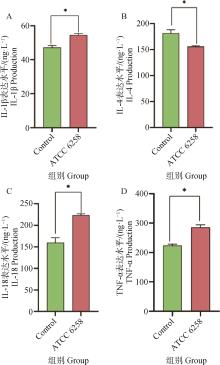
图1
细胞炎性因子表达水平的变化*. P<0.05,n=3"
表2
测序文库质量统计"
样品 Sample | 质控后序列(/%) Clean reads | 有效序列(/%) Valid reads | GC含量/% GC | Q20值/% Q20 | Q30值/% Q30 |
|---|---|---|---|---|---|
空白对照组 1 Control 1 | 8 550 695 (76.42) | 7 853 099 (91.84) | 55.21 | 94.18 | 88.93 |
空白对照组 2 Control 2 | 8 642 738 (86.55) | 8 252 043 (95.48) | 50.74 | 97.74 | 94.60 |
空白对照组3 Control 3 | 11 450 128 (88.86) | 10 954 421 (95.67) | 50.78 | 97.82 | 94.87 |
ATCC 6258感染组1 ATCC 6258 1 | 10 111 972 (90) | 9 783 952 (96.76) | 50.13 | 97.83 | 95.08 |
ATCC 6258 感染组2 ATCC 6258 2 | 10 710 185 (91.32) | 10 278 510 (95.97) | 50.35 | 97.82 | 94.80 |
ATCC 6258感染组3 ATCC 6258 3 | 10 926 138 (91.58) | 10 545 598 (96.52) | 49.97 | 97.97 | 95.29 |
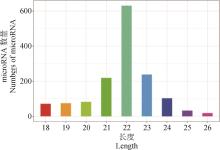
图2
已鉴定的microRNA长度分布"
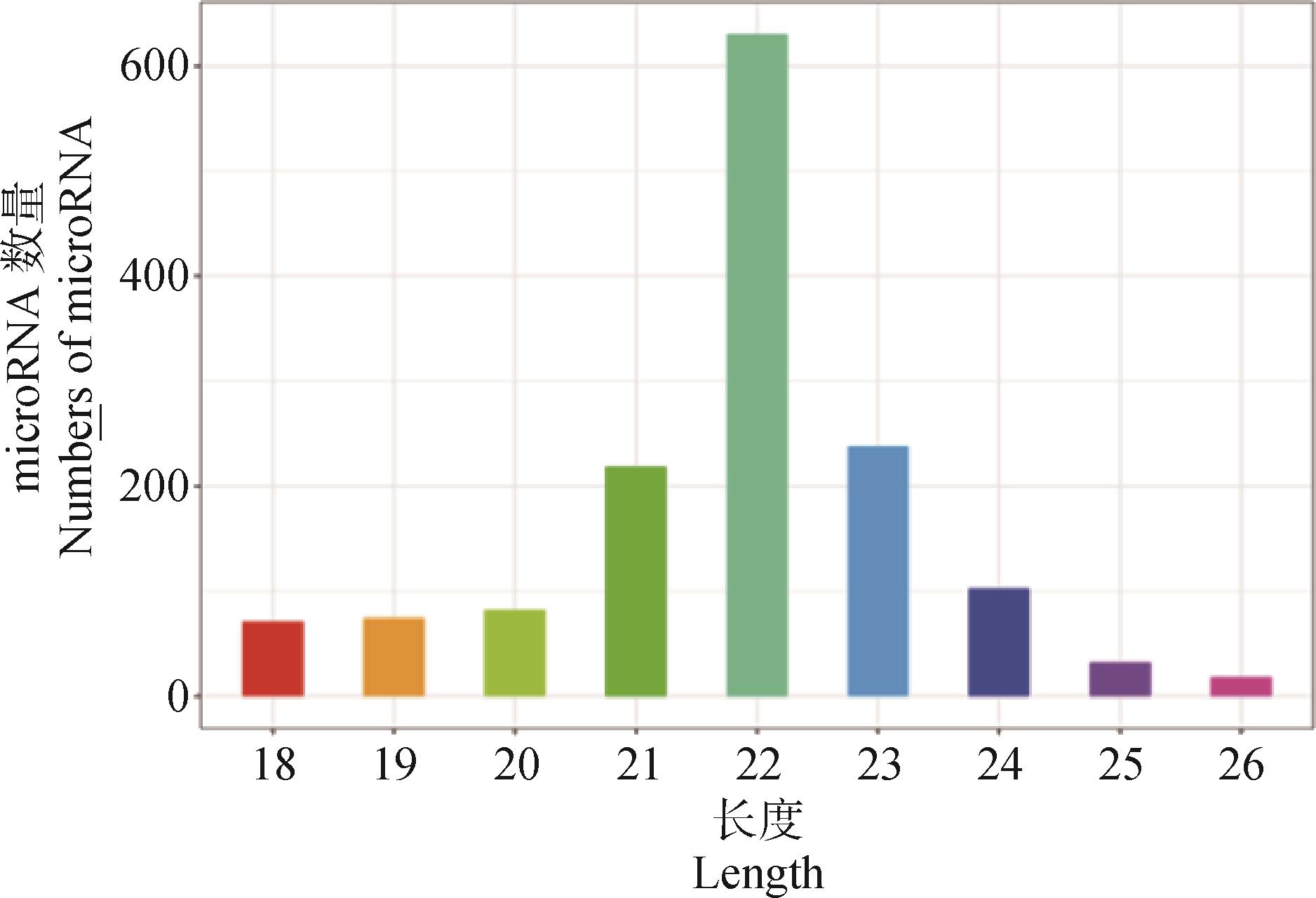
表 3
空白对照组与ATCC 6258感染组差异性表达microRNA"
microRNA名称 microRNA name | 差异倍数 Log2FC | P值 P value | 上调/下调 Up/Down |
|---|---|---|---|
| mdo-miR-196a-5p_R+2 | 2.891 907 300 | 0.001 073 447 | Up |
| PC-3p-17914_31 | 1.948 567 463 | 0.001 313 257 | Up |
| PC-3p-23460_18 | 2.569 135 000 | 0.001 540 719 | Up |
| chi-miR-191-3p | -0.807 459 348 | 0.003 157 484 | Down |
| bta-miR-2377 | -0.723 000 000 | 0.005 163 673 | Down |
| oan-miR-16b-5p_L+1 | 2.369 133 16 | 0.006 208 570 | Up |
| bta-miR-2285i | 0.356 148 451 | 0.009 318 871 | Up |
| PC-5p-8555_99 | -1.033 720 831 | 0.010 246 079 | Down |
| PC-3p-20561_24 | -2.301 896 470 | 0.010 361 880 | Down |
| chi-miR-18a-3p_R+1 | -0.403 969 492 | 0.010 398 300 | Down |
| pal-miR-9993a-3p | -0.330 814 089 | 0.010 453 945 | Down |
| bta-miR-20b_R+3_1ss10CT | 0.719 604 509 | 0.020 103 455 | Up |
| bta-miR-215 | 2.408 603 805 | 0.030 145 620 | Up |
| mmu-miR-378d_R+2_1ss6CA | 1.752 421 816 | 0.035 169 227 | Up |
| bta-miR-362-5p | 0.584 875 060 | 0.038 184 233 | Up |
| eca-miR-1839_L-1R+3 | 2.094 428 940 | 0.042 436 847 | Up |
| PC-3p-13080_52 | -0.486 472 783 | 0.049 297 031 | Down |
| PC-3p-19898_25 | 2.022 363 047 | 0.050 328 524 | Up |
| bta-miR-500_R+2 | 0.370 279 491 | 0.050 354 398 | Up |
| bta-miR-219b-3p | 1.410 831 312 | 0.050 380 862 | Up |
| lca-miR-19b_R+2 | 1.588 370 285 | 0.050 393 992 | Up |
| bta-miR-146b | 0.729 240 479 | 0.050 461 322 | Up |
| PC-3p-17661_32 | 1.303 327 519 | 0.050 485 736 | Up |
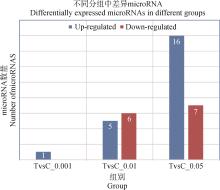
图3
microRNA的差异表达分析"
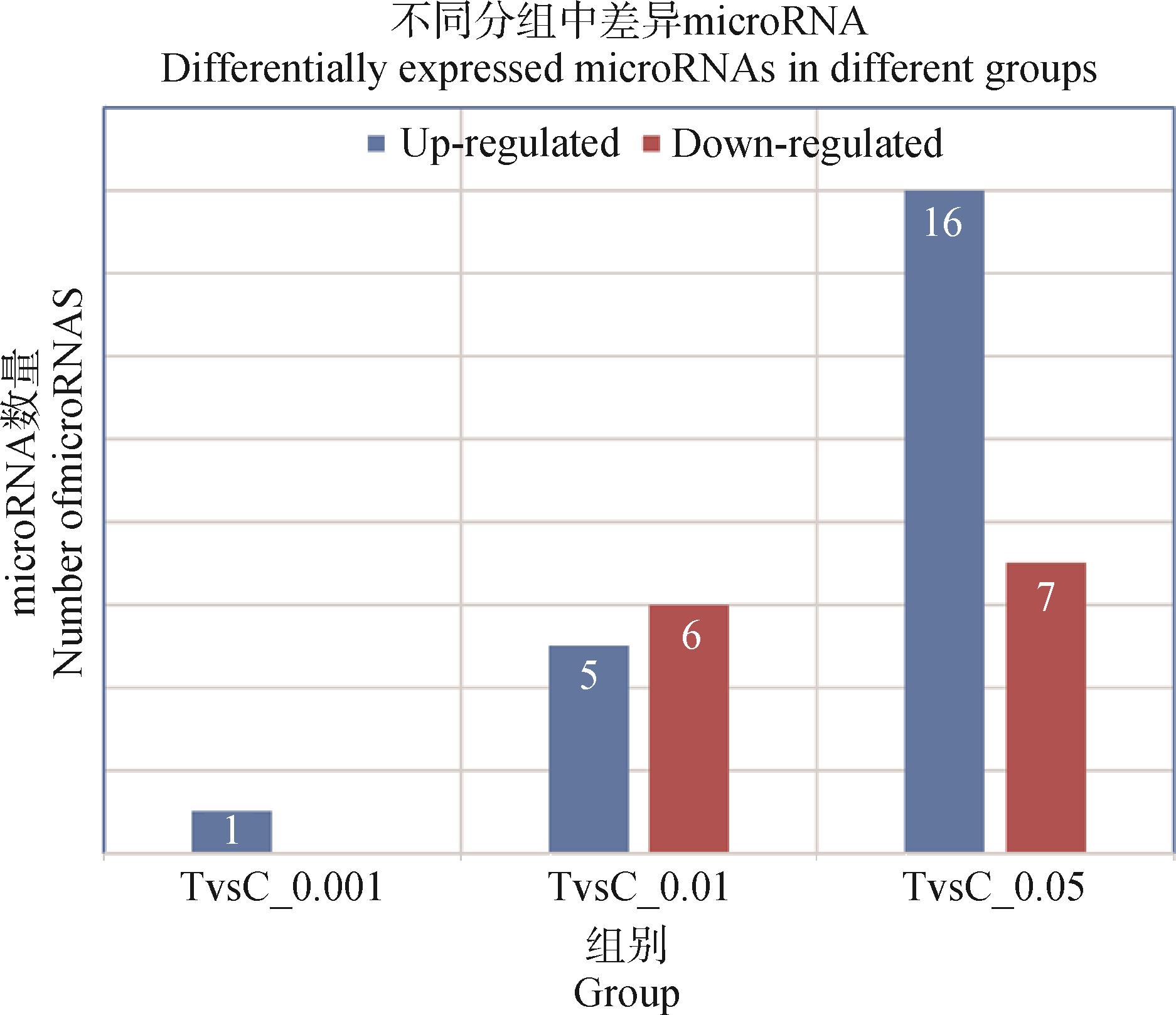
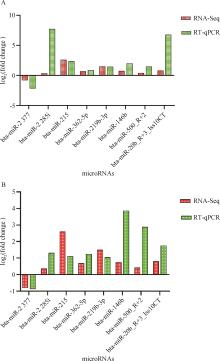
图4
microRNA的RT-qPCR结果与RNA-Seq测序结果比较A.以β-Actin作内参;B.以U6 snRNA作内参"

表 4
差异表达microRNA的GO功能注释"
功能组 Functionalgroup | 分类 Class | GO编号 GO ID | 显著基因数 Significantgenes | 总基因数 Annotated genes |
|---|---|---|---|---|
生物学过程 Biologicalprocess | 蛋白磷酸化 Protein phosphorylation | GO:0006468 | 172 | 3 590 |
RNA聚合酶Ⅱ转录正调控 Positive regulation of transcription by RNA polymerase II | GO:0045944 | 223 | 3 590 | |
细胞增殖负调控 Negative regulation of cell population proliferation | GO:0008285 | 78 | 3 590 | |
| 子宫胚胎发育 In utero embryonic development | GO:0001701 | 62 | 3 590 | |
| 囊泡运输 Vesicle-mediated transport | GO:0016192 | 48 | 3 590 | |
转化生长因子β受体信号通路 Transforming growth factor beta receptor signaling pathway | GO:0007179 | 28 | 3 590 | |
RNA聚合酶Ⅱ转录负调控 Negative regulation of transcription by RNA polymerase II | GO:0000122 | 150 | 3 590 | |
| 中心体定位 Centrosome localization | GO:0051642 | 11 | 3 590 | |
磷脂酰肌醇去磷酸化 Phosphatidylinositol dephosphorylation | GO:0046856 | 14 | 3 590 | |
| 转录正调控 Positive regulation of transcription | GO:0045893 | 123 | 3 590 | |
| 凋亡正调控 Positive regulation of apoptotic process | GO:0043065 | 58 | 3 590 | |
| 血生成 Hemopoiesis | GO:0030097 | 22 | 3 590 | |
| 细胞生长的负调控 Negative regulation of cell growth | GO:0030308 | 31 | 3 590 | |
| BMP信号通路 BMP signaling pathway | GO:0030509 | 26 | 3 590 | |
| 蛋白质转运 Protein transport | GO:0015031 | 45 | 3 590 | |
细胞组分 Cellularcomponent | 细胞溶质 Cytosol | GO:0005829 | 657 | 3 590 |
| 核质 Nucleoplasm | GO:0005654 | 624 | 3 590 | |
| 细胞质 Cytoplasm | GO:0005737 | 700 | 3 590 | |
| 细胞核 Nucleus | GO:0005634 | 725 | 3 590 | |
| 质膜 Plasma membrane | GO:0005886 | 505 | 3 590 | |
| 内质网 Endoplasmic reticulum | GO:0005783 | 200 | 3 590 | |
| 高尔基体 Golgi apparatus | GO:0005794 | 187 | 3 590 | |
胞内膜结合细胞器 Intracellular membrane-bounded organelle | GO:0043231 | 177 | 3 590 | |
| 内质网膜 Endoplasmic reticulum membrane | GO:0005789 | 93 | 3 590 | |
| 膜 Membrane | GO:0016020 | 481 | 3 590 | |
分子功能 Molecularfunction | 相同蛋白结合 Identical protein binding | GO:0042802 | 302 | 3 590 |
| 蛋白结合 Protein binding | GO:0005515 | 639 | 3 590 | |
| 蛋白激酶活性 Protein kinase activity | GO:0004672 | 142 | 3 590 | |
| 蛋白激酶结合 Protein kinase binding | GO:0019901 | 98 | 3 590 | |
| 泛素蛋白连接酶结合 Ubiquitin protein ligase binding | GO:0031625 | 73 | 3 590 | |
| ATP结合 ATP binding | GO:0005524 | 264 | 3 590 | |
| 序列特异性DNA结合 Sequence-specific DNA binding | GO:0043565 | 102 | 3 590 |
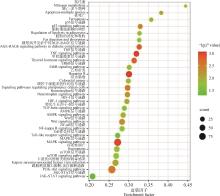
图5
DEmicroRNA靶基因KEGG富集分析"

| [1] | RUEGG P L.A 100-Year Review:Mastitis detection,management,and prevention[J].J Dairy Sci,2017,100(12):10381-10397. |
| [2] | 蔡明玉,张海龙,海珍珍,等.重组克柔念珠菌14-3-3蛋白诱导奶牛乳腺上皮细胞炎症反应的分子机制[J].畜牧兽医学报,2023,54:1679-1689. |
| CAI M,ZHANG H L,HAI Z Z,et al.The inflamed mechanism induced by recombined 14-3-3 protein of Candida krusei on bovine mammary epithelial cells[J].Acta Veterinaria et Zootechnica Sinica,2023,54:1679-1689.(in Chinese) | |
| [3] | 杜 军.克柔念珠菌两相损伤奶牛乳腺上皮细胞机制研究[D].银川:宁夏大学,2021. |
| DU J.Study on the mechanism of two-phase injury of bovine mammary epithelial cells by Candida krusei[D].Yinchuan:Ningxia University,2021.(in Chinese) | |
| [4] | GORJI A E,ROUDBARI Z,SADEGHI B,et al.Transcriptomic analysis on the promoter regions discover gene networks involving mastitis in cattle[J].Microbial Pathog,2019,137:103801. |
| [5] | JU Z H,JIANG Q,LIU G,et al.Solexa sequencing and custom microRNA chip reveal repertoire of microRNAs in mammary gland of bovine suffering from natural infectious mastitis[J].Anim Genet,2018,9(1):3-18. |
| [6] | 杨 箭,王兴平,罗仍卓么,等.miRNA在奶牛乳房炎中的表达模式和分子调控机制[J].农业生物技术学报,2020,28:2069-2079. |
| YANG J,WANG X P,LUORENG Z M,et al.The expression pattern and molecular regulatory mechanism of miRNA in mastitis of dairy cows(Bos taurus)[J].Journal of Agricultural Biotechnology,2020,28:2069-2079.(in Chinese) | |
| [7] | SUN K,LAI E C.Adult-specific functions of animal microRNAs[J].Nat Rev Genet,2013,14(8):535-548. |
| [8] | NORMA S,ISABELLE D R,ISABELLE T,et al.MicroRNAs in inflammasomopathies[J].Immunol Lett,2023,256-257:48-54. |
| [9] | RYAN M O,DINESH S R,C,AADEL A,et al.Physiological and pathological roles for microRNAs in the immune system[J].Nat Rev Immunol,2010,10(2):111-122. |
| [10] | SATOSHI N,YA C,MASAYUKI S,et al.Transcriptomic profiling identifies an exosomal microRNA signature for predicting recurrence following surgery in patients with pancreatic ductal adenocarcinoma[J].Ann Surg,2022,276(6):e876-e885. |
| [11] | DAMIEN F,RONAN G S,LOUISE B,et al.The identification of circulating miRNA in bovine serum and their potential as novel biomarkers of early Mycobacterium avium subsp paratuberculosis infection[J].PloS One,2015.10(7):e0134310. |
| [12] | LI R,ZHANG C L,LIAO X,et al.Transcriptome microRNA profiling of bovine mammary glands infected with Staphylococcus aureus[J].Int J Mol Sci,2015,16(3):4997-5013. |
| [13] | LAI Y C,TAKURO F,TADASHI M,et al.Inflammation-related microRNA expression level in the bovine milk is affected by mastitis[J].PloS One,2017,12(5):e0177182. |
| [14] | LUORENG Z M,WANG X P,MEI C G,et al.Expression profiling of peripheral blood miRNA using RNAseq technology in dairy cows with Escherichia coli-induced mastitis[J].Sci Rep,2018,8(1):12693. |
| [15] | WANG X Z,SU F,YU X H,et al.RNA-seq whole transcriptome analysis of bovine mammary epithelial cells in response to intracellular Staphylococcus aureus[J].Front Vet Sci,2020,7:642. |
| [16] | LUORENG Z M,WEI D W,WANG X P.MiR-125b regulates inflammation in bovine mammary epithelial cells by targeting the NKIRAS2 gene[J].Vet Res,2021,52(1):122. |
| [17] | BAGNICKA E,KAWECKA-GROCHOCKA E,PAWLINA-TYSZKO K,et al.MicroRNA expression profile in bovine mammary gland parenchyma infected by coagulase-positive or coagulase-negative staphylococci[J].Vet Res,2021,52(1):41. |
| [18] | PU J H,LI R,ZHANG C L,et al.Expression profiles of miRNAs from bovine mammary glands in response to Streptococcus agalactiae-induced mastitis[J].J Dairy Res,2017,84(3):300-308. |
| [19] | MA S Y,TONG C,EVELINE M I A,et al.Identification and characterization of differentially expressed exosomal microRNAs in bovine milk infected with Staphylococcus aureus[J].BMC Genomics,2019,20(1):934. |
| [20] | MAN Z,HERMAN W B,JIAN G,et al.MicroRNA miR-223 modulates NLRP3 and Keap1,mitigating lipopolysaccharide-induced inflammation and oxidative stress in bovine mammary epithelial cells and murine mammary glands[J].Vet Res,2023,54(1):78. |
| [21] | CHEN Z,LIANG Y,LU Q,et al.Cadmium promotes apoptosis and inflammation via the circ08409/miR-133a/TGFB2 axis in bovine mammary epithelial cells and mouse mammary gland[J].Ecotoxicol Environ Saf,2021,222:112477. |
| [22] | YU C,JING Y,ZHI H,et al.Exosomal lnc-AFTR as a novel translation regulator of FAS ameliorates Staphylococcus aureus-induced mastitis[J].BioFactors (Oxford,England),2022,48(1):148-163. |
| [23] | 潘晓乐.奶牛金黄色葡萄球菌性乳腺炎免疫相关microRNA的筛选及其生物学功能 [D].银川:宁夏大学,2022. |
| PAN X L.Screening og microRNAs in immune response to S.aureus isolated from bovine mastitis and their biological functions[D].Yinchuan :Ningxia University,2022.(in Chinese) | |
| [24] | ZHANG Y P,XU Y Q,CHEN B W,et al.Selenium deficiency promotes oxidative stress-induced mastitis via activating the NF-κB and MAPK pathways in dairy cow[J].Biol Trace Elem Res,2022,200(6):2716-2726. |
| [25] | LI J D,YIN P,GONG P,et al.8-methoxypsoralen protects bovine mammary epithelial cells against lipopolysaccharide-induced inflammatory injury via suppressing JAK/STAT and NF-κB pathway[J].Microbiol Immunol,2019,63(10):427-437. |
| [26] | MARVALIM C,DATTA A,LEE S C.Role of p53 in breast cancer progression:An insight into p53 targeted therapy[J].Theranostics,2023,13(4):1421-1442. |
| [27] | XU F,NA L X,LI Y F,et al.Roles of the PI3K/AKT/mTOR signalling pathways in neurodegenerative diseases and tumours[J].Cell Biosci,2020,10(1):54. |
| [28] | SEYED H A,KHALIL K,MEHRAN G.Toll-like receptors (TLRs) and their potential therapeutic applications in diabetic neuropathy[J].Int Immunopharmacol,2022.102:108398. |
| [29] | MOSTAFIZAR M,CORTES-PÉREZ C,SNOW W,et al.Challenges with methods for detecting and studying the transcription factor nuclear factor kappa B (NF-κB) in the central nervous system[J].Cells,2021,10(6):1335. |
| [30] | 王 凡.miR-148a靶向TLR4/NF-κB调控奶牛乳腺上皮细胞炎性损伤的研究[D].杨凌:西北农林科技大学,2024. |
| WANG F.MiR-148a targets TLR4/NF-κB pathway to attenuate inflammatory injury in bovine mammary epithelial cells [D].Yangling :Northwest A & F University,2024 (in Chinese) | |
| [31] | MOCKENHAUPT K,GONSIEWSKI A,KORDULA T.RelB and neuroinflammation[J].Cells,2021,10(7):1609. |
| [32] | CILDIR G,LOW K C,TERGAONKAR V.Noncanonical NF-κB signaling in health and disease[J].Trend Mol Med,2016,22(5):414-429. |
| [33] | MILLET P,MCCALL C,YOZA B.RelB:an outlier in leukocyte biology[J].J Leukoc Biol,2013,94(5):941-951. |
| [34] | 吴钟伟,赵圣吉,李春富,等.miR-146a-3p靶向RELB调控动脉粥样硬化小鼠内皮细胞的细胞因子分泌 [J].海南医学院学报,2020,26:742-748. |
| WU Z W,ZHAO S J,LI C F,et al.miR-146a-3p targets RELB regulates cytokine secretion in endothelial cells of atherosclerotic mice[J].Journa of Hainan Medical Colleage,2020,26:742-748.(in Chinese) | |
| [35] | MA Y,JADE N.Specificity models in MAPK cascade signaling[J].FEBS Open Bio,2023,13(7):1177-1192. |
| [36] | AIWEN S,LIU L,LI S,et al.Natural products targeting the MAPK-signaling pathway in cancer:overview[J].J Cancer Res Clin Oncol,2024,150(1):6. |
| [37] | WANG H,BI C L,WANG Y J,et al.Selenium ameliorates Staphylococcus aureus-induced inflammation in bovine mammary epithelial cells by inhibiting activation of TLR2,NF-κB and MAPK signaling pathways[J].BMC Vet Res,2018.14(1):197. |
| [38] | XU P,ZHANG G F,HOU S X,et al.MAPK8 mediates resistance to temozolomide and apoptosis of glioblastoma cells through MAPK signaling pathway[J].Biomed Pharmacother,2018.106:1419-1427. |
| [39] | GU M,LIU K,XIONG H,et al.MiR-130a-3p inhibits endothelial inflammation by regulating the expression of MAPK8 in endothelial cells[J].Heliyon,2024,10(2):e24541. |
| [40] | HU Q,BIAN Q H,RONG D C,et al.JAK/STAT pathway:Extracellular signals,diseases,immunity,and therapeutic regimens[J].Front Bioeng Biotechnol,2023,11:1110765. |
| [41] | NITISH K,NIDHI S,SIDHARTH M.Connection between JAK/STAT and PPARγ signaling during the progression of multiple sclerosis:Insights into the modulation of T-cells and immune responses in the brain[J].Curr Mol Pharmacol,2021,14(5):823-837. |
| [42] | HUANG W,LI Y Y,ZHANG C,et al.IGF2BP3 facilitates cell proliferation and tumorigenesis via modulation of JAK/STAT signalling pathway in human bladder cancer[J].J Cell Mol Med,2020,24(23):13949-13960. |
| [43] | 蒲俊华.奶牛链球菌型乳腺炎乳腺组织基因表达与microRNA分析及miR-122对EPO和JAK-STAT通路靶向调控 [D].扬州:扬州大学,2017. |
| PU J H.Expression profiles of genes and microRNAs from bovine mammary glands in response to Streptococcus agalatiae-induced mastitis and regulation of miR-122 on EPO and JAK-STAT pathway[D].Yangzhou:Yangzhou University,2017.(in Chinese) | |
| [44] | RUCHI P A,SCOTT M L,RAZELLE K.JAK:Not just another kinase[J].Mol Cancer Therap,2022,21(12):1757-1764. |
| [45] | AWASTHI N,LIONGUE C,C,WARD A.STAT proteins:a kaleidoscope of canonical and non-canonical functions in immunity and cancer[J].J Hematol Oncol,2021,14(1):198. |
| [46] | MAURER B,KOLLMANN S,PICKEM J,et al.STAT5A and STAT5B-twins with different personalities in hematopoiesis and leukemia[J].Cancers,2019,11(11):1726. |
| [47] | GOTTHARDT D,TRIFINOPOULOS J,SEXL V,et al.JAK/STAT cytokine signaling at the crossroad of NK cell development and maturation[J].Front Immunol,2019,10:2590. |
| [1] | 万琼飞, 石闪闪, 郭若楠, 吕航, 胡德宝, 郭益文, 张林林, 丁向彬, 郭宏, 李新. 牛胚胎期肌肉发育关键lncRNA的筛选及功能分析[J]. 畜牧兽医学报, 2025, 56(8): 3802-3812. |
| [2] | 吴琼, 李凌丹, 袁辉, 宾晨, 邓可, 李伟, 叶十一, 李国攀, 沈青春, 熊涛. 猪α干扰素8s突变体原核表达及其体内外活性鉴定[J]. 畜牧兽医学报, 2025, 56(5): 2413-2423. |
| [3] | 伏庭书, 周宏达, 王苗, 陈梦炜, 柏小楠, 马保华, 彭莎. 姜黄素缓解热应激诱导的奶牛乳腺上皮细胞氧化应激与凋亡的作用研究[J]. 畜牧兽医学报, 2025, 56(12): 6411-6421. |
| [4] | 马月, 苗宇航, 丁涛, 辛杰, 马文妍, 李雅楠, 周学章, 杜军. 重组克柔念珠菌14-3-3蛋白诱导奶牛乳腺上皮细胞铁死亡的信号通路分析[J]. 畜牧兽医学报, 2025, 56(11): 5706-5720. |
| [5] | 虎喜敏, 罗仍卓么, 周冉, 李宇航, 王兴平. lncRNA PFN1-AS1在奶牛乳腺上皮细胞炎症反应中的作用[J]. 畜牧兽医学报, 2025, 56(11): 5875-5887. |
| [6] | 孙同玉, 马涛. 反刍动物初乳microRNA组成和功能研究进展[J]. 畜牧兽医学报, 2025, 56(1): 74-81. |
| [7] | 周显珊, 黄世会, 牛熙, 冉雪琴, 王嘉福. 皱皮香猪泛素化连接酶2基因结构变异的差异表达研究[J]. 畜牧兽医学报, 2025, 56(1): 136-146. |
| [8] | 王靖, 关淑文, 赵小博, 王琳玮, 郭刚, 蒋林树. 竹叶黄酮对H2O2诱导奶牛乳腺上皮细胞焦亡的保护作用[J]. 畜牧兽医学报, 2025, 56(1): 281-294. |
| [9] | 李相辰, 王林楠, 于正青, 张莉, 杨晨晨, 宋亮丽. 槲皮素抑制自噬恢复LTA诱导的奶牛乳腺上皮细胞紧密连接功能[J]. 畜牧兽医学报, 2024, 55(9): 3887-3896. |
| [10] | 周扬, 吴炜姿, 曹伟胜, 王福广, 许秀琼, 钟文霞, 吴立炀, 叶健, 卢受昇. 基于Nanopore测序技术的非洲猪瘟病毒全基因组测序方法建立[J]. 畜牧兽医学报, 2024, 55(5): 2080-2089. |
| [11] | 曹玉珠, 邢雨欣, 马乘霖, 管宏波, 贾其辉, 康相涛, 田亚东, 李转见, 刘小军, 李红. 鸡FGF6基因生物学特性及其多态性与经济性状的关联分析[J]. 畜牧兽医学报, 2024, 55(4): 1536-1550. |
| [12] | 杨杨, 余乾, 刘昱成, 杨华, 赵卓, 王立民, 周平, 杨庆勇, 代蓉. 绵羊MYL基因家族的鉴定与组织表达分析[J]. 畜牧兽医学报, 2024, 55(4): 1551-1564. |
| [13] | 田睿, 徐思翔, 谢烽, 刘广锦, 王刚, 李庆霞, 代蕾, 谢国信, 张琼文, 陆亚警, 王光文, 王金秀, 张炜. 黄牛源产气荚膜梭菌分离株基因组的生物信息学分析[J]. 畜牧兽医学报, 2024, 55(4): 1707-1715. |
| [14] | 康方圆, 刘镇滔, 吴奎显, 倪晗, 钟凯, 李和平, 杨国宇, 韩立强. 脂噬对奶牛乳腺上皮细胞脂滴大小的调控研究[J]. 畜牧兽医学报, 2024, 55(3): 1095-1101. |
| [15] | 庄翠翠, 韩博. 大肠杆菌感染奶牛乳腺上皮细胞和小鼠乳腺组织致其线粒体损伤的机制研究[J]. 畜牧兽医学报, 2024, 55(2): 822-833. |
| 阅读次数 | ||||||
|
全文 |
|
|||||
|
摘要 |
|
|||||
